Structuring Solar PV Agreements: Negotiating Real Estate - - PowerPoint PPT Presentation

structuring solar pv agreements negotiating real estate
SMART_READER_LITE
LIVE PREVIEW

Structuring Solar PV Agreements: Negotiating Real Estate - - PowerPoint PPT Presentation

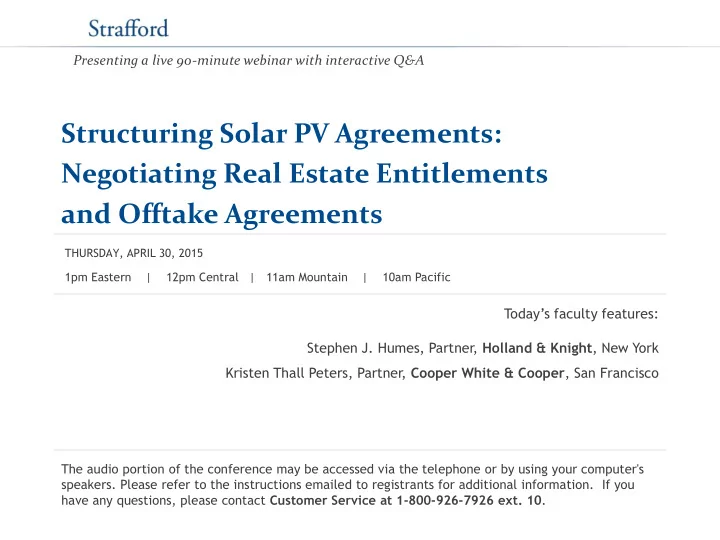
Presenting a live 90-minute webinar with interactive Q&A Structuring Solar PV Agreements: Negotiating Real Estate Entitlements and Offtake Agreements THURSDAY, APRIL 30, 2015 1pm Eastern | 12pm Central | 11am Mountain | 10am


slide-1
SLIDE 1

Structuring Solar PV Agreements: Negotiating Real Estate Entitlements and Offtake Agreements

Today’s faculty features:

1pm Eastern | 12pm Central | 11am Mountain | 10am Pacific

The audio portion of the conference may be accessed via the telephone or by using your computer's

  • speakers. Please refer to the instructions emailed to registrants for additional information. If you

have any questions, please contact Customer Service at 1-800-926-7926 ext. 10.

THURSDAY, APRIL 30, 2015

Presenting a live 90-minute webinar with interactive Q&A Stephen J. Humes, Partner, Holland & Knight, New York Kristen Thall Peters, Partner, Cooper White & Cooper, San Francisco

slide-2
SLIDE 2

Tips for Optimal Quality

Sound Quality If you are listening via your computer speakers, please note that the quality

  • f your sound will vary depending on the speed and quality of your internet

connection. If the sound quality is not satisfactory, you may listen via the phone: dial 1-866-755-4350 and enter your PIN when prompted. Otherwise, please send us a chat or e-mail sound@straffordpub.com immediately so we can address the problem. If you dialed in and have any difficulties during the call, press *0 for assistance. Viewing Quality To maximize your screen, press the F11 key on your keyboard. To exit full screen, press the F11 key again.

FOR LIVE EVENT ONLY

slide-3
SLIDE 3

Continuing Education Credits

For CLE purposes, please let us know how many people are listening at your location by completing each of the following steps:

  • In the chat box, type (1) your company name and (2) the number of

attendees at your location

  • Click the SEND button beside the box

In order for us to process your CLE, you must confirm your participation by completing and submitting an Official Record of Attendance (CLE Form) to Strafford within 10 days following the program. The CLE form is included in your dial in instructions email and in a thank you email that you will receive at the end of this program. Strafford will send your CLE credit confirmation within approximately 30 days of receiving the completed CLE form. For additional information about CLE credit processing call us at 1-800-926-7926

  • ext. 35.

FOR LIVE EVENT ONLY

slide-4
SLIDE 4

Program Materials

If you have not printed the conference materials for this program, please complete the following steps:

  • Click on the ^ symbol next to “Conference Materials” in the middle of the left-

hand column on your screen.

  • Click on the tab labeled “Handouts” that appears, and there you will see a

PDF of the slides for today's program.

  • Double click on the PDF and a separate page will open.
  • Print the slides by clicking on the printer icon.

FOR LIVE EVENT ONLY

slide-5
SLIDE 5

Structuring Solar PV Agreements

April 30, 2015

KRISTEN THALL PETERS

Cooper, White & Cooper LLP

STEPHEN J. HUMES Holland & Knight

5

slide-6
SLIDE 6

Kristen Thall Peters

  • Kristen Thall Peters is Chair of the Green Practice Group at Cooper, White &

Cooper LLP. She is also a member of CWC’s Energy, Real Estate and Environmental practice groups.

  • In 2014, Kristen aided her clients in successfully developing, operating or

expanding over 50 small to medium sized renewable energy facilities, including securing the real property interests for the land on which the facilities operate, drafting host and royalty agreements, ensuring environmental compliance and compliance with renewable portfolio standards, resolving land use and permitting issues, as well as negotiating power purchase and interconnection agreements, construction contracts, and agreements for the purchase, sale and lease of renewable fuel sources and environmental attributes. She has also been successful in closing several financing transactions for these projects.

  • Kristen holds a B.A. in Environmental Sciences from the University of California,

Berkeley and a J.D. from Santa Clara University.

6

slide-7
SLIDE 7

Steve Humes

  • Steve Humes practices environmental, energy, public utility and

infrastructure law at Holland & Knight.

  • Steve advises clients on renewable energy regulatory, project finance and

development issues, including environmental issues and project

  • contracts. He represents project developers and sponsors of solar PV,

biomass, geothermal, and energy storage, among other technologies, and represents the Connecticut Green Bank and New York Green Bank along with project owners and developers from New Jersey to California and New York to Nicaragua. He also assists clients with state and federal environmental and energy regulatory compliance and enforcement proceedings and counsels clients on energy and environmental issues in corporate M&A transactions, including acquisitions and divestitures of fossil and renewable power plants.

  • Steve is based in Holland & Knight’s New York City office.

7

slide-8
SLIDE 8

Renewable Energy Resources

  • Wind
  • Solar
  • Biomass
  • Geothermal
  • Hydro
  • Waste to Energy
  • Energy Storage
  • Energy Efficiency

8

slide-9
SLIDE 9

Overview of a Solar PV Project Transaction Structure

  • Introduction to Power Purchase Agreements
  • Regulatory Considerations (Net Metering; PPAs vs.

Solar Leases; Size Limits)

  • Summary of Ancillary Agreements
  • Real Estate Entitlements

9

slide-10
SLIDE 10

Power Purchase Agreement

Power Purchase Agreement (PPA) – the offtake contract

between Seller that generates electricity and Buyer (can be utility or host customer)

  • PPA defines commercial terms for the sale of electricity

between Seller and Buyer, including when the facility will begin commercial operation, schedule for delivery of electricity, penalties for under delivery, payment terms and liability conditions

  • PPA identifies the revenue and credit quality of a project and

is a key financing instrument

  • Term is typically between 15 and 25 years (or more)

10

slide-11
SLIDE 11

PPA Benefits for Buyer

  • No direct commitment of capital
  • Pay for electricity actually delivered/metered
  • Ownership risks (e.g., equipment failure, damage and
  • bsolescence) shift to third party
  • Non-profits can obtain economic benefits of investment

tax credits and Renewable Energy Credits (RECs) revenue

  • “Green” image from supporting renewable energy
  • Power price often discounted against market price

11

slide-12
SLIDE 12

PPA Risks for Buyer

  • Loss of control from having a third party operating a

facility – often on host premises

  • Cost savings may be based on projections for future

energy costs, which are uncertain

  • Terms may be driven and/or challenged by lender
  • Seller may be unwilling to commit to specific output

levels, yet buyer likely required to buy 100% output

  • Requires monitoring of Seller’s insurance
  • Long-term degradation can reduce savings

12

slide-13
SLIDE 13

Risk Identification

IT’S ALL ABOUT RISK…

CONSTRUCTION OPERATIONS Completion Risk Supply Engineering Risk Operations Force Majeure Environmental Force Majeure Change of Law Financial

13

slide-14
SLIDE 14

Regulatory Considerations: Net Metering and Interconnection issues

State Regulatory Requirements Vary Significantly

  • Distributed Generation: Project is “inside the fence” and

interconnected electrically to host behind the utility meter.

  • Net Metering: Revenue meter tracks electric usage both ways –

when host uses less electricity than solar PV system generates, surplus flows to local electric utility – issue is who gets the credit for surplus power and for how much?

  • DG Size Limits: Could be 2 MW or less; 6 MW or less; or less than

host’s annual consumption needs – states allow utility’s interconnection tariff to limit size of project.

14

slide-15
SLIDE 15

Regulatory Considerations: Renewable Energy Incentives

Incentives for Renewable Energy Development Renewable Portfolio Standards (“RPS”)

  • 29 States Have RPS; 8 States Have Renewables Goals
  • Renewable Energy Certificates (“RECs”) – 1 for every

1,000 kWh produced – market value based on state mandates and alternative compliance penalties Tax Credits

  • Investment Tax Credits
  • Production Tax Credits

15

slide-16
SLIDE 16

Site Acquisition Risks

  • State and Local Regulations and Compliance Obligations
  • NIMBY Issues
  • Zoning and Permitting Requirements/Restrictions
  • Access to Rights of Way
  • Existing Easements/Land Use Restrictions
  • Access to the Electrical Grid (Interconnection)
  • Pre-existing Environmental Conditions
  • Suitability of Existing Ground Conditions
  • Closure Requirements/Termination Assurances (e.g., Restoration of

Site)

16

slide-17
SLIDE 17

Design, Permitting and Construction Risk

  • Will equipment and/or technology fail?
  • Is the site suitable for construction and
  • peration of the facility?
  • Will EPC contractor fail to complete

construction?

17

slide-18
SLIDE 18

Design, Permitting and Construction Risk

TOOLS TO MANAGE RISK:

  • Liquidated damages for performance
  • E&O/Environmental Insurance
  • Construction/Stop Loss Insurance (controls cost overruns from

unexpected conditions)

  • Construction Surety Bonds (Bid Bonds/Completion Bonds)
  • Owner Controlled Insurance Program (OCIP)
  • Independent Engineers
  • Environmental Surveys
  • Geotechnical Studies and Surveys

18

slide-19
SLIDE 19

Completion Risk

Will the Project Be Completed on Time and In Budget?

  • Project development risk is partially allocated to EPC

contractor and insurers – EPC contractor should contractually assume PPA’s COD and related delivery

  • bligations (performance guaranty, minimum system size,

etc.)

  • Conditions Precedent: Interconnection
  • Zoning and Land Use Approvals

19

slide-20
SLIDE 20

Completion Risk

TOOLS TO MANAGE RISK

  • Completion Guarantee Payments
  • Insurance for Delays in Start Up
  • Warranties
  • Lump Sum Turnkey Price
  • Liquidated Damages for Delay

20

slide-21
SLIDE 21

Operating Risk

  • Will there be an interruption or failure in the supply

chain (Force Majeure)?

  • Degradation or decreases in production
  • Maintenance, repairs and monitoring
  • Will the demand for power be reduced or interrupted?
  • Project developer at risk for supply; price risk allocated

to Buyer; usage risk allocated to Buyer in PPA

  • Is there tax recapture risk?
  • Tax indemnification is a risk for small developers
  • Is there a REC recapture risk?
  • Minimum value of RECs is risk for small developers

21

slide-22
SLIDE 22

Operating Risk

TOOLS TO MANAGE RISK:

  • Long term contracts with established suppliers
  • Crafted business interruption insurance

coverage/property risk coverage

  • Adjustments – price escalation, benchmarks, indices
  • Liquidated damages for performance and minimum

system guarantees

  • Equipment/technology warranties

22

slide-23
SLIDE 23

Summary of Ancillary Agreements

  • Lease or License for facility real estate rights
  • Lease or Power Purchase Agreement for supply
  • Security Agreement
  • Engineering Procurement and Construction (EPC) Contract
  • O&M/Management Services Agreement
  • Warranty, Maintenance and Service Agreements
  • Renewable Energy Credits (RECs) Purchase and Sale Agreement

(may be integrated with PPA)

  • ESP Agreement
  • Interconnection Agreement
  • Transmission and Operating Agreement
  • Distribution Agreement
  • Risk Management Plan

23

slide-24
SLIDE 24

Permits

  • Building Permits
  • Federal and State Authorizations
  • Environmental
  • Emissions
  • Generator/USTS
  • Closure Requirements and

Assurances

24

slide-25
SLIDE 25

Engineering, Procurement & Construction Agreement

  • Scope of Work/Project Schedule
  • Compensation
  • Payment Terms
  • Warranties
  • Indemnification
  • Insurance
  • Termination
  • Assignment
  • Guarantees
  • Dispute Resolution

25

slide-26
SLIDE 26

O&M Agreement

  • Description of Operation Services
  • Operator Costs versus Owner Costs/Taxes
  • Insurance
  • Term and Termination
  • Consent and Approvals
  • Indemnification
  • Default and Damages
  • Arbitration and Dispute Resolution
  • Force Majeure
  • Cooperation
  • Confidentiality

26

slide-27
SLIDE 27

Interconnection Agreements

  • Construction
  • Distribution
  • sending energy directly to utility
  • sending energy via utility’s system to 3P off taker
  • Term & Renewals
  • Point of Interconnection/Access
  • Allocation of Responsibility
  • PUC guidelines/tariff
  • Disconnection of Unit
  • Invoicing & Payment
  • Security
  • Governing Law

27

slide-28
SLIDE 28

ESP Agreements

  • Energy Service Provider (“ESP”) contracts directly with

its customers to provide electric supplies

  • Used in jurisdictions that do not allow direct access

service

  • Power producer sells power to ESP which, concurrently,

sells power to power purchaser, most often at same price

  • ESP is often signatory to PPA, as buyer, as well as to

separate ESP agreement with ultimate customer

  • ESP agreement terms must match those of PPA

28

slide-29
SLIDE 29

Standard of Care

“Prudent Electric Industry Practice”

  • Practices that, at a particular time, in the exercise of reasonable

judgment in light of the facts known or reasonably should have been known at the time a decision was made, could have been expected to accomplish the desired result consistent with good business practices, reliability, economy, safety and expedition.

  • Generally conform to operation and maintenance standards

recommended by the Facility’s equipment suppliers and manufacturers, applicable Facility design limits and applicable Governmental Approvals and Applicable Law.

  • Not intended to be limited to the optimum practice, method or act

to the exclusion of all others, but rather to include acceptable practices, methods or acts generally accepted.

  • Includes, but not limited to, practices engaged in or approved by a

significant portion of the U.S. electric power generation industry.

29

slide-30
SLIDE 30

Contents of Pro forma Open Access Transmission Tariff

  • Typical contract provisions such as force majeure, billing,

and dispute resolution

  • Service requirements such as eligibility, reciprocity and

ancillary services

  • Scheduling, system control and dispatch, reactive supply and

voltage control from generation services

  • *Regulation and frequency response, energy imbalance,
  • perating reserve-spinning, and operating and supplemental

reserves

  • Conforming compliance tariffs may contain regional

practices

* Not required to be purchased by the transmission provider

30

slide-31
SLIDE 31

Regional Transmission Arrangements

  • Contractual relationships or structural organizations that coordinate

various functions associated with managing multiple transmission systems

  • FERC believes RTOs are necessary to eliminate impediments to fully

competitive wholesale markets and has an objective to have all transmission-owning entities voluntarily place control of transmission facilities with at RTO

  • FERC encourages participation in an ISO (e.g. CAISO or PJM ISO), an

entity independent from all individual market participants responsible for ensuring equitable and reliable access to the transmission grid and promoting fair transmission pricing

  • ISO is traffic controller determining terms to which generators have

access to grid, and which load is served over what lines. It operates the grid in reliable manner and establishes equitable transmission rates

31

slide-32
SLIDE 32

Financing Agreements

  • Financing Agreement
  • Promissory Note
  • Security Agreement
  • Membership Interest Pledge Agreement
  • Real Property Security Documents
  • Inter-creditor Agreement
  • Consents
  • UCC-1 Financing Statement
  • Guaranty Agreement (in favor of Lender)
  • Forbearance and Non-disturbance (SNDA) agreements

32

slide-33
SLIDE 33

Security Agreements

  • Security Agreement is a contract that governs

the relationship between parties to a secured transaction

  • Personal property in which a secured interest in
  • wned is the “collateral”
  • Collateral can only be personal property, not

real property

  • Stock, membership or partnership interest
  • Licenses, contracts
  • Equipment

33

slide-34
SLIDE 34

Real Estate Entitlements

  • Purchase & Sale Agreement
  • Site Lease
  • Real property interest
  • Ability to obtain title insurance
  • License
  • Personal property interest
  • Sublease or Sublicense
  • Financing tool
  • Access, Rights of Way and Easement Agreements

34

slide-35
SLIDE 35

Leases, Licenses & Easements: Factors to Help Make the Determination

  • Site Lease, License or Easement secures the

location of the power production facility and/or the fuel supply

  • Solar facilities often require too much land to

purchase.

  • Fuel supplies of solar are most often leased, licensed
  • r secured by easement.

35

slide-36
SLIDE 36

Important Terms for Leases and Licenses

  • Term
  • consistent with PPA (but don’t recommend cross-

termination unless considered carefully)

  • consistent with capital investment
  • Rent or Royalty
  • Purchase Options
  • Early buyout option
  • End of term
  • Indemnification
  • Force Majeure

36

slide-37
SLIDE 37

Lease vs. License

  • Lease is real property interest
  • Can be secured by a leasehold mortgage
  • Eligible for leasehold title insurance
  • Notice of lease can be recorded
  • License is personal property interest
  • Contractual right only
  • Can be secured by UCC lien

37

slide-38
SLIDE 38

Site Leases

  • Access
  • Assignment
  • Casualty and Liability
  • Condemnation
  • Construction (Schedule)
  • Default
  • Environmental
  • Indemnification
  • Insurance
  • Interconnection
  • Maintenance and Performance
  • Operations (Commencement

Date)

  • Permits and Approvals
  • Rent and/or Royalty
  • Taxes

Key Lease Terms

38

slide-39
SLIDE 39

Lease Issues

  • Environmental Compliance
  • Real Estate Taxes
  • Rent Commencement
  • Construction Schedule
  • Commencement Date
  • Assignment
  • Condemnation
  • Casualty
  • Default
  • Interconnection

39

slide-40
SLIDE 40

Representations of Lessor

  • Does lessor own the supply rights?
  • Are there other similar rights granted to others?
  • Are those rights exclusive?
  • Is there litigation involving the rights?
  • Is the lessor contemplating bankruptcy?
  • Does lessor know of any legal prohibitions?

40

slide-41
SLIDE 41

Representations of Lessee/Developer

  • Is developer a knowledgeable operator of this type of

renewable energy project?

  • Will developer assume risk of practicability and

possibility of performance?

  • Does developer own the technology rights?
  • Does developer have financing?

41

slide-42
SLIDE 42

Contingencies/Timelines

  • Financing
  • Execution of PPA
  • Granting of permits
  • Granting of any consents that

may be required

  • What are remedies or rights if not

met?

42

slide-43
SLIDE 43

Quality and Quantity

What are obligations regarding quality and quantity of source?

  • Can agreement or certain obligations be terminated?
  • Obligations to ensure quality or quantity?
  • Force majeure

43

slide-44
SLIDE 44

Lessee Covenants

  • Lessee covenants may include operating and

maintaining the premises according to laws, permits, manufacturer’s recommendations and insurance policies, warranties and customary industry practices

  • Replace lost or worn parts
  • No modification of assets or installation of

accessories

  • Provide financial statements and notices
  • No indebtedness or liens

44

slide-45
SLIDE 45

Lessee Covenants

  • No sale or transfer of leased property
  • Affiliate transactions/restrictions on change of

control

  • At end of term, leased property must be return in

specified condition

  • Lessee bears risk of any loss or damages; must

replace or pay termination value

  • Failure to pay rent, breach of covenants, inaccuracy
  • f representations and bankruptcy will trigger

default allowing Lessor to exercise various remedies from repossession to payment of damages

45

slide-46
SLIDE 46

Sublease

  • Large areas of land for solar may be owned by federal

government

  • Smaller facility may occupy/share existing structure to

keep costs down

  • If sharing space, options are direct lease with facility,

sharing agreements or sublease

46

slide-47
SLIDE 47

Access, ROW and Easement Agreements

  • Access and easement rights are typically non-exclusive
  • Supply rights
  • Non-interruptive easements for solar
  • Operational rights
  • Access to leased or owned generating facility is critical

regardless of type of fuel

47

slide-48
SLIDE 48

Mortgages

  • Mortgages can be granted on any real property interest
  • Fee ownership
  • Leasehold interest
  • Underlying interest must be recorded in official records

in order to encumber

48

slide-49
SLIDE 49

Recording Notices of Land Rights

  • Recording land rights provides constructive

notice to all lienholders and interest holders

  • Rights cannot be sold out if junior lienholder

forecloses

  • Foreclosing lienholder takes property subject to

senior recorded rights

49

slide-50
SLIDE 50

Strategies for Negotiation

  • What is the Market for Renewable Energy?
  • RPS and other Required Standards
  • Green Building/LEED Certification
  • Voluntarily Green
  • Why does the lessor/seller/grantor want to contract with you?
  • Royalty
  • Recipient of Clean Energy
  • Initial Stage of Development vs. Established Facility
  • Who is the Offtaker? And will Offtaker help you?
  • IOU
  • Local power company
  • Private User

50

slide-51
SLIDE 51

KRISTEN THALL PETERS STEPHEN J. HUMES

Cooper, White & Cooper LLP Holland & Knight 201 California Street, 17th Floor 31 West 52nd Street San Francisco, California 94111 New York, New York 10019 (415) 433-1900 (212) 513-3473 Email: KTPeters@cwclaw.com Email: steve.humes@hklaw.com Website: www.cwclaw.com Website: www.hklaw.com

Questions and Answers

51