in Bullous Pemphigoid S. BAUM 1 , T. ZEELI 2 , A. BANIEL 2 , E. - - PowerPoint PPT Presentation

in bullous pemphigoid
SMART_READER_LITE
LIVE PREVIEW

in Bullous Pemphigoid S. BAUM 1 , T. ZEELI 2 , A. BANIEL 2 , E. - - PowerPoint PPT Presentation

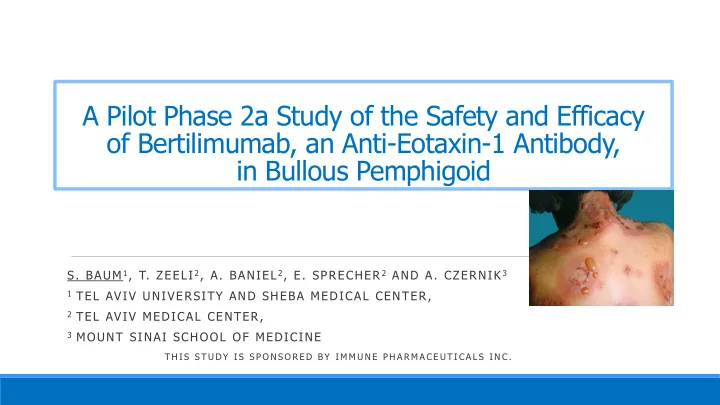
A Pilot Phase 2a Study of the Safety and Efficacy of Bertilimumab, an Anti-Eotaxin-1 Antibody, in Bullous Pemphigoid S. BAUM 1 , T. ZEELI 2 , A. BANIEL 2 , E. SPRECHER 2 AND A. CZERNIK 3 1 TEL AVIV UNIVERSITY AND SHEBA MEDICAL CENTER, 2 TEL AVIV


slide-1
SLIDE 1

A Pilot Phase 2a Study of the Safety and Efficacy

  • f Bertilimumab, an Anti-Eotaxin-1 Antibody,

in Bullous Pemphigoid

  • S. BAUM 1, T. ZEELI 2, A. BANIEL 2, E. SPRECHER 2 AND A. CZERNIK 3

1 TEL AVIV UNIVERSITY AND SHEBA MEDICAL CENTER, 2 TEL AVIV MEDICAL CENTER, 3 MOUNT SINAI SCHOOL OF MEDICINE

T H I S S T U D Y I S S P O N S O R E D B Y I M M U N E P H A R M A C E U T I C A L S I N C .

slide-2
SLIDE 2

Eosinophils Play a Key Role in BP

  • BP lesions have an eosinophil-rich inflammatory infiltrate in the upper dermis
  • Elevated IgE levels commonly observed in BP patients
  • Anti-BMZ, BP180 and BP230 IgEs have been observed in multiple studies (Messingham 2012 / van Beek 2016)
  • Eosinophils from BP patients express the high-affinity IgE receptor FcεRI (Messingham 2014)
  • The anti-IgE antibody omalizumab has been used to treat BP patients with success (Yu 2014 /Balakirski 2016)
  • In animal models, IgEs from BP patients can replicate aspects of BP, pruritus and eosinophil

infiltration, not seen using IgGs (Fairley 2007/ Zone 2007)

2

2/17/2018

slide-3
SLIDE 3

Eotaxin-1 is a Target in BP

  • Binds CCR3 on eosinophils, driving chemotaxis and at higher concentrations, degranulation
  • Also binds CCR2 (monocytes, memory T cells, B cells and basophils) and CCR5 (dendritic cells,

hematopoietic precursor cells, some Th1 lymphocytes)

  • Produced by a variety of immune and non-immune cells in response

to inflammatory mediators including (TNFα, IFNγ, IL-1, IL-3 and IL-4)

  • BP blister fluid has high levels of eotaxin-1, in contrast

to blister fluid from pemphigus vulgaris or mechanically- induced blisters (Frezzolini 2002)

3

2/17/2018

Consequently a strong rationale for eotaxin-1 blockade to reduce eosinophil activity in BP patients

slide-4
SLIDE 4

Bertilimumab – An Anti-Eotaxin-1 Antibody

  • Human IgG4 Ab with high affinity (Kd = 8.8pM) and

specificity for eotaxin-1

  • Blocks eotaxin-mediated chemotaxis
  • Single dose showed prolonged and dose-dependent inhibition
  • f eotaxin-1-induced eosinophil shape change
  • Pharmacokinetic profile consistent with biweekly dosing
  • Good safety profile in over 100

subjects treated to date

  • >60 received IV
  • 4 infusion reactions with repeat dosing
  • 46 ocular and 8 intranasal
  • Well-tolerated by all routes

4

2/17/2018

slide-5
SLIDE 5

Study Design

An Open-Label, Proof of Concept Study Designed to Evaluate the Safety, Efficacy and Pharmacodynamic Effect of Bertilimumab in Newly Diagnosed Patients and Patients Resistant To Corticosteroid Tapering with Moderate to Extensive BP (NCT02226146)

  • Single-arm, open-label phase 2a study (enrollment is ongoing)
  • 10-15 subjects with moderate-to-extensive disease
  • 3 doses bertilimumab IV q2 weeks; subjects followed for 12 weeks
  • Prednisone maximum initial dose of 30 mg PO qD
  • Key inclusion/exclusion criteria:
  • Newly diagnosed or resistant to steroid taper
  • Prednisone dose 40 mg PO qD or lower within 4 week screening period (for newly diagnosed)
  • Class 1/2 topical steroids not allowed
  • No other prior treatment for BP or immunosuppressive biologics within 1 or 4 months
  • Primary endpoint is safety; key secondary efficacy endpoint is change in BPDAI score

5

2/17/2018

slide-6
SLIDE 6

Demographics

  • Through mid-January, screened 13 patients and enrolled 9
  • 12 newly diagnosed and 1 steroid-refractory
  • Presenting results on the 6 subjects with complete follow-up
  • For all subjects screened, average age - 76y (range 61-86y)
  • 8 / 5
  • Baseline Karnofsky Performance status 87 (range 70-100)
  • Mean tissue eosinophils – 32 per hpf
  • Mean blood eosinophil count – 0.33*109/L

6

2/17/2018

slide-7
SLIDE 7

Safety

  • Bertilimumab has been very well tolerated
  • 4 AEs reported in 3 subjects (all recovered)
  • SAE : hospitalization for lower extremity angiography in a subject with peripheral

vascular disease that was unrelated to bertilimumab

Subject AE Description Intensity Serious Relationship to Study Drug Outcome S01-02 Blurred vision Mild No Unrelated Recovered S02-02 Traumatic laceration right big toe Mild No Unrelated Recovered Angiography of femoral and low extremities arteries due to PVD Mild Yes Unrelated Recovered S02-03 Upper respiratory tract infection Mild No Possibly related Recovered

7

2/17/2018

slide-8
SLIDE 8

Efficacy

  • 85% reduction in BPDAI Total Activity Index (p=0.0096)
  • All subjects achieved a >50% improvement
  • 4/6 with >90% improvement
  • Pruritis Visual-Analog Scale score improved from 13 to 8
  • Modest improvement seen on the Autoimmune Bullous Diseases Quality Of Life

(ABQOL) questionnaire

  • Mean initial prednisone dose of 26 mg (0.3 mg/kg) tapered to a mean of 9 mg (0.1

mg/kg) by the last assessment (p=0.0145)

  • Standard regimen would have begun at ~60 mg and been at ~30 mg by day 84
  • Subjects spared more than 2,500 mg prednisone over 84 days
  • These patients should have fared poorly on the protocol-mandated prednisone dose

8

2/17/2018

slide-9
SLIDE 9

Efficacy – 85% Improvement in BPDAI

9

2/17/2018

slide-10
SLIDE 10

Efficacy – BPDAI Subscores and Pruritus

10

2/17/2018

slide-11
SLIDE 11

Efficacy – Large Steroid-Sparing Effect

Mean starting dose of 26 mg Expected prednisone dose (based on Joly et al, 2002)

Subjects received on average 2,555 mg less prednisone

Tapered to 9 mg by study end

11

2/17/2018

slide-12
SLIDE 12

Representative Subject

Day 0 Day 7 Day 14 Day 28 Day 42 Day 60

12

2/17/2018

slide-13
SLIDE 13

Representative Subject

Day 0 Day 7 Day 14 Day 28 Day 42 Day 60

13

2/17/2018

slide-14
SLIDE 14

Conclusions

  • Bertilimumab appears safe in moderate-to-extensive BP patients
  • Patients receiving bertilimumab did well despite receiving low doses of prednisone that

were rapidly tapered

  • Unclear if efficacy is superior to that of standard prednisone dosing
  • Compared to a typical prednisone regimen, subjects received 2,500 mg less prednisone
  • ver the 12 weeks of the study
  • Planning has begun for a randomized study of bertilimumab + low-dose prednisone

versus standard-of-care

  • Can likely use a more aggressive steroid regimen in conjunction with bertilimumab
  • Possibly steroid sparing as primary endpoint and non-inferiority efficacy comparison
  • Will address ideal dosing duration and interval
  • Considering switch to fixed dosing and subcutaneous administration

14

2/17/2018