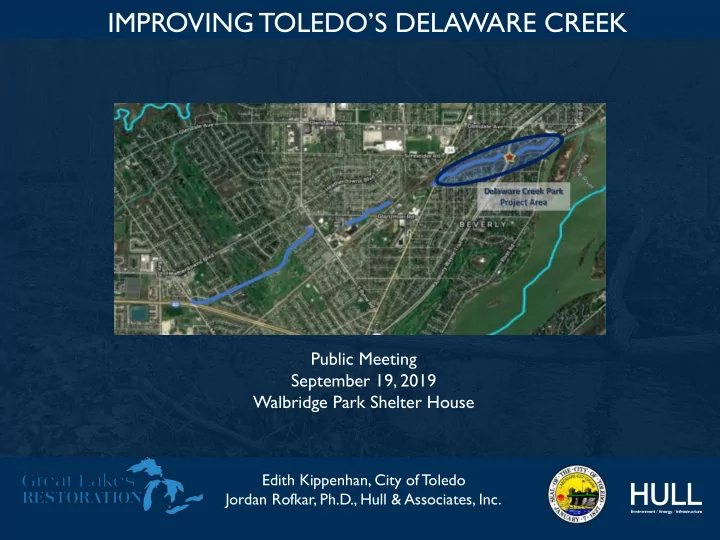
IMPROVING TOLEDOS DELAWARE CREEK Public Meeting September 19, 2019 - - PowerPoint PPT Presentation

improving toledo s delaware creek
SMART_READER_LITE
LIVE PREVIEW

IMPROVING TOLEDOS DELAWARE CREEK Public Meeting September 19, 2019 - - PowerPoint PPT Presentation

IMPROVING TOLEDOS DELAWARE CREEK Public Meeting September 19, 2019 Walbridge Park Shelter House Edith Kippenhan, City of T oledo Jordan Rofkar, Ph.D., Hull & Associates, Inc. WELCOME Project Introduction Edith Kippenhan, City


slide-1
SLIDE 1

IMPROVING TOLEDO’S DELAWARE CREEK

Public Meeting September 19, 2019 Walbridge Park Shelter House

Edith Kippenhan, City of T

  • ledo

Jordan Rofkar, Ph.D., Hull & Associates, Inc.

slide-2
SLIDE 2

WELCOME

  • Project Introduction
  • Edith Kippenhan, City of Toledo
  • Delaware Creek Overview,

Conditions and Initial Restoration Considerations

  • Jordan Rofkar, Ph.D.,

Hull & Associates, Inc.

  • Anticipated Project Schedule
  • Questions/Discussions
slide-3
SLIDE 3

PROJECT INTRODUCTION

  • The City of T
  • ledo is leading efforts to create

rain gardens and bioswales at Delaware Creek Park to improve water quality and habitat within the park property.

  • The City received a grant from Ohio EPA

sourced through the U.S. EPA Great Lakes Restoration Initiative - Nonpoint Source program to help address the high levels of nutrients and sedimentation in the creek.

  • Hull & Associates, Inc. was hired through a

competitive procurement process to provide professional science and engineering services to establish plans and oversee improvement installations.

  • Sharing our initial considerations and

concepts to gain your ideas and input is an important part of this process.

slide-4
SLIDE 4

DELAWARE CREEK OVERVIEW

  • Delaware Creek is a 1.8-mile perennial stream that drains five square miles.
  • It is located in the Maumee River watershed in south Toledo, Lucas County, Ohio.
  • Delaware Creek enters the Maumee River from the west at river mile 9.2.
  • Our project area is in the 0.9-mile lower reach of the creek and entirely within

the permanently protected City of Toledo Delaware Creek Park.

slide-5
SLIDE 5

DELAWARE CREEK CONDITIONS

  • Ohio EPA water quality sampling results in the

creek show:

  • Significant sedimentation/siltation
  • Excessive nitrate/nitrite and phosphorus
  • Elevated levels of pesticides, chloride, and total

dissolved solids

  • Ohio EPA biological sampling results in the creek

show:

  • Above target for fish communities
  • Below target for invertebrate communities
  • “Very poor” narrative score and an

estimated 20% of the target goal

  • Below target for aquatic habitat quality
  • 74% of the target goal
  • Decreased 4.5 points between 2006 and

2017 Ohio EPA sampling events

slide-6
SLIDE 6

DELAWARE CREEK OBSERVATIONS

slide-7
SLIDE 7

DELAWARE CREEK OBSERVATIONS

slide-8
SLIDE 8

DELAWARE CREEK RESTORATION CONSIDERATIONS

slide-9
SLIDE 9

DELAWARE CREEK RESTORATION CONSIDERATIONS

slide-10
SLIDE 10

DELAWARE CREEK RESTORATION CONSIDERATIONS

slide-11
SLIDE 11

DELAWARE CREEK RESTORATION CONSIDERATIONS

slide-12
SLIDE 12

DELAWARE CREEK RESTORATION CONCEPTS

slide-13
SLIDE 13

ANTICIPATED BENEFITS

  • Mitigate some erosion concerns by capturing road runoff in

key locations

  • Reduce sediment, nutrient and chemical loading from

stormwater into local waterways

  • Improve habitat by installing native plants
slide-14
SLIDE 14

ANTICIPATED SCHEDULE

September 19, 2019 Public Meeting Mid-November 2019 Plans Finalized Late Winter/Spring 2020 Construction July 31, 2020 Grant Closeout Ongoing Project Maintenance

slide-15
SLIDE 15

QUESTIONS/DISCUSSION

Photo Credit: Mary Healey

slide-16
SLIDE 16

PROJECT CONTACTS

Marisa Stewart and Edith Kippenhan City of Toledo Division of Environmental Services (419) 936-3015 Marisa.DeLancey@toledo.oh.gov Edith.Kippenhan@toledo.oh.gov Jordan Rofkar, Ph.D. and Jenny Carter-Cornell, APR Hull & Associates, Inc. (419) 385-2018 jrofkar@hullinc.com jcornell@hullinc.com

slide-17
SLIDE 17

This product or publication was financed in part or totally through a grant from the Ohio Lake Erie Commission and the United States Environmental Protection Agency with Great Lakes Restoration Initiative funds. The contents and views, including any opinion, findings, or conclusions or recommendations contained in this product or publication are those of the authors and have not been subject to any Ohio Lake Erie Commission or United States Environmental Protection Agency peer or administrative review and may not necessarily reflect the views of the Ohio Lake Erie Commission

  • r the United States Environmental Protection Agency and no
  • fficial endorsement should be inferred.