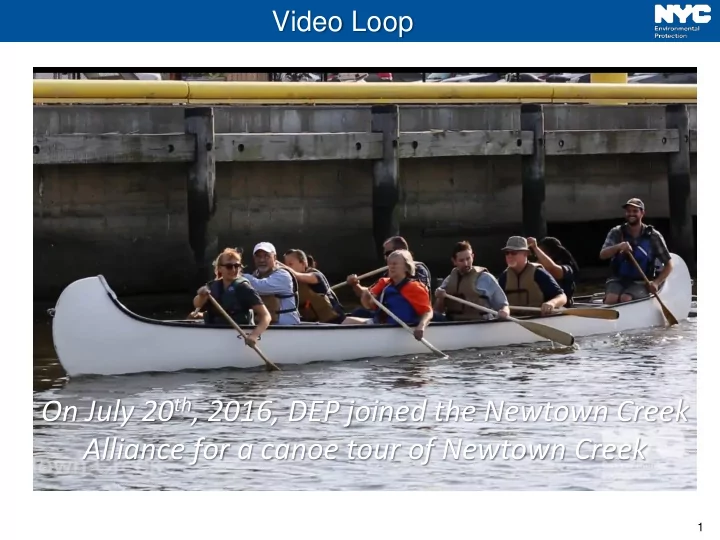
On July 20 th , 2016, DEP joined the Newtown Creek Alliance for a - - PowerPoint PPT Presentation

on july 20 th 2016 dep joined the newtown creek
SMART_READER_LITE
LIVE PREVIEW

On July 20 th , 2016, DEP joined the Newtown Creek Alliance for a - - PowerPoint PPT Presentation

Video Loop On July 20 th , 2016, DEP joined the Newtown Creek Alliance for a canoe tour of Newtown Creek 1 Newtown Creek Combined Sewer Overflow Long Term Control Plan Public Kickoff Meeting Location: Newtown Creek WWTP Date: November 15,


slide-1
SLIDE 1

1

On July 20th, 2016, DEP joined the Newtown Creek Alliance for a canoe tour of Newtown Creek

Video Loop

slide-2
SLIDE 2

Public Kickoff Meeting

Location: Newtown Creek WWTP Date: November 15, 2016

Newtown Creek Combined Sewer Overflow Long Term Control Plan

slide-3
SLIDE 3

3

Agenda

Topic Speaker 1 Welcome & Introductions

Mikelle Adgate

2 Waterbody & Watershed Characteristics and Water Quality Sampling

Keith Mahoney

3 Water Quality Improvement Projects

  • Grey Infrastructure

Keith Mahoney

  • Green Infrastructure

Pinar Balci

4 LTCP Modeling & Alternative Development Process

Keith Mahoney

5 Next Steps

Mikelle Adgate

6 Discussion and Q&A Session

All

slide-4
SLIDE 4

4

Welcome & Introductions

Mikelle Adgate Director of Stormwater Management Outreach DEP – BPA

slide-5
SLIDE 5

5

Newtown Creek: Historical Context

  • The shoreline of Newtown Creek

in the 1800’s – the system has since been drastically altered.

  • Urban development throughout

the decades has led to a highly impervious watershed in Newtown Creek. 1800’s TODAY

slide-6
SLIDE 6

6

Newtown Creek: Superfund

  • September 29, 2010: Newtown Creek designated as Superfund Site
  • July 2011: EPA administrative order to 6 potential responsible parties (PRPs):

1) Phelps Dodge Refining Corporation 2) Texaco, Inc. 3) BP Products North America Inc. 4) National Grid NY 5) ExxonMobil Oil Corporation 6) The City of New York

Newtown Creek Group (NCG)

Tonight’s meeting will focus on Newtown Creek LTCP and Clean Water Act Requirements

slide-7
SLIDE 7

7

What is a Combined Sewer Overflow (CSO)?

  • NYC’s sewer system is approximately 60% combined, which means it is

used to convey both sanitary and storm flows.

  • 65% to 90% of combined sanitary & storm flow is captured at treatment plants.
  • When the sewer system is at full capacity, a diluted mixture of rain water and sewage

may be released into local waterways. This is called a combined sewer overflow (CSO).

Down Spout Catch Basin Combined Sewer Outfall Sewer Regulator

Dry Weather Conditions

City Sewer Main

Building Sewer Connection

Down Spout Catch Basin

Stormy Weather Conditions

Combined Sewer Outfall Sewer Regulator City Sewer Main

Building Sewer Connection

slide-8
SLIDE 8

8

How does rainfall affect CSOs?

  • Rainfall characteristics that

trigger a CSO event at Newtown Creek:

  • 0.05 to 0.27-inch of constant

rainfall over a period of 2 to 10 hours

  • Of the average 100 rainfall

events per year about 63% may trigger a CSO at Newtown Creek

Photo Credit: Baptisete Pons https://www.flickr.com/photos/bpt/2882285636/

slide-9
SLIDE 9

9

What is a LTCP and CSO Consent Order?

Long Term Control Plan (LTCP)

identifies appropriate CSO controls to achieve applicable water quality standards

consistent with the Federal CSO Policy and Clean Water Act CSO Consent Order

an agreement between NYC and DEC that settles past legal disputes without prolonged litigation

DEC requires DEP to develop LTCPs and mitigate CSOs

slide-10
SLIDE 10

10

LTCP Process and Public Involvement

ONGOING PUBLIC / STAKEHOLDER INPUT

Existing Information Review Data Collection & Analysis Modeling Alternatives Development & Evaluation LTCP DEC Review

Kickoff Meeting TODAY Alternatives Meeting

TBD

Final Plan Review Meeting

TBD

LTCP Due

6/30/17

slide-11
SLIDE 11

11

Questions?

slide-12
SLIDE 12

12

Waterbody & Watershed Characteristics and Water Quality Sampling

Keith Mahoney, P.E. Director of Water Quality Planning DEP – BEDC

slide-13
SLIDE 13

13

Newtown Creek and Bowery Bay WWTPs Drainage Areas

Newtown Creek WWTP

15,033 acres

Drainage Areas:

Bowery Bay WWTP

14,928 acres

Portion that Drains to Newtown Creek

7,442 acres

Citywide Drainage Area

≈ 300,000 acres

slide-14
SLIDE 14

14

Newtown Creek Drainage Area

  • 5 Urban CSO Tributaries
  • English Kills
  • East Branch
  • Maspeth Creek
  • Sewer System
  • Newtown Creek (NC) WWTP
  • Bowery Bay (BB) WWTP
  • 4 Major CSO Outfalls ( )
  • 2 Major DEP owned MS4 Outfalls ( )

Newtown Creek

  • Dutch Kills
  • Whale Creek

BB-026 NCB-631 NCQ-077 NCB-083 NCB-015 NCB-629 Newtown Creek Watershed served by Newtown Creek WWTP (5,577 acres) Newtown Creek Watershed served by Bowery Bay WWTP (1,865 acres) Combined Sewer (4,950 acres)

Total Drainage Area Area that drains to Newtown Creek Area that drains to Newtown Creek served by combined sewers NC WWTP

15,033 5,577 4,636

BB WWTP

14,928 1,865 314

Citywide

~300,000 7,442 4,950

Drainage Areas in Acres:

slide-15
SLIDE 15

15

Water Quality Standards & LTCP Goals

CLASS SD

F i s h S u r v i v a l The best usage of Class SD water is fishing. These waters shall be suitable for fish, shellfish, and wildlife survival. In addition, the water quality shall be suitable for primary and secondary contact recreation, although other factors may limit the use for these purposes.

Parameter Criteria* DEC Water Quality Parameter Reference Fecal Coliform

Monthly Geometric Mean ≤ 200 col/100 mL

  • New York Codes, Rules and Regulations
  • (NYCRR Part 703.4)

Total Coliform

Monthly Geometric Mean ≤ 2,400 col/100 mL 80% ≤ 5,000 col/100 mL

  • New York Codes, Rules and Regulations
  • (NYCRR Part 703.4)

Dissolved Oxygen

≥ 3.0 mg/L (acute, never less than)

  • New York Codes, Rules and Regulations
  • (NYCRR Part 703.3)

* EPA has also proposed a potential future RWQC for enterococcus: 30-Day Rolling GM ≤ 30 col/100 mL.

  • CSO LTCP Goals and Targets:
  • Annual and Seasonal Bacteria Compliance
  • Annual Dissolved Oxygen Compliance
  • Time to Recovery for Bacteria of < 24 hours
  • Floatables Control
slide-16
SLIDE 16

16

Ongoing Receiving Water Sampling Programs

*YSI Parameters include: Dissolved Oxygen, Temperature, Conductivity, and Salinity.

Program Sampling Frequency #of Sampling Locations Parameters Fecal Entero *YSI

Harbor Survey Monitoring Monthly (Oct – May) Weekly (Jun – Sept) 4 Sentinel Monitoring Quarterly 4

*YSI Parameters include: Dissolved Oxygen, Temperature, Conductivity, and Salinity.

Data is available here: http://www.nyc.gov/html/dep/html/harborwater/harbor_water_sampling_results.shtml

slide-17
SLIDE 17

17

LTCP Sampling & Monitoring Programs

Sampling Period: 7/1/2016 – 10/31/2016

Flow Monitoring

  • 3/1/2014 – 3/31/2015
  • 5 locations
  • Continuously monitored
  • Depth & Velocity measurements

Receiving Water

  • 14 locations
  • Four 4-day events
  • Fecal, Entero, YSI, TSS

CSO / MS4 Sampling

  • 4 CSO, 2 MS4 locations
  • 4 wet weather events
  • Fecal, Entero, YSI, TSS, CBOD,

Nitrogen

SOD

  • 6 locations
  • 2 dry & 2 wet-weather events

Data Sondes / ADCPs

  • 3 locations
  • Continuous over 60 days
  • Temperature, DO, Salinity
slide-18
SLIDE 18

18

Flow Monitoring

Parameter Value

Duration of Study March 28, 2014 to March 27, 2015

  • No. of CSO Outfalls Monitored

5

  • No. of Monitored Rain Events per Location

60 to 119 per location

  • No. of CSO Monitored Events per Location

24 to 51 per location Range of Monitored CSO Volume 21 MG to 440 MG per location

slide-19
SLIDE 19

19

Fecal Coliform Sampling – Geometric Means

14

January 1, 2016 to September 30, 2016

LTCP: ~6 Dry and ~44 Wet samples per location HSM: ~10 Dry and ~32 Wet samples per location

slide-20
SLIDE 20

20

Fecal Coliform Recovery Over Time

0.50 0.00 0.00 0.00 0.78 0.00 0.00 1.02 0.18 0.57 0.00 0.00 0.00 0.00

46,540 2,862 522 367 171,438 52,574 2,598 18,660 6,204 3,477 63,491 3,780 157 294

0.0 0.2 0.4 0.6 0.8 1.0 1.2 1.4 1.6 1.8 2.0 1 10 100 1,000 10,000 100,000 1,000,000 7/15/2016 7/16/2016 7/17/2016 7/18/2016 7/26/2016 7/27/2016 7/28/2016 7/29/2016 7/30/2016 7/31/2016 8/1/2016 8/2/2016 8/3/2016 8/4/2016 Event #1 Event #2 Event #3 Event #4 Rainfall, in Fecal Coliform Geomean, cfu/100mL LGA Daily Rainfall Fecal Geomean

Target ≤ 1,000 cfu/100mL

Single Rain Event Consecutive Rain Events

Based on NC10 LTCP Receiving Water Sampling Data

slide-21
SLIDE 21

21

Enterococci Sampling – Geometric Means

15

January 1, 2016 to September 30, 2016

LTCP: ~6 Dry and ~44 Wet samples per location HSM: ~10 Dry and ~32 Wet samples per location

slide-22
SLIDE 22

22

Enterococci Recovery Over Time

0.50 0.00 0.00 0.00 0.78 0.00 0.00 1.02 0.18 0.57 0.00 0.00 0.00 0.00

707 24 10 12 26,533 387 19 3,888 256 87 3,509 35 7 5

0.0 0.2 0.4 0.6 0.8 1.0 1.2 1.4 1.6 1.8 2.0 1 10 100 1,000 10,000 100,000 7/15/2016 7/16/2016 7/17/2016 7/18/2016 7/26/2016 7/27/2016 7/28/2016 7/29/2016 7/30/2016 7/31/2016 8/1/2016 8/2/2016 8/3/2016 8/4/2016 Event #1 Event #2 Event #3 Event #4 Rainfall, in Enterococci Geomean, cfu/100mL LGA Daily Rainfall Enterococci Geomean

Single Rain Event Consecutive Rain Events

Target ≤ 110 cfu/100mL

Based on NC10 LTCP Receiving Water Sampling Data

slide-23
SLIDE 23

23

23

Dissolved Oxygen Sampling – 5th Percentile Values

January 1, 2016 to September 30, 2016

LTCP: ~6 Dry and ~38 Wet samples per location HSM: ~10 Dry and ~32 Wet samples per location

slide-24
SLIDE 24

24

  • On July 20th, 2016, DEP joined the

Newtown Creek Alliance for a canoe tour of Newtown Creek

  • Sampling results from this excursion

are within the ranges observed under the LTCP / HSM sampling programs

Canoe Excursion Sampling Results

Enterococcus Sampling Results: Fecal Sampling Results:

GM of LTCP/HSM Sampling Results (1/1/16 – 9/30/16) Canoe Excursion Results (7/20/16) Primary Contact Criteria

  • Fecal Monthly GM ≤ 200 cfu/100 mL
  • Entero 30-day Rolling GM ≤ 30 cfu/100 mL

*Prior rainfall on 7/14 of 0.15-in

slide-25
SLIDE 25

25

Questions?

slide-26
SLIDE 26

26

Water Quality Improvement Projects Grey and Green Infrastructure

Keith Mahoney, P.E. Director of Water Quality Planning DEP – BEDC Pinar Balci Assistant Commissioner DEP – BEPA

slide-27
SLIDE 27

27

Newtown Creek: CSO Mitigation Projects

Recommended Project

Construction Cost

Status

Brooklyn/Queens Pump Station at Newtown Creek WWTP $300 M

Substantially Completed in 2013

Bending Weirs and Underflow Baffles $42 M

In-Construction thru 2017

In-Stream Aeration Projects (4) $60 M1

In-Construction thru 2020

Built and Planned GI Projects $45 M2

Ongoing Design and Construction

Total = $447 M

1 2 3 4

1) Cost pending for Maspeth Creek aeration. 2) Cost to date, more GI projects may be pending.

slide-28
SLIDE 28

28

  • Continued operation of

the Brooklyn/Queens Pumping Station (PS) at NC WWTP

  • PS Wet Weather

Capacity = 400 MGD

  • PS Upgraded in 2013:

~$300 M

(includes 5 new MSPs, headworks upgrade, in-line storage facility, odor control)

Brooklyn/Queens PS at Newtown Creek WWTP

1

slide-29
SLIDE 29

29

  • Construction Cost: $42 M
  • Construction Completion: Dec. 2017
  • Volume Reduction: 62 MGY
  • Provides Floatables Control
  • Being installed at 4 locations ( ):
  • B-01 (NCB-015), NCQ-01 (NCQ-077), NCB-2

(NCB-083), BB-L4 (BB-026)

Bending Weir and Underflow Baffles

2

slide-30
SLIDE 30

30

In-Stream Aeration Projects

EK-11: Upper English Kills Aeration NC-2: Lower English Kills Aeration NC-4: Dutch Kills and Newtown Creek Aeration NC-3: East Branch Aeration Maspeth Creek Aeration (Pending) Blower Building Blower Building Blower Building

Note: Alignment of Proposed Aeration System is Approximate

Contract Aeration Location Construction Completion Cost

EK-11

Upper English Kills

  • Dec. 2008

$9.0 M

CSO-NC-2

Lower English Kills

  • Jan. 2014

$2.2 M

CSO-NC-3

East Branch

  • Jun. 2018

$18.0 M

CSO-NC-4

Dutch Kills and Newtown Creek

  • Dec. 2020

$30.8 M

Pending

Maspeth Creek

Project on-hold pending results of clean-up operations in the Superfund area.

3

slide-31
SLIDE 31

31

Green Infrastructure in New York City

  • Green Infrastructure (GI) collects

stormwater runoff from impervious surfaces, such as streets and roofs, reducing flow to sewers

  • $1.5 billion committed for GI Citywide to

manage stormwater runoff from impervious combined sewered areas by 2030

  • DEP will meet this goal through:
  • Area-Wide ROW Program
  • Public Property Retrofits
  • Grant Program for Private Property Owners
  • Detention Rule for New Development

Permeable Pavers Green Roofs Rain Gardens

4

slide-32
SLIDE 32

32

Newtown Creek Built and Planned GI Projects

  • More than 1,300 GI assets

within streets, parks, and schools built or planned

  • 98% are ROW Rain Gardens

(aka bioswales)

  • Future GI include ROW Rain

Gardens, schools, parks, and housing projects

Legend

CSO Outfalls CSO Outfall Watersheds GI Constructed GI In Construction GI Planned Waterbodies

4

slide-33
SLIDE 33

33

Public Property Retrofits in Newtown Creek

Project Status Parks/ Playgrounds Public Schoolyards NYCHA Housing Developments Total Potential 1 3 4 Preliminary 12 6 6 24 Schematic 4 2 6 Constructed 2 1 3

Total 17 10 10 37 Junior High School 162, 1390 Willoughby Ave, Bushwick Before After

slide-34
SLIDE 34

34

GI Opportunities for Private Property Owners

  • Green Infrastructure Grant Program:

DEP provides funding for the design and construction costs of green infrastructure on private property in combined sewer areas of the City.

  • Green Roof Tax Abatement:

The City provides a one-year property tax abatement for private properties that install green roofs. The abatement value is $5.23 per square foot (up to the lesser of $200,000 or the building’s tax liability) and is available through March 15, 2018.

  • 2012 Stormwater Rule:

In 2012, DEP amended the allowable flow rate of stormwater to the City’s combined sewer system for new and existing development. Site Connection Proposals may include green infrastructure technologies to meet the new allowable rate.

  • New Private Incentive Program:

DEP is currently developing a new private property green infrastructure retrofit initiative to augment its current efforts on stormwater management on private property. An RFI was released on 9/19 in which DEP sought ideas on innovative program management structures for this new initiative.

slide-35
SLIDE 35

35

Questions?

slide-36
SLIDE 36

36

LTCP Modeling and Alternatives Development Process

Keith Mahoney, P.E. Director of Water Quality Planning DEP – BEDC

slide-37
SLIDE 37

37

Newtown Creek Landside Model Calibration

  • DEP’s process for flow

monitoring and modeling has been nationally peer reviewed and published

  • DEP implemented that process to

update and validate its Newtown Creek sewer system model based upon:

  • Field surveys and record drawings of

physical structures.

  • A validation dataset based upon a 12-

month sewer-monitoring program and extensive data analyses.

  • Data was analyzed using WaPUG

approved methodologies and showed very good correlation.

Outfall NCB-015 Outfall BBL-026

slide-38
SLIDE 38

38

Model Calibration Inputs and Assumptions

  • Landside Model calibrated based on flow monitoring data, gauge adjusted

radar rainfall data, and satellite flyover impervious data

  • Water Quality Model calibrated with Harbor Survey and LTCP sampling data
  • Calibrated modeling inputs and assumptions include:
  • Committed CSO and BNR projects
  • 2040 sanitary flows and loads
  • JFK 2008 “Typical Year Rainfall” for Alternative Analysis
  • JFK 10-yr data (2001 to 2011) for baseline and selected alternatives

5-Year Moving Average

Standard for WWFP

(JFK 1988 – 40.7 inches)

LTCP Typical Year Rainfall

(JFK 2008 – 46.3 inches)

2002-2011 10-Year Water Quality Period for Selected Plan

slide-39
SLIDE 39

39

LTCP Baseline Conditions Modeling

Continued operation of Brooklyn / Queens PS at NC WWTP at up to 400 MGD during wet weather Construction of Bending Weirs and Underflow Baffles at 4 Locations Construction of In-Stream Aeration Committed Green Infrastructure in Newtown Creek watershed

1 2 3

WWFP Plan ($402 M)1

+

3.2% Green Infrastructure ($45 M for 110 acres)2

LTCP Baseline

≈1.2 BGY CSO3

4

1) Cost pending for Maspeth Creek aeration. 2) Cost to date, more GI projects may be pending. 3) Preliminary estimate.

slide-40
SLIDE 40

40

CSO Control Evaluation Process

  • 1. Bacteria Source Component Analysis
  • CSO, stormwater and direct drainage
  • 2. Gap Analysis for Water Quality Standard

(WQS) Attainment

  • Calculate bacteria and dissolved oxygen for:
  • Baseline Conditions
  • 100% CSO Control Conditions
  • 3. Assess Levels of CSO Control Necessary

to Achieve WQS

  • 4. Identify Technologies to Cost-Effectively

Achieve the Required Level of CSO Control Increasing CSO Reduction Potential

  • Storage
  • Treatment
  • System

Optimization

  • Source

Control

Sample Technologies:

slide-41
SLIDE 41

41

Source Control Existing GI Additional GI High Level Sewer Separation System Optimization Fixed Weir Parallel Interceptor / Sewer Bending Weirs Control Gates Pump Station Optimization Pump Station Expansion CSO Relocation Gravity Flow Tipping to Other Watersheds Pumping Station Modification Flow Tipping with Conduit/Tunnel and Pumping Water Quality / Ecological Enhancement Floatables Control Environmental Dredging Mechanical Aeration Flushing Tunnel Treatment Satellite: Centralized: Outfall Disinfection Retention Treatment Basin (RTB) High Rate Clarification (HRC) WWTP Expansion Storage In-System Shaft Tank Tunnel

CSO Mitigation Toolbox

Completed or underway per Waterbody / Watershed Facility Plan (WWFP)

INCREASING COST INCREASING COMPLEXITY

slide-42
SLIDE 42

42

Questions?

slide-43
SLIDE 43

43

How You Can Help & Next Steps

Mikelle Adgate Director of Stormwater Outreach DEP – BPA

slide-44
SLIDE 44

44

Wait…Water Quality Program

  • Water quality program that

encourages residential participants to postpone typical household water uses (i.e, laundry, dishwashing,

etc.) during heavy storm

  • Text 38671 with wait-nycdep

start to join

slide-45
SLIDE 45

45

Wait… Pilot Program

  • Wait… is a water quality improvement pilot program that

encourages residential participants to voluntarily postpone water use during combined sewer overflow (CSO) events

  • Goal: increase capacity in combined sewer system during

large storm events and reduce concentration of wastewater in CSOs

Toilets 28% Faucets 16% Dishwashing 2% Laundry 24% Leaks 10% Showers 18% Bath 2%

Indoor water use in a typical single-family home

  • Target: residential water uses

individuals can choose to delay

  • DEP is first water utility in US

to pilot this type of behavior modification program

  • Technical, creative and
  • utreach components
slide-46
SLIDE 46

46

Wait… Pilot Program – How it Works

Heavy Rain: Please Wait…

CSO Event Ends Real-time Rainfall Data Collected at Newtown WWTP CSO Event Begins Heavy Rain Event Data Sent to DEP’s Wait… Texting System

Heavy Rain Over… All Clear!

slide-47
SLIDE 47

47

Wait… Pilot Program – Preliminary Results

47

  • Pilot monitoring phase: June 6 to November 30, 2016
  • Number of pilot participants in Newtown Creek sewershed: 379
  • Water consumption used as metric: if participants use less water during a CSO

event, compared to what they normally use (baseline consumption), they “waited”

  • Number of CSO events to date: 7
  • Participants “waited” 4 out of 5 CSO events; analysis pending for 2 events

Wait… Pilot Program Preliminary Results and Data

CSO Event Percent Change from Baseline Consumption #1 5% reduction #2 2% reduction #3 2% increase #4 7% reduction #5 10% reduction #6 Data/Analysis Pending #7 Data/Analysis Pending

slide-48
SLIDE 48

48

Questions?

slide-49
SLIDE 49

49

Next Steps

  • Newtown Creek LTCP Public Meeting #2, Spring 2017
  • LTCP Submittal to NYS DEC in June 2017
  • Public Comments will be accepted through Dec. 30, 2016
  • There will be subsequent comment periods following the alternative

and final plan review meetings.

  • Comments can be submitted to:
  • New York City DEP at: ltcp@dep.nyc.gov
slide-50
SLIDE 50

50

Additional Information & Resources

  • Visit the informational tables tonight for handouts and

poster boards with detailed information

  • Go to www.nyc.gov/dep/ltcp to access:
  • LTCP Public Participation Plan
  • Presentation, handouts and poster boards from this meeting
  • Links to Waterbody/Watershed Facility Plans
  • CSO Order including LTCP Goal Statement
  • NYC’s Green Infrastructure Plan
  • Green Infrastructure Pilots 2011 and 2012 Monitoring Results
  • NYC Waterbody Advisory Program
  • Upcoming meeting announcements
  • Other LTCP updates