www.handels.gu.se
Improving sustainability through digitalisation in reverse - - PowerPoint PPT Presentation
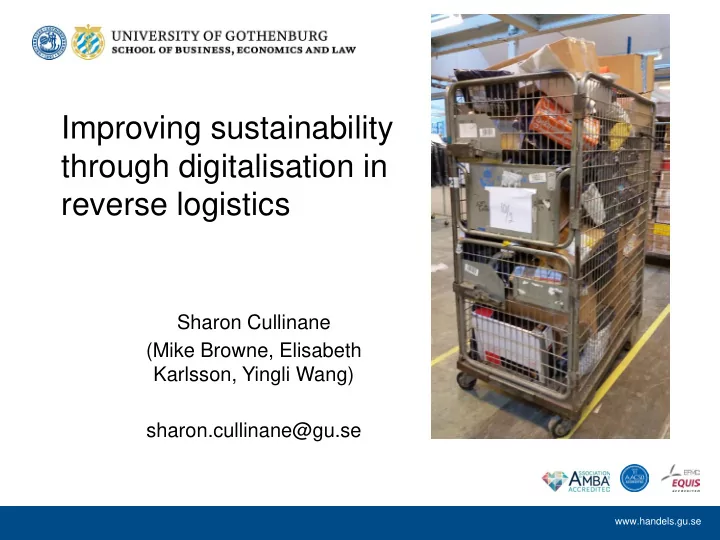
Improving sustainability through digitalisation in reverse logistics Sharon Cullinane (Mike Browne, Elisabeth Karlsson, Yingli Wang) sharon.cullinane@gu.se www.handels.gu.se Purpose How can digitalisation help reduce the return rates of
www.handels.gu.se
Purpose
- How can digitalisation help reduce
the return rates of clothing bought
- nline?
- Currently EU average return rate for
clothing is 22% but in high fashion in Germany it can reach 70%!!
- This means high costs to retailers
and high environmental costs to society
www.handels.gu.se
Methodology
- Literature review and subsequent primary
data collection.
- Case studies of the reverse logistics
- perations of 5 major clothing retailers and
2 major logistics companies in Sweden, carried out in Spring 2017.
- Interviews and observations lasting
between 3 and 7 hours at each company.
www.handels.gu.se
Limitations
The research is based on a limited sample of clothing retailers in Sweden, so the findings cannot be generalised to all retailers. However, the research provides some interesting insights which can be followed up in future research.
www.handels.gu.se
E-tailing
- Clothing is the biggest single sector of e-tailing in
most European countries and is growing fast
- 40% of global shoppers prefer to purchase
clothing and footwear online, while 51% prefer in store.
- 28% of global shoppers purchasing most or all of
their clothing and footwear online in the last 12 months (PWC, 2017)
www.handels.gu.se
- Average return rate for clothing is 22% but this
varies between customer type, clothing type and country.
- Approximately 35% of these returns are made
cross-border
- So, literally billions of items of clothing are being
returned to retailers every year.
Returns
www.handels.gu.se
Reasons for customer returns
- Damaged/faulty items
- The wrong items being received
- The items not looking like they do on the website/not
matching expectations
- The items not fitting
- The customer just changing their mind
- Customers buying multiple items and sending some
back
- Fraudulent reasons
- Items never picked up
- Returns are free/cheap
www.handels.gu.se
Returns by country and brand
Brand A (low fashion) Brand B (high fashion) Country % returns (on an item basis) Items returned % returns (on an item basis) Items returned Finland 24.5 126,000 45 51,700 Sweden 15.6 248,000 31.6 176,000 Denmark 13.9 44,000 25.7 10,000 Norway 14.2 74,000 25.3 7,500 Source: case study company with 200 employees
www.handels.gu.se
How can digitalisation help?
Two main ways:
- 1. By reducing the
number/rate of returns to start with and
- 2. By making the reverse
logistics process more efficient.
www.handels.gu.se
- 1. Reducing the number/rate of returns to
start with.
(i) Digital changing rooms
Digitalisation can reduce the gap between what the customer perceives on the website and the product in reality through virtual changing rooms and other augmented reality apps in which customers can input their measurements and other key body descriptors.
www.handels.gu.se
(ii) Social Media
- By communicating with customers via social media, products can be
described more personally and realistically.
- Retailers can monitor the perception of their products. If a product is
continuously being described as being wrongly sized or badly made, the image or description can be changed.
- If an item has a great many ‘dislikes’, it gives the company the
- pportunity to determine why.
www.handels.gu.se
- 2. Improving the efficiency of
reverse logistics
(i) Apps
- to improve the quality of information provided to
customers so that returns can be reduced.
- Parcel tracking apps can provide the customer with real-
time pick-up information - reducing the number of failed pick-ups.
- Apps linked to smart devices enable parcel carriers to
access locations at people’s homes using PIN codes to enable them to pick up returns parcels.
However maybe the easier the returns process, the more the returns!
www.handels.gu.se
(ii) Electronic data interchange (EDI)
- Provides end-to-end visibility of the return enabling
collaboration and integration of chain partners.
- A combination of barcodes and EDI can enable swifter
turnarounds and improved lead time. Better omni-channel integration.
- EDI could change C2B into C2C???
- Improves parcel carriers routing and scheduling.
www.handels.gu.se
(iii) Radio Frequency Identification (RFID)
- Speeds up tracking process enabling shorter lead times
for re-sale of returned products and less waste.
- Again, segments of the returns process could be
eliminated by using RFID
www.handels.gu.se
(iv) Customer Profiling
- differential charges for returns. Customers who
return a lot but don’t buy much could be charged a higher price than those who return little or who return a lot but also buy a lot.
- Could also be used to track customers who
continuously try to make fraudulent returns
www.handels.gu.se
(v) Packaging
Digitalise the return label and ‘reason for return’ form – saving paper
www.handels.gu.se
Concluding Remarks
- Returns posed a big problem for all of our case
study companies.
- Most agreed that it was a problem that was
going to get worse before it got better.
- Determinimg which form of digitalisation would
be most beneficial for them was important.
- Consequences of getting it wrong are
potentially catastrophic
www.handels.gu.se