Improving QOS in IP Networks Principles for QOS Guarantees - - PowerPoint PPT Presentation

improving qos in ip networks principles for qos
SMART_READER_LITE
LIVE PREVIEW

Improving QOS in IP Networks Principles for QOS Guarantees - - PowerPoint PPT Presentation

Improving QOS in IP Networks Principles for QOS Guarantees Improving QOS in IP Networks Principles for QOS Guarantees Thus far: making the best of best effort Example: 1MbpsI P phone, FTP share 1.5 Mbps link. Future: next generation


slide-1
SLIDE 1

1

Improving QOS in IP Networks Improving QOS in IP Networks

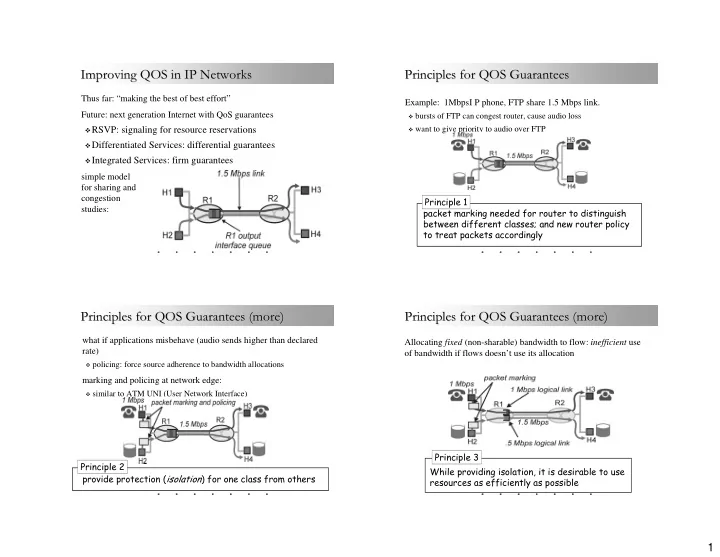
Thus far: “making the best of best effort” Future: next generation Internet with QoS guarantees

RSVP: signaling for resource reservations Differentiated Services: differential guarantees Integrated Services: firm guarantees

simple model for sharing and congestion studies:

Principles for QOS Guarantees Principles for QOS Guarantees

Example: 1MbpsI P phone, FTP share 1.5 Mbps link.

bursts of FTP can congest router, cause audio loss want to give priority to audio over FTP

packet marking needed for router to distinguish between different classes; and new router policy to treat packets accordingly Principle 1

Principles for QOS Guarantees (more) Principles for QOS Guarantees (more)

what if applications misbehave (audio sends higher than declared rate)

policing: force source adherence to bandwidth allocations

marking and policing at network edge:

similar to ATM UNI (User Network Interface)

provide protection (isolation) for one class from others Principle 2

Principles for QOS Guarantees (more) Principles for QOS Guarantees (more)

Allocating fixed (non-sharable) bandwidth to flow: inefficient use

  • f bandwidth if flows doesn’t use its allocation

While providing isolation, it is desirable to use resources as efficiently as possible Principle 3

slide-2
SLIDE 2

2

Principles for QOS Guarantees (more) Principles for QOS Guarantees (more)

Basic fact of life: can not support traffic demands beyond link capacity Call Admission: flow declares its needs, network may block call (e.g., busy signal) if it cannot meet needs Principle 4

Summary of Summary of QoS QoS Principles Principles

Let’s next look at mechanisms for achieving this ….

Scheduling And Policing Mechanisms Scheduling And Policing Mechanisms

scheduling: choose next packet to send on link FIFO (first in first out) scheduling: send in order of arrival to queue

real-world example? discard policy: if packet arrives to full queue: who to discard?

Tail drop: drop arriving packet priority: drop/remove on priority basis random: drop/remove randomly

Scheduling Policies: more Scheduling Policies: more

Priority scheduling: transmit highest priority queued packet multiple classes, with different priorities

class may depend on marking or other header info, e.g. IP

source/dest, port numbers, etc..

Real world example?

slide-3
SLIDE 3

3

Scheduling Policies: still more Scheduling Policies: still more

round robin scheduling: multiple classes cyclically scan class queues, serving one from each class (if available) real world example?

Scheduling Policies: still more Scheduling Policies: still more

Weighted Fair Queuing: generalized Round Robin each class gets weighted amount of service in each cycle real-world example?

Policing Mechanisms Policing Mechanisms

Goal: limit traffic to not exceed declared parameters

Three common-used criteria: (Long term) Average Rate: how many pkts can be sent per unit time (in the long run)

crucial question: what is the interval length: 100 packets per sec or

6000 packets per min have same average!

Peak Rate: e.g., 6000 pkts per min. (ppm) avg.; 1500 ppm peak rate (Max.) Burst Size: max. number of pkts sent consecutively (with no intervening idle)

Policing Mechanisms Policing Mechanisms

Token Bucket: limit input to specified Burst Size and

Average Rate. bucket can hold b tokens tokens generated at rate r token/sec unless bucket full

  • ver interval of length t: number of packets admitted less than
  • r equal to (r t + b).
slide-4
SLIDE 4

4

Policing Mechanisms (more) Policing Mechanisms (more)

token bucket, WFQ combine to provide guaranteed upper bound on delay, i.e., QoS guarantee!

WFQ

token rate, r bucket size, b

per-flow rate, R D = b/R max

arriving traffic

IETF Integrated Services IETF Integrated Services

architecture for providing QOS guarantees in IP networks for individual application sessions resource reservation: routers maintain state info (a la VC) of allocated resources, QoS req’s admit/deny new call setup requests: Question: can newly arriving flow be admitted with performance guarantees while not violated QoS guarantees made to already admitted flows?

Intserv Intserv: : QoS QoS guarantee scenario guarantee scenario

Resource reservation

call setup, signaling (RSVP) traffic, QoS declaration per-element admission control QoS-sensitive

scheduling (e.g., WFQ)

request/ reply

Call Admission Call Admission

Arriving session must :

declare its QOS requirement

R-spec: defines the QOS being requested

characterize traffic it will send into network

T-spec: defines traffic characteristics

signaling protocol: needed to carry R-spec and T-spec to routers (where reservation is required)

RSVP

slide-5
SLIDE 5

5

Intserv Intserv QoS QoS: Service models : Service models [rfc2211,

[rfc2211, rfc rfc 2212] 2212]

Guaranteed service:

worst case traffic arrival: leaky-bucket- policed source simple (mathematically provable) bound on delay [Parekh 1992, Cruz 1988]

Controlled load service:

"a quality of service closely approximating the QoS that same flow would receive from an unloaded network element."

WFQ

token rate, r bucket size, b

per-flow rate, R D = b/R max

arriving traffic

IETF Differentiated Services IETF Differentiated Services

Concerns with Intserv: Scalability: signaling, maintaining per-flow router state difficult with large number of flows Flexible Service Models: Intserv has only two classes. Also want “qualitative” service classes

“behaves like a wire” relative service distinction: Platinum, Gold, Silver

Diffserv approach: simple functions in network core, relatively complex functions at edge routers (or hosts) Do’t define define service classes, provide functional components to build service classes

Diffserv Diffserv Architecture Architecture

Edge router:

  • per-flow traffic management
  • marks packets as in-profile

and out-profile

Core router:

  • per class traffic management
  • buffering and scheduling

based on marking at edge

  • preference given to in-profile

packets

  • Assured Forwarding

scheduling

. . .

r b marking

Edge Edge-

  • router Packet Marking

router Packet Marking

class-based marking: packets of different classes marked differently intra-class marking: conforming portion of flow marked differently than non- conforming one profile: pre-negotiated rate A, bucket size B packet marking at edge based on per-flow profile

Possible usage of marking:

User packets Rate A B

slide-6
SLIDE 6

6

Classification and Conditioning Classification and Conditioning

Packet is marked in the Type of Service (TOS) in IPv4, and Traffic Class in IPv6 6 bits used for Differentiated Service Code Point (DSCP) and determine PHB that the packet will receive 2 bits are currently unused

Classification and Conditioning Classification and Conditioning

may be desirable to limit traffic injection rate of some class: user declares traffic profile (eg, rate, burst size) traffic metered, shaped if non-conforming

Forwarding (PHB) Forwarding (PHB)

PHB result in a different observable (measurable) forwarding performance behavior PHB does not specify what mechanisms to use to ensure required PHB performance behavior Examples:

Class A gets x% of outgoing link bandwidth over time intervals of a

specified length

Class A packets leave first before packets from class B

Forwarding (PHB) Forwarding (PHB)

PHBs being developed:

Expedited Forwarding: pkt departure rate of a class equals or exceeds specified rate

logical link with a minimum guaranteed rate

Assured Forwarding: 4 classes of traffic

each guaranteed minimum amount of bandwidth each with three drop preference partitions