Improving Employability through appropriate technologies and skills - - PDF document

improving employability through appropriate technologies
SMART_READER_LITE
LIVE PREVIEW

Improving Employability through appropriate technologies and skills - - PDF document

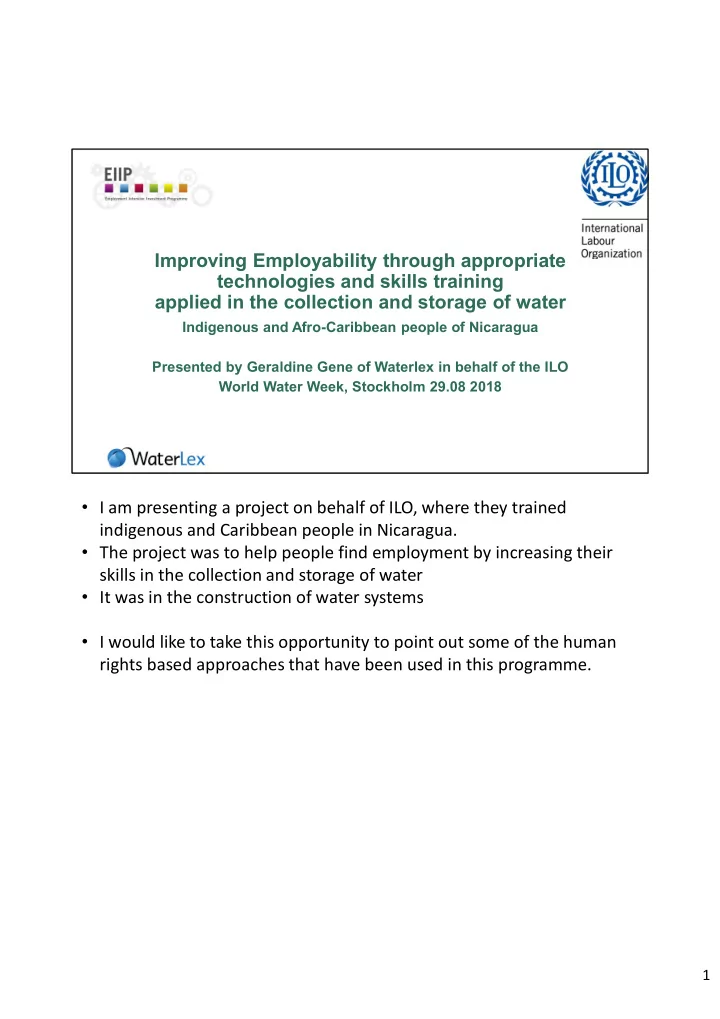
Improving Employability through appropriate technologies and skills training applied in the collection and storage of water Indigenous and Afro-Caribbean people of Nicaragua Presented by Geraldine Gene of Waterlex in behalf of the ILO World


slide-1
SLIDE 1

Improving Employability through appropriate technologies and skills training applied in the collection and storage of water

Indigenous and Afro-Caribbean people of Nicaragua Presented by Geraldine Gene of Waterlex in behalf of the ILO World Water Week, Stockholm 29.08 2018

  • I am presenting a project on behalf of ILO, where they trained

indigenous and Caribbean people in Nicaragua.

  • The project was to help people find employment by increasing their

skills in the collection and storage of water

  • It was in the construction of water systems
  • I would like to take this opportunity to point out some of the human

rights based approaches that have been used in this programme.

1

slide-2
SLIDE 2

The ILO and Indigenous and Tribal Peoples, ITPs

  • The ILO is the only tripartite U.N. agency, since 1919 brings together

governments, employers and workers of 187 member States.

  • Promote rights at work
  • Encourage decent employment opportunities
  • Enhance social protection
  • Strengthen dialogue on work-related issues.
  • ITPs are indigenous and tribal peoples
  • ILO is a UN agency, and it brings governments, employers and workers together.
  • Its mission is to promote rights at work and improve working conditions
  • The success of this programme is the inclusion of a human rights based approach,

which I will explain as we go through 2

slide-3
SLIDE 3

The ILO Indigenous and Tribal Peoples Convention (No. 169)

  • Cornerstone of the international framework for promoting human

rights of IPs, along with 2007 UN Declaration

  • Recognizing aspirations of IPs to:

₋ exercise control over their own institutions, ways of life and economic development ₋ maintain and develop their identities, languages and religions

  • Valuing contributions of IPs to cultural diversity and “social and

ecological harmony”

  • ILO Convention 169 of 2007 is the cornerstone of the international framework for

promoting rights of Indigenous Peoples

  • This declaration recognises the aspirations of indigenous peoples to have control
  • ver their lives and maintain their identies
  • It helps to value the contribution that indigenous peoples make to cultural

diversity and social and ecological harmony

  • Sometimes it is the only regulatory framework that can protect them

3

slide-4
SLIDE 4

4

  • Labour
  • Skills
  • Local Materials
  • Tools, Equipment
  • Local Technologies
  • Local Contractors
  • Communities
  • Local Governments
  • Local service Providers
  • Local Natural Resources

INPUTS Participation & Planning

Implementation

Technologies

Implementation

Modalities Operation & Maintenance

Infrastructure, Environment and

  • ther Community

Assets

  • Addressing Local Access Needs
  • Local Jobs
  • Local Income
  • Multiplier Effect
  • Local Economic Development
  • Environmental Improvement
  • Local Economic Recovery
  • Local Capacity

OUTCOMES THE ILO’s LOCAL RESOURCE-BASED APPROACH (LRB) (for infrastructure development and job creation) Environmental and Social Safeguards

  • EIIP‘s local resource-based approach recognizes and promotes indigenous

knowledge, values and traditions,

  • It explores local skills and technologies to increase vulnerable groups’ participation

in society,

  • and develop local assets and skills.
  • In particular, as part of the training for construction work ITPs can receive formal

certification expanding on their empirical knowledge of construction methods and materials.

  • This approach has proven effective for strengthening the self-esteem and

institutions of marginalised ITPs as well as contradict any local prejudices against their work capacity.

  • Furthermore, the training and experience received during the projects can boost

ITPs employability after the project

  • Participation is a key principles of a human rights based approach, but it has to be

inclusive of all members of society, inclusing women, elders and youth

slide-5
SLIDE 5

The case of Nicaragua: LRB in the collection and storage

  • f water
  • Context of the Project: UN Joint Program to improve WASH Governance

(2009- 2012)

  • Objective: strengthen the economic and democratic governance of WAS

sector to increase sustainable access to water and sanitation services

  • Target group: Indigenous peoples and Afro-Caribbean descendent

minorities (IP&AC)

  • Beneficiaries of the project:
  • North Atlantic Autonomous Region(RAAN): 5 municipalities, 10 communities
  • South Atlantic Autonomous Region(RAAS): 5 municipalities, 10 communities

UNICEF, UNDP, ILO, PAHO , UNESCO, UNCDF, UNODC

  • The objectives of the Program were to strengthen the economic and democratic

governance of the water and sanitation sector of the Nicaraguan Caribbean Coast

  • This was achieved through :
  • greater participation and coordination among institutional and social

actors,

  • strengthening the institutional framework, and
  • investment in infrastructure seeking to increase sustainable access to water

and sanitation services, prioritizing indigenous peoples and communities of African descent.

  • The Program was conducted within the framework of the MDG-F Programs
  • It was implemented in 20 communities in the north and south autonomous

regions

  • With the participation of 7 UN agencies

5

slide-6
SLIDE 6

Enhancing capabilities and strengthening the institutional framework

  • The communities were empowered by:
  • Supporting local management
  • improving local access to services, and
  • Supporting institutional, legal and regulatory reform
  • The outcome was in job creation and higher incomes

6

slide-7
SLIDE 7

Learning by doing: Combining theoretical lessons … with …..

Appropriate training materials

The learning by doing method combines theoretical lessons with practical training 7

slide-8
SLIDE 8

On site practices … Women participation

Project results:

  • 24 water/sanitation projects operational in

20 communities

  • 7.2% improved access to water
  • 5.1% improved access to sanitation

The participation of women was very important, and formed the backbone of the inclusivity programme. The importance of training women to do traditionally men’s work is critical to the ability to lift them out of poverty and take an equal role 8

slide-9
SLIDE 9

Outcomes of the approach to the project

  • Two people per community were trained as masons for

the maintenance of water systems.

  • In total, 109 people were trained in the construction and

maintenance of Water and Sanitation systems, of which 81 (40% women) have been qualified as Entrepreneurs.

  • 35 constructive service providers were trained in

appropriate technologies and business organization issues

  • Creation of a guidebook on appropriate technologies and

skills training for Indigenous and Afro Caribbean people.

In total:

  • 2 people in each community were trained as masons
  • 109 people were trained to construct water and sanitation systems, of which 40%

were women

  • 35 construction workers trained in technologies and business organisation
  • Plus a guidebook was created

9

slide-10
SLIDE 10

Recommendations for empowering ITPs in Development Projects (1)

  • Empowering ITPs requires a specific approach ideally based on

anthropological studies.

  • Identify internal power relations and political decision-making

structure/levels to allow inclusive participation, social dialogue and negotiation.

  • Understand the social structure and the position and role of women,

elders, youth and people with disabilities within the community and their relationship with access, management and control over economic and natural resources

  • Locate and respect sacred places and associated rituals with the
  • bject of the project i.e. roads, sources of water

The learnings that were found were that it was necessary to understand:

  • The anthropological background
  • internal political relationships to enable inclusive participation
  • The role of women, elders, youth and people with disabilities and their ability to

access and control economic and natural resources

  • The location of sacred places to be respected

10

slide-11
SLIDE 11

Recommendations for empowering ITPs in Development Projects (2)

  • Take into account local perception of time
  • Project implementers and indigenous leaders might have different

perspective of understanding of the projects.

  • It is crucial to make sure that the purpose of the project is clear and

aligned with people’s needs and interests. Two or three meetings may be required to reach a common understanding.

  • Identify traditional practices, biological indicators related to natural

resources management and infrastructure development

  • Promote Local knowledge and appropriate traditional technologies

and expertise.

In addition, the following need to be considered;

  • Local perception of time
  • Interpretation of project
  • The need for several meetings to design the project according to peoples needs
  • Traditional practices and
  • Promotion of local know-how and traditional expertise
  • In this case, participation needed to be adapted to their cultural needs to make it

work 11

slide-12
SLIDE 12

www.ilo.org/piie

Thank you for listening.

  • If you would like to see other examples of a human rights based approach you can

find copies of our good practices guide from Central America at our stand. 12