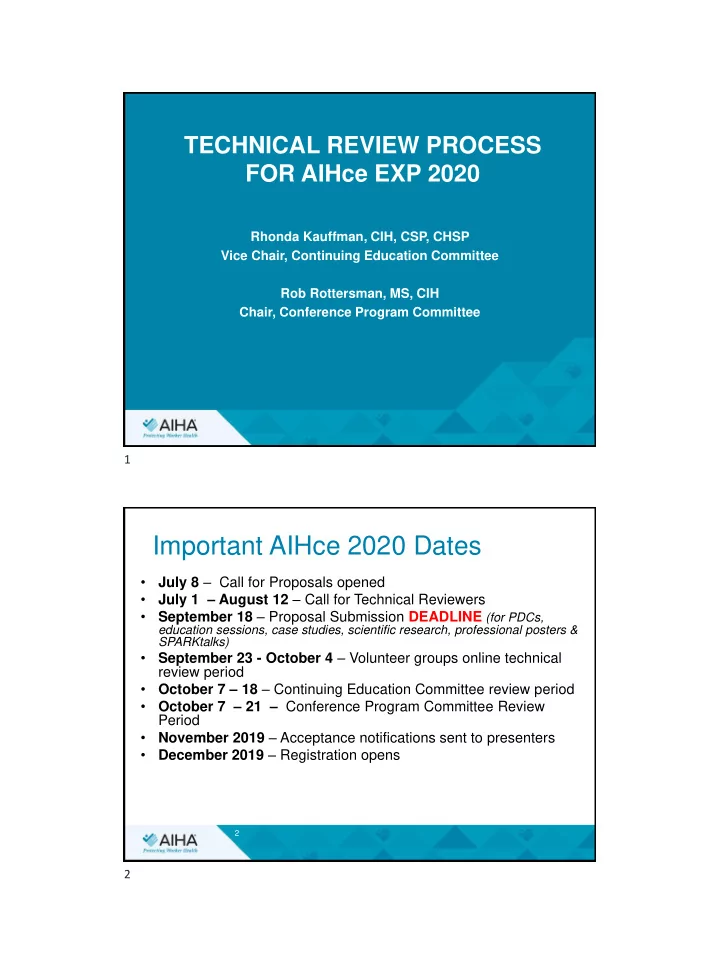
Important AIHce 2020 Dates July 8 Call for Proposals opened July - - PDF document

important aihce 2020 dates
SMART_READER_LITE
LIVE PREVIEW

Important AIHce 2020 Dates July 8 Call for Proposals opened July - - PDF document

TECHNICAL REVIEW PROCESS FOR AIHce EXP 2020 Rhonda Kauffman, CIH, CSP, CHSP Vice Chair, Continuing Education Committee Rob Rottersman, MS, CIH Chair, Conference Program Committee 1 Important AIHce 2020 Dates July 8 Call for Proposals


slide-1
SLIDE 1

TECHNICAL REVIEW PROCESS FOR AIHce EXP 2020

Rhonda Kauffman, CIH, CSP, CHSP Vice Chair, Continuing Education Committee Rob Rottersman, MS, CIH Chair, Conference Program Committee

Important AIHce 2020 Dates

  • July 8 – Call for Proposals opened
  • July 1 – August 12 – Call for Technical Reviewers
  • September 18 – Proposal Submission DEADLINE (for PDCs,

education sessions, case studies, scientific research, professional posters & SPARKtalks)

  • September 23 - October 4 – Volunteer groups online technical

review period

  • October 7 – 18 – Continuing Education Committee review period
  • October 7 – 21 – Conference Program Committee Review

Period

  • November 2019 – Acceptance notifications sent to presenters
  • December 2019 – Registration opens

2

1 2

slide-2
SLIDE 2

Call for AIHce EXP 2020 Technical Reviewers

  • A technical reviewer serves as the subject

matter expert and reviews submissions to ensure they are scientifically sound, innovative, and relevant to the profession

  • Review is bi-level with two phases (technical

reviewers and CPC/ CEC)

  • The technical review process occurs prior to

the CPC/ CEC reviews and assists the committees in selecting the final content to be presented as the 2020 education program

3

Technical Review Logistics

  • Review is conducted entirely online and will be
  • pen September 23 to October 4, 2019
  • The review process is blind, and no submitter

information will be shared

  • The time commitment, per proposal, is approximately

15-20 minutes, and will vary, depending on the number

  • f submissions received in your topic area
  • Most topics receive a handful of proposals (5-10 total),

while more popular topics, like Risk Assessment, could have many more reviews to complete (50-100 total)

  • Accurate count of proposals in each topic area cannot

be provided until the submission deadline has passed

3 4

slide-3
SLIDE 3

Technical Review Instructions

  • We ask each volunteer group to submit the names of 4

reviewers and 2 alternates by Monday, August 12

  • We need a minimum of 2 reviewers for PDCs and 2 for

the education program (the same 2 volunteers can review both PDCs and education submissions), and an alternate for each in any given topic area

– This is the minimum number needed, but more can volunteer to review if desired

– You can volunteer to review PDCs or education sessions, or both (please specify at the time of volunteering)

5

Technical Review Instructions

  • If volunteer names are not supplied by

volunteer groups, we will ask committee leadership (Chair and Vice Chair) to assume review responsibility for each committee

  • This is your committee’s opportunity to

help select the content offered at the 2020 conference

5 6

slide-4
SLIDE 4
  • Professional Development Courses

– Will be held on Saturday, Sunday, and Thursday – Half-day, one-day, and two-day formats – Selections made by Continuing Education Committee

7

PDC Review & Selection Process Flow Chart

7 8

slide-5
SLIDE 5

PDC Volunteer Group Technical Review Process

  • Prior to reaching the CEC, the submissions

assigned to volunteer groups, according to their topic area, for technical content review.

  • These reviews are factored into the CEC

quantitative review process.

  • For 2020, this review is scheduled for

September 23 – October 4, 2019.

– A call for reviewers (4 members from each VG + 2 alternates) is open now, thru August 12, 2019.

How are PDCs scored?

  • Is the topic is relevant to OEHS?
  • Is the topic: New/Emerging, Core/Foundational, Waning

(Rating 1-5)

  • The proposal has a sound technical basis
  • Course description is clear and concise
  • Learning Outcomes are appropriate for level
  • Outline describes the content appropriate for selected course

level (introductory, intermediate, advanced) and selected learning level(s) (novice, competent, experienced, expert)

  • Recommendation: (Suggest that the CEC ACCEPT or REJECT the

proposal)

  • Comments: (Open text box)

The evaluation is conducted in a uniform manner using a format, which results in a quantified rating for each proposal. 9 10

slide-6
SLIDE 6

How does the CEC review PDCs?

  • Each proposal is evaluated by at least two

members of the CEC to assure that it is relevant to the profession, titled properly and meets its stated

  • bjectives. Course outline and teaching methods

are critiqued and presenter credentials/biographies are reviewed.

  • The Committee then considers all proposals and

their ratings in light of program topical balance, educational needs expressed by member surveys, and the AIHA’s strategic goals.

– For courses previously conducted, the major factor in the review are the student evaluations.

How are PDCs selected?

  • Wide range of topics representing field of IH
  • 40% introductory, 50% intermediate, and 10% advanced
  • 75% full day, 15% half day, 10% two day
  • One PDC addressing each of the CPAG content priorities
  • At least 25% new courses each year.
  • Top 5 courses from the previous year (based on ratings and

attendance) automatically accepted

  • Final selections are limited by the number of rooms available

to us at the convention center.

11 12

slide-7
SLIDE 7

Why would the committee not accept a PDC proposal?

Many more proposals are submitted than can be accommodated at the AIHce EXP. There are several reasons for not selecting a particular course.

Examples include:

  • relevance to the members
  • accuracy of technical information presented
  • previous student evaluations
  • verabundance of course offerings in one area
  • content similar to another course
  • need for course rotation
  • simply lack of interest by the members at large
  • AIHce Education Sessions

– Will be held Monday, Tuesday, and Wednesday

  • Scientific Research (20 min)
  • Case Studies (20 min)
  • Technical Sessions (1 hour)
  • SparkTalks
  • Professional Posters
  • Student Posters
  • Student Presentations (Academic Track)

13 14

slide-8
SLIDE 8

How are proposals reviewed?

  • Technical committees review

– September 23 – October 4, 2019

  • A call for reviewers (4 members, +2 alternates from

each VG) is open now thru August 12

  • Conference Program Committee review

– October 7-October 21

  • Scores from separate groups are tabulated
  • Comparison of scores forms basis for

discussion by CPC

  • Final selections made by November

15

How are proposals scored?

(1–Strongly Disagree to 5–Strongly Agree)

  • This presentation will be of interest to the

AIHce audience

  • The content of this session is current and

relevant to OEHS professionals

  • This proposal is clear, well-organized, and

well-written

  • This presentation should be accepted for

AIHce

16

15 16

slide-9
SLIDE 9

Selection Process

  • Ratings from previous conferences used

to inform the selection process

  • Data from AIHA surveys will help identify

popular topics

  • Tracks will be identified based on

accepted proposals/ spread of topics

17

Session Arranging

  • Three individual case study or scientific

research presentations (20 minutes each) comprise a single one hour session

  • Conference Program Committee will

arrange combined sessions based on content

– AIHA staff will ask Volunteer Groups for names of Moderators for any combined sessions in their topic area

17 18

slide-10
SLIDE 10

Multiple Part Sessions

  • Option to submit two proposals with the

same title, identified as Part 1 or Part 2

  • Each Part can have a maximum of 3

speakers (maximum session total of 6 speakers)

  • The two Parts should have different

content and presenters

– Conference Program Committee may decide to accept only one of them

Proposal Selection Process

  • Proposals not selected are considered for

posters, webinars, Synergist articles, etc.

  • Intent is to have an open process with

wider participation in order to select the best content for AIHce EXP

19 20

slide-11
SLIDE 11

AIHA Education Needs Assessment Findings

  • Align education with demand
  • Levels of education should be considered
  • Create tracks to help with planning AIHce

experience

  • Experiment with new engagement

approaches

  • Identify how education helps IHs in terms
  • f work and career

21

Content Priorities 2020-2025

  • Big Data & Sensor Technology
  • Communicating IH Concepts
  • Changing Workforce
  • Exposure Banding
  • Total Worker Exposure

22

21 22

slide-12
SLIDE 12

Committee Award Lectures

  • Any AIHA committee that wants a committee award lecture on

the program must have all content finalized and submitted by the deadline of September 18, 2019,11:59pm Eastern, no exceptions

– The CPC will review these submissions based on the same criteria as all of the other session types and there is no guarantee of acceptance

  • All content needs to be in final form, nothing “to be

determined”

  • These sessions will be accepted based on merit of content

and should not be focused on the award itself

  • For any committee award that is accepted on to the education

program, the committee award name cannot be listed in the title

– List the title in the session description instead

Proof of Participation

  • Per ABIH, this activity would fall under the

pro-bono activity, (.5 points for each 40 hours)

  • AIHA will issue you a letter of participation

in late October and list the # of reviews you completed for proof for ABIH

23 24

slide-13
SLIDE 13

Thank you for your support!

For weekday education: Kathryn Christoe, kchristoe@aiha.org For PDCs: Erin Breece, ebreece@aiha.org

25

25