Implementing Critical Sections in Software Hard The following - - PDF document

implementing critical sections in software hard
SMART_READER_LITE
LIVE PREVIEW

Implementing Critical Sections in Software Hard The following - - PDF document

Implementing Critical Sections in Software Hard The following example will demonstrate the difficulty of providing mutual exclusion with memory reads and writes Hardware support is needed The code must work all of


slide-1
SLIDE 1 1

Thre read S d Synchro ronization: Too M Much M Milk

2

Implementing ¡Critical ¡Sections ¡in ¡Software ¡Hard ¡

The following example will demonstrate the difficulty

  • f providing mutual exclusion with memory reads and

writes

Ø Hardware support is needed

The code must work all of the time

Ø Most concurrency bugs generate correct results for some interleavings

Designing mutual exclusion in software shows you how to think about concurrent updates

Ø Always look for what you are checking and what you are updating Ø A meddlesome thread can execute between the check and the update, the dreaded race condition

3

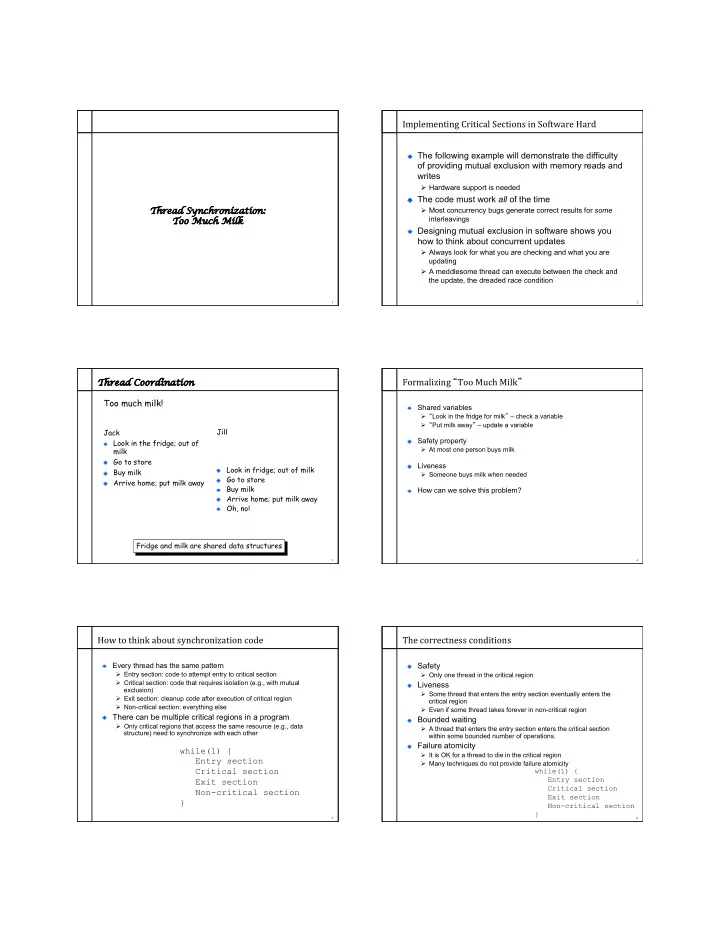
Thre read C d Coordi rdination

Jack Look in the fridge; out of milk Go to store Buy milk Arrive home; put milk away Jill Look in fridge; out of milk Go to store Buy milk Arrive home; put milk away Oh, no!

Too much milk!

Fridge and milk are shared data structures

4

Formalizing ¡“Too ¡Much ¡Milk” ¡

Shared variables

Ø “Look in the fridge for milk” – check a variable Ø “Put milk away” – update a variable

Safety property

Ø At most one person buys milk

Liveness

Ø Someone buys milk when needed

How can we solve this problem?

5

How ¡to ¡think ¡about ¡synchronization ¡code ¡

Every thread has the same pattern

Ø Entry section: code to attempt entry to critical section Ø Critical section: code that requires isolation (e.g., with mutual exclusion) Ø Exit section: cleanup code after execution of critical region Ø Non-critical section: everything else

There can be multiple critical regions in a program

Ø Only critical regions that access the same resource (e.g., data structure) need to synchronize with each other

while(1) { Entry section Critical section Exit section Non-critical section }

6

The ¡correctness ¡conditions ¡

Safety

Ø Only one thread in the critical region

Liveness

Ø Some thread that enters the entry section eventually enters the critical region Ø Even if some thread takes forever in non-critical region

Bounded waiting

Ø A thread that enters the entry section enters the critical section within some bounded number of operations.

Failure atomicity

Ø It is OK for a thread to die in the critical region Ø Many techniques do not provide failure atomicity

while(1) { Entry section Critical section Exit section Non-critical section }

slide-2
SLIDE 2 7

Too ¡Much ¡Milk: ¡Solution ¡#0 ¡

Is this solution

Ø 1. Correct Ø 2. Not safe Ø 3. Not live Ø 4. No bounded wait Ø 5. Not safe and not live

It works sometime and doesn’t some other times

Ø Threads can be context switched between checking and leaving note Ø Live, note left will be removed Ø Bounded wait (‘buy milk’ takes a finite number of steps)

while(1) { if (noMilk) { // check milk (Entry section) if (noNote) { // check if roommate is getting milk leave Note; //Critical section buy milk; remove Note; // Exit section } // Non-critical region } What if we switch the

  • rder of checks?
8

Too ¡Much ¡Milk: ¡Solution ¡#1 ¡

while(1) { while(turn ≠ Jack) ; //spin while (Milk) ; //spin buy milk; // Critical section turn := Jill // Exit section // Non-critical section } while(1) { while(turn ≠ Jill) ; //spin while (Milk) ; //spin buy milk; turn := Jack // Non-critical section }

Is this solution

Ø 1. Correct Ø 2. Not safe Ø 3. Not live Ø 4. No bounded wait Ø 5. Not safe and not live

At least it is safe turn := Jill // Initialization

9

Solution ¡#2 ¡(a.k.a. ¡Peterson’s ¡algorithm): ¡ ¡ combine ¡ideas ¡of ¡0 ¡and ¡1 ¡

Variables:

Ø ini: thread Ti is executing , or attempting to execute, in CS Ø turn: id of thread allowed to enter CS if multiple want to

Claim: We can achieve mutual exclusion if the following invariant holds before thread i enters the critical section: Intuitively: j doesn’t want to execute

  • r it is i’s turn to execute

{(¬inj ∨ (inj ∧ turn = i )) ∧ ini} ((¬in0 ∨ (in0 ∧ turn = 1)) ∧ in1) ∧ ((¬in1 ∨ (in1 ∧ turn = 0)) ∧ in0) ⇒ ((turn = 0) ∧ (turn = 1)) = false

10

Peters rson’s A Algori rithm Safe, live, and bounded waiting But, only 2 participants

Jack while (1) { in0:= true; turn := Jill; while (turn == Jill && in1) ;//wait Critical section in0 := false; Non-critical section } Jill while (1) { in1:= true; turn := Jack; while (turn == Jack && in0);//wait Critical section in1 := false; Non-critical section }

in0 = in1 = false; turn=Jill, in0 = true turn=Jack, in0 = true, in1:= true

Spin!

turn=Jack, in0 = false, in1:= true

11

Too ¡Much ¡Milk: ¡Lessons ¡

Peterson’s works, but it is really unsatisfactory

Ø Limited to two threads Ø Solution is complicated; proving correctness is tricky even for the simple example Ø While thread is waiting, it is consuming CPU time

How can we do better?

Ø Use hardware to make synchronization faster Ø Define higher-level programming abstractions to simplify concurrent programming

12

Towards ¡a ¡solution ¡

The problem boils down to establishing the following right after

entryi (¬inj ∨ (inj ∧ turn = i)) ∧ ini = (¬inj ∨ turn = i) ∧ ini

Or, intuitively, right after Jack enters:

u Jack has signaled that he is in the entry section (ini) u - And - u Jill isn’t in the critical section or entry section (¬inj ) u - Or – u Jill is also in the entry section but it is Jack’s turn (inj ∧ turn = i)

How can we do that?

entryi = ini := true; while (inj ∧turn ≠ i);

slide-3
SLIDE 3 13

We h hit a a s snag

Thread T0 while (!terminate) { in0:= true {in0} while (in1 ∧turn ≠ 0); {in0 ∧ (¬ in1 ∨ turn = 0)} CS0 ……… } Thread T1 while (!terminate) { in1:= true {in1} while (in0 ∧turn ≠ 1); {in1 ∧ (¬ in0 ∨ turn = 1)} CS1 ……… }

The assignment to in0 invalidates the invariant!

14

What c can w we do do? ?

Thread T0 while (!terminate) { in0:= true; turn := 1; {in0} while (in1 ∧turn ≠ 0); {in0 ∧ (¬ in1 ∨ turn = 0 ∨ at(α1) )} CS0 in0 := false; NCS0 } Thread T1 while (!terminate) { in1:= true; turn := 0; {in1} while (in0 ∧turn ≠ 1); {in1 ∧ (¬ in0 ∨ turn = 1 ∨ at(α0) )} CS1 in1 := false; NCS1 }

Add assignment to turn to establish the second disjunct

α0 α1

15

Safe? ?

Thread T0 while (!terminate) { in0:= true; turn := 1; {in0} while (in1 ∧turn ≠ 0); {in0 ∧ (¬ in1 ∨ turn = 0 ∨ at(α1) )} CS0 in0 := false; NCS0 } Thread T1 while (!terminate) { in1:= true; turn := 0; {in1} while (in0 ∧turn ≠ 1); {in1 ∧ (¬ in0 ∨ turn = 1 ∨ at(α0) )} CS1 in1 := false; NCS1 }

α0 α1

If both in CS, then in0 ∧ (¬in1 ∨ at(α1) ∨ turn = 0) ∧ in1 ∧ (¬in0 ∨ at(α0) ∨ turn = 1) ∧

∧ ¬ at(α0) ∧ ¬ at(α1) = (turn = 0) ∧ (turn = 1) = false

16

Live? ?

Thread T0 while (!terminate) { {S1: ¬in0 ∧ (turn = 1 ∨ turn = 0)} in0:= true; {S2: in0 ∧ (turn = 1 ∨ turn = 0)} turn := 1; {S2} while (in1 ∧turn ≠ 0); {S3: in0 ∧ (¬ in1 ∨ at(α1) ∨ turn = 0)} CS0

{S3}

in0 := false; {S1} NCS0 } Thread T1 while (!terminate) { {R1: ¬in0 ∧ (turn = 1 ∨ turn = 0)} in1:= true; {R2: in0 ∧ (turn = 1 ∨ turn = 0)} turn := 0; {R2} while (in0 ∧turn ≠ 1); {R3: in1 ∧ (¬ in0 ∨ at(α0) ∨ turn = 1)} CS1

{R3}

in1 := false; {R1} NCS1 }

α0 α1

Non-blocking: T0 before NCS0, T1 stuck at while loop S1 ∧ R2 ∧ in0 ∧ (turn = 0) = ¬in0 ∧ in1 ∧ in0 ∧ (turn = 0) = false Deadlock-free: T1 and T0 at while, before entering the critical section S2 ∧ R2 ∧ (in0 ∧ (turn = 0)) ∧ (in1 ∧ (turn = 1)) ⇒ (turn = 0) ∧ (turn = 1) = false

17

Bounde ded w d waiting? ? Yup!

Thread T0 while (!terminate) { in0:= true; turn := 1; while (in1 ∧turn ≠ 0); CS0 in0 := false; NCS0 } Thread T1 while (!terminate) { in1:= true; turn := 0; while (in0 ∧turn ≠ 1); CS0 in1 := false; NCS0 }