ILLINOIS FARM INCOME SITUATION FOR 2002 Dale Lattz, Gary Schnitkey, - - PDF document

illinois farm income situation for 2002
SMART_READER_LITE
LIVE PREVIEW

ILLINOIS FARM INCOME SITUATION FOR 2002 Dale Lattz, Gary Schnitkey, - - PDF document

ILLINOIS FARM INCOME SITUATION FOR 2002 Dale Lattz, Gary Schnitkey, and Paul Ellinger Department of Agricultural and Consumer Economics University of Illinois at Urbana-Champaign Executive Summary Estimates of 2002 financial performance for 993


slide-1
SLIDE 1

ILLINOIS FARM INCOME SITUATION FOR 2002

Dale Lattz, Gary Schnitkey, and Paul Ellinger Department of Agricultural and Consumer Economics University of Illinois at Urbana-Champaign

Executive Summary

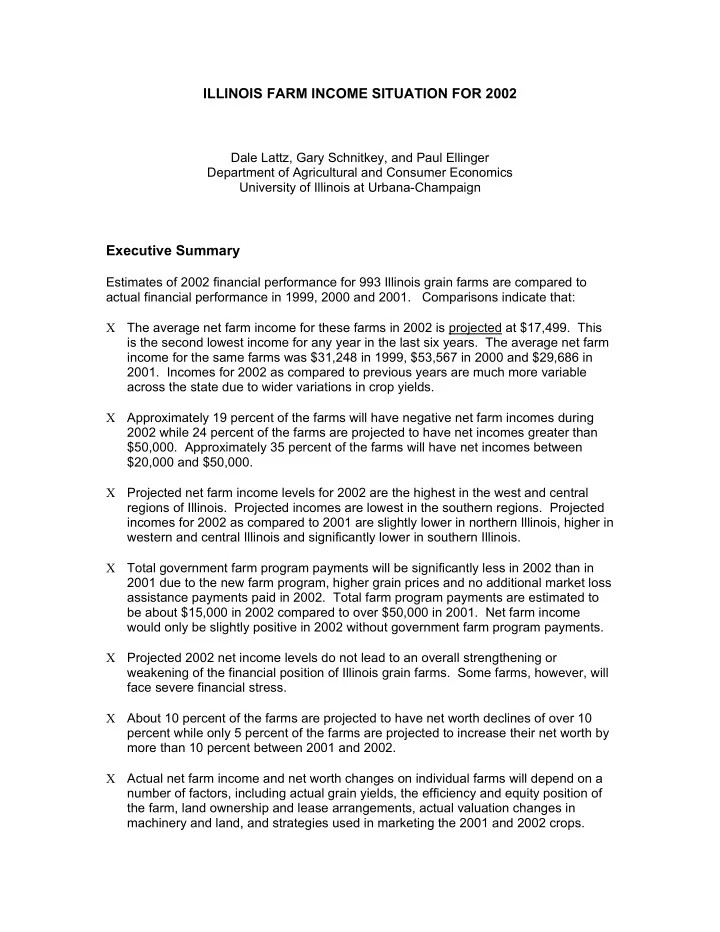
Estimates of 2002 financial performance for 993 Illinois grain farms are compared to actual financial performance in 1999, 2000 and 2001. Comparisons indicate that: Χ The average net farm income for these farms in 2002 is projected at $17,499. This is the second lowest income for any year in the last six years. The average net farm income for the same farms was $31,248 in 1999, $53,567 in 2000 and $29,686 in

  • 2001. Incomes for 2002 as compared to previous years are much more variable

across the state due to wider variations in crop yields. Χ Approximately 19 percent of the farms will have negative net farm incomes during 2002 while 24 percent of the farms are projected to have net incomes greater than $50,000. Approximately 35 percent of the farms will have net incomes between $20,000 and $50,000. Χ Projected net farm income levels for 2002 are the highest in the west and central regions of Illinois. Projected incomes are lowest in the southern regions. Projected incomes for 2002 as compared to 2001 are slightly lower in northern Illinois, higher in western and central Illinois and significantly lower in southern Illinois. Χ Total government farm program payments will be significantly less in 2002 than in 2001 due to the new farm program, higher grain prices and no additional market loss assistance payments paid in 2002. Total farm program payments are estimated to be about $15,000 in 2002 compared to over $50,000 in 2001. Net farm income would only be slightly positive in 2002 without government farm program payments. Χ Projected 2002 net income levels do not lead to an overall strengthening or weakening of the financial position of Illinois grain farms. Some farms, however, will face severe financial stress. Χ About 10 percent of the farms are projected to have net worth declines of over 10 percent while only 5 percent of the farms are projected to increase their net worth by more than 10 percent between 2001 and 2002. Χ Actual net farm income and net worth changes on individual farms will depend on a number of factors, including actual grain yields, the efficiency and equity position of the farm, land ownership and lease arrangements, actual valuation changes in machinery and land, and strategies used in marketing the 2001 and 2002 crops.

slide-2
SLIDE 2

Illinois Farm Income Situation for 2002

by Dale Lattz, Paul Ellinger and Gary Schnitkey

slide-3
SLIDE 3

2

Objectives

  • Evaluate the financial condition of

Illinois grain farms.

  • Examine the impact of the 2002

Farm Bill.

slide-4
SLIDE 4

3

Approach

  • Use a sample of Illinois FBFM grain farms with

historical financial records.

  • Use projections of NASS yields and prices to

determine revenue for each farm.

  • Adjust historical expenses and financial data

for each farm.

  • Project net farm income and net worth change

for each farm in the sample.

slide-5
SLIDE 5

4

Last Year’s Results Last Year’s Results

Last year’s projection $29,686 actual income $30,771 projection on Nov 1 $ 1,085 difference Expenses were projected on the mark Missed revenue

slide-6
SLIDE 6

5

What About 2002???

slide-7
SLIDE 7

6

Sample Farms by Size Sample Farms by Size

300 to 500 acres 18% 501 to 1000 acres 43% 1001 to 1500 acres 23% 1501 to 2000 acres 7% greater than 2000 acres 2% less than 300 acres 7%

993 grain farms Average farm: 855 total acres 635 operator acres 993 grain farms Average farm: 855 total acres 635 operator acres

slide-8
SLIDE 8

7

Below Average Yields in 2002

20 40 60 80 100 120 140 160 Corn 129 141 140 151 152 138 Soybeans 43 44 42 44 45 41 Wheat 61 48 60 57 61 48 1997 1998 1999 2000 2001 2002 est.

slide-9
SLIDE 9

8

Increasing Grain Prices

$1.50 $2.50 $3.50 $4.50 $5.50 $6.50 $7.50 $8.50 Corn $2.70 $2.30 $1.97 $1.89 $1.94 2.20 Soybeans $7.55 $6.05 $4.68 $4.82 $4.53 5.05 Wheat $3.43 $2.63 $2.11 $2.18 $2.49 3.13 1997 1998 1999 2000 2001 2002 est.

*Calendar year average

slide-10
SLIDE 10

9

Key Assumptions

  • Estimated prices received / year end inventory

price

– Corn: $2.40 / bu. – Soybeans: $5.60 / bu. – Wheat: $3.20 / bu.

  • No estimated LDP’s included
  • Estimated crop insurance proceeds for the first

time

slide-11
SLIDE 11

10

Key Assumptions – cont.

  • Marketing margins on old crop

– Corn: none (basically sold at inventory price) – Soybeans: Gain of $0.20/ bu. – 60% of crop

  • Pricing opportunities on new crop

– Corn – none included – Soybeans – none included

  • Use NASS November report of district

projections of yields

slide-12
SLIDE 12

11

Estimated Yields

FBFM Adjusted Yields Crop Reporting District 2001 2002 2001 2002 Northwest 50 49 151 153 Northeast 48 44 149 142 West 50 50 159 162 Central 48 50 157 161 East 47 49 146 147 West Southwest 49 48 164 150 East Southeast 47 38 156 122 Southwest 40 33 137 85 Southeast 43 31 138 87 NASS Weighted Average 48 46 153 145 Soybean Yield Corn Yield

November 2002 NASS projections. Yields adjusted to represent differences between NASS and FBFM

slide-13
SLIDE 13

12

Other Key Assumptions

  • Average increase in farm size 3.0%
  • Operating expenses adjustments from 2001

– Crop expenses - - 3% decrease (nitrogen cost) – Fuel and oil - - no change – All other expenses - - no change

  • Market value machinery and machinery

depreciation – no change from 2001

  • Average increase in land values 3.0%
  • Interest expense decrease 1% from 2001

(overall interest expense not rates)

slide-14
SLIDE 14

13

Net Farm Income

Net farm income does not include:

  • Payments for operator labor/family

withdrawals

  • Nonfarm income
  • Income taxes

1999 $31,248 2000 53,567 2001 29,686 2002 17,499

Estimate

Actual

slide-15
SLIDE 15

14

Net Farm Income 1997 - 2002

Net Farm Income

$0 $10,000 $20,000 $30,000 $40,000 $50,000 $60,000 1997 1998 1999 2000 2001 2002*

Year Dollars

* Estimated

slide-16
SLIDE 16

15

Sensitivity of Estimate

One bushel change in Corn yields Soybean yields Change in effective price Corn price - $.05 Soybean price - $.10

Change in Average Income $ 2,304 1,398 $ 751 1,754

slide-17
SLIDE 17

16

Net Farm Income by Region

Crop Reporting District 1998 1999 2000 2001 2002 Northwest 18,714 34,037 39,638 19,379 18,449 Northeast 25,342 23,892 39,226 18,420 17,969 Central & West 16,912 33,879 50,502 27,983 39,351 East 13,427 38,088 44,405 34,103 38,426 West Southwest 22,138 36,694 64,681 26,230 33,088 East Southeast 6,984 29,578 59,328 43,495 (534) Southwest 1,970 15,432 51,207 28,335 (27,235) Southeast (20,807) 14,751 78,224 40,724 (55,333) NASS Weighted Average 12,621 31,248 53,567 29,686 17,499

Actual Projected

slide-18
SLIDE 18

17

2002 Net Farm Income by Region

  • $55,333
  • $27,235
  • $534

$33,088

$38,426 $39,351 $17,969 $18,449

slide-19
SLIDE 19

18

Change in Net Farm Income 2001 to 2002

  • $96,057
  • $55,570
  • $44,029

$6,858 $4,323 $11,368

  • $451
  • $930
slide-20
SLIDE 20

19

Distribution of Net Farm Income

19% 1% 16% 28% 32% 18% 5% 3% 16% 22% 35% 19% 5% 6% 36% 25% 13% 1%0% 7% 19% 33% 29% 12%

0% 10% 20% 30% 40% Less Than - 50,000

  • 50,000 to 0

0 to 20,000 20,000 to 50,000 50,000 to 100,000 Greater than 100,000 Net Farm Income Percent of Farms 1999 2000 2001 2002

Distribution of Net Farm Incomes of 993 Illinois Grain Farms, 1999 - 2002

slide-21
SLIDE 21

20

Effect of 2002 Farm Bill

  • Direct payments – guaranteed, based on base

acres and program yields for each program

  • crop. Replace AMTA payments.
  • Counter Cyclical payments – not guaranteed,

based on 12 month national average price, and base acres and program yields. Institutionalize market loss assistance payments.

  • LDP’s, marketing loans– same as in the past,

although we have different county loan rates. Available when PCP below loan rate.

slide-22
SLIDE 22

21

Calculation of Direct Payments

Corn Beans Wheat Per bu. rate $.28 $.44 $.52 x Program yield (bu.) 115 34 45 x Base acres 1 1 1 x .85 .85 .85 .85 = $27.37 $12.72 $19.89

slide-23
SLIDE 23

22

Benefit of Proving SB Yield for Direct Payments

Proven yield Plugged yield Per bu. rate $.44 $.44 x Program yield (bu.) 34 26 x Base acres 1 1 x .85 .85 .85

=

$12.72 $ 9.72

slide-24
SLIDE 24

23

Maximum Counter-Cyclical Payment Rate

Target price $2.60 $5.80 $3.86 Direct payment rate 0.28 0.44 0.52 Trigger price ¹ 2.32 5.36 3.34 Loan rate 1.98 5.00 2.80

  • Max. counter-cyclical payment ²

0.34 0.36 0.54 ¹ Trigger price equals target price less direct payment rate. ² Equals trigger price minus loan rate.

  • ----------------------$ per bu. ----------------------

Corn Soybeans Wheat

Higher of loan rate or season average price used in rate calculation

slide-25
SLIDE 25

24

Counter Cyclical Payments

Corn Beans Wheat Per bu. rate (max) $.34 $.36 $.54 x Program yield (bu.) 137 41 52 x Base acres 1 1 1 x .85 .85 .85 .85 = $39.59 $12.55 $23.87 Remember CC payments are not guaranteed!! Program yields equals 1998-01 state avg. x .935

slide-26
SLIDE 26

25

Outlook for 2002 CC Payments

Corn Soybeans Wheat Trigger price $2.32 $5.36 $3.34 12 month est. price for 2002* $2.40 $5.40 $3.80 2002 CC Payments?? 0 0 0 * Midpoint of Nov. 11 USDA Supply and Demand Report

slide-27
SLIDE 27

26

Cash Flow/Income Considerations

Per bu. Per acre Per bu. Per acre Jan. PFC Corn 0.269 $ 16.42 $ 0.261 $ 15.93 $ Aug. MLA Corn 0.307 18.74 XX XX Oilseed SB 0.121 2.78 XX XX

  • Nov. ?? LDP

Corn 0.17 15.42 SB 1.25 28.75

  • Nov. ?? CCP

Corn XX XX SB XX XX

  • Nov. ?? DP

Corn XX XX 0.019 1.16 SB XX XX 0.44 6.71 Per acre totals 82.11 $ 23.80 $ Note: 2003 direct paym ent advance of 50% available in Decem ber, 2002. 2002 CCP paym ent not determ ined until October, 2003. 2000 Oilseed paym ent also received in Feb. 2001. 2001 2002

slide-28
SLIDE 28

27

Program Fall D ec. Feb. July O ct. D ec. C rop 2002 2002 2003 2003 2003 2003 2002 C C 2002 C C 2002 C C 1st A dv. 2nd Adv. Final C orn 2003 C C Soybeans

  • 1st. A dv.

S orghum 2002 D irect 2003 D irect 2003 D irect 2004 D irect Final Adv. Final Adv. 2002 C C 2002 C C 2002 C C 1st A dv. 2nd Adv. Final W heat 2003 C C Barley

  • 1st. A dv.

O ats 2002 D irect 2003 D irect 2003 D irect 2004 D irect Final Adv. Final Adv.

C C = C

  • unter-cyclical

A

  • dv. = A

dvance A dvance paym ents (D irect) - A t the option of the producer, up to 50%

  • f the direct paym

ent w ill be paid in advance. A dvance paym ents (C

  • unter-cyclical) - The first advance paym

ent m ay be up to 35%

  • f the projected total C

C paym

  • ents. The total of the first tw
  • advance paym

ents m ay not exceed 70%

  • f the projected total C

C paym ents.

Direct and Counter Cyclical Payment Schedule

slide-29
SLIDE 29

28

Cash Flow/Income Considerations

  • Looking at significantly less total government

payments this year. And no more payments until

  • perators/landlords sign up for the program!!
  • Will be a “hole” in the cash flow.
  • Producers may need to consider more fall grain
  • sales. Especially commercially stored grain.

Save on storage costs.

  • Likely more price variability, marketing needs

attention again!!

  • Income tax planning important, especially this

year.

slide-30
SLIDE 30

29

Significance of Government Payments

Average Net Farm Income 17,499 $ Government Payments 14,952 Direct payments Counter cyclical payments

LDP Assumptions

Corn 0.00 Soybeans 0.00 Wheat 0.00

14,952 Loan deficiency payments

slide-31
SLIDE 31

30

LDP and Market Loan Gains

Market % Bu. Crop LDP Loan Receive Effective Year Payments Gain LDP or Gain Bu. Rate 1999 $304,111,280 $42,256,320 88.6% $0.23 2000 $406,686,160 $23,794,260 93.3% $0.26 2001 $219,648,600 $10,770,390 90.1% $0.14 1999 $365,455,130 $25,874,100 98.4% $0.88 2000 $398,287,340 $32,709,100 99.5% $0.94 2001 $551,277,100 $28,560,970 98.2% $1.21 Soybeans Corn

http://www.fsa.usda.gov/dafp/psd/reports.htm

slide-32
SLIDE 32

31

Changes to Net Worth

Net Income $17,499

  • Family Living

49,429 + Nonfarm Income 23,881

  • Income Taxes

11,771

  • /+ Valuation Change

12,528 Total Change in Net Worth 2001 to 2002

  • $7,292

Assumptions:

  • 3.0% increase in land values
  • no change in machinery values
slide-33
SLIDE 33

32

Change in Net Worth

Assumptions:

  • 3.0% increase in land values
  • no change in machinery values

Annual Change Median 1998-99 4.43% 1999-00 5.25% 2000-01 1.16% 2001-02

  • 0.18%
slide-34
SLIDE 34

33

Distribution of Net Worth Change

Distribution of Net Worth Change for Illinois Grain Farms

3% 6% 20% 22% 9% 24% 9% 2% 7% 34% 39% 12% 6% 2% 8% 40% 45% 4% 1% 40%

1%

4% 45% 18%

0% 5% 10% 15% 20% 25% 30% 35% 40% 45% 50% < -30%

  • 30% to -10%
  • 10% to 0%

0% to 10% 10% to 30% > 30%

1998-99 1999-00 2000-01 2001-02

slide-35
SLIDE 35

34

Simple Risk Rating Model

Positive Working Capital (Current Ratio greater than 1) Less Than Greater Than Debt to Asset Ratio

  • 20%
  • 20% to -5%
  • 5% to 5%

5% to 20% 20% 0 to 10% Vulnerable Vulnerable Stable Strong Strong 10% to 40% Vulnerable Vulnerable Stable Strong Strong 40% to 70% Vulnerable Vulnerable Vulnerable Stable Stable 70% to 100% Vulnerable Vulnerable Vulnerable Vulnerable Vulnerable Greater than 100% Severe Severe Severe Severe Severe Negative Working Capital (Current Ratio less than 1) Less Than Greater Than Debt to Asset Ratio

  • 20%
  • 20% to -5%
  • 5% to 5%

5% to 20% 20% 0 to 10% Stressed Stressed Vulnerable Stable Stable 10% to 40% Stressed Stressed Vulnerable Stable Stable 40% to 70% Stressed Stressed Stressed Vulnerable Vulnerable 70% to 100% Stressed Stressed Stressed Stressed Stressed Greater than 100% Severe Severe Severe Severe Severe Rate of Return on Equity (before depreciation) Rate of Return on Equity (before depreciation)

slide-36
SLIDE 36

35

Financial Position

Distribution of Illinois Grain Farms by Financial Position Category, 1999-2002

16% 47% 21% 16% 0% 15% 49% 21% 15% 0% 18% 47% 21% 13% 0% 0% 10% 20% 40% 29%

0% 10% 20% 30% 40% 50% 60% Strong Stable Vulnerable Stressed Severe Financial Position Percent of farms

1999 2000 2001 2002

slide-37
SLIDE 37

36

What commodity price levels are needed if government payments are eliminated?

  • To achieve Net Farm Income of

$21,046 with 2002 estimated yields

Commodity prices would need to increase to Corn $2.69 Soybeans $5.92 Wheat $3.45

  • To achieve Net Farm Income of

$50,000 with 2002 estimated yields

Commodity prices would need to increase to Corn $3.06 Soybeans $6.74 Wheat $3.92

slide-38
SLIDE 38

37

Conclusions and Limitations

  • Many assumptions made in study
  • Sensitivity of projections to prices
  • Grain farms only, no livestock returns
  • 2002 incomes projected lower than 2001
  • Much more variability in income around the

state, southern Illinois hurt the most

  • Government program payments have less of an

impact on income as compared to the last few years

  • In general, financial health remaining stable