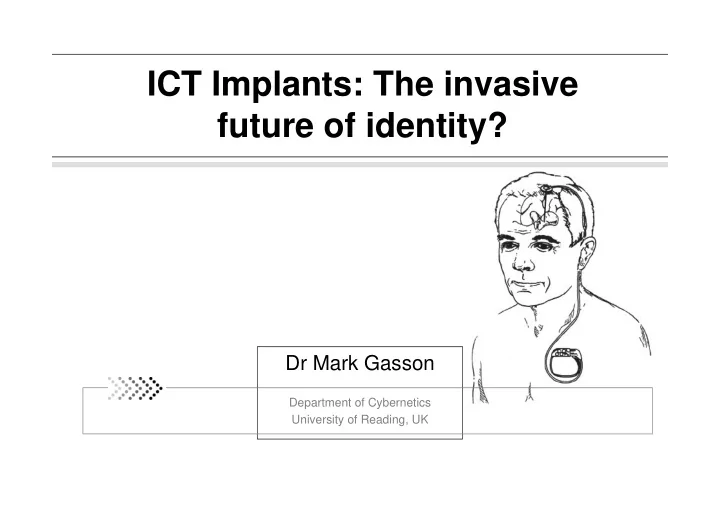
SLIDE 1 ICT Implants: The invasive future of identity?
Dr Mark Gasson
Department of Cybernetics University of Reading, UK
SLIDE 2 Objectives . . .
- An overview of the state-of-
the-art
- Establish a scientific basis for
some futuristic claims
- Generate discussion on this
important topic
SLIDE 3 Objectives . . .
- An overview of the state-of-
the-art
- Establish a scientific basis for
some futuristic claims
- Generate discussion on this
important topic Not an objective . . .
- To necessarily defend anything
as right, wrong, moral, ethical
SLIDE 4 Introduction to Implantable Devices
- Restorative: restore lost
functions and replace lost
- rgans and limbs
- Normalising: restore some
creature to indistinguishable normality
- Reconfiguring: creating post-
humans equal to but different from humans
- Enhancing: nobody mention
‘the matrix’, please
SLIDE 5
Introduction to Implantable Devices Emerging technologies - new and potentially disruptive technologies: nanotechnology, biotechnology, information technology, cognitive science, robotics, AI etc, etc . . . . . . clusters of technologies that are considered critical to humanity's future
SLIDE 6
Introduction to Implantable Devices
ICT IMPLANTS
SLIDE 7
Introduction to Implantable Devices
ICT IMPLANTS = Ethics
SLIDE 8
Introduction to Implantable Devices
ICT IMPLANTS = Ethics + RFID???
SLIDE 9
ICT Implants = RFID?
SLIDE 10
RFID
Seriously, would anyone really implant an RFID tag?
SLIDE 11
Chip on the Shoulder?
SLIDE 12
RFID
Well, good for them… But I don’t want one.
SLIDE 13
Passive Medical Devices?
– artificial joints – vascular implants – artificial valves – . . .
SLIDE 14
Active Medical Devices
SLIDE 15 Active Medical Devices
Cardiovascular pacers Cochlear and brainstem implants Deep brain stimulation Spinal cord stimulation Sacral nerve stimulation Vagus nerve stimulation Drug delivery pumps Intrathecal administration of Baclofen …
SLIDE 16
Active Medical Devices
SLIDE 17
Active Medical Devices?
SLIDE 18
Onwards and Upwards . . .
– Interfaces with the Central Nervous System
SLIDE 19
Active Medical Devices
SLIDE 20
Active Medical Devices
SLIDE 21
A Case Study: Deep Brain Stimulation
SLIDE 22 A Case Study: Deep Brain Stimulation Why use Deep Brain Stimulation?
- Alleviates the motor symptoms of
conditions such as Parkinson’s Disease
- Avoids the disabling side effects of
long term treatment with L-dopa by reducing medication requirements
- An option following failure of
conventional drug treatments
- Similar effects to lesioning, but
largely reversible
SLIDE 23 A Case Study: Deep Brain Stimulation What is Deep Brain Stimulation?
- Classic DBS uses continuous
stimulation of deep brain structures (thalamus, sub-thalamus or globus pallidus for the treatment of tremor, Parkinson’s, dystonia and pain)
- Suppression of symptoms occurs at
amplitudes of 1-8mA, pulse widths of 60-120µsec, and rates of 130-185Hz
- It is hypothesised that DBS locks
neurons to every 5th-10th stimulus preventing the slow synchronous cycles that may cause motor symptoms
Neurostimulator Implanted Electrodes Lead
SLIDE 24 Developing a Demand Driven Stimulator
STFT spectrogram of sub- thalamic nucleus LFPs and forearm extensor surface EMGs during the onset of resting tremor
SLIDE 25 Developing a Demand Driven Stimulator
STFT spectrogram of globus pallidus LFPs and forearm extensor surface EMGs during the onset of resting tremor
SLIDE 26
The Future?