ICQI-Lahore, 2-3 May 2011 4/27/2011 Ali H. Fayadh Program - - PDF document

icqi lahore 2 3 may 2011 4 27 2011
SMART_READER_LITE
LIVE PREVIEW

ICQI-Lahore, 2-3 May 2011 4/27/2011 Ali H. Fayadh Program - - PDF document

ICQI-Lahore, 2-3 May 2011 4/27/2011 Ali H. Fayadh Program Director, ELS-Oman, Muscat, Sultanate of Oman ahfayadh@omantel.net.om ahfayadh@yahoo.com In HE , Protectionism is seen as a HEI's " m otivation to om it or conceal areas


slide-1
SLIDE 1

ICQI-Lahore, 2-3 May 2011 4/27/2011 1

Ali H. Fayadh

Program Director, ELS-Oman, Muscat, Sultanate of Oman

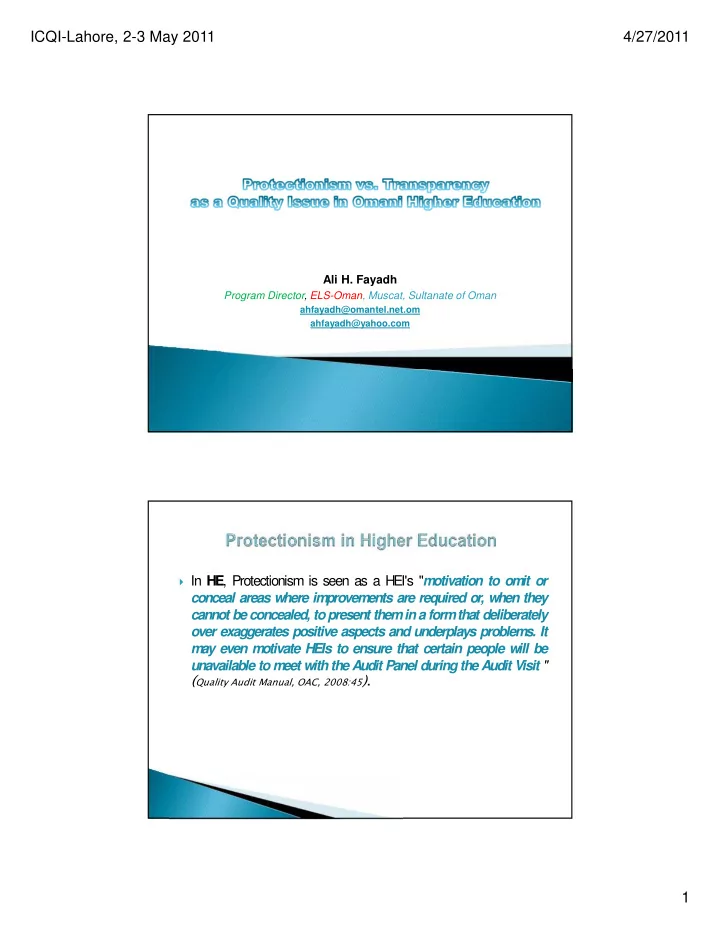
ahfayadh@omantel.net.om ahfayadh@yahoo.com In HE, Protectionism is seen as a HEI's "m

  • tivation to om

it or conceal areas where im provem ents are required or, when they cannot be concealed, topresent themina formthat deliberately

  • ver exaggerates positive aspects and underplays problem
  • s. It

m ay even m

  • tivate HEIs to ensure that certain people will be

unavailable to m eet with the Audit Panel during the Audit Visit "

slide-2
SLIDE 2

ICQI-Lahore, 2-3 May 2011 4/27/2011 2

In order to explore the situation in the HE sector, this work attem pts to answer the following questions:

W hat m easures do quality m

  • nitoring organizations take to ensure

transparencyinOm ani HigherEducation? Arethesem easuresadequateornot? W hat arethetypesof protectionaryactsexercisedbysom eHEIs? Howtoavoidprotectionism ?

(1) Route & Intensity

Protectionary acts are undertaken to protect the HEI against

(an)otherstakeholder(s); stakeholdersareof different ranks:

  • Governing (regulatory authorities),
  • Governed (students, parents, and other beneficiaries),
  • Equal (other HEIs and com

petitors).

Figure (1) shows the course and intensity of Protectionism

slide-3
SLIDE 3

ICQI-Lahore, 2-3 May 2011 4/27/2011 3

Regualting Authorities (MoHE, OAC, etc.) Regualting Authorities (MoHE, OAC, etc.) HEI Possible Competitors Possible Competitors Other HEIs Other HEIs Students & Parents Students & Parents

Protectionism

can occur in these form s: Legal protectionism where a HEI can follow its own laws, i.e., it can drawitsownprotectionarym echanism , supportedbyall stakeholders (including the regulatory authority). This type m ay am

  • unt to

transparency . Rationalized protectionism is

  • bserved when a num

ber

  • f

stakeholders, not all, legislate (and m ake public) certain acts to protect their own entity . Such acts usually raise criticism and/or refusal by other stakeholders. These acts are of relative transparency . Protectionismper se occurswhenaHEI concealsfactsfromsom eor all stakeholders.Thisisatotallyrejectednon-transparent action.

slide-4
SLIDE 4

ICQI-Lahore, 2-3 May 2011 4/27/2011 4

1.

Flexibility of Current Policies

2.

Safe Investm ent

3.

Foreign Affiliation Leniency

4.

Insubstantial Statem ent of Intent

  • Unfulfilled prom

ises

They are noticed when the HEI makes hollow prom

ises accompanied with propaganda coverage, e.g., newcam puses, m

  • refacilities, enrolm

ent concessions, etc.

  • Unsolicitedactions

These are claim

ed to be done to satisfy higher m

  • nitoring authorities, e.g., requirem

ents of perform ance indicators (staff numbers, Om anization rates, new posts, etc.), benchm arking, etc.

  • Latent incom

petence

This is practiced in the absence of efficient staff and/or effective adm

inistrative m echanism s andacadem ic policies, e.g., practicingplagiarism , unreal statistics, etc.

  • V
  • racity

This is exercised when the HEI m

inim izes its statem ent of intent to generate m

  • re profits,

e.g., indulgence in non-academ ic investm ents, creating false settings, m ism anagement of (financial) resources, etc.

slide-5
SLIDE 5

ICQI-Lahore, 2-3 May 2011 4/27/2011 5

During Norm

al Tim es Self-Prom

  • tion or Bragging

Propaganda Com m unity Service Exploitation Im proper Labels Ineffective Practices

Post-Norm

al Tim es (during Quality Checks) Before During Portfolio W riting Before Panel Visit During Panel Visit After Panel Visit Before Panel Report In Reply to Panel Report After Panel Report

slide-6
SLIDE 6

ICQI-Lahore, 2-3 May 2011 4/27/2011 6

Question Answer Action to A void Protectionism W hat is Protectionism ? Protectionismisan undesirableact aim ed to conceal facts from the HEI’s stakeholders, by providing false/distorted inform ation about the institution in order to distance itself from possibleharm ful m

  • easures. In other words,

it is an unethical, unlawful action.

  • 1. T
  • accom

plish transparency , a HEI m ust:

  • a. Identify itself clearly by

drawing a sound statem ent of intent (vision, m ission, goals and objectives) and applies them via realistic strategic planning.

  • b. Maintain a delicate Resource

m anagem ent process.

  • c. Com

m unicate honestly with its stakeholders.

  • d. Act as a non-profit
  • rganization.
  • 2. T
  • servethe interests of ALL

stakeholders, and respect the requirem ents of the regulatory authorities through a legal (and even legalized) protectionary fram ework.

W hopractices it? It is intentionally practiced by the HEI’s owners and senior m anagers who know the real irregularities

  • f

the

  • rganization,

and inadvertently by

  • ther

stakeholders who are unaware they are protecting anoffensive practice.

  • 1. T
  • set clear roles and responsibilities
  • f each stakeholder, and sustain them

ineveryday transactions.

  • 2. T
  • ensure that the people responsible

for governance (BoDs & BoT s) and adm inistration (Chancellors, Deans, HoDs, etc.) act independently in term s

  • f their roles and responsibilities and

in line with the HEI’s statem ent of intent.

  • 3. T
  • avoid

all acts

  • f

coercing, threatening, etc. practiced to m isinform regulatory bodies or their representatives.

  • 4. T
  • enroll

professional cadre and sustain honest com m unity , adopt rigid criteria of selection, procedures of

  • rientation,

and appeal/com plaint m echanism to be checked by regulatoryauthoritiesperiodically .

slide-7
SLIDE 7

ICQI-Lahore, 2-3 May 2011 4/27/2011 7

Howis it practiced?

  • 1. Unfulfilled prom

ises

  • 2. Unsolicited actions
  • 3. Latent incom

petence

  • 4. Indifference
  • 5. V
  • racity
  • 1. T
  • act rationally in line with a

HEI’s own realistic statem ent of intent.

  • 2. T
  • satisfy international

perform ance indicators and cooperate with other peer HEIs.

  • 3. T
  • provide learners with reputed

hum an resources and reliable facilities.

  • 4. T
  • avoid all ungrounded

allegations.

W henis it m

  • st

practiced? Protectionism is adhered to in:

  • 1. Self-reports to a

regulatory authority (during quality checks)

  • 2. Reports to a

governing body (in annual reports)

  • 3. Peaks of student

enrolm ent (before regular study com m encem ent)

  • 1. T
  • provide self-inform

ative m anuals and guidelines concerning all types of reports required.

  • 2. T
  • organize explanatory workshops,

m eetings and gatherings to sim plify the tasks and exchange experience.

  • 3. T
  • produce evaluative reports relying
  • n accurate data, and relevant

perform ance indicators and benchm arking tools.

  • 4. T
  • endorsean obviousreward policy

, reflecting dedication on the part of the governing and regulatory stakeholders.

  • 5. T
  • facilitate cooperation, not

com petition, between HEIs. This is the role of the regulatory authorities who m ust m anage annual fairs, control program m elicensing policy , and assure existence of m anuals.

slide-8
SLIDE 8

ICQI-Lahore, 2-3 May 2011 4/27/2011 8

AHEI is quality-wise if it acts transparently

, andit isnot if it resorts to protectionism ;inother words, If T ransparency=qualitylabel and Protectionism≠ qualitylabel then, T ransparency≠ Protectionism

Aprotectionary act m

ay be accepted if it aim s to save the interests of ALL stakeholders, not som e of them only , particularly , investors and/or senior m anagers. Irrespective of the counter argum ents, protectionism m ay be hailed by a HEI’s society when it defends its interests, provided that the HEI itself acts within the fram ework of the effective regulations as well, that is, the regulations legislated by the country’s regulating authorities, the MoHE and OAC in the Sultanate

  • f Om

an.