SLIDE 1
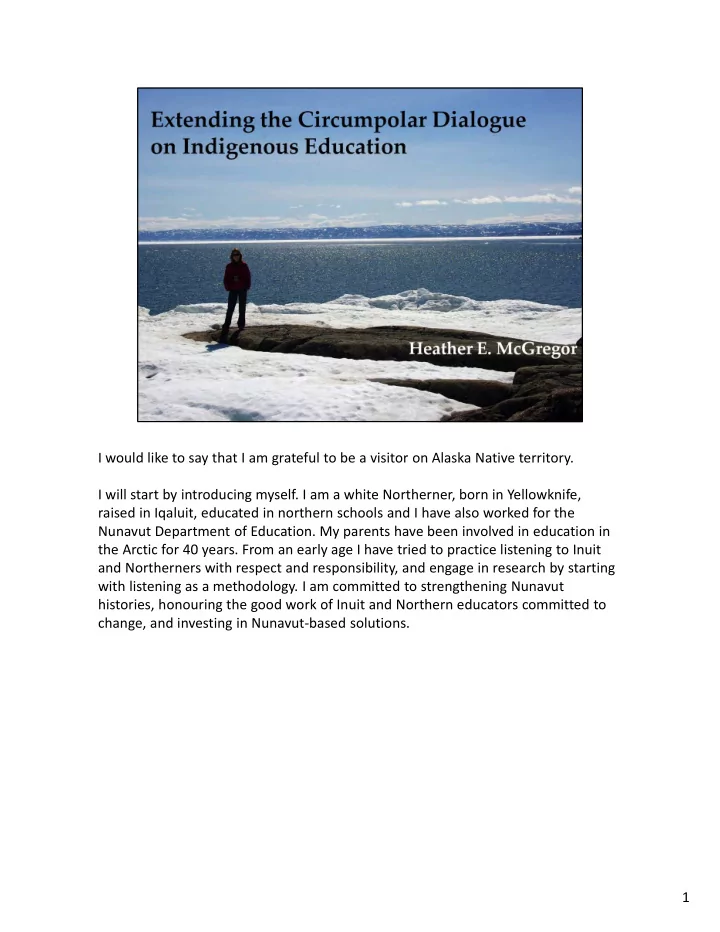
I would like to say that I am grateful to be a visitor on Alaska Native territory. I will start by introducing myself. I am a white Northerner, born in Yellowknife, raised in Iqaluit, educated in northern schools and I have also worked for the Nunavut Department of Education. My parents have been involved in education in the Arctic for 40 years. From an early age I have tried to practice listening to Inuit and Northerners with respect and responsibility, and engage in research by starting with listening as a methodology. I am committed to strengthening Nunavut histories, honouring the good work of Inuit and Northern educators committed to change, and investing in Nunavut-based solutions. 1
SLIDE 2
Today I will be presenting work that began with a paper focused on the Canadian context, which I have started expanding towards a circumpolar view. I should preface this work with the comment that have a great deal more to learn about Alaska, which is why I am here to get to know this place better. When I arrived at the University of British Columbia in 2011 to do my doctoral studies, a place that is known across the world for their Indigenous education graduate programs, I heard very little about circumpolar Indigenous peoples. Now, we did read Oscar Kawagley and Ray Barnhardt in Dr. Marker’s class, but this reading and the importance Dr. Marker attributed to Oscar and Ray’s work, only heightened my concern that others weren’t aware of the distinct and important Arctic context and peoples. In Canada, Inuit distinctions are not always taken into account in generalizations about Indigenous experience, and the movement towards educational self- determination in Nunavut is largely being left out of the literature and conversation. I wondered: In the interest of greater understanding about decolonizing schools, can the same reference points about the past, present and future be used for Inuit education as are used in the literature on Indigenous education? What common strengths and challenges can be identified, and further explored? What distinctions must be noted? I am now attempting to think about these questions in a 2
SLIDE 3
circumpolar context. 2
SLIDE 4
The population of Nunavut is 33,000 people. Those people are spread out over 25 fly-in communities in a territory that takes up 1/5th of Canada’s landmass. This remoteness would be familiar to many Alaskans. Unlike Alaska, where the population majority is non-Indigenous, 85% of the people in Nunavut are Inuit and 59% of Inuit are under the age of 24. In common with Alaska, there were no early treaties or reservations created in the Canadian Arctic. Nunavut was recognized as a separate territory within Canada in 1999. This happened after the largest land claim in Canada’s history was signed in the eastern Arctic in 1993. Despite sophisticated technology, modern infrastructure, or government jobs, geography and ecology continues to pervade life in the Arctic through a complex matrix of challenges and opportunities. The ways in which environmental factors have shaped, and continue to actively shape culture, history, education and politics in the Arctic cannot be overstated and do distinguish the Arctic from other places. The history of Nunavut has been characterized by relatively recent colonization and settlement; early policy moves to endorse the primacy of Inuit language and culture in all public schools; and, Inuit cultural and linguistic vitality. Nunavut is the only jurisdiction within North America with a public government privileging Indigenous (specifically Inuit) culture and language. Since 2009 the schools have been run under an Education Act that requires all curriculum, programs and administration to 3
SLIDE 5
be based on foundations of Inuit knowledge. These environmental and historical factors have created the unusual circumstances under which Nunavut is now pursuing educational change; indeed, these factors have provided opportunities in asserting self-determination in education. 3
SLIDE 6
This is not an exhaustive list, but rather some of the more important moments in circumpolar collaboration on issues of education. Frank Darnell and William Demmert led the charge in the early days, and various other initiatives have kept communication open between Alaska, Nunavut and Greenland. My own parents participated in this exchange when they came from Nunavut as graduate students to study at the University of Alaska Fairbanks with Jerry Lipka and Ray Barnhardt in the year 2000. Oscar Kawagley visited Nunavut, and Elders who work as advisors for the Department of Education have been to visit Alaska as well. In 2012 we have seen increased communication through the Inuit Studies Conference in October in Washington DC and the conference held in Iqaluit in November. 4
SLIDE 7 There are challenges through which Inuit and other Indigenous peoples across Canada and the Circumpolar world can find common ground, while balancing particularities of place. Keeping Inuit in the forefront of my analysis, as well as reviewing literature on Indigenous education, I have identified four shared
- struggles. By highlighting these themes, which are already evident in the literature, I
am trying to reflect and support the great deal of good work going on. Perhaps educational change-makers may consider greater emphasis on some of these undertakings, or look for ways to share experiences in these common efforts. Perhaps this may open up a more complex and comparative discussion. The first theme. Walking in two worlds - Reconciling the Demands of Contemporary Life with Cultural Roots in Traditional Life For schools that have an Indigenous population and take on a commitment to reflect culture in learning, this challenge does not just mean presenting two sides to the history of settlement of North America. It means asking Elders for their knowledge or advice and then seeking ways to translate that to fit contemporary school contexts and curriculum, or adapting those contexts and curriculum. It means making choices about how much time is spent in the computer lab versus on a land trip. Preparing students for community life, using their language and local practices, and preparing students for post-secondary education or employability
- utside their communities. It means the flexibility to discuss human rights and
5
SLIDE 8
multiculturalism in the same course as cultural notions of responsibility and Indigenous sovereignty. It means encouraging students to be critical of the world around them in ways that may not have been part of their cultural practice, and yet respectful of that which is sacred in their culture and other cultures. It means helping people understand that “traditional” need not be synonymous with old or unchanging, and that choosing to sustain tradition may not be simply conservative, but also activist. 5
SLIDE 9 The second share struggle: Training and Retaining Sufficient Human Resources with the Right Skills and Capacity Supporting enough Inuit educators, administrators and support staff, as well as long-term Northerners who have important experience on which to draw, is becoming a significant barrier to implementation of Indigenous education. In Nunavut, the urgency around implementation of the bilingual education system from Kindergarten to grade 12 has put immense pressure on existing Inuit teachers with language skills and is deterring new teachers. They know they may be expected to teach at levels or in courses where system resources, adequate training and program supports are not yet ready. Nunavut is working on several important professional development initiatives, but even with more funding it would be challenging to move any faster because for such programs to be effective they need experienced people - facilitators who have in-depth knowledge of northern
- education. Ambitious goals for Indigenous education, especially ones that
necessitate specific areas of expertise (such as language) must be preceded and accompanied by ambitious goals for Indigenous staff development, and significant
- rientation or support for existing staff in the meantime.
6
SLIDE 10
The third theme I am advancing is Continuing to Actively Facilitate and Participate in Decolonization It is clear that contemporary Indigenous schools cannot be successful without engaging with the colonial past and its ongoing impacts. I see history, and particularly acknowledging the history of education, as an important aspect of, and avenue towards, decolonizing. Whatever a community’s history is, consciousness of the local past must be part of shaping the way forward on a community-by- community, school-by-school, family-by-family basis. In some communities, conversations about the past may involve residential/boarding school experiences and reasons why parents continue to feel unwelcome or disengaged from the school environment. Whereas in others it may involve positive memories of supportive teachers in early day schools and appreciation of more recent community engagement by school administrators. Decolonizing necessitates activation of teaching and learning approaches that both acknowledge and deconstruct structures of power associated with colonization in an effort to create space for, and give legitimacy to, Indigenous ways of knowing, being and doing. This is another reason to start with the past, and tie it to the present and future. The process of decolonizing schools is not achieved solely through the integration of Indigenous content, but through understanding the history of power relationships within schools that have made them both vehicles for assimilation as well as for self-determination. 7
SLIDE 11 The fourth theme Radical Implementation and Radical Pedagogy to Better Serve the Interests of Students and Community Following Verna Kirkness, education requires radical disruption. This point not only applies to ideological challenges in the classroom, but to the beliefs and structures taken for granted in the ways schools operate, and by extension, the possibilities for radical reconstruction. Changes could be seen to the daily schedule and annual calendar, the assignment of students into grades, the course options available to students, the nature of relationships between administration and teachers / teachers and students, assessment frameworks, use of funds for local or cultural programs, even the extent to which education should take place inside the school. Now it is time to flex any available leverage for change to enact place-based education and better meet the strengths and needs of the students and
- communities. The risks and potential sacrifices associated with implementing
change are well worth accommodating if the alternative is continued disengagement from schooling by Indigenous youth – and the associated social issues seen to impact Indigenous families as a result. How do these shared struggles play out when we apply them to concrete educational programs? How can they be seen in some real examples? As I describe two recent made-in-Nunavut social studies modules for the grade 10 level, I hope you will see how these two examples begin to reflect the four themes I just 8
SLIDE 12
identified. 8
SLIDE 13
In Nunavut we have a grade 10 social studies module that examines the history of four Inuit land claims processes across Canada, called Staking the Claim: Dreams, Democracy & Canadian Inuit (2009). The program is based on a film of the same title that documents four Inuit youth interviewing negotiators and leaders involved in the claims, seeking histories and experiences, and making connections between what they learn and their own lives. The film footage is combined with archival photos and other material, available in English and Inuktitut, it is intended to be used throughout the module to support student learning activities. A range of issues, historical events, and collective and individual perspectives are examined, beginning with traditional Inuit lifeways, delving deeply into the difficult experiences of settlement and colonization, and tracing the pathways towards political mobilization, land claims and self-determination. Students are encouraged to engage with family and community members to learn about their experiences and memories from the time of the land claims process. The module clearly demonstrates the initiative, perseverance and leadership of two generations of Inuit – the older generation who struggled to bring about the Inuit land claims, and the younger generation who care about investigating and documenting their people’s history for the future. 9
SLIDE 14 This project is one I have been more deeply involved in. This year the Departments
- f Education in Nunavut and the Northwest Territories issued a module focused on
telling the northern story of, and context for, residential schools, where many Indigenous students were attending long after residential schools were closed in
- ther parts of Canada. In addition to a comprehensive Teacher’s Guide, each school
received a box full of literature on the history of residential schools, as well as parent materials, a large timeline banner and DVD of media and resources. A significant accomplishment of this project is that a majority of the materials are available in Inuktitut as well as English. The northern territories in Canada have the highest per capita number of residential school survivors, so including this topic in high school history education is more than a gesture towards a difficult chapter in Canada’s history. Focusing on northern stories about the educational past, and connecting them with the Canadian history of colonization and contemporary movement towards reconciliation and decolonization, is intended to help students better understand their families, communities and country. 10
SLIDE 15 How these reflect the four shared struggles, I identified earlier? Among many other points I could make, Both of these grade 10 history modules were developed in the Arctic, by Arctic peoples, for Arctic peoples
- They incorporate a range of Indigenous and critical pedagogies, nurturing
contemporary social studies skills as well as place based perspectives on the past, present and future
- They both provide a fully laid out program for the teacher with all the learning
activities and resources provided, so that they aren’t making it up as they go
- They include guidelines and recommendations regarding how to go about
instruction that reflects northern realities of schools and the content being learned
- To address the need to familiarize teachers with history they may not have
learned themselves, each module was introduced to teachers who will teach these units with an in-depth in-service, there was also in-service offered to all
- ther teaching staff on the importance of the topics for all educators
11
SLIDE 16 Nunavut schools and communities continue to grapple with overwhelming social issues, disengagement by Inuit youth, and an education system that lacks human resource stability, all of which undermine the potential benefits of educational self-
- determination. Indigenous student and family disengagement suggests that the
structures of schooling are still not addressing their strengths and needs effectively. However, it is worth recognizing that schooling in Nunavut is being built on Inuit foundations, and that educational self-determination is being pursued in other circumpolar jurisdictions as well. This moment in history, this place on the path, will become another point against which to measure further decolonization and further educational change. Greater recognition and celebration of the Arctic journey completed thus far could be combined in future with greater dialogue and solidarity between Inuit and other Indigenous peoples – especially other circumpolar
- peoples. Inuit and Northerners in Nunavut can benefit from continuing to be
included in the literature on Indigenous educational change, and other Indigenous peoples may benefit from greater exposure to the stories of Nunavut. 12