I : The Root System of En . A Very I 't Brief - Moody Algebras - - PDF document

i
SMART_READER_LITE
LIVE PREVIEW

I : The Root System of En . A Very I 't Brief - Moody Algebras - - PDF document

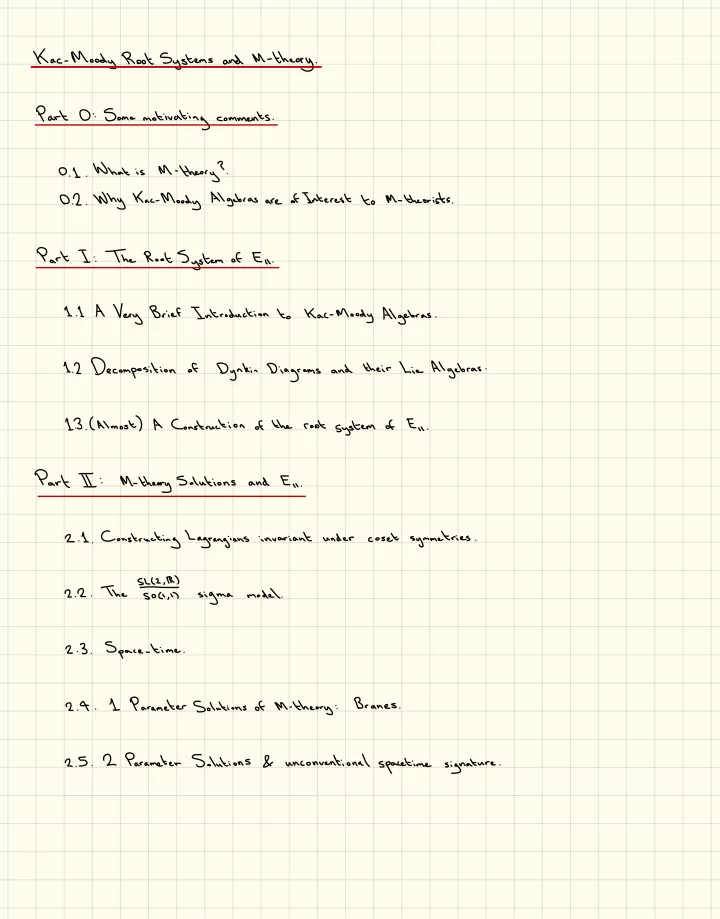
- theory Kac - Moody Root M Systems and . Part O : Some comments motivating . - theory ? What M 0.1 is . Kac - Moody of Interest . theorists 0.2 . Why Algebras to M are . Part I : The Root System of En . A Very I 't


slide-1
SLIDE 1 Kac
  • Moody
Root Systems and M
  • theory
. Part O : Some motivating comments . 0.1 . What is M
  • theory?
0.2 . Why Kac
  • Moody
Algebras are
  • f
Interest to M . theorists . Part I: The Root System of En . I 't A Very Brief Introduction to Kac
  • Moody Algebras
. 1.2 Decomposition
  • f
Dynkin Diagrams and their Lie Algebras . 1.3 . ( Almost ) A Construction
  • f the
root system
  • f
En . Part I : M . theory Solutions and En . 2.1 . Constructing Lagrangian invariant under coset symmetries . 2.2 . The 5413¥ i ) sigma model . 2.3 . Space
  • time
. 2.4 . 1 Parameter Solutions
  • f
M
  • theory

:

Branes . 2.5 . 2 Parameter Solutions & unconventional spacetime signature .
slide-2
SLIDE 2 Some motivating comments . What is M
  • theory?
String theories in 10 D are unified by U
  • duality
. IA LIB M
  • theory
I in IID .

Egxt

w

32 ) . eterotic theories . [ Witten ' 95 ] . The low energy description
  • f
M . theory is the maximal supergravity theory in 1113 , whose boson :c part is : 1=13*1
  • HE ,n*E ,
the ,nF¢nA , . where F+=4dA . . E .H . term . KE . for Self
  • interaction
a 3
  • Form
gauge Field

,

A } , term . ' ' Chern . Simons term ? Comment it describes the degrees
  • f
freedom
  • f
an elf
  • bein
, en " , and a 3- Form gauge field An ,µµ ] . Comparison with Maxwell 's electromagnetic field An which sources a point charge will lead you to Surmise correctly that An ,µµ , sources a membrane ( the MZ
  • brane )
, 2 . its equations
  • f
motion are R~
  • tzgwr
  • kzt , Fun ,µµFu"
Mti ' + 'ziIgnvFnµµµF" MHM =D fm+µsM6M > FNSMAMOM " =D , 2 " Fun ,µµ3 + { Emvrztynx . . M "
slide-3
SLIDE 3 3 . It has simple solutions : the pp
  • wave
, the MZ
  • brane
, the MS
  • brane
and the KKG
  • brane
. 4 . M
  • theory
must agree with Su Gra at low energies but must also include all the string excitations in the Iod string theories . Which Kac . Moody algebras are relevant to M
  • theory?
The two pioneering arguments : 1. Dimensional Reduction . ( See the lectures
  • n
Kaluza
  • Klein
theory by Chris Pope) The rough idea : make
  • ne
  • f
the spatial dimensions compact , typically St , and let the cycle shrink to small volume . Excitations
  • f
the circle ( For example ) are standing waves satisfying nX=2TR where R is the radius
  • f
the circle , X the wavelength
  • f the
wave and NEZ . Such waves have energy E=Ku=hT#=X¥r hence R
  • =
> E
  • if
into . So small radii imply very high
  • energy
excitations ( too high to have been reached in
  • ur
colliders ) . Hence
  • ne
may neglect the impact
  • f
the small compact coordinate in the low energy theory . In practise the effect
  • n
the Field content
  • f
the theory is to neglect the compact index e.g. consider the metric being reduced in
  • ne
  • dimension
( call it xs ) from SD to 4D : gnv
  • gmn
, gms ± Am and gss =D . From a theory
  • f
gravity in SD emerges a theory
  • f
gravity , a vector ( electromagnetism) and a scalar . This
slide-4
SLIDE 4 was the
  • riginal
  • bservation
  • f
Kaluza in ' 21 and Klein in ' 26 made to propose a SD unification
  • f
gravity and electromagnetism . The scalar was an unwanted extra , but it is the scalars appearing in the dimensional reduction
  • f
Sugra that give the first motivation For a Kac
  • Moody
algebra in M
  • theory
. As
  • ne
reduces the HD Sugra the scalars that appear in D= 10 , 9,8 ... have the symmetries in the Lagrangian G-
  • f
a coset K(G)
  • f
greater complexity as the reduction descends to fewer dimensions : Gy D. KCG) . Dynk :n diagram For G .

Rn

1 . ÷ : ( SLCZR ) ×Rµ iii 9 . So (2) 543 ,R)×SL( 2,42) 8 . %( 31×5012 )
  • _O
SLCS ,Rµ
  • 7
. Soto ) . b-
  • _O
.
  • 6
. 5°€%( sjxsocs ) . 0-150-0 .
  • s
. ⇐%p(8) . taboo . E >
  • 4
. TUC8) .
  • _O
  • 0-10-0-0
.

Esisoab

) .
  • _O
  • 0-0-150-0
. The early
  • bservation
  • f
Julia was that these hidden symmetries
  • ught
to continue and he argued For Ea and E , . in D= 2 and D= 1 . [ Julia ' 78 , ' 80 , ' 85 ) The extension would be that Eu should appear in D= . Peter West argued that En was a symmetry
  • f
an extension
  • f
Sugra in 2001 , N
  • B
. Eu should be a symmetry
  • f
M
  • theory
in IID . Ea , E , . and E , , are all Kac
  • Moody
algebras .
slide-5
SLIDE 5 2 . Cosmological Billiards . At the start
  • f the
millenium a different line
  • f
investigation led Damour , Henneaux and Nicolai tosee the Fingerprints
  • f
E ,o within HD Sugra . They were considering the physics in the vicinity
  • f
a cosmological singularity where they allowed the Sugra fields to depend
  • n
  • nly
time , t . The greatly simplified equations
  • f
motion had a Solution which was identical to hull
  • geodesic
motion
  • f
a coset
  • f
E , . : E "€(E , ,) . ¥HE 'D _
  • y
Spacetime solution gn✓( t ) , An ,mµ(t)

to

¥ near a cosmological singularity . =⇒ x Later Englert and Houart extended this picture to restore space and time to an equal Footing and their construction was called the brome 6
  • model
and the asset symmetry was enlarged to ⇐¥Ed . This is the setting we will work in For this talk and
  • ur
aims are two
  • Fold
( time . permitting) : 1. To construct the root system
  • f
E , , . 2. To use the brane 6- model to build Solutions
  • f
M
  • theory
.
slide-6
SLIDE 6
slide-7
SLIDE 7 So , if we know the algebra we can construct all the roots and likewise if we know all the roots we can construct the algebra . It is Frequently simpler to work with the root system : . Root vectors add while in the algebra
  • ne
must commute matrices : Suppose that [ Ea , ,E&z] = Ed } in some algebra then [ Hi ,

Ea

, ]=[ Hi ,[ Ex , ,Ea )] =
  • [ E.
, ,[

En

. ,H ;D
  • [

Eg

.CH ,

;D

] ( by the Jacobi identity) . =< xi ,x , >[Ea

,Ea

, ]+< xi ,x , >[

Ea

,

,t]

= < 2 ; ,Litdz >Ex , . = > 2 , =L , tdz .
  • For
Kac
  • Moody
algebras the Matrix representations will ( without a great inspiration ) be
  • f
infinite rank , while the roots will ( for a finite Dynkin diagram) reside in a finite
  • dimensional
vector space . Before completing the root system For SLC 3 , R ) let us introduce the defining relations For a Kac
  • Moody
algebra where the simple roots all have ( xi )2=2 :
slide-8
SLIDE 8 A Very Brief Introduction to Kac
  • Moody Algebras
. Given an appropriate Cartan matrix A ;, a Kac
  • Moody
algebra is Formed
  • f
(

Cheaney

) generators Ei , F ; and H ; such that ¥ i ,'s [ Hi , H ;] = , [ Hi , E ;

]=<

xi ,& ;>Ej , [ Hi , -5 . ]=
  • <
xi ,x ; > Fj , [ Ei , F ; ]=8ijH , and the Serve relations : [ Ei ,[Ei , . :[ Ei , E ;] ... ) ]=o [ Fi ,[ Fi , , . .a÷ , F , ] ... ]]=o ,} where there are A- Ai ; ) commuters . Comments . 1 . If det ( A ;j) > the above relations define a finite Lie algebra , if det ( Aij )fO then the algebra is a Kac . Moody algebra . 2 . The Serre relations guarantee that the adjoint representation is irreducible . The Serve relations are worth exploring in detail as they will give a simple route to construct the root system
  • f
a Kac
  • Moody
algebra .
slide-9
SLIDE 9 The Serre Relations and Root Systems . Recalling that we have limited
  • ur
focus to root systems where simple roots all have the same length
  • Squared ( normalised
to 2) [ Such algebras are called simply
  • laced ]
.

There

are three distinct entries in the Cartan matrix : Aij I
  • Aij
. Serre Relation . Ci=j ) . 2 .
  • 1
. [ E ; ,E ;] =D . . I . [ E ; , Ej ]=o .
  • 1
. 2 . [ Ei ,[ Ei ,E ;] ]=0 . = > [ E ; ,E ; ]=Ei+j Starting from the simple roots 2 ; the Serre relations tell us that ditxj is a root if 4 Xi , dj >=
  • 1
. In this case we
  • bserve
that ( Ci txj ) ' = ( xi )
  • +2C
xi , Lj > + ( xj )
  • =
2
  • 2
+2 = 2 . Consider now adding a third simple root to
  • btain
2 ; + Ljt Lk . This is a root if the commentator [ tie ,[ Ei ,E ;]] = Ei+j+k is not trivial . By the Jacobi identity we have : [ En , C Ei ,E;] ]=
  • [ Ei ,[ E ; ,En] ]
  • [ E ; ,[ En
, 't ;] ] The right
  • hand
. side is non . trivial if < 2 ; ,Ln > =
  • 1
  • r
( Ln , Li > =
  • 1
  • r
even both are true .
slide-10
SLIDE 10 This means that if xitdjtdk is a root then ( xitdjtxn )
  • =
( ai )2+(Lj)2+(xh ) ' +2<2,2 ; > +2<2 ; , 2h > +2<2 ,,Ln > = { 2 if
  • nly
  • ne
  • f
< dink >
  • r
< 2js&k> equals
  • 1
. O if < a ; ,Ln)=
  • 1
=< dj ,Lk>=
  • 1
. This line
  • f
argument can be generalised to non
  • simple
roots so that we can say that the roots
  • f
any simply
  • laced
Dynkin diagram satisfy 132=2 , ,
  • 2
,
  • 4
,
  • 6
. . . This is almost , but not quite , a sufficient algebraic condition to find all roots
  • f
Eu . Let us return to SL( 3,113) and complete the construction
  • f
its root system . Recall we have that ( a , )k ( 2212=2 and Lx , , dz > =
  • l
and now we wish to Find all p = nd , tmaz where n ,m EZ such that p2= 2,0 ,
  • 2
, . . . So p2= 2n2+2m2
  • 2hm
= 2(n+m)2
  • 6hm
For n=o we have Zm ? f2 = > m=±l . n =\ we have 2+2 m2-2m{ 2 =) m2
  • m
f D = > m=0
  • r
m= I . n= 2 we have 8t2m2
  • 8m
f 2 . m ' . fm +6<-0 . fm
  • 25+2<-0
. =) no solutions . We also have that (
  • p )
' 52 .
slide-11
SLIDE 11 Hence the root system
  • f
SLC 3,113) is

Lzn

2

,ts

  • x. :
  • X
,
  • a
z
  • Xz
. At this point we may realise that we might have employed the Weyl reflections ( reflections in the planes perpendicular to the roots) starting from just the simple positive roots to construct the root system . The reason being that reflections preserve inner products and the inner products contain all the information in the root System . For semi simple Lie algebras the root systems are Finite , i.e. there are finite solutions to (B) " f 2 , this is because there are
  • nly
roots
  • f
positive length . Squared . For affine Kac
  • Moody
algebras there exists a root
  • f
length
  • squared
zero ( a null root ) whose inner product with the simple positive roots Xi is zero i.e. < 8 , S > =
  • and
< xi > to . So that
  • ne
can construct an infinite set
  • f
roots
  • f
the Form 2 ; tns n EZ as ( a ;+n8 ) ' = ( xi )2+2n< 5 ,xi>+n2 ( 557=2 . For general Kao . Moody algebras there are roots
  • f
negative length
  • squared
too ( imaginary roots ) and the root systems are also infinite , and of faster growth than the affine case .
slide-12
SLIDE 12 In passing through the example
  • f
543,112 ) it is useful to highlight that a canonical matrix representation
  • f
the generators exists which has a simple extension to AH SLCN ,lR) : + , ,=HI :) E .=K! :o)
  • =k'
z el :B :7=k : +, .=k÷ ) e .=kIIt=k ; r=EF:Hk : E ,=( Is :B Hk 's Fs=( III ) -=k3 , . For SLCN , R ) algebras the matrices Kij , which are N×N matrices with a 1 at row i , column j , but is
  • therwise
Filled with zeroes , give a representation
  • f
the ±z ( N
  • l )
positive generators and their transposes represent the negative generators . Let us now graduate to the main example of this talk : En .
slide-13
SLIDE 13 The Roots
  • f
En . ' ' O Dynkin diagram : 0-0-0-0.0=0-0/-0-0 \ 2 3 4 5 67 8 9 10 The problem : Find all coefficients m : EZ such that For p=÷}m ; X ; , 132
  • <
2 . We will solve the problem in a way that allows us to grade the roots and collect them into highest weight representations
  • f
the SLCH , IR) sub . algebra formed From nodes 1 to 10 above . To do this we note that it is straightforward to split P into a root in SLCH , IR ) and a multiple
  • f
x , , : is p= Emi di + m , , x. , = €?mi&i tm " ( 8- Xs) = m , , 8
  • m
, ,Xgt¥°mix; =m , ,8
  • A
p i=i Where 2 , ,= 8- Xg where A ; are Fundamental weights
  • f
SLCIYIR ) satisfying ( Xi ,&j > = § ; and 8 is
  • rthogonal
to the roots
  • f
SKY ,R ) . Hence , , Lg > = <
  • Xg
, Lg > =
  • I
as required . A p is a weight
  • f
SLCY ,R) associated to p labelled by the unique highest weight . The root an = 8- Xg is associated with the highest weight
  • f
the SLC " ,R ) tensor representation with three antisymmetric indices , i.e. Eg , = R " " " . The addition
  • f
5411,113 ) roots lowers the index labels , e.g. Ex "+×s= R 's " " ( recall that East Ksq and ftp.Ragy?+YY Fortunately it is not necessary to already have an intimate knowledge
  • f
the algebra to identify the 5411,112 ) tensor irreps that appear in the decomposition
  • f
E , , into highest weights
  • f
SLC " ,lR ) and
slide-14
SLIDE 14 a level m , , . Instead by making a choice
  • f
basis For 2 ; we can have a quick way to read
  • ff
the highest weight
  • f
SLC " ,1R) . We choose :
  • 2. ,
= e ;
  • e
;+ , For it \ to lo ( compare with Kiiti the corresponding generator
  • f
SLC 4/113 ) ) an = eate , .ie " ( compare with Ee ,,=R" ' ° " ) . then we have P =÷€miLi = .€ , wiei where for roots corresponding to the highest weight
  • f
A- p wi are the widths
  • f
the SLC 11,112) Young tableau , the sign
  • f
the e ; coefficient indicates where the corresponding index is covariant (
  • ✓e )
  • r
cantravariant ( t.ve ) , e.g. given a simple root 2 , = e ,
  • ez
we may read
  • f
the tensor Klz
  • r
2 , ,= eqtqotei , we read
  • ff
R " ' . " . and if 13 is a highest weight under the 5411,112) action then PIE÷iei the Young tableau widths is W. . pa. ... ai , lb , . . . b , ,1c , . :c , , 1 d , . . . d ,o| e , . . . eql . . . 1 iilzlj ; w .a . : . W , We are able to pick such an embedding into R " so long as we can define an inner product
  • n
IR " such that inner products
  • f
En 's simple roots are reproduced .
slide-15
SLIDE 15 This is achieved by ' < p , ,p . > =I}wYwi "
  • k }÷÷"
Iziws ? where p , I }÷wi' lei and Pz±E÷!Yei . The
  • '
' a comes from ( x ,,Y=2 . Note that I}W ; = the number
  • f
boxes
  • n
the corresponding Young tableau = #p . Furthermore at level [ I m , , each generator is formed from L commentators
  • f
R " '^M3 so #p= 3L , hen

:

p. , is . > =÷}wYwi2 '
  • L
" 'd ? and importantly For
  • ur
construction
  • f
the root Space : p2= www.t
  • L
' where L is the level
  • f
p . To restate
  • ur
problem in the context
  • f
Young tableaux : at level L we aim to find Young tableaux Formed of 3L boxes satisfying 13252 . We will need a helpful trick : moving a box
  • n
a Young tableau
  • ne
column to the left reduces PZ by 2 . I # i 2 W ;
  • Wi
  • I
# j Wj
  • wjtl
such that Wi = wjt 2 . : . Bi = ( w , )2+ . . . ( wi
  • I)2+
. . .+(w ;ti)2+ . . . Hw , ,)2
  • L2
= ÷}CwD2
  • L
2
  • 2W
; + Zwj +2 = p?
  • 2
.
slide-16
SLIDE 16 Let us construct the roots
  • f
Eu at each level L as Young Tableau : Level 2 ; , i=i , . . no Kij \ 3 RniM2M3 , 2 ps [ Length
  • squared
. 3 × 3 = +0 s " +0 . . . +0 33 2 . 6 X ruled
  • ut by
root length ( Serre relations) . 8 . 4 2 136 3 . 6 × 3 = +0 g " to > 2 +0 . . . q 4 2
  • 138,1
We can complete the prescription for Finding all the roots by noting that S = est . . . ten ( p3+n8)2= 2 , ( paths )2=2 and Cps , ,tn8T= 2 . This gives a real root at any level
  • f
length . squared 2 as 13 }+n8 has level ntl 136 tns has level nt2 paths has level nt3 . From these real roots we may construct all roots at any level by hand , e.g. at level 6 we have : 0?Pep?0 : . 0.03053 0.0¥ .

fi

4 .
slide-17
SLIDE 17 There is a caveat . in
  • ur
replacement
  • f
Serre relations with a condition
  • n
the root length we have discarded properties of the algebra coming from the symmetries
  • f
the Lie bracket . In particular the Jacobi identity which projects
  • ut
some generators has been lost , the first example is 9 as [ R ' " , [12456,127893+[13*6,4238913123]] + [ 13789,[ R '23 , R 's " ] ]=
  • .
p\2 3456789 + p 456789123 + R 789123456 = zp 123456789 = g . i.e. The null root appears as a weight within the R " 'M 'M "M%M8k , when V€{ µ , , . . . ,µg } .
slide-18
SLIDE 18 Part II : M
  • theory
and Eu . Recall the low energy bosonic description
  • f
M
  • theory
is HD bosonic supergrarity : L = 13*1
  • KE
,n*E , + ! E ,nE,nA3 . This is a Lagrangian describing the elf . bein

en

" ( gravity ) and An ,µµ ( gauge theory ) The Hodge dual *F+=G , = dA6t ... where As is a six
  • Form
An ,µzµ3µnsµb . If
  • ne
were to extend this theory so that the dual
  • f
the gravity degrees
  • f
Freedom are also included a a this would require the addition
  • f
a field An , . . .ms ) as

*2n,eµ

, " = &sAµ , , ,1 + . . . a The fields are en > ( gravity) . An 'mµ , *⇐membrane ) Supergravity . An , . . .no ( fivebrane ) a a An , . . .ms1 ( dual gravity) . Eu extension
  • f
Super gravity . These fields are the algebra coefficients
  • f
the level O , 1 , 2 and 3 generators
  • f
En . This ismore than a coincidence
  • f
the tensor index structure : the corresponding roots
  • f
E ii can be used to reconstruct the solutions
  • f
supergrauity precisely .
slide-19
SLIDE 19 The Braine 6
  • model
. En The Lagrangian should be invariant under the coset %( E. ,) where K (En) is a real
  • form
  • f
En : a mathematical
  • bject
which deserves more investigation . K( En ) is the extension
  • f
SOG , lo ) a real
  • form
  • f

S0(

4)

relevant to supergravity and En . How does
  • ne
construct a Lagrangian For scalars taking values in E¥( E , ,) ? The ingredients are :
  • a
coset representative in Borel ( upper triangular gauge) : g. = exp ( 01 . H ) exp ( C
  • E )
where 01=-0/4) , C=C( {)
  • gravity
gauge .
  • the
Maurer
  • Cartan
Form : v
  • =
dg . 5 ' =P + Q where QEKCE ") and PEE , ,\K( E , ,) . The Lagrangian
  • I
' ( PIP ) where ( MIN ) =Tr( MN ) and p is the lapse Function .
  • f
is included to guarantee that the Action Sdq I is invariant under the reparameterisation
  • f
{ . I is invariant under a global transformation go ( i.e. go does not depend
  • n
{) : g- gg .
slide-20
SLIDE 20 as this leaves the Maurer
  • Cartan
form unchanged : v
  • d(
gig . )( g. g.)"=(dg .)g .gs 'g= dg.gs ' =D . The local transformation under K( Eu ) given by : g- kg where k=k( { ) E KCE , ,) transform V as

kg )( kg ) "= dk . k ' ' tkuk " hence P
  • KPK
' ' and Q KQK
  • '
+ dkk ' ' , leaving I unchanged . Abstractly the equations
  • f
motion are : ( P , P ) =D ( From varying z ) . dp
  • [
Q , P ) =o These define a null geodesic
  • n
the coset . We are unable to carry this procedure
  • ut
For [ %( Eii) instead we may use it for assets % (G) where GC Eu . We will Find that : ( i .) brane solutions are given by null geodesics
  • n
" " '

¥÷

( ii .) bound states
  • f
branes are given by null geodesics
  • n
%) where Rank ( G ) > 't . Along the way we will highlight ambiguities in this construction and investigate its meaning For spacetime .
slide-21
SLIDE 21 The * (2 ' *¥( in ) brave a model . g= exp ( Bk ) H )e×p( CHE ) where Hi ( ' of) and E=( : ! ) hence s=CY . :# v = 2g . ej ' where 2= ÷ = 201 . Ht e*2CE . Now as D= Soa , 1) then k=E
  • F
hence v= aol.tl + ' ze2*2C ( E+F ) + 'ze2×2C( E- F) . =p a : . p = ( B tzezxsc
  • tense
.
  • ax
. . ) I = [ ' ( 24×5
  • Ee'(242)
. The equations
  • f
motion for X , C and
  • f respectively
are : 5X+E( zcpe '=o TI ] 2 ( JC .e* ) =D
  • [
I ] ( arg ) '
  • 't ( X )2e*
=o .
  • [#
] As 2(2Ce* ) =D then Jce " = A a constant . Substitution into (# ] gives : ( sp ) ' = t+(Ae*}e4*= HA 't " a¢=±tAe2× . )e*dX=fkAd{ e2* = ± Az +13 : ¢=Eln(±A{ +13 ) .
slide-22
SLIDE 22 Let N = a{ + b then trivially N is a harmonic function in { and D= 's In ( N ) ace '= A =) 2C = Inz = IF = > ( =
  • N
. 't D . Comment : IF you have solved the Su Gra equations this all sounds familiar , in that case a brane solution is characterised by a harmonic function ( no longer a trivial
  • ne )
with field strength given by F= e2*2C . In this simple model are all the necessary parts for a brane solution all that remains is to embed the co set in Eu/k(
  • E. ,)
and identify { with a spacetime parameter . Example : Level 1
  • the
MZ brane . et the embedding
  • f
SLCZ ,R ) CE , , be : E
  • =E*=R
" " ' , F±E.%=Ra,o , , and H=H, , ,=
  • 'z( Kit
. . .tk 's )+}( kaatkii.tk " ") . So g=exp( 01 . Ha , )
  • exp (
C
  • Ra
" " )=exp( klnn . H )e×p( f N
  • '
tD)R " " " ) Let h ; " denote coefficient
  • f
Kii then we read
  • ff
: h , ' =h,2= . . .=hs8=
  • blnn
, ha9=h , .l°=h , "=ElnN . Noting that under gpng ' ' = exp ( habkab ) Pnexpfhcdkid ) where [ In , Kay]=8nB = expfhfn "

Pat

... then expfhtn " = en " the elf
  • bein
, so g~=en^eubzab with x " time . like gives :
slide-23
SLIDE 23 Is ' = N 's (( dx ') '+( de ) 't . . .+(d×8)2 ) + N ' "3((d×a)I( dx 'T . Ax " ) ' ) Supergravity dictionary : Fg a , . , , = i. }c = n }N ' ' Embed in spacetime ( using elf . bein ) curvilinear coordinate with hat ^ { : Fiore = 2in ' ' Make the solution spherically symmetric = > N= bt % ( keep 22N =o ) This is the full MZ brave solution
  • f
Sugra . N
  • B
. this means it solves 66 Einstein equations and 165 gauge field equations , although in practise
  • nly
the same 3 equations we solved are non
  • trivial
and distinct . It describes a membrane from the root #E whose world volume directions are × " , xD and t ' ' . Higher Level Real Roots . he level 2 root µ[¥ gives the spacetime solution
  • f
the fivebrane (using the " " ' " ¥04,1 ) coset & Supergravity dictionary construction ) . Other real roots all correspond to gauge fields
  • f
mixed symmetry . The level 3 root gives a pure gravity solution . . The KKG monopole .
slide-24
SLIDE 24 Problems with mixed symmetry Fields The mixed symmetry fields present immediate ambiguities For the supergravity dictionary . Consider the level ¢ real root , corresponding to the highest weight
  • f
the (9) ? SLCZR ) The gauge
  • field
A ]⇐s6>ga .sn/aio , , is treated as a scalar in the # coset model , but at the point
  • f
embedding the model in space
  • time
the gauge Field is imbued with the Structure
  • f
a mixed symmetry tensor i.e. F{ 34 . . -11191011 I Fio , } Fg = eH}C
  • dq Azcesoisaioiilaioi
' € OR F34 . . . 111 { 91011 . I ¥14 . sea ,R ) Both choices work i.e. the null geodesic
  • n
¥1,11 gives a solution to the equations
  • f
motion
  • f
both : S , =SR*1
  • IF
, . ,sn* ' Fo ,3 and ^ t alise
  • n
the set
  • f
indices including the derivative index . 5 , = fR*1
  • E
Fa ,⇐^*zF" ¢ . But it is no longer evident how to relate these field strengths back to Fae art Sugra as : * , to , } = F , , } = } An ,µµ ,
  • A
} . level 1 . ¥2 Fail = Fql > = 4 , An , . . .µa1y . . .v ,
  • Aqlg
. level 5 . An extension
  • f
Hodge duality is required to write an E , , invariant action . First steps : embed the Hodge duality within an affine duality [ See Eq Multiplet
  • f BPS
States by Englert , Houart , Kleinschmidt , Nicolai &Tabti ] .
slide-25
SLIDE 25 Interpretations
  • f
Mixed
  • Symmetry
Fields . Fundamental idea : Break up the high level root into its low level parts , i.e. play with the Young tableau as if they were Lego bricks . 1 2 q 3 = g ' @ 3 KKG . D MZ .

I

, = e- at . . . tea +21 , , +32 = zzteqte , . Now B , .Bz=
  • l
and I ? = +3.2=2 . These Form the root system
  • f
5431112 )
  • we
may construct the level 4 solution ' ' Exotic
  • E. , branes
as . . . " SL( 31113) g by solving the brane 6
  • model
for # . [ PPC ' 09 & Kleinschmidt , Houart & Hjrnlund . Lindman
  • q
' ' Somealgebraic Aspects . :] There are simpler examples than this to commence with ! For example consider Rs " " = [ Ksa , R " " " ] as an SLC 31112) sigma model . > Lorentz boost MZ
  • boost
parameter . The solution describes two MZ branes p§¥¥ . " H , =
  • f(
kit . . . + K8g ) + ÷( Kaatk 's.tk " , ,) Hz = Ksg
  • K9a
E , = Rai . " Ez = K8q E ,z = R8:y=exp( AH .to/Hz)exp(CiE,tCzEz+C.zE.z ) .
slide-26
SLIDE 26 NN geodesic equations are solved by : Of , = ' z Inn , , & = k In Nz a a
  • G=tF
, G=s÷ and c , .=zo÷o( ÷ + 'F) where N ,= It Q { and Nz =\ + Q cos 'D . { . Note the solution is described by 2 harmonic functions : N , and Nz and an interpolating slam parameter . When 0=42 , Nz=1 is trivial and the solution reduces to that
  • f
the # SLG , R ) model . When D= , N ,= Nz and the solution becomes a solution
  • f
another ¥1 coset model inside Eu . Example : The Dyonic Membrane . 3 6 = to 12 , 3 . Bit
  • 132
Rz MS . =

52

+

MZ

. ( where ×6 is timeline ) . dim , .si ( N ,Nz)↳ (( dx ' ) 't . . .+( dxs) ' + ni 't¢x42+( dx ' ) + ( dxs) ) + Ni'( ( axalitldx'T'+( dx " )) . When D= Iz , Nil the solution is the MZ brane along ( x 9×3×8 ) D= , Nz=N , the solution is the Ms brave along ( ×6 , × ? ×8,× " , x ' ?x " ) . This is a bound state
  • f
an MZ brane and an MS brane first Found in N=8 Sugra by Izquierdo , Lambert , Papadopoulos & Townsend in ' 95 .
slide-27
SLIDE 27 Other solutions
  • f
bound states
  • f
branes have been found ( PPC ' " ] For larger groups G in the context
  • f
D= lo string theory ( types IIA and IIB ) . 544,112 ) . e.g. an 5o( 1,3 ) null geodesic 1011 R 678 R 67891011 MZ , MS > R456 Rv no , R 456 > MS D , R 4569101 , R 678

KK6*

67891011/6 he SOC 1,3 )
  • rbit
  • f
the MZ brane gives the Full solution . Comment All real roots
  • f
E , , can be interpreted as bound states
  • f
MZ branes . ° Many branes are space . Filling which presents a problem embedding { in space
  • time
transverse to the brand world
  • volume
, as the SUG . a dictionary suggests . G ' General KTG ) cosets do not have G semi simple but G is Kac
  • Moody
itself ,
  • r
worse G may not be recognisable as a Dynkin diagram
  • AH
boosts under K( Eu ) are extensions
  • f
the Lorentz group 504,3 ) and
  • n
the same Footing =) that Spacetime Should be extended to an infinite
  • dimensional
manifold , constructed From the 1st fundamental representation
  • f
En : L , ie . the full theory has symmetries L±X E%⇐ , , ) ( cf. Pa X GIFT ) .
slide-28
SLIDE 28 Where are the assets ? Recall that the scalar ( osets appeared in the dimensional reduction
  • f
Sugra and that the Sugra dictionary advocates embedding the null geodesic 's parameter
  • n
the coset with a SL (2,112) spacetime coordinate e.g. {
  • XT
. However there cos et space
  • f
Toll , l ) is ' two
  • dimensional
. There is the possibility
  • f
considering a 2
  • parameter
solution ( the world volume
  • f
a string SLGR ) moving
  • n
# ) and embedding both parameters in spacetime ( Work in progress with Sarben Sarkar .] SLH ,R ) SLCZR ) The topology
  • f
# is 5×1131 . It is simple to see TSC , ,1 ) as a single
  • sheeted
hyperboloid : b cosh ( r ) +aysinhlr ) . = sinhlr ) . Let

Mesic

,iR)\s%i ) be M=exP(aHtb( E ' F )) = (
  • by
sinhcr ) . c .sh(r ) . aysinhf ) .) where r2=a2- b

?

Now writing ×= ¥ sinhlr ) , y= ÷ sinhlr ) and z= cosh ( r ) : detm =1 = > xt 5+22=1 . ( Single
  • sheeted
hyperboloid) ± ytarmonic Function singularity .

=

( space
  • time
event horizon ) > / {
  • ÷
The single . parameter solution is given by the path From '11 to the point where N becomes singular . SLA ,lR ) The solution has no knowledge
  • f
the compact cycle
  • n
F) : this is due to fixing the Borel 542 , R ) gauge in the setup
  • f
the brane a
  • model
. If two
  • parameter
solutions
  • n
exist then
slide-29
SLIDE 29 spacetime needs to be enlarged , as dim (÷) = dim (G)
  • dim ( K ) ?7
11 when G= SLCS ,R ) K = socl , 4) . N . D .dimflls ,RD=24 , dim ( so ( i , 4) ) = { (4) = 10 . This
  • ffers
another motivation for enlarging spacetime to have coordinates sitting in the fundamental representation
  • f
E , , . [ Kleinschmidt & West ' 03 ] . In this setting the costs would be geometrised in an enlarged space
  • time
.
slide-30
SLIDE 30 Concluding Remarks .
  • Much mathematical
work is needed
  • n
the representation theory
  • f
E. , and K( E , ,)
  • see
the attempts to construct spin
  • r
representations
  • f
K( Eio) by Kleinschmidt & Nicolai . i Spacetime generalised in the manner described by Eu has produced many results recently under the title
  • f
Double
  • Field
Theory ( See Siegel , Hull

,H

. .hn , Zweibach , Samtlebeen and
  • thers]
and more recently exceptional Field theory [ Hohm , Samuelsen ] Both
  • f
these directions involve investigation
  • f
truncated versions
  • f
the ↳ . coordinates : Pa , zab , za ' " . as , zai . . . ailb , zai . . .a8 , , , 11 55 385 3,465 165 . . .
  • Recent
progress has been made by Tumanov & West by finding the equation
  • f
motion For the dual graviton .