B ALANCED T REES Acknowledgement: The course slides are adapted from - - PowerPoint PPT Presentation

b alanced t rees
SMART_READER_LITE
LIVE PREVIEW

B ALANCED T REES Acknowledgement: The course slides are adapted from - - PowerPoint PPT Presentation

BBM 202 - ALGORITHMS B ALANCED S EARCH T REES 2-3 search trees Red-black BSTs D EPT . OF C OMPUTER E NGINEERING B-trees Geometric applications of BSTs B ALANCED T REES Acknowledgement: The course slides are adapted from


slide-1
SLIDE 1

BBM 202 - ALGORITHMS

BALANCED TREES


  • DEPT. OF COMPUTER ENGINEERING

Acknowledgement: The course slides are adapted from the slides prepared by R. Sedgewick 
 and K. Wayne of Princeton University.

BALANCED SEARCH TREES

  • 2-3 search trees
  • Red-black BSTs
  • B-trees
  • Geometric applications of BSTs

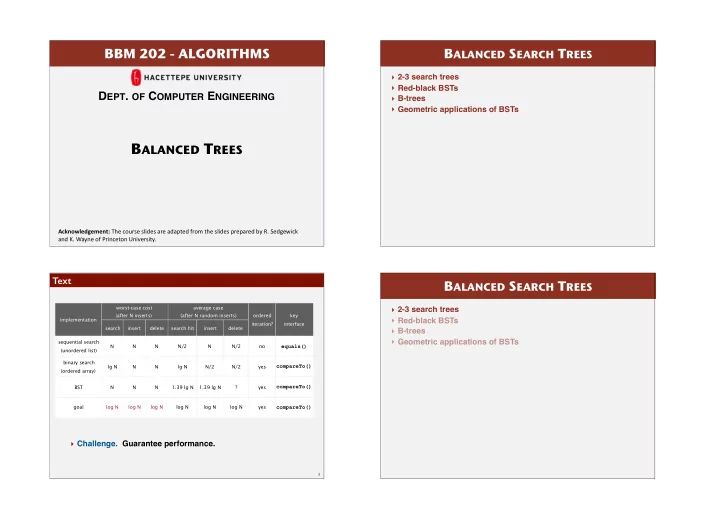
Text

3

  • Challenge. Guarantee performance.

implementation worst-case cost (after N inserts) average case (after N random inserts)

  • rdered

iteration? key interface search insert delete search hit insert delete sequential search
 (unordered list) N N N N/2 N N/2 no

equals()

binary search
 (ordered array) lg N N N lg N N/2 N/2 yes

compareTo()

BST N N N 1.39 lg N 1.39 lg N ? yes

compareTo()

goal log N log N log N log N log N log N yes

compareTo()

BALANCED SEARCH TREES

  • 2-3 search trees
  • Red-black BSTs
  • B-trees
  • Geometric applications of BSTs

slide-2
SLIDE 2

You can read it as 2 or 3 children tree Allow 1 or 2 keys per node.

  • 2-node: one key, two children.
  • 3-node: two keys, three children.

2-3 tree

5

S X A C P H R M L

3-node

E J

2-node null link

Allow 1 or 2 keys per node.

  • 2-node: one key, two children.
  • 3-node: two keys, three children.

Our Aim is Perfect balance. Every path from root to null link has same length.

2-3 tree

6

S X A C P H R M L

3-node

E J

2-node null link

Allow 1 or 2 keys per node.

  • 2-node: one key, two children.
  • 3-node: two keys, three children.

Perfect balance. Every path from root to null link has same length. Symmetric order. Inorder traversal yields keys in ascending order.

2-3 tree

7

between E and J larger than J smaller than E

S X A C P H R M L E J

Search.

  • Compare search key against keys in node.
  • Find interval containing search key.
  • Follow associated link (recursively).

2-3 tree demo

search for H

H

H is less than M (go left)

S X A C P H R M L E J

slide-3
SLIDE 3

Search.

  • Compare search key against keys in node.
  • Find interval containing search key.
  • Follow associated link (recursively).

2-3 tree demo

S X A C P H R M L E J

search for H

H is between E and J (go middle)

H

Search.

  • Compare search key against keys in node.
  • Find interval containing search key.
  • Follow associated link (recursively).

2-3 tree demo

S X A C P H R M L E J

search for H

found H (search hit)

H

Search.

  • Compare search key against keys in node.
  • Find interval containing search key.
  • Follow associated link (recursively).

2-3 tree demo

S X A C P H R M L E J

search for B

B

B is less than M (go left)

Search.

  • Compare search key against keys in node.
  • Find interval containing search key.
  • Follow associated link (recursively).

2-3 tree demo

S X A C P H R M L E J

search for B

B is less than E (go left)

B

slide-4
SLIDE 4

Search.

  • Compare search key against keys in node.
  • Find interval containing search key.
  • Follow associated link (recursively).

2-3 tree demo

S X A C P H R M L E J

search for B

B

B is between A and C (go middle)

Search.

  • Compare search key against keys in node.
  • Find interval containing search key.
  • Follow associated link (recursively).

2-3 tree demo

S X A C P H R M L E J

search for B

B

link is null (search miss)

Insert Operation

  • Problem with Binary Search Tree: when the tree grows from leaves, it

is possible to always insert to same branch. (worst-case)


  • Instead of growing the tree from bottom, try to grow upwards.
  • If there is space in a leaf, simply insert it
  • Otherwise push nodes from bottom to top, if done recursively the tree will be

balanced as it grows (increasing the height by introducing a new root)

  • If we keep on inserting to same branch;

15

9 8 7 6

BST: 2 or 3 Tree:

8 9

6,7

Insert into a 2-node at bottom.

  • Search for key, as usual.
  • Replace 2-node with 3-node.

2-3 tree demo

S X A C P H R M L E J

insert K

K

K is less than M (go left)

slide-5
SLIDE 5

Insert into a 2-node at bottom.

  • Search for key, as usual.
  • Replace 2-node with 3-node.

2-3 tree demo

S X A C P H R M L E J

K is greater than J (go right)

K

insert K

Insert into a 2-node at bottom.

  • Search for key, as usual.
  • Replace 2-node with 3-node.

2-3 tree demo

S X A C P H R M L E J

search ends here

K

insert K

Insert into a 2-node at bottom.

  • Search for key, as usual.
  • Replace 2-node with 3-node.

S X A C P H R M E J

replace 2-node with 3-node containing K

2-3 tree demo

L K

insert K

Insert into a 2-node at bottom.

  • Search for key, as usual.
  • Replace 2-node with 3-node.

S X A C P H R M E J

2-3 tree demo

S X A C P H R M E J LL K

insert K

slide-6
SLIDE 6

Insert into a 3-node at bottom.

  • Add new key to 3-node to create temporary 4-node.
  • Move middle key in 4-node into parent.

S X P R

2-3 tree demo

A C H K L E J M Z

Z is greater than M (go right)

insert Z

Insert into a 3-node at bottom.

  • Add new key to 3-node to create temporary 4-node.
  • Move middle key in 4-node into parent.

S X P R

2-3 tree demo

A C H K L E J M Z

Z is greater than R (go right)

insert Z

Insert into a 3-node at bottom.

  • Add new key to 3-node to create temporary 4-node.
  • Move middle key in 4-node into parent.

S X P R

2-3 tree demo

A C H K L E J M Z

search ends here

insert Z

Insert into a 3-node at bottom.

  • Add new key to 3-node to create temporary 4-node.
  • Move middle key in 4-node into parent.

S X

2-3 tree demo

A C H K L E J M Z

replace 3-node with temporary 4-node containing Z

P R

insert Z

slide-7
SLIDE 7

Insert into a 3-node at bottom.

  • Add new key to 3-node to create temporary 4-node.
  • Move middle key in 4-node into parent.

P

2-3 tree demo

A C H K L E J S X Z M R

insert Z

Insert into a 3-node at bottom.

  • Add new key to 3-node to create temporary 4-node.
  • Move middle key in 4-node into parent.

P

2-3 tree demo

A C H K L E J

split 4-node into two 2-nodes (pass middle key to parent)

S Z M R X

insert Z

Insert into a 3-node at bottom.

  • Add new key to 3-node to create temporary 4-node.
  • Move middle key in 4-node into parent.

P

2-3 tree demo

A C H K L E J M Z S R X

insert Z

Insert into a 3-node at bottom.

  • Add new key to 3-node to create temporary 4-node.
  • Move middle key in 4-node into parent.

P

2-3 tree demo

A C H K L E J M Z S R X

insert Z

slide-8
SLIDE 8

Insert into a 3-node at bottom.

  • Add new key to 3-node to create temporary 4-node.
  • Move middle key in 4-node into parent.
  • Repeat up the tree, as necessary.
  • If you reach the root and it's a 4-node, split it into three 2-nodes.

2-3 tree demo

S X A C E R H P

convert 3-node into 4-node

L

insert L

Insert into a 3-node at bottom.

  • Add new key to 3-node to create temporary 4-node.
  • Move middle key in 4-node into parent.
  • Repeat up the tree, as necessary.
  • If you reach the root and it's a 4-node, split it into three 2-nodes.

2-3 tree demo

S X A C E R H P L

insert L

Insert into a 3-node at bottom.

  • Add new key to 3-node to create temporary 4-node.
  • Move middle key in 4-node into parent.
  • Repeat up the tree, as necessary.
  • If you reach the root and it's a 4-node, split it into three 2-nodes.

2-3 tree demo

S X A C

split 4-node (move L to parent)

H P E R L

insert L

Insert into a 3-node at bottom.

  • Add new key to 3-node to create temporary 4-node.
  • Move middle key in 4-node into parent.
  • Repeat up the tree, as necessary.
  • If you reach the root and it's a 4-node, split it into three 2-nodes.

2-3 tree demo

S X A C P H E R L

insert L

slide-9
SLIDE 9

Insert into a 3-node at bottom.

  • Add new key to 3-node to create temporary 4-node.
  • Move middle key in 4-node into parent.
  • Repeat up the tree, as necessary.
  • If you reach the root and it's a 4-node, split it into three 2-nodes.

2-3 tree demo

S X A C P H

split 4-node (move L to parent)

E R L

insert L

Insert into a 3-node at bottom.

  • Add new key to 3-node to create temporary 4-node.
  • Move middle key in 4-node into parent.
  • Repeat up the tree, as necessary.
  • If you reach the root and it's a 4-node, split it into three 2-nodes.

2-3 tree demo

insert L

S X A C P H E R L

height of tree increases by 1

Insert into a 3-node at bottom.

  • Add new key to 3-node to create temporary 4-node.
  • Move middle key in 4-node into parent.
  • Repeat up the tree, as necessary.
  • If you reach the root and it's a 4-node, split it into three 2-nodes.

2-3 tree demo

S X A C P H E R L

insert L

  • Compare search key against keys in node.
  • Find interval containing search key.
  • Follow associated link (recursively).

Search in a 2-3 tree

36

found H so return value (search hit)

H is less than M so

look to the left

H is between E and L so

look in the middle

B is between A and C so look in the middle B is less than M so

look to the left

B is less than E

so look to the left link is null so B is not in the tree (search miss) E J H L M R P S X A C E J H L M R P S X A C E J H L M R P S X A C E J H L M R P S X A C E J H L M R P S X A C E J H L M R P S X A C

successful search for H unsuccessful search for B

slide-10
SLIDE 10

Case 1. Insert into a 2-node at bottom.

  • Search for key, as usual.
  • Replace 2-node with 3-node.

Insertion in a 2-3 tree

37

search for K ends here replace 2-node with new 3-node containing K E J H L M R P S X A C E J H M R P S X K L A C

inserting K

38

Insertion in a 2-3 tree

Case 2. Insert into a 3-node at bottom.

  • Add new key to 3-node to create temporary 4-node.
  • Move middle key in 4-node into parent.
  • Repeat up the tree, as necessary.

split 4-node into two 2-nodes pass middle key to parent replace 3-node with temporary 4-node containing Z replace 2-node with new 3-node containing middle key S X Z S Z E J H L L M R P A C search for Z ends at this 3-node E J H L M R P S X A C E J H M P R X A C

inserting Z

Case 2. Insert into a 3-node at bottom.

  • Add new key to 3-node to create temporary 4-node.
  • Move middle key in 4-node into parent.
  • Repeat up the tree, as necessary.
  • If you reach the root and it's a 4-node, split it into three 2-nodes.

39

Insertion in a 2-3 tree

split 4-node into two 2-nodes pass middle key to parent split 4-node into three 2-nodes increasing tree height by 1 add middle key C to 3-node to make temporary 4-node A D C E J H L A D H L C J E

A C D search for D ends at this 3-node E J H L A C E J H L add new key D to 3-node to make temporary 4-node

inserting D increases height by 1

40

Local transformations in a 2-3 tree

Splitting a 4-node is a local transformation: constant number of

  • perations.

b c d a e between

a and b

less than a between

b and c

between

d and e

greater than e between

c and d

between

a and b

less than a between

b and c

between

d and e

greater than e between

c and d

b d a c e

slide-11
SLIDE 11
  • Invariants. Maintains symmetric order and perfect balance.
  • Pf. Each transformation maintains symmetric order and perfect balance.

41

Global properties in a 2-3 tree

b

right middle left right left

b d b c d a c a a b c d c a b d a b c c a

root parent is a 2-node parent is a 3-node

c e b d c d e a b b c d a e a b d a c e a b c d e c a b d e

42

2-3 tree: performance

Perfect balance. Every path from root to null link has same length. Tree height.

  • Worst case:
  • Best case:

43

2-3 tree: performance

Perfect balance. Every path from root to null link has same length. Tree height.

  • Worst case:

lg N. [all 2-nodes]

  • Best case:

log3 N ≈ .631 lg N.[all 3-nodes]

  • Between 12 and 20 for a million nodes.
  • Between 18 and 30 for a billion nodes.

Guaranteed logarithmic performance for search and insert.

ST implementations: summary

44

constants depend upon implementation

implementation worst-case cost (after N inserts) average case (after N random inserts)

  • rdered

iteration? key interface search insert delete search hit insert delete sequential search
 (unordered list) N N N N/2 N N/2 no equals() binary search
 (ordered array) lg N N N lg N N/2 N/2 yes compareTo() BST N N N 1.39 lg N 1.39 lg N ? yes compareTo() 2-3 tree c lg N c lg N c lg N c lg N c lg N c lg N yes compareTo()

slide-12
SLIDE 12

45

2-3 tree: implementation?

Direct implementation is complicated, because:

  • Maintaining multiple node types is cumbersome.
  • Need multiple compares to move down tree.
  • Need to move back up the tree to split 4-nodes.
  • Large number of cases for splitting.

Bottom line. Could do it, but there's a better way.

BALANCED SEARCH TREES

  • 2-3 search trees
  • Red-black BSTs
  • B-trees
  • Geometric applications of BSTs

Multiple Node Types

  • In 2-3 Trees, the algorithm automatically balances the tree
  • However, we have to keep track of two different node types,

complicating the source code.

  • Nodes with one key
  • Nodes with two keys
  • Instead of multiple nodes:
  • Multiple edge types; red and black
  • Rotations instead of Split

47

  • 1. Represent 2–3 tree as a BST.
  • 2. Use "internal" left-leaning links as "glue" for 3–nodes.

48

Left-leaning red-black BSTs (Guibas-Sedgewick 1979 and Sedgewick 2007)

larger key is root

a b between

a and b

less than a greater than b

a b

3-node

between

a and b

less than a greater than b

X S H P J R E A M C L

black tree

E J H L M R P S X A C

black links connect
 2-nodes and 3-nodes red links "glue" 
 nodes within a 3-node 2-3 tree corresponding red-black BST

slide-13
SLIDE 13

A BST such that:

  • No node has two red links connected to it.
  • Every path from root to null link has the same number of black links.
  • We will only allow one red link to simulate 2 keys in node
  • A node with two red links would be the same as having 3 keys
  • Red links lean left (correct ordering)

49

An equivalent definition

"perfect black balance"

X S H P J R E A M C L

black tree

Key property. 1–1 correspondence between 2–3 and LLRB.

50

Left-leaning red-black BSTs: 1-1 correspondence with 2-3 trees

X S H P J R E A M C L X S H P J R E A M C L

red−black tree horizontal red links 2-3 tree

E J H L M R P S X A C

Search implementation for red-black BSTs

  • Observation. Search is the same as for elementary BST (ignore color).

  • Remark. Most other ops (e.g., ceiling, selection, iteration) are also

identical.

51

public Val get(Key key) { Node x = root; while (x != null) { int cmp = key.compareTo(x.key); if (cmp < 0) x = x.left; else if (cmp > 0) x = x.right; else if (cmp == 0) return x.val; } return null; }

but runs faster because of better balance

X S H P J R E A M C L

black tree

Red-black BST representation

Each node is pointed to by precisely one link (from its parent) ⇒
 can encode color of links in nodes.

52

private static final boolean RED = true; private static final boolean BLACK = false; private class Node { Key key; Value val; Node left, right; boolean color; // color of parent link } private boolean isRed(Node x) { if (x == null) return false; return x.color == RED; }

null links are black

J G E A D C

h h.left.color

is RED

h.right.color

is BLACK

slide-14
SLIDE 14

Elementary red-black BST operations

Left rotation. Orient a (temporarily) right-leaning red link to lean left.

  • Invariants. Maintains symmetric order and perfect black balance.

53

greater than S x h

S

between E and S less than E

E

rotate E left (before)

private Node rotateLeft(Node h) { assert isRed(h.right); Node x = h.right; h.right = x.left; x.left = h; x.color = h.color; h.color = RED; return x; }

Elementary red-black BST operations

Left rotation. Orient a (temporarily) right-leaning red link to lean left.

  • Invariants. Maintains symmetric order and perfect black balance.

54

greater than S less than E x h

E

between E and S

S

rotate E left (after)

private Node rotateLeft(Node h) { assert isRed(h.right); Node x = h.right; h.right = x.left; x.left = h; x.color = h.color; h.color = RED; return x; }

Elementary red-black BST operations

Right rotation. Orient a left-leaning red link to (temporarily) lean right.

  • Invariants. Maintains symmetric order and perfect black balance.

55

rotate S right (before) greater than S less than E h x

E

between E and S

S

private Node rotateRight(Node h) { assert isRed(h.left); Node x = h.left; h.left = x.right; x.right = h; x.color = h.color; h.color = RED; return x; }

Elementary red-black BST operations

Right rotation. Orient a left-leaning red link to (temporarily) lean right.

  • Invariants. Maintains symmetric order and perfect black balance.

56

private Node rotateRight(Node h) { assert isRed(h.left); Node x = h.left; h.left = x.right; x.right = h; x.color = h.color; h.color = RED; return x; }

rotate S right (after) greater than S h x

S

between E and S less than E

E

slide-15
SLIDE 15

Color flip. Recolor to split a (temporary) 4-node.

  • Invariants. Maintains symmetric order and perfect black balance.

Elementary red-black BST operations

57

greater than S between E and S between A and E less than A

E

h

S A

private void flipColors(Node h) { assert !isRed(h); assert isRed(h.left); asset isRed(h.right); h.color = RED; h.left.color = BLACK; h.right.color = BLACK; }

flip colors (before)

Color flip. Recolor to split a (temporary) 4-node.

  • Invariants. Maintains symmetric order and perfect black balance.

Elementary red-black BST operations

58

E

h

S A

private void flipColors(Node h) { assert !isRed(h); assert isRed(h.left); asset isRed(h.right); h.color = RED; h.left.color = BLACK; h.right.color = BLACK; }

flip colors (after) greater than S between E and S between A and E less than A

Basic strategy. Maintain 1-1 correspondence with 2-3 trees by
 applying elementary red-black BST operations.

Insertion in a LLRB tree: overview

59

E A R S E R S A C E A E R S R S A C E R S C A add new node here right link red so rotate left

insert C

Warmup 1. Insert into a tree with exactly 1 node.

Insertion in a LLRB tree

60

red link to new node containing a converts 2-node to 3-node search ends at this null link b a b

root root left search ends at this null link attached new node with red link rotated left to make a legal 3-node a b a a b root root right

slide-16
SLIDE 16

Case 1. Insert into a 2-node at the bottom.

  • Do standard BST insert; color new link red.
  • If new red link is a right link, rotate left.

Insertion in a LLRB tree

61

E A R S E R S A C E A E R S R S A C E R S C A add new node here right link red so rotate left

insert C

Warmup 2. Insert into a tree with exactly 2 nodes.

Insertion in a LLRB tree

62

search ends at this null link attached new node with red link colors flipped to black a b a b c a b c

larger search ends at this null link attached new node with red link rotated left rotated right colors flipped to black ped k a c b a b c a b c a c a c b

between

search ends at this null link attached new node with red link a c b rotated right colors flipped to black w d b c a b c a b c

smaller bet

Think of this as a split in 2-3 tree

Case 2. Insert into a 3-node at the bottom.

  • Do standard BST insert; color new link red.
  • Rotate to balance the 4-node (if needed).
  • Flip colors to pass red link up one level.
  • Rotate to make lean left (if needed).

Insertion in a LLRB tree

63

S R E H A C E R S A C add new node here

inserting H

H node here E R S A C two lefts in a row so rotate right S E H R A C both children red so flip colors right link red so rotate left S E H R A C

As with 2-3 Trees we have to update parents, bottom-to-top if we violate the conditions

Case 2. Insert into a 3-node at the bottom.

  • Do standard BST insert; color new link red.
  • Rotate to balance the 4-node (if needed).
  • Flip colors to pass red link up one level.
  • Rotate to make lean left (if needed).
  • Repeat case 1 or case 2 up the tree (if needed).

Insertion in a LLRB tree: passing red links up the tree

64

A P S R E A C H M both children red so flip colors S R E add new node here A C H M

inserting P

P both children red so flip colors S R E A C H M right link red so rotate left P S R E A C H M P S R E A C H M two lefts in a row so rotate right both children red so flip colors P S R E A C H M

slide-17
SLIDE 17

Red-black BST insertion

65

S

insert S

E

Red-black BST insertion

66

S

insert E

A

Red-black BST insertion

67

S E

insert A

Red-black BST insertion

68

S E A

two left reds in a row (rotate S right)

insert A

slide-18
SLIDE 18

Red-black BST insertion

69

S E A

both children red (flip colors)

Red-black BST insertion

70

S E A

both children red (flip colors)

Red-black BST insertion

71

S E A

red-black BST

Red-black BST insertion

72

S E A

red-black BST

slide-19
SLIDE 19

R

Red-black BST insertion

73

S E A

insert R

Red-black BST insertion

74

A

red-black BST

E S R

Red-black BST insertion

75

A E S R

red-black BST

C

Red-black BST insertion

76

A E S R

insert C

slide-20
SLIDE 20

Red-black BST insertion

77

E S R C

right link red (rotate A left)

A

Red-black BST insertion

78

E S R C A

red-black BST

Red-black BST insertion

79

red-black BST

E C A S R

Red-black BST insertion

80

S R E C A

red-black BST

slide-21
SLIDE 21

H

Red-black BST insertion

81

S R E C A

insert H

Red-black BST insertion

82

E C A H R

two left reds in a row (rotate S right)

S

Red-black BST insertion

83

E C A H R S

both children red (flip colors)

Red-black BST insertion

84

E C A H R S

both children red (flip colors)

slide-22
SLIDE 22

Red-black BST insertion

85

H S E R C A

right link red (rotate E left)

Red-black BST insertion

86

H R S E C A

red-black BST

Red-black BST insertion

87

S

red-black BST

C A H R E

Red-black BST insertion

88

C A H R E

red-black BST

S

slide-23
SLIDE 23

X

Red-black BST insertion

89

C A H R E

insert X

S

Red-black BST insertion

90

C A H R E X S

right link red (rotate S left)

insert X

Red-black BST insertion

91

C A H R E X S

red-black BST

Red-black BST insertion

92

C A H R E X S

red-black BST

slide-24
SLIDE 24

Red-black BST insertion

93

R E X S

red-black BST

C A H M

Red-black BST insertion

94

R E X S

insert M

C A H

Red-black BST insertion

95

C A R E X S M H

right link red (rotate H left)

insert M

Red-black BST insertion

96

C A R E X S M H

red-black BST

slide-25
SLIDE 25

P H

Red-black BST insertion

97

C A R E X S M

insert P

H

Red-black BST insertion

98

C A R E X S P M

two red children (flip colors)

insert P

H

Red-black BST insertion

99

C A R E X S P M

two red children (flip colors)

insert P

H

Red-black BST insertion

100

C A E X S P M

right link red (rotate E left)

R

slide-26
SLIDE 26

H

Red-black BST insertion

101

C A E X S P M

two left reds in a row (rotate R right)

R H

Red-black BST insertion

102

C A E X S P M

two red children (flip colors)

R H

Red-black BST insertion

103

C A E X S P M

two red children (flip colors)

R H

Red-black BST insertion

104

C A E X S P M R

red-black BST

slide-27
SLIDE 27

Red-black BST insertion

105

H C A E X S P M R

red-black BST

Red-black BST insertion

106

red-black BST

X S P M R H C A E L

Red-black BST insertion

107

insert L

X S P M R H C A E

Red-black BST insertion

108

C A E X S P M R

insert L

L

right link red (rotate H left)

H

slide-28
SLIDE 28

Red-black BST insertion

109

C A E X S P M R

red-black BST

L H

Standard indexing client.

110

LLRB tree insertion trace

S E A S E A E A R C H E R S R S A C E S S R E A C H

insert S

S S E A E S R S E A S E R S A C H E R A C

red-black BST corresponding 2-3 tree

Standard indexing client (continued).

111

LLRB tree insertion trace

X M P L S X M R E A H C S X R E A C H P R S X M E A C H P R S H X M E A C L M E R H P H S X E R A C S X E R A C H M S X A C M E R P S X A C H L red-black BST corresponding 2-3 tree

Insertion in a LLRB tree: Java implementation

Same code for both cases.

  • Right child red, left child black: rotate left.
  • Left child, left-left grandchild red: rotate right.
  • Both children red: flip colors.

112

private Node put(Node h, Key key, Value val) { if (h == null) return new Node(key, val, RED); int cmp = key.compareTo(h.key); if (cmp < 0) h.left = put(h.left, key, val); else if (cmp > 0) h.right = put(h.right, key, val); else if (cmp == 0) h.val = val; if (isRed(h.right) && !isRed(h.left)) h = rotateLeft(h); if (isRed(h.left) && isRed(h.left.left)) h = rotateRight(h); if (isRed(h.left) && isRed(h.right)) flipColors(h); return h; }

insert at bottom (and color red) split 4-node balance 4-node lean left

  • nly a few extra lines of code 


provides near-perfect balance flip colors right rotate left rotate

Passing a red link up a red-black tree

h h h

slide-29
SLIDE 29

Insertion in a LLRB tree: visualization

113

255 insertions in ascending order

114

Insertion in a LLRB tree: visualization

255 insertions in descending order

  • Remark. Only a few extra lines of code to standard BST insert.

115

Insertion in a LLRB tree: visualization

255 random insertions

  • Remark. Only a few extra lines of code to standard BST insert.

116

Balance in LLRB trees

  • Proposition. Height of tree is ≤ 2 lg N in the worst case.

Pf.

  • Every path from root to null link has same number of black links.
  • Never two red links in-a-row.


  • Property. Height of tree is ~ 1.00 lg N in typical applications.
slide-30
SLIDE 30

ST implementations: frequency counter

117

Costs for java FrequencyCounter 8 < tale.txt using RedBlackBST 20 14350

  • perations

cost

12 Costs for java FrequencyCounter 8 < tale.txt using BST 20 14350

  • perations

cost

13.9

ST implementations: summary

118

implementation worst-case cost (after N inserts) average case (after N random inserts)

  • rdered

iteration? key interface search insert delete search hit insert delete sequential search
 (unordered list) N N N N/2 N N/2 no equals() binary search
 (ordered array) lg N N N lg N N/2 N/2 yes compareTo() BST N N N 1.39 lg N 1.39 lg N ? yes compareTo() 2-3 tree c lg N c lg N c lg N c lg N c lg N c lg N yes compareTo() red-black BST 2 lg N 2 lg N 2 lg N 1.00 lg N * 1.00 lg N * 1.00 lg N * yes compareTo() * exact value of coefficient unknown but extremely close to 1

BALANCED SEARCH TREES

  • 2-3 search trees
  • Red-black BSTs
  • B-trees
  • Geometric applications of BSTs

120

File system model

  • Page. Contiguous block of data (e.g., a file or 4,096-byte chunk).
  • Probe. First access to a page (e.g., from disk to memory).
  • Property. Time required for a probe is much larger than time to access


data within a page. Cost model. Number of probes.

  • Goal. Access data using minimum number of probes.

slow fast

slide-31
SLIDE 31

B-tree. Generalize 2-3 trees by allowing up to M - 1 key-link pairs per node.

  • At least 2 key-link pairs at root.
  • At least M / 2 key-link pairs in other nodes.
  • External nodes contain client keys.
  • Internal nodes contain copies of keys to guide search.

121

B-trees (Bayer-McCreight, 1972)

choose M as large as possible so
 that M links fit in a page, e.g., M = 1024 Anatomy of a B-tree set (M = 6) 2-node external 3-node external 5-node (full) internal 3-node external 4-node all nodes except the root are 3-, 4- or 5-nodes * B C sentinel key D E F H I J K M N O P Q R T * D H * K K Q U U W X Y each red key is a copy

  • f min key in subtree

client keys (black) are in external nodes

  • Start at root.
  • Find interval for search key and take corresponding link.
  • Search terminates in external node.

* B C

searching for E

D E F H I J K M N O P Q R T * D H * K K Q U U W X search for E in this external node follow this link because

E is between * and K

follow this link because

E is between D and H

Searching in a B-tree set (M = 6)

122

Searching in a B-tree

  • Search for new key.
  • Insert at bottom.
  • Split nodes with M key-link pairs on the way up the tree.

123

Insertion in a B-tree

* A B C E F H I J K M N O P Q R T * C H * K K Q U U W X * A B C E F H I J K M N O P Q R T U W X * C H K Q U * A B C E F H I J K M N O P Q R T U W X * H K Q U * B C E F H I J K M N O P Q R T U W X * H K Q U new key (A) causes

  • verflow and split

root split causes a new root to be created new key (C) causes

  • verflow and split

Inserting a new key into a B-tree set

inserting A

  • Proposition. A search or an insertion in a B-tree of order M with N keys

requires between log M-1 N and log M/2 N probes.

  • Pf. All internal nodes (besides root) have between M / 2 and M - 1 links.

In practice. Number of probes is at most 4.

  • Optimization. Always keep root page in memory.

124

Balance in B-tree

M = 1024; N = 62 billion log M/2 N ≤ 4

slide-32
SLIDE 32

125

Building a large B tree

full page splits into two half -full pages then a new key is added to one of them full page, about to split white: unoccupied portion of page black: occupied portion of page each line shows the result

  • f inserting one key

in some page

126

Balanced trees in the wild

Red-black trees are widely used as system symbol tables.

  • Java: java.util.TreeMap, java.util.TreeSet.
  • C++ STL: map, multimap, multiset.
  • Linux kernel: completely fair scheduler, linux/rbtree.h.

B-tree variants. B+ tree, B*tree, B# tree, … B-trees (and variants) are widely used for file systems and databases.

  • Windows: HPFS.
  • Mac: HFS, HFS+.
  • Linux: ReiserFS, XFS, Ext3FS, JFS.
  • Databases: ORACLE, DB2, INGRES, SQL, PostgreSQL.

BALANCED SEARCH TREES

  • 2-3 search trees
  • Red-black BSTs
  • B-trees
  • Geometric applications of BSTs


GEOMETRIC APPLICATIONS OF BSTS

  • kd trees
slide-33
SLIDE 33

129

2-d orthogonal range search

Extension of ordered symbol-table to 2d keys.

  • Insert a 2d key.
  • Delete a 2d key.
  • Search for a 2d key.
  • Range search: find all keys that lie in a 2d range.
  • Range count: number of keys that lie in a 2d range.


 Geometric interpretation.

  • Keys are point in the plane.
  • Find/count points in a given h-v rectangle.


  • Applications. Networking, circuit design, databases,...

rectangle is axis-aligned

130

2d orthogonal range search: grid implementation

Grid implementation.

  • Divide space into M-by-M grid of squares.
  • Create list of points contained in each square.
  • Use 2d array to directly index relevant square.
  • Insert: add (x, y) to list for corresponding square.
  • Range search: examine only those squares that intersect 2d range query.

LB RT

131

2d orthogonal range search: grid implementation costs

Space-time tradeoff.

  • Space: M 2 + N.
  • Time: 1 + N / M 2 per square examined, on average.

Choose grid square size to tune performance.

  • Too small: wastes space.
  • Too large: too many points per square.
  • Rule of thumb: √N-by-√N grid.


 Running time. [if points are evenly distributed]

  • Initialize data structure: N.
  • Insert point: 1.
  • Range search: 1 per point in range.

choose M ~ √N

LB RT

Grid implementation. Fast and simple solution for evenly-distributed points.

  • Problem. Clustering a well-known phenomenon in geometric data.
  • Lists are too long, even though average length is short.
  • Need data structure that gracefully adapts to data.

132

Clustering

slide-34
SLIDE 34

Grid implementation. Fast and simple solution for evenly-distributed points.

  • Problem. Clustering a well-known phenomenon in geometric data.
  • Ex. USA map data.

133

Clustering

half the squares are empty half the points are
 in 10% of the squares 13,000 points, 1000 grid squares

Use a tree to represent a recursive subdivision of 2d space.

  • Grid. Divide space uniformly into squares.

2d tree. Recursively divide space into two halfplanes.

  • Quadtree. Recursively divide space into four quadrants.

BSP tree. Recursively divide space into two regions.

134

Space-partitioning trees

Grid 2d tree BSP tree Quadtree

Applications.

  • Ray tracing.
  • 2d range search.
  • Flight simulators.
  • N-body simulation.
  • Collision detection.
  • Astronomical databases.
  • Nearest neighbor search.
  • Adaptive mesh generation.
  • Accelerate rendering in Doom.
  • Hidden surface removal and shadow casting.

135

Space-partitioning trees: applications

Grid 2d tree BSP tree Quadtree

136

Kd tree

Kd tree. Recursively partition k-dimensional space into 2 halfspaces.

  • Implementation. BST, but cycle through dimensions ala 2d trees.

Efficient, simple data structure for processing k-dimensional data.

  • Widely used.
  • Adapts well to high-dimensional and clustered data.
  • Discovered by an undergrad in an algorithms class!

level ≡ i (mod k)

points whose ith
 coordinate
 is less than p’s points whose ith
 coordinate
 is greater than p’s

p Jon Bentley

slide-35
SLIDE 35
  • Goal. Simulate the motion of N particles, mutually affected by gravity.

Brute force. For each pair of particles, compute force.

137

N-body simulation

F = G m1 m2 r2

http://www.youtube.com/watch?v=ua7YlN4eL_w

138

Appel algorithm for N-body simulation

Key idea. Suppose particle is far, far away from cluster of particles.

  • Treat cluster of particles as a single aggregate particle.
  • Compute force between particle and center of mass of aggregate particle.

139

Appel algorithm for N-body simulation

  • Build 3d-tree with N particles as nodes.
  • Store center-of-mass of subtree in each node.
  • To compute total force acting on a particle, traverse tree, but stop as soon as

distance from particle to subdivision is sufficiently large.

  • Impact. Running time per step is N log N instead of N 2 ⇒ enables new

research.

SIAM J. ScI. STAT. COMPUT.

  • Vol. 6, No. 1, January 1985

1985 Society for Industrial and Applied Mathematics O08

AN EFFICIENT PROGRAM FOR MANY-BODY SIMULATION*

ANDREW W. APPEL

  • Abstract. The simulation of N particles interacting in a gravitational force field is useful in astrophysics,

but such simulations become costly for large N. Representing the universe as a tree structure with the particles at the leaves and internal nodes labeled with the centers of mass of their descendants allows several simultaneous attacks on the computation time required by the problem. These approaches range from algorithmic changes (replacing an O(N’) algorithm with an algorithm whose time-complexity is believed to be O(N log N)) to data structure modifications, code-tuning, and hardware modifications. The changes reduced the running time of a large problem (N 10,000) by a factor of four hundred. This paper describes both the particular program and the methodology underlying such speedups.

  • 1. Introduction. Isaac Newton calculated the behavior of two particles interacting

through the force of gravity, but he was unable to solve the equations for three particles. In this he was not alone [7, p. 634], and systems of three or more particles can be solved only numerically. Iterative methods are usually used, computing at each discrete time interval the force on each particle, and then computing the new velocities and positions for each particle.

A naive implementation of an iterative many-body simulator is computationally

very expensive for large numbers of particles, where "expensive" means days of Cray-1 time or a year of VAX time. This paper describes the development of an efficient program in which several aspects of the computation were made faster. The initial step was the use of a new algorithm with lower asymptotic time complexity; the use

  • f a better algorithm is often the way to achieve the greatest gains in speed [2].

Since every particle attracts each of the others by the force of gravity, there are

O(N2) interactions to compute for every iteration. Furthermore, for the same reasons

that the closed form integral diverges for small distances (since the force is proportional to the inverse square of the distance between two bodies), the discrete time interval must be made extremely small in the case that two particles pass very close to each

  • ther. These are the two problems on which the algorithmic attack concentrated. By

the use of an appropriate data structure, each iteration can be done in time believed to be O(N log N), and the time intervals may be made much larger, thus reducing the number of iterations required. The algorithm is applicable to N-body problems in any force field with no dipole moments; it is particularly useful when there is a severe nonuniformity in the particle distribution or when a large dynamic range is required (that is, when several distance scales in the simulation are of interest).

The use of an algorithm with a better asymptotic time complexity yielded a

significant improvement in running time. Four additional attacks on the problem were also undertaken, each of which yielded at least a factor of two improvement in speed. These attacks ranged from insights into the physics down to hand-coding a routine in

assembly language. By finding savings at many design levels, the execution time of a large simulation was reduced from (an estimated) 8,000 hours to 20 (actual) hours. The program was used to investigate open problems in cosmology, giving evidence to support a model of the universe with random initial mass distribution and high mass density.

* Received by the editors March 24, 1983, and in revised form October 1, 1983.

r Computer Science Department, Carnegie-Mellon University, Pittsburgh, Pennsylvania 15213. This

research was supported by a National Science Foundation Graduate Student Fellowship and by the office

  • f Naval Research under grant N00014-76-C-0370.

85