I is for Turtle, Bagels, Loop Tracing, Files Part 1 of 4 Identity - - PowerPoint PPT Presentation

i is for
SMART_READER_LITE
LIVE PREVIEW

I is for Turtle, Bagels, Loop Tracing, Files Part 1 of 4 Identity - - PowerPoint PPT Presentation

Compsci 101 I is for Turtle, Bagels, Loop Tracing, Files Part 1 of 4 Identity Who are you? Computer Science Student Susan Rodger Invariant September 15, 2020 Reasoning formally and informally about loops Internet


slide-1
SLIDE 1

Compsci 101 Turtle, Bagels, Loop Tracing, Files Part 1 of 4

9/15/2020 Compsci 101, Fall 2020 1

Susan Rodger September 15, 2020

I is for …

  • Identity
  • Who are you? Computer Science Student
  • Invariant
  • Reasoning formally and informally about loops
  • Internet
  • Network of networks
  • Far more than that!

9/15/2020 Compsci 101, Fall 2020 2

PFTD

  • Turtle
  • Bagels APT
  • Trace through loops
  • Files

9/15/2020 Compsci 101, Fall 2020 3

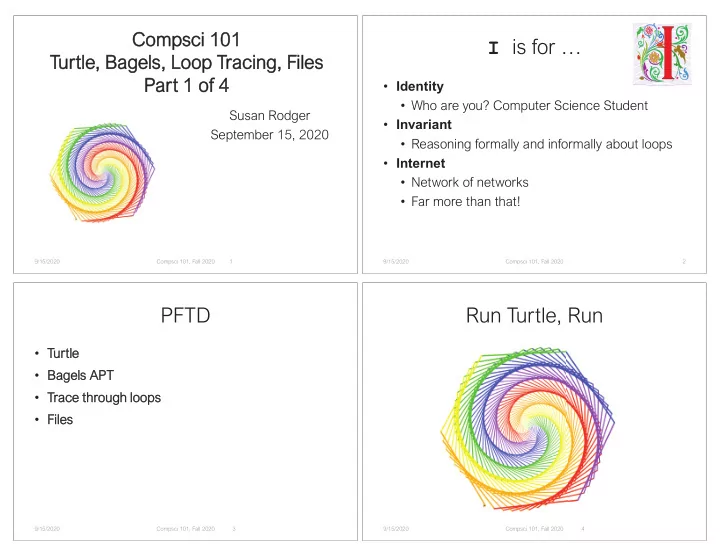
Run Turtle, Run

9/15/2020 Compsci 101, Fall 2020 4

slide-2
SLIDE 2

Turtle Programming

  • Must:
  • Import turtle module
  • Create window/Screen
  • Last thing - exit on click
  • Create turtles to use, name/type/value
  • Review Turtle commands and concepts
  • http://bit.ly/turtle_tutorial for more, and book
  • See Snowpeople.py, ColorMyWorld.py, and Spiro.py for

some ideas

  • Color, Position, Leaving Turtle where started
  • Many more commands than this

9/15/2020 Compsci 101, Fall 2020 5

Put yourself in the turtle t…

t.forward(50) # turtle moves forward # drawing a line t.left(90) # turtle turns to its left t.pencolor(“blue”) # change pen color t.forward(100) # turtle moves forward # drawing line, new color

9/15/2020 Compsci 101, Fall 2020 6

Example: simple.py

9/15/2020 Compsci 101, Fall 2020 7

Example: Simple.py parts

  • Import at the top
  • Create canvas
  • Create turtle
  • Call function to draw
  • Close canvas when

click on it

9/15/2020 Compsci 101, Fall 2020 8

slide-3
SLIDE 3

Example: Simple.py parts

  • Import at the top
  • Create window
  • Create turtle
  • Call function to draw
  • Close canvas when

click on it

9/15/2020 Compsci 101, Fall 2020 9

Example: Simple.py parts

  • Import at the top
  • Create canvas
  • Create turtle
  • Call function to draw
  • Close canvas when

click on it

9/15/2020 Compsci 101, Fall 2020 10

Example: Simple.py parts

  • Import at the top
  • Create canvas
  • Create turtle
  • Call function to draw
  • Close canvas when

click on it

9/15/2020 Compsci 101, Fall 2020 11

Example: Simple.py parts

  • Import at the top
  • Create canvas
  • Create turtle
  • Call function to draw
  • Close canvas when

click on it

9/15/2020 Compsci 101, Fall 2020 12

slide-4
SLIDE 4

Example: Simple.py DrawPicture

9/15/2020 Compsci 101, Fall 2020 13

Example: Simple.py DrawPicture

9/15/2020 Compsci 101, Fall 2020 14

Example: Simple.py DrawPicture

9/15/2020 Compsci 101, Fall 2020 15

Example: Simple.py DrawPicture

9/15/2020 Compsci 101, Fall 2020 16

slide-5
SLIDE 5

Example: Simple.py DrawPicture

9/15/2020 Compsci 101, Fall 2020 17 9/15/2020

Compsci 101 Turtle, Bagels, Loop Tracing, Files Part 2 of 4

9/15/2020 Compsci 101, Fall 2020 18

Susan Rodger September 15, 2020

What are key concepts in Spiro.py?

9/15/2020 Compsci 101, Fall 2020 19

Create screen/window Close on click Create turtle 1 – slowest 10 – fastest 0 – No animation Import turtle

Useful turtle functions

  • forward(n)/backward(n) – move turtle n pixels
  • left(n)/right(n) – turn turtle n degrees
  • pendown()/pendup() – whether actually drawing
  • setposition(x, y) – puts turtle in this (x,y)

coordinate (a.k.a. goto, setpos)

  • sethead(n) – points turtle in this direction (n=0 is

east)

  • Many more in documentation!
  • https://docs.python.org/3/library/turtle.html

9/15/2020 Compsci 101, Fall 2020 20

slide-6
SLIDE 6

ColorMyWorld.py

9/15/2020 Compsci 101, Fall 2020 21

Turtle Concepts

  • Create a screen so you can ..
  • Exit On Click
  • Some other Screen Functions
  • Create a turtle so you can …
  • Move and draw using the turtle
  • Drawing Concepts
  • Pen [up and down]
  • Fill
  • Color
  • Position

9/15/2020 Compsci 101, Fall 2020 22

Compsci 101 Turtle, Bagels, Loop Tracing, Files Part 3 of 4

9/15/2020 Compsci 101, Fall 2020 23

Susan Rodger September 15, 2020

Code-Tracing a Loop

  • 1. Find the changing variables/expressions
  • 2. Create table, columns are variables/expressions
  • 1. First column is loop variable
  • 2. Add columns to help track everything else
  • 3. Each row is an iteration of the loop
  • 1. Before execute code block, copy down each

variable’s value

  • 2. Execute code block, update a value in the row

as it changes

9/15/2020 Compsci 101, Fall 2020 24

slide-7
SLIDE 7

Code-Tracing a Loop

  • 1. Find the changing variables/expressions
  • 2. Create table, columns are variables/expressions
  • 1. First column is loop variable
  • 2. Add columns to help track everything else

9/15/2020 Compsci 101, Fall 2020 25

What should be the table’s columns?

Code-Tracing a Loop

  • 1. Find the changing variables
  • 2. Create table, columns are the variables
  • 1. First column is loop variable
  • 2. Add columns to help track everything else

9/15/2020 Compsci 101, Fall 2020 26

Loop variable Other variable Useful expression to track

Fill in table

9/15/2020 Compsci 101, Fall 2020 27

  • 1. Before execute code

block, copy down each variable’s value

  • 2. Execute code block,

update a value in the row as it changes

i idxMax lst[idxMax] lst[i] lst[idxMax] < lst[i]

mystery([2, 12, 4, 15, 15])

Fill in table

9/15/2020 Compsci 101, Fall 2020 28

  • 1. Before execute code

block, copy down each variable’s value

  • 2. Execute code block,

update a value in the row as it changes

i idxMax lst[idxMax] lst[i] lst[idxMax] < lst[i] 2 2 False 1

mystery([2, 12, 4, 15, 15]) #1

slide-8
SLIDE 8

Fill in table

9/15/2020 Compsci 101, Fall 2020 29

  • 1. Before execute code

block, copy down each variable’s value

  • 2. Execute code block,

update a value in the row as it changes

i idxMax lst[idxMax] lst[i] lst[idxMax] < lst[i] 2 2 False 1 0 1 2 12 True

mystery([2, 12, 4, 15, 15]) #2

Compsci 101 Turtle, Bagels, Loop Tracing, Files Part 4 of 4

9/15/2020 Compsci 101, Fall 2020 30

Susan Rodger September 15, 2020

Examples of Processing Data

  • Lecture 1: count letters in Bible
  • Another example: Google Ngram viewer
  • https://books.google.com/ngrams

9/15/2020 Compsci 101, Fall 2020 31

Studying Language Evolution

  • Ngram informs how words evolve
  • From dove to dived
  • https://www.youtube.com/watch?v=tFW7orQsBuo

9/15/2020 Compsci 101, Fall 2020 32

slide-9
SLIDE 9

Sequences, Repetition

  • Parameters? What are they to this query?
  • https://books.google.com/ngrams/graph?conte

nt=terrorism%2Cpatriot&year_start=1800&year _end=2000&corpus=15&smoothing=3

9/15/2020 Compsci 101, Fall 2020 33

What can the URL tell you?

Sequences, Repetition

  • Parameters? What are they to this query?
  • https://books.google.com/ngrams/graph?conte

nt=terrorism%2Cpatriot&year_start=1800&year _end=2000&corpus=15&smoothing=3

9/15/2020 Compsci 101, Fall 2020 34

Search words Year start search Year end search

Processing Data

  • How do we find the longest word in .. Any text?
  • How do we find the word that occurs the most?
  • How is this related to how Google Search works?
  • Text files can be viewed as sequences
  • Sequences of lines
  • Each line is a string
  • Some clean-up because of ‘\n’

9/15/2020 Compsci 101, Fall 2020 35

s

File Pattern: One line at a time

  • Simplest and reasonably efficient Python pattern
  • Open, loop, close, return/process
  • LineCounter.py in code zip file
  • File as sequence
  • One line at-a-time
  • Asymmetry in

Open vs Close steps

9/15/2020 Compsci 101, Fall 2020 36

slide-10
SLIDE 10

altCount.py

  • a

9/15/2020 Compsci 101, Fall 2020 37

  • a

File Objects

  • A file is an object, like a string
  • Functions applied to object: len(“word”)
  • To get file object use open(“data.txt”)
  • What is returned? Integer value, file object
  • Often methods (aka function) applied to object
  • f.readlines(), f.read(), f.close()
  • Just like: st.lower(), st.count(“e”)

9/15/2020 Compsci 101, Fall 2020 38

Text File Processing Pattern

  • See module FileStuff.py in code zip file
  • If newline ’\n’ is read, call .strip()
  • If want to break line into “words”, call .split()
  • Process the list returned by .split()
  • May need to convert strings to int or float or …
  • The for line in f: pattern is efficient
  • Contrast list returned by f.readlines()

9/15/2020 Compsci 101, Fall 2020 39

FileStuff.py: avgWord

  • a

9/15/2020 Compsci 101, Fall 2020 40

  • a