I have no relevant financial relationships with the manufacturer(s) - - PDF document

i have no relevant financial relationships with the
SMART_READER_LITE
LIVE PREVIEW

I have no relevant financial relationships with the manufacturer(s) - - PDF document

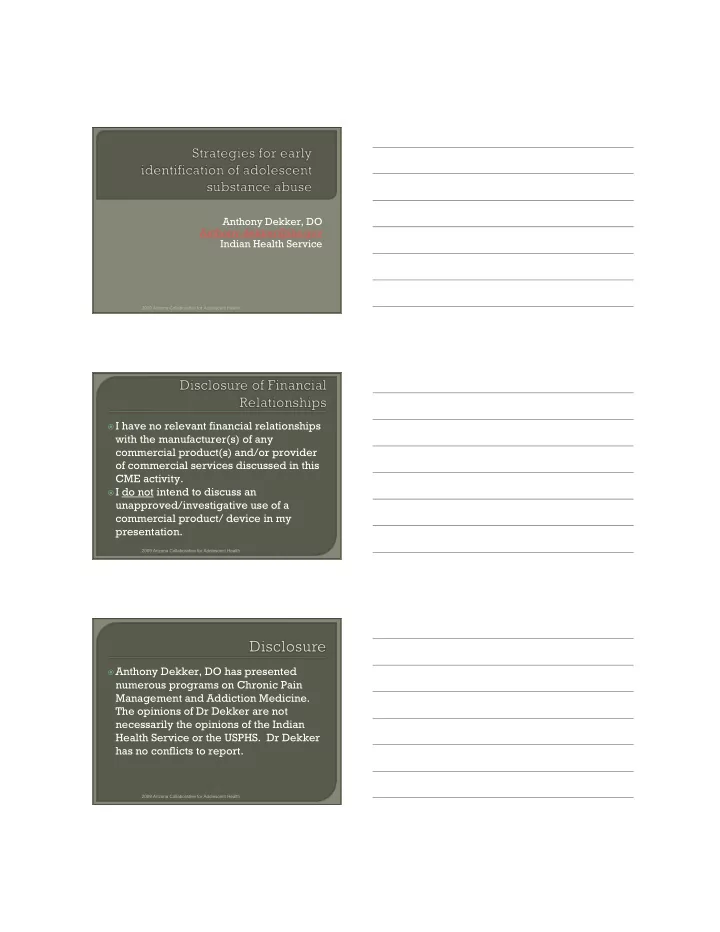
Anthony Dekker, DO Anthony.dekker@ihs.gov Indian Health Service 2009 Arizona Collaborative for Adolescent Health I have no relevant financial relationships with the manufacturer(s) of any commercial product(s) and/or provider of commercial


slide-1
SLIDE 1

Anthony Dekker, DO Anthony.dekker@ihs.gov Indian Health Service

2009 Arizona Collaborative for Adolescent Health

I have no relevant financial relationships

with the manufacturer(s) of any commercial product(s) and/or provider

  • f commercial services discussed in this

CME activity.

I do not intend to discuss an

unapproved/investigative use of a commercial product/ device in my presentation.

2009 Arizona Collaborative for Adolescent Health

Anthony Dekker, DO has presented

numerous programs on Chronic Pain Management and Addiction Medicine. The opinions of Dr Dekker are not necessarily the opinions of the Indian Health Service or the USPHS. Dr Dekker has no conflicts to report.

2009 Arizona Collaborative for Adolescent Health

slide-2
SLIDE 2

1.

State the demographics of Arizona alcohol and substance use and abuse.

2.

Recognize at least three early signs of alcohol and substance use, especially prescription drugs.

3.

Identify the impact of adolescent cognitive development on decision-making involving risk behavior including alcohol and substance abuse.

4.

Describe at least two communication skills necessary in interacting early, middle and late adolescents.

5.

Advise parents and adolescents on substance use and treatment.

2009 Arizona Collaborative for Adolescent Health

 79% had at least one drink of alcohol on one or

more days during their life.

 • 27% had their first drink of alcohol, other

than a few sips, before age 13.

 • 47% had at least one drink of alcohol on one

  • r more occasion in the past 30 days.

 • 31% had five or more drinks of alcohol in a

row (i.e. binge drinking) in the past 30 days.

 • 8% had at least one drink of alcohol on

school property on one or more of the past 30 days

2009 Arizona Collaborative for Adolescent Health

2005 National Survey on Drug and

Alcohol Use (NSDUH) data from Substance Abuse and Mental Health Services Administration (SAMHSA)

Drug and Alcohol Services Information

Systems 2/11/2007

NIDA ‘Monitoring the Future’ study, 2008

data

2009 Arizona Collaborative for Adolescent Health

slide-3
SLIDE 3

2009 Arizona Collaborative for Adolescent Health

2005 National Survey on Drug Use & Health

Current= 1 drink in last 30 days, binge= 5 or more drinks at one time in 30 days, heavy= 5 or more drinks 5 times in 30 days 2009 Arizona Collaborative for Adolescent Health

2005 National Survey on Drug Use & Health

2009 Arizona Collaborative for Adolescent Health

slide-4
SLIDE 4

 First use of alcohol at under 15 y.o. predicts a

fourfold increase in lifetime risk for alcohol dependence

 Data gathered from US general population  Each year that first use is delayed results in

decreased risk of alcohol dependence

 Native American communities have varying

but LOWER age at onset

2009 Arizona Collaborative for Adolescent Health

Age <12 No probs 3% Abuse 5%

Dependence

92% 13 7% 13% 80% 14 11% 19% 70% 15 19% 22% 59% 16 15% 22% 63% 17 32% 22% 46% 18 39% 20% 41% 19 22% 17% 61% 20 29% 43% 29% 21 and up 72% 15% 12%

2009 Arizona Collaborative for Adolescent Health

 2001-2002 NIAAA study  40.000 face to face interviews  4778 alcohol-dependent patients

  • 15% diagnosable <18 y.o.
  • 47% diagnosable <21 y.o.
  • 66% diagnosable <25 y.o.

 Earlier onset predicts LESS likelihood of

ever seeking treatment and MORE severe course

2009 Arizona Collaborative for Adolescent Health

slide-5
SLIDE 5

Ralph Hingson, Boston University School

  • f Public Health and its Youth Alcohol

Prevention Center. "This analysis suggests that interventions that delay drinking onset may not only reduce the acute consequences of drinking among youth, but may help reduce alcohol dependence among adolescents and adults"

2009 Arizona Collaborative for Adolescent Health

47% of who drank before age 14

developed alcohol dependence compared to 9% of those who started after age 21.

Survey with 43,000 adults Reference:

Hingson, R. W., Heeren, T., Winter, M.

  • R. (2006) Age at Drinking Onset and

Alcohol Dependence Age at Onset, Duration, and Severity. Arch Pediatr Adolesc Med., 160(7): 739-746.

2009 Arizona Collaborative for Adolescent Health 2009 Arizona Collaborative for Adolescent Health

slide-6
SLIDE 6

2003 National Survey on Drug Use & Health: Results

2009 Arizona Collaborative for Adolescent Health 3

Mean Age at First Use for Specific Illicit Drugs among Past Year Initiates Aged 12 to 49: 2005

Fig 5.2

Age in Years 16.1 16.5 17.4 18.3 19.7 20.1 20.7 21.2 22.2 22.9 25.7

5 10 15 20 25 30 PCP Heroin Ecstasy Stimulants Marijuana Sedatives LSD Cocaine Inhalants Pain Relievers Tranquilizers

2009 Arizona Collaborative for Adolescent Health

 Sweden, Netherlands: 2 retrospective reviews  New Zealand: 2 studies, prospective from birth  Cannabis use in adolescence associated with

2-3 x increase in schizophrenia risk

 Population-attributable risk of schizophrenia =

8% (removal of cannabis would have led to 8% reduction in schizophrenia cases)

2009 Arizona Collaborative for Adolescent Health

slide-7
SLIDE 7

 In May 2006, San Carlos Apache Chairwoman

Kathleen Wesley-Kitcheyan reported to the Senate Committee on Indian Affairs that of 256 babies born in San Carlos in 2004, 64 tested positive for methamphetamine, and

 Deputy IHS director Robert McSwain reported

the number of methamphetamine-related IHS patient services more than doubled between 2000 and 2005

2009 Arizona Collaborative for Adolescent Health 2009 Arizona Collaborative for Adolescent Health 2009 Arizona Collaborative for Adolescent Health

slide-8
SLIDE 8

2009 Arizona Collaborative for Adolescent Health 2009 Arizona Collaborative for Adolescent Health 18

Source Where Psychotherapeutics Were Obtained for Most Recent Nonmedical Use among Past Year Users Aged 12 or Older: 2005

Percent of Past Year Users

20 40 60 80 100

Pain Relievers Tranquilizers Methamphetamine Stimulants

O t h e r B

  • u g h t o n

I n t e r n e t D r u g D e a l e r / S t r a n g e r 1 o r M

  • r e

D

  • c t o r s

B

  • u g h t / T
  • o k

f r o m F r i e n d / R e l a t i v e F r e e f r o m F r i e n d / R e l a t i v e

8 2009 Arizona Collaborative for Adolescent Health