I call it the Vegetable Visa:" A Gender Structure Analysis of - - PowerPoint PPT Presentation

i call it the vegetable visa a gender structure analysis
SMART_READER_LITE
LIVE PREVIEW

I call it the Vegetable Visa:" A Gender Structure Analysis of - - PowerPoint PPT Presentation

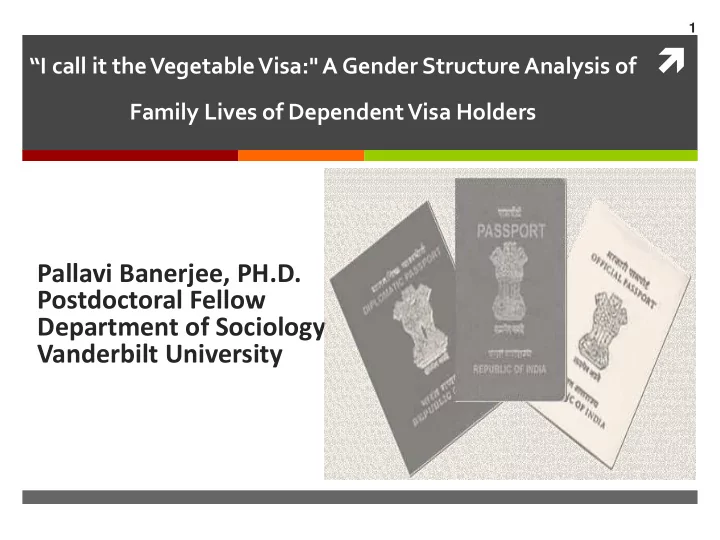
1 I call it the Vegetable Visa:" A Gender Structure Analysis of Family Lives of Dependent Visa Holders Pallavi Banerjee, PH.D. Postdoctoral Fellow Department of Sociology Vanderbilt University 2 Context of Indian Migration


slide-1
SLIDE 1

“I call it the Vegetable Visa:" A Gender Structure Analysis of Family Lives of Dependent Visa Holders

Pallavi Banerjee, PH.D. Postdoctoral Fellow Department of Sociology Vanderbilt University

1
slide-2
SLIDE 2

Context of Indian Migration

 Immigration Act of 1990 and H visa category  India the second largest recipients of

professional work visas

 25% of all work visas issued by U.S in 2010

went to Indian workers.

 Fuelled by technology boom in India and U.S.

2

slide-3
SLIDE 3

Families under study

 Male-led migration:

 High-tech workers on skilled workers visas and

dependent wives

 Female-led migration:

 Nurses on work visas and dependent husbands

3

slide-4
SLIDE 4

CRITERIA FOR THE TWO VISAS UNDER STUDY AS STATED BY U.S CONSULATES IN INDIA

H1B OR SKILLED WORKERS TEMPORARY MIGRATION VISA H4 VISA OR DEPENDENT VISA FOR FAMILY MEMBERS

Visa for professionals in “Specialty Occupation” (SO) with at least a bachelor’s degree. Spouse and children of any of the H (1, 2 and 3) visa holders can apply for a H4 dependent visa SO include: accounting, computer professionals, engineers, financial analysts, doctors, scientists, architects and lawyers. The term of the visa aligns with the term

  • f the employed spouse

Issued for 3 years and extendable for another 3 years H4 visa holder may not hold any kind of employment in the United States Employer can choose to apply for permanent residency or not They may not have social security card or any kind of government issued identification H1B workers are expected to make valuable contribution to American society Some states they are not allowed to drive.

4

slide-5
SLIDE 5

Research Questions

How does U.S. visa policies for high-skilled workers and their families affect parenting and gender relationship in these migrant families?

 What are gendered implications of the visa policies

when the migration is male-led and when it is female led?

5

slide-6
SLIDE 6

Theoretical Framework

 Gender Structure Theory (Risman 1998)

 Gender at the individual level or internalized gender  Gender at the interactional level or the social and

cultural performance of gender

 Gender at the institutional level or organizations as

gendered.

6

slide-7
SLIDE 7

Methods

 Ethnography

  • In-depth interviews with 100 individuals selected

through convenience sampling

 86 interviews with both spouses in families of

nurses and high-tech workers.

 14 interviews with immigration policy officials

– lawyers, legislators and activist groups.

  • Participant Observations

 2 years of participant observations at various

public spaces to observe family and gender dynamics.

7

slide-8
SLIDE 8

Key Background Information of Participants

HiGH TECH WORKERS AND SPOUSES NURSES AND SPOUSES Mostly from urban, metropolitan, northern part of India Mostly from rural and South India –

  • ne particular State in the South

Middle to upper middle calls backgrounds in India when in Indian Lower middle to middle class background when in India Both spouse proficient in English and had high human capital. Wives often had higher degrees than the professional “skilled” husband. Nurses had mostly BSN degrees. The husbands were comparatively low on human capital. Most did not go to college and did not have English proficiency Religiously diverse but mostly Hindu or Muslim All families of nurses were Christians

8

slide-9
SLIDE 9

 Institutional level:

 “Visas to Create of Stable Migrant Families”  Gender-neutral language

 Individual Level:

 Falling back on internalized gendered understandings to

cope with state-imposed dependence

 Interactional Level:

 Conflicting familial gendered and social expectations  Undoing gender in the realm of childcare in both family

forms.

Findings

9

slide-10
SLIDE 10

Congresswoman in talking H-4 visas: “We need these people to work our high-tech jobs. We work with the industries to make that happen. This was the

  • nly and best way to let the workers have families here

in the United States. I think this is a fair policy. We need stable families in the United States for our workers and this visa ensures that.”

Construction of “ideal workers”

10

slide-11
SLIDE 11

Wives on dependent Visa: Jaya: I call this the “vegetable visa”. It is meant to take away your identity and make you vegetate. Mili: “I landed in this country and what I was, what I became was just an H-4. I was just Ravish’s wife, a housewife, with no identity of my own. Yes, when I chose to come here on H-4, I gave up what was me. My work ID back in India that stated by name, what I did, who I was, was gone. I became invisible just like what my driver’s license says: not valid for identification. It took me a while to come to terms with it; but, I did.”

Shame, humiliation and trauma

11

slide-12
SLIDE 12

12

slide-13
SLIDE 13

Husbands on dependent Visa: George: “It’s a visa, what else can I say…” (moves on other topics) Johnny: “I am a loser, loser, loser….(garbled speech) for coming as a dependent on a woman and now I am the bad one. I took to drinking and smoking, what else could I do? When men are unhappy they drink because we can’t cry but then we drink and we cry inside – tears that kill”

Shame, humiliation and trauma

13

slide-14
SLIDE 14

Individual Level: Families of High-Tech Workers

Women drawing on gendered meanings of marriage to cope

Mili: “Suddenly I became this obedient, good housewife and just dedicated my life to keeping my husband happy. I have worked since I was 16 and lived by myself, supported my own education back in India. I never thought I would have to be so dependent economically and mentally. I call it the H-4 syndrome.” I: “You knew you were coming on dependent visa? Why did you choose to come?” Mili: “Well, once you are married you are supposed to be with your husband and take care of him and his household. My dad and Ravish’s family wanted me to join him ASAP after we got married. Not that I did not want to come but had I known I probably would rethink…and now those nuts want grandchildren…I am not falling in that trap…”

14

slide-15
SLIDE 15

Interactional Level: Families of High-Tech Workers

Women resentfully did 95% of the household work and continuous parenting Jaya in counting housework hours say: “Wow a 100+ hours per week, imagine how much I could have billed if I was still working. I am practically a single mother and I never thought of myself as a housewife and definitely not a single mother.” Mia: “In the U.S, you are the cook, the maid, the driver, the nanny – you are working round the clock practically and now with the baby I practically feel like a single mother because Rex is never home”

15

slide-16
SLIDE 16

Interactional Level: Families of High-Tech Workers

 Husbands guilty because loss of class status and losing on

fatherhood

Akash, Jaya’s husband: I hardly get to see my son because I am working so much….when my white boss’s dog gets sick he takes off at midday but I can’t even take off when my kid is sick because they know I have a wife at home. We Indians are all glorified servants in the U.S.

Rex, Mia’s husband: “the only reason, I would ever think of going back to India would be so that we can afford help and have a better quality of life with my kid. Also that way Mia does not have to do all the crappy work she does here and we can have a relaxed life.”

16

slide-17
SLIDE 17

Individual Level: Families of Nurses

Nurses: Compensatory overemphasis of femininity in family context

Dependent husbands: Reassertion masculinity in family context to maintain male privilege.

Shija on cooking: “This is the only, most real way I can show my kids and my husband that I care for them. Also, I want my kids to grown up eating Malayalee food. It is big part of who we are. I grew up eating my mother’s home cooked meal and so should they. This is least I can do for them. I feel so guilty for being mother who is always gone.” Joseph a dependent husband: “As a man I needed to make sure my family is okay and my wife was getting this opportunity to help our family and for that I would have to sacrifice a little and I was ready for that. I don’t think about these things. Government does what it has to – it is no point getting depressed about this. I am doing my duty of keeping my family secure. That is what a man should do.”

17

slide-18
SLIDE 18

Interactional Level: Families of Nurses

Social expectations of dependence trumped by gendered cultural beliefs

Some undoing of gender Gina on household income: “I am not quite sure; you have to ask my husband. He is the one who handles all the money things. My salary goes into our account and then he manages it – does what he thinks best. We are still a traditional Indian family. He is still the master of the house. Any major decisions about the kids or money, he takes those decisions. It is important for us as family to give him that respect. Just because he cannot work because of the visa we don’t want him to feel he is not the head of the family.” John: “My children really love me. If they need anything or if they have to share anything, the first person they run to is me, not their mother. It makes me feel important. It is a wonderful feeling to be loved by your children.”

18

slide-19
SLIDE 19

Dependent Visa Policy – A Failing Policy

Visa holders actively resisting reformulation of the self

Stable migrant families: a myth

Lasting impact on mental heath and family

Breaking up families Kaushik: “her visa fucked it up for us…We had no issues as couples; but, with the visa situation and the mounting frustration, I think this is the best solution. It is unfortunate! (Sighs)”

19

slide-20
SLIDE 20

Implication for Policy Reform

 Allow legal paid for dependent visa holders  Allow access to other social and economic resources

available to visa holders in the U.S.

 Regulating exploitative work practices for migrant

professional workers.

 Form communities of support

20