Hypoxia-Dependent Epigenetic Modifications in the Pulmonary I have - - PowerPoint PPT Presentation

hypoxia dependent epigenetic modifications in the
SMART_READER_LITE
LIVE PREVIEW

Hypoxia-Dependent Epigenetic Modifications in the Pulmonary I have - - PowerPoint PPT Presentation

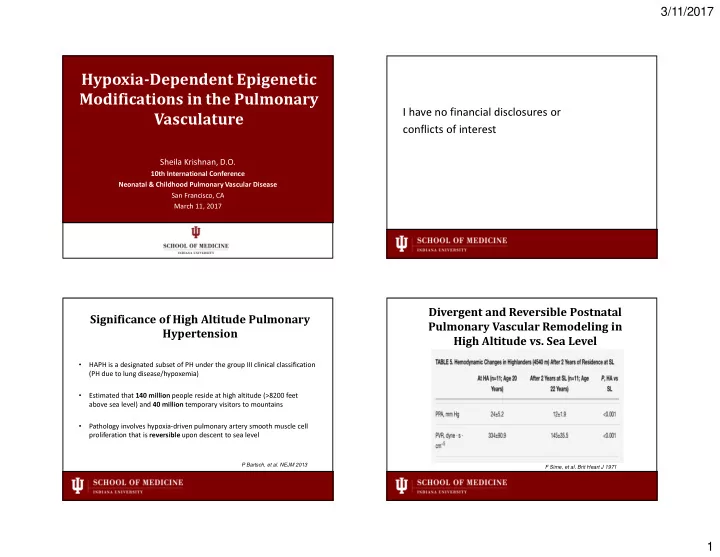
3/11/2017 Hypoxia-Dependent Epigenetic Modifications in the Pulmonary I have no financial disclosures or Vasculature conflicts of interest Sheila Krishnan, D.O. 10th International Conference Neonatal & Childhood Pulmonary Vascular


slide-1
SLIDE 1

3/11/2017 1

Sheila Krishnan, D.O.

10th International Conference Neonatal & Childhood Pulmonary Vascular Disease San Francisco, CA March 11, 2017

Hypoxia-Dependent Epigenetic Modifications in the Pulmonary Vasculature

I have no financial disclosures or conflicts of interest Significance of High Altitude Pulmonary Hypertension

  • HAPH is a designated subset of PH under the group III clinical classification

(PH due to lung disease/hypoxemia)

  • Estimated that 140 million people reside at high altitude (>8200 feet

above sea level) and 40 million temporary visitors to mountains

  • Pathology involves hypoxia-driven pulmonary artery smooth muscle cell

proliferation that is reversible upon descent to sea level

P Bartsch, et al. NEJM 2013 D Penaloza, et al. Circ 2007

Divergent and Reversible Postnatal Pulmonary Vascular Remodeling in High Altitude vs. Sea Level

F Sime, et al. Brit Heart J 1971

slide-2
SLIDE 2

3/11/2017 2

Peri and Postnatal Events in PH

Risk Factors

  • Genetic
  • Environmental
  • Endogenous

Derived from E Austin, et al. Ann Am Thorac Soc 2014

Fetus Child Adult TIME

*☨

C Sartori, et al. Lancet 1999

Augmented Vasoreactivity in Adult Life Associated with Perinatal Vascular Insult

Significance of Epigenetics and PH

  • Epigenetics: refers to changes in gene expression that

do not involve changes in the DNA sequence

– Change in phenotype without change in genotype

  • Epigenetic changes in mitochondrial metabolism and

histone acetylation have been linked to vascular pathology in PH development in animal models

SL Archer, et al. Circ 2010 L Zhao, et al. Circ 2012 E Rexhaj, et al. Am J Physiol Heart Circ Physiol 2011

Epigenetic Induction of Pulmonary Vascular Dysfunction is Reversible through Modification of the In Utero Environment

# p=0.002 vs. controls ⍺ p=0.009 vs. diet + vehicle ✻p=0.02 vs. controls

slide-3
SLIDE 3

3/11/2017 3

Research Questions

  • Do epigenetic modifications play a role in the

adaptive response to chronic hypoxia?

  • If so, what pathways are involved and how

early in life do these modifications begin?

Green: hypomethylated (upregulated) genes Red: hypermethylated (downregulated) genes Hypomethylated pathways/genes

  • Lung differentiation (NFATc1)
  • VEGF signaling (SEMA3A)

Differentially Methylated Genes in Peripheral Blood of High Altitude vs. Low Altitude Infants

Low Altitude n=10 High Altitude n=10

  • S. Krishnan, et al. Am J Respir Crit Care Med

193;2016:A7841

Hypotheses

  • Epigenetic changes play a role in the developmental adaptive

response to chronic hypoxia

  • Chronic hypoxia in utero stimulates epigenetic modifications of

hypoxia-sensitive pathways that provide developmental adaptive processes in the cardiopulmonary system and minimize HAPH

  • The epigenetic modifications that occur in utero are inducible and

reversible when the post utero environment is changed

  • Responses to chronic hypoxia differ between males and females

Research Design

Breeding pair in hypobaric hypoxia (FiO2=15%; equiv to 9,000 ft altitude) Breeding pair in normoxia

Hypoxia In-utero Hypoxia Post-natal Room air In-utero Room air Post-natal

slide-4
SLIDE 4

3/11/2017 4

Datapoints

  • Post natal day 1:
  • Lung and vascular structure
  • DNA-epigenetic analysis: peripheral blood, lung, heart, skeletal muscle
  • 6 weeks:
  • Lung volumes
  • Diffusing capacity
  • Right ventricular thickness
  • Cardiac output
  • Hemodynamics
  • Pulmonary artery structure
  • DNA-epigenetic analysis: peripheral blood, lung, heart, skeletal muscle

Simulated High Altitude Exposure is Associated with Increased Diffusing Capacities at 6 wks of age

male female male female 0.00 0.05 0.10 0.15 DLCO RA-RA H-H

p=0.028 p=0.0127

Simulated High Altitude Exposure is Associated with Increased Functional Residual Capacity at 6 wks of age

male female male female 0.000 0.005 0.010 0.015 0.020 FRC/weight RA-RA H-H

p=0.007

Simulated High Altitude Exposure is Associated with Increased RV Cardiac Output in Males at 6 wks of age

male female male female 0.0 0.5 1.0 1.5 2.0

RV CO/weight

RA-RA H-H p=0.0475

slide-5
SLIDE 5

3/11/2017 5 Simulated High Altitude Exposure is Associated with Increased RV Mass in Males at 6 wks of age

male female male female 0.0 0.1 0.2 0.3 0.4 0.5 RV/LV+septum

RA-RA H-H p=0.0019

Summary

  • Preliminary data indicates there is a HAPH phenotype at 15% FiO2
  • Males seem to have a more distinct phenotype compared to females, suggesting

that sex hormones may play a role

  • Next Steps:

– Perform epigenetic analyses on tissue from RA-RA and H-H groups – Perform cross-over study for RA-H and H-RA groups

Mentors: Tim Lahm, M.D. Rob Tepper, M.D, Ph.D. Lab Members: Yong Gao Amanda Fischer Margie Albrecht Andrea Frump, Ph.D. Funding: PHA - Cordelia's Pediatric PH Research and Mentoring Grant T32 Training Program in Molecular Physiology and Clinical Mechanisms of Lung Disease, Indiana University

THANK YOU