Hyperball -- Hypernuclear spectroscopy at J-PARC -- H. Tamura - - PowerPoint PPT Presentation

hyperball
SMART_READER_LITE
LIVE PREVIEW

Hyperball -- Hypernuclear spectroscopy at J-PARC -- H. Tamura - - PowerPoint PPT Presentation

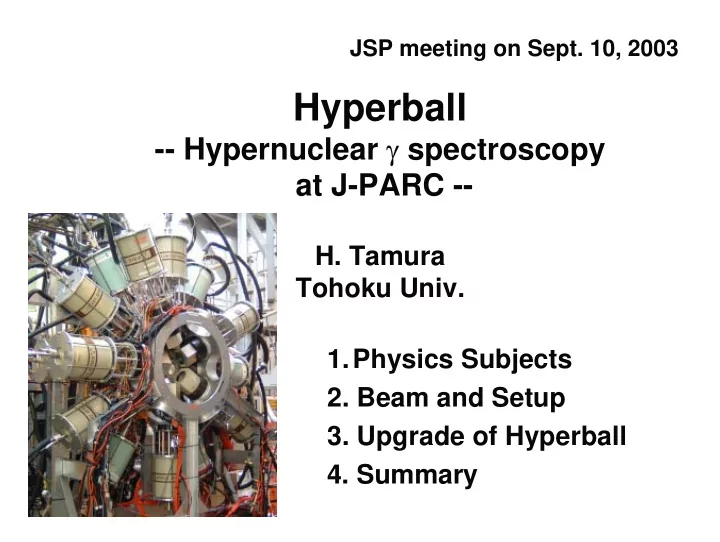
JSP meeting on Sept. 10, 2003 Hyperball -- Hypernuclear spectroscopy at J-PARC -- H. Tamura Tohoku Univ. 1.Physics Subjects 2. Beam and Setup 3. Upgrade of Hyperball 4. Summary 1. Physics subjects of spectroscopy Systematic Study of


slide-1
SLIDE 1

Hyperball

  • - Hypernuclear γ spectroscopy

at J-PARC --

  • H. Tamura

Tohoku Univ. 1.Physics Subjects

  • 2. Beam and Setup
  • 3. Upgrade of Hyperball
  • 4. Summary

JSP meeting on Sept. 10, 2003

slide-2
SLIDE 2
  • 1. Physics subjects of γ spectroscopy

YN interactions

ΛN : spin-dependent forces ΛN-ΣN / ΛNN forces charge symmetry breaking p-wave interaction ΞN, ΛΛ interactions

Impurity effects

B(E2) -> shrinking effect Shrinkage of n-halo Change of cluster/shell structure

Nuclear medium effect

B(M1) -> µΛ inside a nucleus density / isospin dependence Systematic Study of High-Precision (2 keV) Hypernuclear Structure = “ Table of Hyper-Isotopes ”

spin-spin: 7

ΛLi (KEK E419)

PRL 84 (2000) 5963

LS: 9

ΛBe (BNL E930)

PRL 84 (2002) 082501

tensor: 16

ΛO (BNL E930)

Ukai, 12aSE PRL 86 (2001) 1982

B(E2): 7

ΛLi (KEK E419) 11 ΛB (KEK E518)

New method: Hyperfragments (KEK E509)

slide-3
SLIDE 3

Letter Of Intent [ S = -1 ]

(1) Light Hypernuclei by (K-, π- γ) p= 1.1 and 0.8 GeV/c All targets of A<30 Detailed (γγ、γπ/γγ corr., pol, B(E2)) for 12

ΛC, 20 ΛNe, 28 ΛSi, …

(2) Medium and heavy Hypernuclei (89

ΛY, 139 ΛLa, 208 ΛPb, ..) by (K-, π- γ)

E1(pΛ->sΛ) => p-wave ΛN interaction (3) Hyperfragments by (K-stop, γγ) / (K-, γπ-) p= 0.8--0.6 n-rich/ p-rich hypernuclei, A=8 (4) Mirror / n-rich Hypernuclei by (K-, π0 γ) p= 1.1 and 0.8

4 ΛH(4 ΛHe) , 12 ΛB(12 ΛC), 16 ΛN(16 ΛO)

=> Charge Sym. Break. (5) B(M1) by DSAM (π+, K+ γ) or (K-, π- γ) p=1.1

11 ΛB, 7 ΛLi etc.

(6) B(M1) by γ-weak (K-, π- γ weak) p= 1.1 or 0.8

12 ΛC, heavier

=> Impurity effect (Shrinkage of n-halo) => µΛ in nucleus

Beam intensity

Low (<1/10) Med (1/10~1/2) High (>1/2) => ΛN spin-dep. and ΛN/ΣN interactions, Impurity effect p=1.8, 1.1, 0.8 “Day-one experiment”
slide-4
SLIDE 4

Letter Of Intent [ S = -2 ]

=> ΞN interaction (7) Ξ atom by (K-, K+ γ) p= 1.8 GeV/c ・ wide range of A (8) ΛΛ−nuclei by (K-, K+π- γ) p=1.8 ・ several p-shell targets => ΛΛ interaction

Beam intensity

Low (<1/10) Med (1/10~1/2) High (>1/2)

slide-5
SLIDE 5

Letter Of Intent [ S = -1 ]

(1) Light Hypernuclei by (K-, π- γ) p= 1.1 and 0.8 GeV/c All targets of A<30 Detailed (γγ、γπ/γγ corr., pol, B(E2)) for 12

ΛC, 20 ΛNe, 28 ΛSi, …

(2) Medium and heavy Hypernuclei (89

ΛY, 139 ΛLa, 208 ΛPb, ..) by (K-, π- γ)

E1(pΛ->sΛ) => p-wave ΛN interaction (3) Hyperfragments by (K-stop, γγ) / (K-, γπ-) p= 0.8--0.6 n-rich/ p-rich hypernuclei, A=8 (4) Mirror / n-rich Hypernuclei by (K-, π0 γ) p= 1.1 and 0.8

4 ΛH(4 ΛHe) , 12 ΛB(12 ΛC), 16 ΛN(16 ΛO)

=> Charge Sym. Break. (5) B(M1) by DSAM (π+, K+ γ) or (K-, π- γ) p=1.1

11 ΛB, 7 ΛLi etc.

(6) B(M1) by γ-weak (K-, π- γ weak) p= 1.1 or 0.8

12 ΛC, heavier

=> Impurity effect (Shrinkage of n-halo) => µΛ in nucleus

Beam intensity

Low (<1/10) Med (1/10~1/2) High (>1/2) => ΛN spin-dep. and ΛN/ΣN interactions, Impurity effect p=1.8, 1.1, 0.8 “Day-one experiment”

slide-6
SLIDE 6

Expected transitions

12C (π+,K+) 12 ΛC

SKS ∆E~1.5 MeV(FWHM)

Simulation: K1.1, 10g/cm2, 120 hours

(1) Light hypernuclei

  • -- example of 12

ΛC

b a c d g f e h i j k l m n

  • p

c b h g k e j i f a l d

slide-7
SLIDE 7

θπγ angular correlation

  • > spin assignment

γγ coincidence

and angular correlations

γγ coincidence spectrum

  • > level scheme
  • coinc. with a (21
  • ->11
  • )
  • coinc. with c (12
  • -> 21
  • )

k h f j h k c

12 ΛC: simulation

slide-8
SLIDE 8

(1) Light hypernuclei

Impurity effect

  • -- example of 20

ΛNe : change of cluster structure

shrinking effect considered (cluster model)

slide-9
SLIDE 9

Letter Of Intent [ S = -1 ]

(1) Light Hypernuclei by (K-, π- γ) p= 1.1 and 0.8 GeV/c All targets of A<30 Detailed (γγ、γπ/γγ corr., pol, B(E2)) for 12

ΛC, 20 ΛNe, 28 ΛSi, …

(2) Medium and heavy Hypernuclei (89

ΛY, 139 ΛLa, 208 ΛPb, ..) by (K-, π- γ)

E1(pΛ->sΛ) => p-wave ΛN interaction (3) Hyperfragments by (K-stop, γγ) / (K-, γπ-) p= 0.8--0.6 n-rich/ p-rich hypernuclei, A=8 (4) Mirror / n-rich Hypernuclei by (K-, π0 γ) p= 1.1 and 0.8

4 ΛH(4 ΛHe) , 12 ΛB(12 ΛC), 16 ΛN(16 ΛO)

=> Charge Sym. Break. (5) B(M1) by DSAM (π+, K+ γ) or (K-, π- γ) p=1.1

11 ΛB, 7 ΛLi etc.

(6) B(M1) by γ-weak (K-, π- γ weak) p= 1.1 or 0.8

12 ΛC, heavier

=> Impurity effect (Shrinkage of n-halo) => µΛ in nucleus

Beam intensity

Low (<1/10) Med (1/10~1/2) High (>1/2) => ΛN spin-dep. and ΛN/ΣN interactions, Impurity effect p=1.8, 1.1, 0.8 “Day-one experiment”

slide-10
SLIDE 10

Letter Of Intent [ S = -1 ]

(1) Light Hypernuclei by (K-, π- γ) p= 1.1 and 0.8 GeV/c All targets of A<30 Detailed (γγ、γπ/γγ corr., pol, B(E2)) for 12

ΛC, 20 ΛNe, 28 ΛSi, …

(2) Medium and heavy Hypernuclei (89

ΛY, 139 ΛLa, 208 ΛPb, ..) by (K-, π- γ)

E1(pΛ->sΛ) => p-wave ΛN interaction (3) Hyperfragments by (K-stop, γγ) / (K-, γπ-) p= 0.8--0.6 n-rich/ p-rich hypernuclei, A=8 (4) Mirror / n-rich Hypernuclei by (K-, π0 γ) p= 1.1 and 0.8

4 ΛH(4 ΛHe) , 12 ΛB(12 ΛC), 16 ΛN(16 ΛO)

=> Charge Sym. Break. (5) B(M1) by DSAM (π+, K+ γ) or (K-, π- γ) p=1.1

11 ΛB, 7 ΛLi etc.

(6) B(M1) by γ-weak (K-, π- γ weak) p= 1.1 or 0.8

12 ΛC, heavier

=> Impurity effect (Shrinkage of n-halo) => µΛ in nucleus

Beam intensity

Low (<1/10) Med (1/10~1/2) High (>1/2) => ΛN spin-dep. and ΛN/ΣN interactions, Impurity effect p=1.8, 1.1, 0.8 “Day-one experiment”

slide-11
SLIDE 11

(5),(6) B(M1) measurements

Λ

core nucleus Jc Jc +1/2 Jc -1/2

M1

in s-orbit

"hypernuclear fine structure"

hypernucleus

ψ

Λ↑ψ

c

ψ

Λ↓ψ

c

µΛ in nucleus -> medium effect of baryons

B(M1) ∝| < Φf |

µ z|

Φi> |

2 = |

< ψ

Λ↑ψ

c|

gcJcz + gΛJΛz | ψ

Λ↓ψ

c>

|

2 ∝

( gc - gΛ )2

Doppler shift attenuation method [same as B(E2), established]

for light hypernuclei; Weak K- or π+ beam usable

γ-weak coincidence method [new, only possible at J-PARC]

for 12

ΛC and heavy hypernuclei; Intense K- beam necessary

Accuracy ∆gΛ < 5% achievable

slide-12
SLIDE 12

B(M1) measurement by γ-weak coincidence method

400 hours for 12

ΛC

  • > 5% error of B(M1)
slide-13
SLIDE 13

0.8, 1.8 GeV/c (K-,π-) = large σ and non-spin-flip + 1.1 GeV/c (K-,π-) = spin-flip

・ Reveal all the levels ・ Level assignment ・ Spin-flip B(M1) -> µΛ

K- Beam momentum for S=-1

slide-14
SLIDE 14
  • 3. Beam and Setup
  • Beamline: K1.1

K- at 1.1, 0.8 GeV/c 4.2x10⁷ K-/spill K/π > 1 π+ at 1.05 GeV/c

  • Spectrometer: SPESII

(existing) ∆p/p < 2 MeV (FWHM) Ω ~ 20 msr SKS (100 msr) is better

  • Hyperball3 (2007?)

ε > 10% at 1 MeV

  • r Hyperball2 (2003)

ε ~ 5% at 1 MeV

Hyperball3

slide-15
SLIDE 15

Comparison of K1.1, K1.1BR, and K1.8

Beamline K1.1 K1.1BR K1.8 Momentum 1.1 1.1 1.1 K- intensity /spill 4.2x10⁷ 1.0x10⁷ 0.049x10⁷ K/π > 1 / 1 ~ 1 / 5 > 1 / 1

  • eg. 7

ΛLi (3/2+) (spin-flip state): dσ/dΩ = 17 µb/sr @100 , Hyperball3

Ω (msr) 20 (SPESII) 50 (SKS) γ yield (counts/hour) Ge rate limit = 2x10⁷/spill 280 44 17 0.2 (E419) (Ge no rate limit) (580) (134) (17) Ge damage (relative) 1 6 1

Subjects (1), (2), (4), (5), (6) require production of spin-flip states by 1.1 GeV/c (K-,π-) reaction.

slide-16
SLIDE 16
  • 4. Upgrade of Hyperball
  • Clover Ge (r.e. >120%)

+BGO x 6 added

  • Peak eff.

~ 2.5% -> 5% at 1 MeV

  • Beam test of Clover Ge

(T536, June 2003) OK

  • VME-based fast readout
  • Improvement of preamplifier

Hyperball2 : under construction (2003)

collaboration with CYRIC, Tohoku

slide-17
SLIDE 17

Hyperball3

(Segmented Clover version)

PWO counters

14 sets

r.e.= 350%

ε > 10% at 1 MeV

(x4 of Hyperball)

Rate limit

~2x10⁷ particles /s (x5)

Yield: x20 for single γ

x80 for γγ

PWO counters

slide-18
SLIDE 18

R&D for Hyperball3

Waveform readout method –> pileup decomposition, baseline restoration High resolution waveform digitizer Data transfer Analysis software Lower-gain, faster-reset preamplifiers Faster suppressor than BGO (PWO, BSO, ..) LN2-free cooling Radiation damage

slide-19
SLIDE 19
  • 5. Summary
  • γ spectroscopy is one of the main strangeness

programs in J-PARC.

  • Systematic studies for various subjects

(YN interaction, impurity effects, medium effects) are proposed. Regarded as a day-one experiment.

  • K1.1 + Hyperball3 gives 103 improvement.
  • R&Ds for Hyperball3 have been started.