
SLIDE 1
Hydrophysical processes of the Aral sea desiccation: historical data - - PowerPoint PPT Presentation
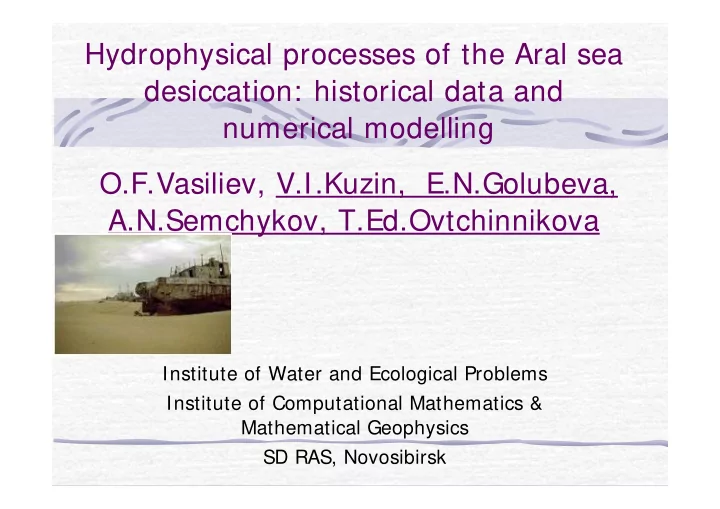
Hydrophysical processes of the Aral sea desiccation: historical data and numerical modelling O.F.Vasiliev, V.I.Kuzin, E.N.Golubeva, A.N.Semchykov, T.Ed.Ovtchinnikova Institute of Water and Ecological Problems Institute of Computational
10 20 30 40 50 60 70 80 1930 1940 1950 1960 1970 1980 1990 2000
Flow (km3), Level (m), Area (103 km2)
1 2 3 4 5 6 7 8
Irrigated Land (106 ha)
Flow
Area Level Irrigated Land
1995 1996 Difference
Climatic consequences Ecological / economic consequences Health consequences
precipitation and water exchange with ice-snow cover.
water free surface or ice-snow cover, heat income with water of tributaries, precipitates, evaporating water and by water exchange with ice-snow cover.
empirical dependence of salinity of chlorinity. Income on chorine-ions with water of tributaries and its loss with water remaining in bottom asperities of drained area.
Results of modelling by the 0D and 1D models during 1.5 year period 1,2-sea level, 3,4-averaged salinity, 5,7-averaged temperature, 6- averaged temperature
Left: The levels of height (Baltic system) for Aral Sea basin in meters. Right: а) The vertical cross-section of Aral Sea alone latitude;
в) Schematic representation of the sigma-coordinate grid; с) Schematic representation of the z-grid.
50 100 150 200 250 300 350 20 40 60 depth (m) 50 100 150 200 1 2 3 4 5 6 7 8 depth (m) 50 100 150 200 1 2 3 4 5 6 7 8 depth (m) a) b) c)
The first experiment At the first stage of the numerical experiment the Aral Sea basin was taken in a total configuration without damn between the Eastern and the Western parts. The Amy-Darya river runoff was directed to the Eastern part. The integration of the model was carried out during the period of about two years with the wind-stress produced from the NCEP/NCAR wind. The Amu-Darya runoff was taken from the estimates of the hydrologists. The initial salinity was taken 60 g/l (1998). The ice sea model includes only the thermodynamic part without dynamics, reology and drift of ice. On each step, the following 3D hydrophysical fields were calculated: temperature, salinity, velocity. The results of the numerical experiment allow as obtaining some specific features of the Aral Sea circulation, thermodynamics and fresh water spreading.
The circulation in the Aral Sea basin is highly varying and although there are no strongly dominated picturers of the main circulation, it is possible to separate some specific features. First, the circulation is very sensitive to the wind and is mainly derived by the wind, except a short period of the ice covering the sea surface. The Eastern part is very shallow and has the fastest feedback to the wind change. Wide area of the Eastern part allows a well-manifested cyclonic or anticyclonic circulation to be formed. The transition period between them is characterized by the dipole circulation. The Western basin is more narrow and deep. So, the circulation consists of more local gyres, but the feedback to the wind change is slower then this of the Eastern one. The circulation variations during the seasons of the integration period may roughly be described in the following way. In the summer of the integration period in the Eastern part there was a cyclonic circulation. The velocity value reaches 30 cm/s. The circulation in the Eastern basin is cyclonic in the South and anticyclonic in the North. There also exist some local circulations caused by the bottom topography and the basin
dipole circulation. During the winter period, when the wind is blocked by the ice cover this circulation is weakening, until the ice cover disappeares. In Spring, the reconstruction of the circulation in some periods leads to the chaotic enough circulation certain periods, becoming sufficiently stable by May.
The salinity conditions during the integration period are defined by the Amy- Darya inflow during the May-September 1998. In this period the river inflow was extremely high. The pictures present the propagation of the fresh water through the Eastern basin. In the slides the horizontal pictures of the demineralization is presented. After the river inflow stopped, the horizontal distribution became nearly uniform, but the salinity is lower then in the initial
the South to the North. The pool of the freshened water has a tendency to tern to the East under the influence of the Coriolis parameter. Freshened water reaches the narrow straight between the Eastern and Western basins and propagates to the Eastern part as it is shown in the slides. The latitudinal cross-sections represent the vertical distribution during the river inflow and when it was
water front with time.
Meridional salinity cross-section for June, August, October, December 1998 Low two figures: Latitudinal salinity cross-section (September and December 1998)
10 20 30 40 50 60 50 100 150
10 20 30 40 50 50 100 150
10 20 30 40 50 50 100 150
10 20 30 40 50 60 50 100 150
V I V I I I X X I I
3 0 3 2 3 4 3 6 3 8 4 0 4 2 4 4 4 6 8 0 1 0 0 1 2 0 1 4 0 At the final stage of the numerical experiments the Aral Sea basin was taken in a configuration where exists only the Western part. The Amu-Darya river runoff was directed to the Western part with the amount estimated by the hydrologists. At the initial stage, we have no spatial distribution of the temperature and salinity in the basin. So, the constant values of the temperature (-2.5 C) and salinity (140 g/l) corresponding to the winter season (January) were set in a whole basin. The integration of the model was carried out during the period of 18 months with the wind-stress produced from the climatic wind. The ice sea model includes only the thermodynamic part without dynamics, reology and drift of ice. The time step was one hour. On each step, the following 3D hydrophysical fields were calculated: velocity, temperature and, finally, salinity changes as a result of the refreshing by the river runoff.
5 10 15 20 25 30 35 40 45 10 20 30 40 50 60 70 80 90 100 Velocity at the depth of 1 m
Horizontal temperature distribution in the second experiment when the inflow is to the Western basin (March, May, July, 0ctober, January, May)
20 21 22 20 40 60 80 50 100 150 11 12 13 20 40 60 80 50 100 150
20 40 60 80 50 100 150 6.8 7 7.2 7.4 7.6 20 40 60 80 50 100 150
20 40 60 80 50 100 150 8 10 12 14 20 40 60 80 50 100 150 III V VII X XIII XVII Temperature at the depth of 1 m
Zonal cross-section of the temperature (March, May, July, 0ctober, January, April)
50 100 150
5 10 15 50 100 150
10 20 50 100 150
10 20 50 100 150
5 50 100 150
5 50 100 150
III V VII X XIII XVI Temperature (section)
Meridional cross-section of the temperature (March, May, July, 0ctober, January, April)
40 60 80 100 120 140 20 40 60 80 20 40 60 80 100 120 140 160 180 40 60 80 100 120 140 20 40 60 80 20 40 60 80 100 120 140 160 180 40 60 80 100 120 140 20 40 60 80 20 40 60 80 100 120 140 160 180 40 60 80 100 120 140 20 40 60 80 20 40 60 80 100 120 140 160 180 40 60 80 100 120 140 20 40 60 80 20 40 60 80 100 120 140 160 180 40 60 80 100 120 140 20 40 60 80 20 40 60 80 100 120 140 160 180 III V VII X XIII XVI Salinity at the depth 1 m
128 130 132 134 136 138 50 100 150
70 80 90 100 110 120 50 100 150
70 80 90 100 110 50 100 150
85 90 95 100 105 50 100 150
92 93 94 95 96 97 98 99 100 50 100 150
100 100.5 101 50 100 150
III V VII X XIII XVI
Processes in the Aral Sea region during the last 40 years is one
man-induced environmental changes The Aral Sea desiccation changed the regional climate and initiate the problems in ecology, agriculture, fishery, industry, health and social conditions; The use of the Amu-Darya, Sur-Darya water for the agriculture results to the loss 90% of the area and 80% of the volume with increasing of the salinity from 10 to 140 g/l; There exist the real possibility to save only one of the parts of the Big Aral (Western basin) with the reducing of the water use for the agriculture and with the transferring of the Amu-Darya runoff to the western basin.