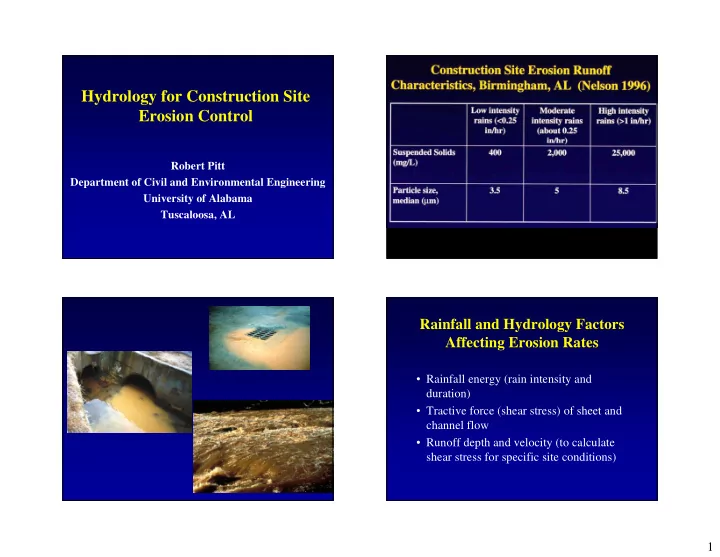
Hydrology for Construction Site Erosion Control Robert Pitt - - PowerPoint PPT Presentation

hydrology for construction site erosion control
SMART_READER_LITE
LIVE PREVIEW

Hydrology for Construction Site Erosion Control Robert Pitt - - PowerPoint PPT Presentation

Hydrology for Construction Site Erosion Control Robert Pitt Department of Civil and Environmental Engineering University of Alabama Tuscaloosa, AL Rainfall and Hydrology Factors Affecting Erosion Rates Rainfall energy (rain intensity and


slide-1
SLIDE 1

1

Hydrology for Construction Site Erosion Control

Robert Pitt Department of Civil and Environmental Engineering University of Alabama Tuscaloosa, AL

Rainfall and Hydrology Factors Affecting Erosion Rates

  • Rainfall energy (rain intensity and

duration)

  • Tractive force (shear stress) of sheet and

channel flow

  • Runoff depth and velocity (to calculate

shear stress for specific site conditions)

slide-2
SLIDE 2

2

Hydrology Parameters Needed for the Design of Construction Site Erosion Control Practices

  • Mulches – water velocities and water depth
  • Ditch liners – water velocities and water depth
  • Slope down shoots – peak flow rates
  • Diversion dikes and swales – peak flow rates
  • Filter fabric fences – water velocities and

hydrographs

  • Sediment ponds – water volume and

hydrographs

Factors Affecting Runoff

  • Rainfall – The duration of the storm and the

distribution of the rainfall during the storm are the two major factors affecting the peak rate of runoff. The rainfall amount affects the volume of runoff.

  • Soil conditions – antecedent moisture conditions

generally affects the infiltration rate of the rainfall falling on the ground. Soil texture and compaction (structure) usually has the greatest effect on the infiltration.

  • Surface cover – the type and condition of the soil

surface cover affects the rain energy transferred to the soil surface and can affect the infiltration rate also. Birmingham Intensity - Duration - Frequency (IDF) Curve

Time of Concentration (tc)

  • The duration must be equal to the time of

concentration for the drainage area.

  • The time of concentration (tc) is equal to the longest

flow path (by time).

  • If the tc is 5 min for a storm having a return period of

25 years, the associated peak intensity (which has a duration of 5 min) would be about 8.6 in/hr.

  • If the tc for this same return period was 40 min, the

peak rain intensity would be “only” 3.8 in/hr.

slide-3
SLIDE 3

3

Rainfall Frequency

  • Rainfall frequency is commonly expressed as the

average return period of the event.

  • The value should be expressed as the probability of

that event occurring in any one year.

  • As an example, a 100-yr storm, has a 1% chance of
  • ccurring in any one year, while a 5-yr storm has a

20% chance of occurring in any one year.

  • Multiple rare events may occur in any one year, but

that is not very likely.

SCS (NRCS) Rainfall Distributions

slide-4
SLIDE 4

4

Zones of Different Rainfall Distributions Rainfall Distributions in the Southeastern U.S.

Probability of design storm (design return period) not being exceeded during the project life (design period). As an example, if a project life was 5 years, and a storm was not to be exceeded with a 90% probability, a 50 year design return period storm must be used.

SCS (NRCS) TR-55 Curve Number Model of Rainfall vs. Runoff

slide-5
SLIDE 5

5

Typical curve number (CN) values for urban areas.

Typical CN Values for Pastures, Grasslands, and Woods

Time of Concentration Estimates

  • The TR-55 procedures estimate tc using three

flow segment types:

– Sheetflow (maximum of 300 ft) – Shallow concentrated flow (paved or unpaved surfaces – Channel flow (using Manning’s equation)

  • Candidate tc pathways are drawn on the site

map and the travel times for the three flow segments are calculated.

  • The tc for the drainage area is the longest travel

time calculated.

Figure illustrating sheetflow travel time for dense grass surfaces, for varying slopes and flow lengths.

slide-6
SLIDE 6

6

Figure illustrating shallow concentrated flow velocities for paved and unpaved surfaces and for different slopes. NRCS Travel Time Example: A-B sheetflow (100 ft) B-C shallow concentrated flow (1,400 ft) C-D channel flow (7,300 ft)

Tabular Hydrograph Method

  • The NRCS TR-55 Tabular Hydrograph Method uses

watershed information and a single design storm to predict the peak flow rate, the total runoff volume, and the hydrograph.

  • Information needed includes:

– Drainage area (square miles) – Time of concentration (hours) – Travel time through downstream segments (hours) – 24-hr rainfall total for design storm – Rainfall distribution type – Runoff curve number (and associated initial abstraction)

slide-7
SLIDE 7

7

Layout of Subwatersheds for NRCS Example The initial abstraction values (mostly detention storage) are a direct function of the curve number.

The dimensionless unit hydrograph is selected from tables in TR-55

slide-8
SLIDE 8

8

slide-9
SLIDE 9

9

slide-10
SLIDE 10

10

slide-11
SLIDE 11

11

Upslope and downslope drainage areas for construction site.

Subdrainages on and near construction site affecting control design.

Acceptable Levels of Protection for Different Site Activities (1 year construction period)

6.6 and 8.4 20 and 100 5% and 1% Sediment pond 4.0 1.9 50% Site filter fence 6.0 10 10% Site slopes 6.6 20 5% Main site channel 5.5 inches 6.5 years 25% Diversion channels 24-hr Rain Depth Design Storm Return Acceptable Failure Rate

Upslope Subdrainage Area Characteristics

20.7 73 12.7 0.4 2.4 Peak flow rate and hydrograph (to be combined with U1 and U2) Diversion to site stream U3 25 73 11.5 0.4 14.6 Peak flow rate and hydrograph (to be combined with U1 and U3) Diversion to site stream U2 29 73 8 % 0.4 37.4 Hydrograph (to be combined with U2 and U3) Direct to site U1 tc (min) CN Flow path slope Cover n Acres Calculation

  • bjective
slide-12
SLIDE 12

12

Alabama Rainfall Conditions

  • Are there specific rains that are most important from

an erosion control viewpoint? (yes, about 5 rains a year are responsible for about half of the annual

  • erosion. These are greater than about 1.5 inches in

depth)

  • Are there seasons of the year that are less prone to

erosion than other times? (not really; June, July and August, plus October and November generally have had fewer of these large rains, but they may occur during any month)

  • Intensity-Duration-Frequency curves used for

hydrology calculations.