HUMAN SPEECH RECOGNITION PERFORMANCE ON THE 1995 CSR HUB-3 CORPUS - - PDF document

human speech recognition performance on the 1995 csr hub
SMART_READER_LITE
LIVE PREVIEW

HUMAN SPEECH RECOGNITION PERFORMANCE ON THE 1995 CSR HUB-3 CORPUS - - PDF document

INSTITUTE FOR SIGNAL AND INFORMATION PROCESSING HUMAN SPEECH RECOGNITION PERFORMANCE ON THE 1995 CSR HUB-3 CORPUS by N. Deshmukh, A. Ganapathiraju, R. Duncan, and J. Picone {deshmukh, ganapath, picone}@isip.msstate.edu URL:


slide-1
SLIDE 1

INSTITUTE FOR SIGNAL AND INFORMATION PROCESSING

I S I P I S I P

s p ee c h s p ee c h

HUMAN SPEECH RECOGNITION PERFORMANCE ON THE 1995 CSR HUB-3 CORPUS

by

  • N. Deshmukh, A. Ganapathiraju, R. Duncan, and J. Picone

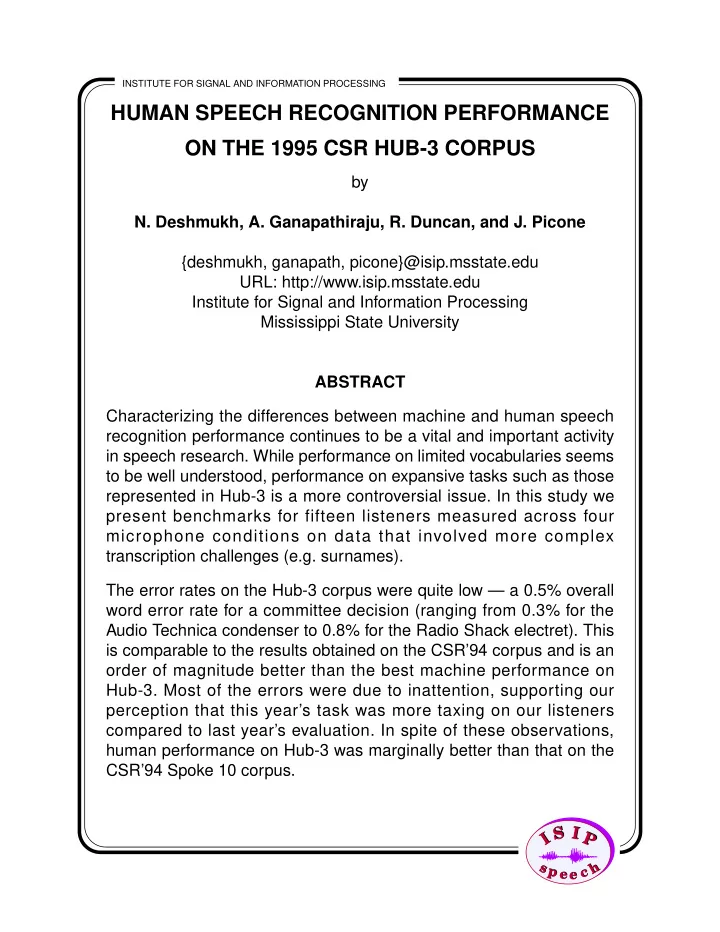
{deshmukh, ganapath, picone}@isip.msstate.edu URL: http://www.isip.msstate.edu Institute for Signal and Information Processing Mississippi State University ABSTRACT Characterizing the differences between machine and human speech recognition performance continues to be a vital and important activity in speech research. While performance on limited vocabularies seems to be well understood, performance on expansive tasks such as those represented in Hub-3 is a more controversial issue. In this study we present benchmarks for fifteen listeners measured across four microphone conditions on data that involved more complex transcription challenges (e.g. surnames). The error rates on the Hub-3 corpus were quite low — a 0.5% overall word error rate for a committee decision (ranging from 0.3% for the Audio Technica condenser to 0.8% for the Radio Shack electret). This is comparable to the results obtained on the CSR’94 corpus and is an

  • rder of magnitude better than the best machine performance on

Hub-3. Most of the errors were due to inattention, supporting our perception that this year’s task was more taxing on our listeners compared to last year’s evaluation. In spite of these observations, human performance on Hub-3 was marginally better than that on the CSR’94 Spoke 10 corpus.

slide-2
SLIDE 2

INSTITUTE FOR SIGNAL AND INFORMATION PROCESSING FEBRUARY 20, 1996 CSR’95 PAGE 2 OF 13

WHAT DID WE LEARN LAST YEAR? ❐ The CSR’94 Spoke 10 Corpus Nominally 11 utterances/speaker, 10 speakers Four conditions: no noise, SNR = 22dB, 16dB, 10dB ❐ Combined word error rates for all subjects ❐ Human performance was high and at least one order of magnitude better than machines ❐ No clear relationship between word error rate and SNR: ❐ Human performance exceeded machines by at least 10 dB Evaluation Group Vocabulary Open Closed Average 2.1 (0.7) 1.0 (0.6) Committee 1.2 (0.6) 0.5 (0.6) Listener SNR High 22 dB 16 dB 10 dB Ave Group 1: 0.6 1.0 1.1 1.0 0.9 Group 2: 0.8 0.8 0.8 1.1 0.9 Group 3: 1.4 0.8 1.0 1.3 1.2 All Committee 0.9 0.4 0.9 0.4 1.0 0.5 1.1 0.6 1.0 0.5

slide-3
SLIDE 3

INSTITUTE FOR SIGNAL AND INFORMATION PROCESSING FEBRUARY 20, 1996 CSR’95 PAGE 3 OF 13

CSR’95 HUB-3 CORPUS ❐ Text Source: The North American Business (NAB) News 20 groups (articles) of 15 sentences each Each article of 15 sentences was a contiguous excerpt drawn from a different article appearing in the August 1995 issue of a source A judgement was made regarding the effort required to correctly read the article ❐ Multiple Microphone Conditions The data was balanced for sex (10 males/10 females) Each group of 15 sentences was read by a different speaker and recorded simultaneously using two microphones One of the microphones was fixed for all speakers — (a Sennheiser HMD-410 microphone (mic s) Three alternates microphones: mic_b: a Shure SM58 boom-mounted mic mic_f: an Audio Technica AT851a Micro Cardioid Cond. mig_g: Radio Shack 33-1060 Omni Elect. mic (desk stand) ❐ Total of 600 utterances: 20 speakers x 15 utt./speaker x 2 mics/utt.

slide-4
SLIDE 4

INSTITUTE FOR SIGNAL AND INFORMATION PROCESSING FEBRUARY 20, 1996 CSR’95 PAGE 4 OF 13

LISTENER ASSIGNMENTS ❐ Major Constraints: 120 utterances per listener (time) Minimize total number of listeners (volunteers) Support a committee decision for all utterances (inattention) ❐ 15 listeners x 120 utterances gives desired coverage (900 utt. for mic_s; 900 utt. for alternate mics): List # Speaker index Sennheiser mic Mic b Mic f Mic g 1 711, 713, 715, 717 710, 716 712 718 2 710, 712, 714, 716 71j 719, 71d 711 3 719, 71b, 71d, 71f 71c 71i 713, 715 4 718, 71a, 71c, 71e 71g, 71h 714 71b 5 71g, 71h, 71i, 71j 717 71e, 71f 71a 6 71i, 71g, 71e, 71c 710 712 711, 713 7 71j, 71h, 71f, 71d 716, 717 714 715 8 71a, 718, 716, 714 71g 719, 71d 71b 9 71b, 719, 717, 715 71c, 71j 71e 718 10 713, 712, 711, 710 71h 71f, 71i 71a 11 710, 715, 71a, 71f 71g 719 713, 71b 12 711, 716, 71b, 71g 710 71e, 71i 718 13 712, 717, 71c, 71h 71j, 716 71d 71a 14 713, 718, 71d, 71i 71h 714, 71f 711 15 714, 719, 71e, 71j 717, 71c 712 715

slide-5
SLIDE 5

INSTITUTE FOR SIGNAL AND INFORMATION PROCESSING FEBRUARY 20, 1996 CSR’95 PAGE 5 OF 13

AN OVEVIEW OF THE LISTENER POPULATION Note: Listeners 1 and 15 participated in the CSR’94 experiment. All

  • ther listeners were first-time participants.

Listener Sex Age (yrs) Time (min) Errors (%) v1.0 v1.1 01 M 19 225 2.1 2.0 02 F 23 135 1.7 1.5 03 F 22 190 4.0 3.3 04 F 23 215 4.1 3.0 05 M 22 180 1.8 1.7 06 F 24 110 1.5 1.4 07 M 23 160 1.7 0.9 08 M 24 157 2.0 1.4 09 M 23 225 2.1 2.0 10 M 31 115 2.0 1.4 11 M 23 270 3.7 3.2 12 F 26 210 4.1 4.0 13 F 21 195 2.4 2.2 14 M 28 150 3.6 3.5 15 F 40 305 2.1 1.2 Average 25 190 2.7 2.2

slide-6
SLIDE 6

INSTITUTE FOR SIGNAL AND INFORMATION PROCESSING FEBRUARY 20, 1996 CSR’95 PAGE 6 OF 13

COMBINED WORD ERROR RATES FOR ALL SUBJECTS Notes: Results comparable with CSR’94 Spoke 10 Larger difference between overall and committee results for Hub-3 augmented vocabulary condition (an indication of the difficulty of the task) Vocab type Listener Error (%) on corpus Spoke 10 Hub - 3 Open Overall 2.1 2.2 Committee 1.2 0.8 Listener 01 2.7 2.0 Listener 15 1.3 1.2 Augmt. Overall 1.0 2.1 Committee 0.5 0.4 Listener 01 1.0 2.0 Listener 15 0.7 1.1

slide-7
SLIDE 7

INSTITUTE FOR SIGNAL AND INFORMATION PROCESSING FEBRUARY 20, 1996 CSR’95 PAGE 7 OF 13

DETAILED OPEN-VOCABULARY RESULTS Listeners & groups Word error (%) on microphone conditions Mic s Mic b Mic f Mic g All Group 1 2.1 2.3 2.0 3.0 2.3 Listener 01 2.3 1.0 4.2 0.3 2.0 Listener 02 1.3 2.1 1.2 2.3 1.5 Listener 03 3.3 4.7 3.4 2.2 3.3 Listener 04 2.5 1.1 2.3 9.9 3.0 Listener 05 1.6 5.0 0.4 0.6 1.7 Group 2 1.4 1.3 0.9 2.2 1.4 Listener 06 1.6 0.0 0.6 1.9 1.4 Listener 07 0.4 2.2 1.0 0.0 0.9 Listener 08 1.1 0.8 0.4 5.4 1.4 Listener 09 2.3 1.9 0.3 2.4 2.0 Listener 10 1.5 0.6 2.0 1.3 1.4 Group 3 2.5 2.1 2.8 4.7 2.8 Listener 11 1.2 3.0 0.4 8.4 3.2 Listener 12 4.0 1.5 4.8 5.1 4.0 Listener 13 3.0 1.0 1.7 1.3 2.2 Listener 14 3.6 2.5 3.3 4.6 3.5 Listener 15 0.4 2.6 1.5 0.4 1.2 Overall 2.0 1.9 1.9 3.3 2.2 Committee 0.8 1.0 0.2 1.5 0.8

  • Aug. Com.

0.3 0.6 0.1 0.8 0.4

slide-8
SLIDE 8

INSTITUTE FOR SIGNAL AND INFORMATION PROCESSING FEBRUARY 20, 1996 CSR’95 PAGE 8 OF 13

PERFORMANCE AS A FUNCTION OF SPEAKER Speaker Word error (%) on microphone conditions Speech Rate (words/ min.) Mic s Mic b Mic f Mic g All 710 1.0 1.0

  • 1.0

192 711 2.3

  • 3.3

2.8 184 712 2.8

  • 2.5
  • 2.7

217 713 1.4

  • 2.8

2.1 205 714 0.4

  • 2.0
  • 1.2

158 715 1.4

  • 0.7

1.1 212 716 2.0 0.8

  • 1.4

176 717 5.4 4.0

  • 4.7

181 718 3.0

  • 2.3

2.6 227 719 1.0

  • 1.2
  • 1.1

162 71a 0.6

  • 1.2

0.9 187 71b 5.7

  • 8.7

7.2 232 71c 3.7 2.8

  • 3.2

172 71d 1.5

  • 0.7
  • 1.1

210 71e 1.6

  • 1.5
  • 1.5

197 71f 0.2

  • 1.7
  • 0.9

165 71g 1.8 1.6

  • 1.7

240 71h 0.5 1.5

  • 1.0

188 71i 2.5

  • 4.1
  • 3.3

174 71j 1.4 1.3

  • 1.3

170

slide-9
SLIDE 9

INSTITUTE FOR SIGNAL AND INFORMATION PROCESSING FEBRUARY 20, 1996 CSR’95 PAGE 9 OF 13

WORD ERROR CATEGORIES

Mic s Mic b Mic f Mic g Total Proper Nouns 25 8 1 10 44 (45.8%) Listener 5 1

  • 4

10 (10.4%) Articulation 1 1 1 1 4 (4.2%) Inattention 14 10 1 9 34 (35.4%) Signal

  • 2
  • 2

4 (4.2%) Total 45 (46.9%) 22 (22.9%) 3 (3.1%) 26 (27.1%) 96 (100)

slide-10
SLIDE 10

INSTITUTE FOR SIGNAL AND INFORMATION PROCESSING FEBRUARY 20, 1996 CSR’95 PAGE 10 OF 13

AUGMENTED COMMITTEE DECISION RESULTS AUGMENTED WORD ERROR CATEGORIES Listener Word error (%) on microphone conditions (noise levels) Mic s (38 dBA) Mic b (21 dBA) Mic f (21 dBA) Mic g (19 dBA) Over-all Humans 0.3 0.6 0.1 0.8 0.4 Machine 6.6 5.1 5.4 9.9 6.7

Mic s Mic b Mic f Mic g Total Listener 5 1

  • 4

10 (19.2%) Articulation 1 1 1 1 4 (7.7%) Inattention 14 10 1 9 34 (65.4%) Signal

  • 2
  • 2

4 (7.7%) Total 20 (38.5%) 14 (26.9%) 2 (3.8%) 16 (30.8%) 52 (100%)

slide-11
SLIDE 11

INSTITUTE FOR SIGNAL AND INFORMATION PROCESSING FEBRUARY 20, 1996 CSR’95 PAGE 11 OF 13

TYPICAL ERRORS Listener Errors:

id: (717c0202/mic_ss) REF: ... compelling them to EMIGRATE to the u. s. HYP: ... compelling them to IMMIGRATE to the u. s. id: (71jc020a/l02_mic_ab) REF: it seems to be the fraud DU jour said allen hile... HYP: it seems to be the fraud DE jour said allen hile...

Signal Errors:

id: (713c020a/mic_ag) REF: AND this has all happened... HYP: * this has all happened...

Inattention:

id: (712c020a/mic_af) REF: given the demand it is expected **** i. b. m. will... HYP: given the demand it is expected THAT i. b. m. will...

Articulation:

id: (71gc0203/mic_ab) REF: ...network shares TRADED in the low sixty dollar... HYP: ...network shares TREATED in the low sixty dollar...

Other Interesting Errors:

id: (711c0206/mic_ag) REF: ...more of a speculation said GIAN CAMUZZI senior... HYP: ...more of a speculation said JION CAMUTSIE senior... id: (711c0207/mic_ag) REF: ...and goldman SACHS AND company... HYP: ...and goldman * SAXON company...

Note: audio tape contains mic_ss followed by the actual mic for the condition in which the error occurred.

slide-12
SLIDE 12

INSTITUTE FOR SIGNAL AND INFORMATION PROCESSING FEBRUARY 20, 1996 CSR’95 PAGE 12 OF 13

WHAT ABOUT NEXT YEAR?

  • Our subjects have requested that you do not make the task

any harder! (my wife is tired of cooking brownies...)

  • More control over listening (windowing):
slide-13
SLIDE 13

INSTITUTE FOR SIGNAL AND INFORMATION PROCESSING FEBRUARY 20, 1996 CSR’95 PAGE 13 OF 13

SUMMARY ❐ The Hub-3 evaluation yielded results consistent with those

  • btained for Spoke 10:

Performance of common listeners was comparable Human performance is high (average of 0.4% word error rate) Human performance is at least one order of magnitude better than machines ❐ Human performance was also fairly consistent across all the microphones ❐ Context did not play a significant role ❐ Listener inattention is becoming an increasingly significant problem