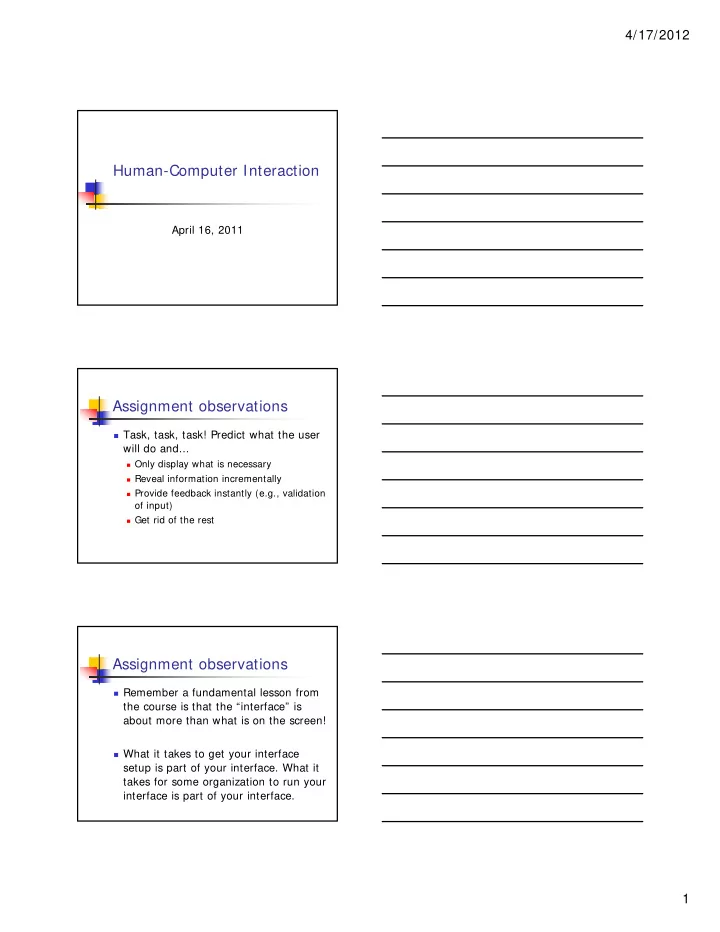
Human-Computer Interaction April 16, 2011 Assignment observations - - PDF document

human computer interaction
SMART_READER_LITE
LIVE PREVIEW

Human-Computer Interaction April 16, 2011 Assignment observations - - PDF document

4/17/2012 Human-Computer Interaction April 16, 2011 Assignment observations Task, task, task! Predict what the user will do and... Only display what is necessary Reveal information incrementally Provide feedback instantly (e.g.,


slide-1
SLIDE 1

4/17/2012 1

Human-Computer Interaction

April 16, 2011

Assignment observations

 Task, task, task! Predict what the user

will do and...

 Only display what is necessary  Reveal information incrementally  Provide feedback instantly (e.g., validation

  • f input)

 Get rid of the rest

Assignment observations

 Remember a fundamental lesson from

the course is that the “interface” is about more than what is on the screen!

 What it takes to get your interface

setup is part of your interface. What it takes for some organization to run your interface is part of your interface.

slide-2
SLIDE 2

4/17/2012 2

Assignment observations

 Don’t get hung up on the back end.

Make it “good enough” so that the user gets the user interface experience (e.g., it doesn’t need to scale)

Assignment observations

 Dialogs ... part of your application too!

 Meaningful titles  Same look and feel  Large fonts  Non-computer button terms (verbs)  Only if needed ... Avoid 1-option dialogs

Assignment observations

 Still more thought needed on layout to

take ideas to next level of professional look and feel

 Typos, mis-spelling inconsistent

Capitalization or fonts or awkward wording all redooc the credibilities of your appliation!

slide-3
SLIDE 3

4/17/2012 3

Assignment observations

 Passwords – who needs ‘em?  My information is VALUABLE. If you

want it, you’d better give me a good reason

 Only ask for what you need

Assignment observations

 Choice is not always a good thing

 The more “stuff” on a screen, the harder

the interface will appear to be

 “Click here”

Assignment observations

 Design for tablets

 Finger-sized buttons  One-tap (e.g. avoid right click)

slide-4
SLIDE 4

4/17/2012 4

Communication highlights

 F2F communication involves

 Speech  Gaze  Gesture

 Remote work – video greater sense of

presence

Communication highlights

 Eye gaze – tricky  Back channel communication

 Ums, ahs, ...  Important!

Communication highlights

 Important to consider emotional state  E.g.

 People use stronger language in email  But less likely to get emotionally charged

themselves

 Cultural black hole ... Not sure how

message will be interpreted

slide-5
SLIDE 5

4/17/2012 5

Communication highlights

 Importance of WYSIWIS

 Point of reference tricky (deixis)  Email threads adaptation

 Examples?

 Google Docs  Pair programming tools?

Help highlights

 Build a “help system” not

documentation

 Should not interfere with workflow  “Just in time” help should be your goal

Help highlights

 Tutorials helpful for complex tasks

 Progress at own speed  Repeat parts if needed

 Better: exploratory learning

 Navigate the system without risk  Most good modern interfaces have this

quality

slide-6
SLIDE 6

4/17/2012 6

Help highlights

 Wizards

 Infamous “Clippy”  Is there a place for them?

 How do most video games provide

help?

Help highlights

 Instructional material: tell the user how

to use the system (action!) rather than describing the system

 “To close the window, click on the box in

the top right-hand corner of the window”

 “Windows can be closed by clicking on the

box in the top right-hand corner of the window.”

Ubicomp video examples