Human-Computer Interaction CS 5340 Prof. Stephen Intille (Many - - PDF document

human computer interaction cs 5340
SMART_READER_LITE
LIVE PREVIEW

Human-Computer Interaction CS 5340 Prof. Stephen Intille (Many - - PDF document

1/15/2012 Human-Computer Interaction CS 5340 Prof. Stephen Intille (Many thanks to Prof. Tim Bickmore) Overview for Today Introductions Overview of the Course First homework exercise Model Paper Presentations Logistics


slide-1
SLIDE 1

1/15/2012 1

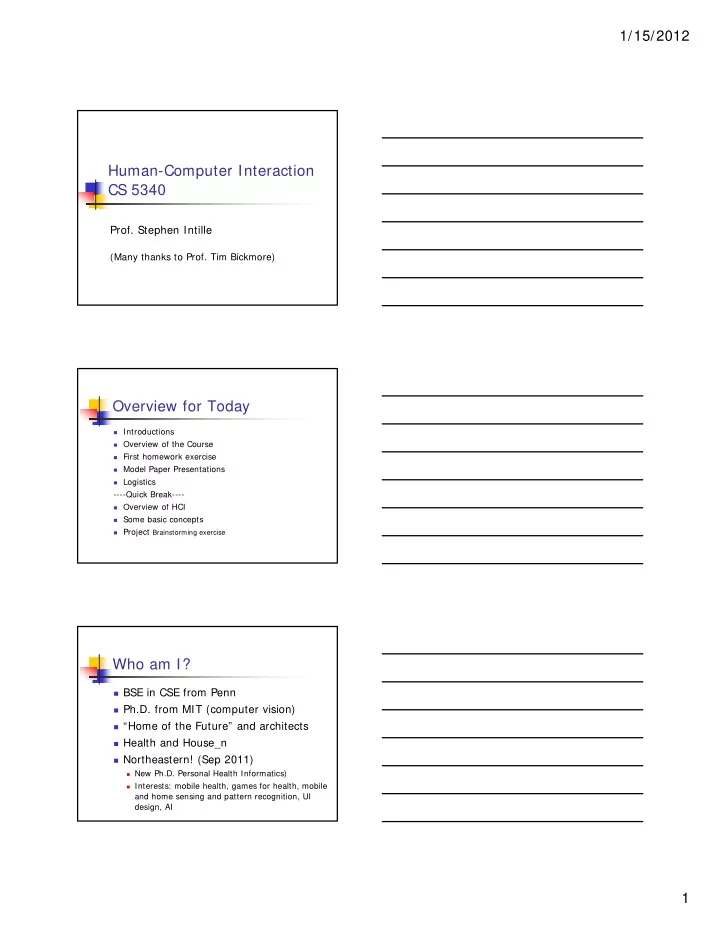
Human-Computer Interaction CS 5340

  • Prof. Stephen Intille

(Many thanks to Prof. Tim Bickmore)

Overview for Today

 Introductions  Overview of the Course  First homework exercise  Model Paper Presentations  Logistics

  • ---Quick Break----

 Overview of HCI  Some basic concepts  Project Brainstorming exercise

Who am I?

 BSE in CSE from Penn  Ph.D. from MIT (computer vision)  “Home of the Future” and architects  Health and House_n  Northeastern! (Sep 2011)

 New Ph.D. Personal Health Informatics)  Interests: mobile health, games for health, mobile

and home sensing and pattern recognition, UI design, AI

slide-2
SLIDE 2

1/15/2012 2

Introductions

 Name  Your background  Worst user interface you have ever

used & why

Administrivia

 Stephen

 450 WVH, s.intille@neu.edu  Office hours

 TBD  After class  Send email

 Facilitator/Grader - Zeeshan Sayyed

 sayyed.z@husky.neu.edu  Office hours: TBD

 Class discussion/questions: Piazza

http://piazza.com/northeastern/spring2012/cs5340

Overview of Course

http://bit.ly/neu-hci-spring-12

slide-3
SLIDE 3

1/15/2012 3

Overview of Course

 Topics covered

 HCI theory & practice  A bit on good design  A lot of hands-on experience

(You haven’t learned it until you can apply it!)

 Cutting-edge HCI research

 Topics on your own:

 GUI programming in your favorite language

 Prerequisites

 Programming basics (or see me)

Overview of Course

 Texts

 Required:

 Dix, et al, Human-Computer Interaction  A bit dated, but comprehensive  In bookstore  Other chapters/articles to be provided on Blackboard

 Recommended:

 Nielsen, Usability Engineering  Norman, The Design of Everyday Things

Overview of Course

 Weekly Requirements

 Read (and absorb!) 50-150 pages  Your reading notes  Individual homework assignment  Team project assignment  Describe and discuss assignments in class

 Periodic Requirements

 Perform a design session in class  Present a research paper in class

slide-4
SLIDE 4

1/15/2012 4

Typical Class*

1.

Review assignments. Presentation and discussion by randomly selected students

2.

Lecture on HCI practice topic

3.

Discussion of next week’s assignments

4.

Break

5.

Intro to research topic by instructor

6.

Research paper presentations or design session presentations by students

* Changes may be made based on composition of the class

Overview of Course

 Your reading notes

 Bullet lists of most important ideas  Bullet lists of thoughts/ideas generated during

reading

 Show evidence of thoughtful reading and

synthesis of readings throughout course

 Post prior to class and hand in hardcopy at class

Course Website

http://bit.ly/neu-hci-spring-12 (Papers on Blackboard) (Discussion on Piazza)

slide-5
SLIDE 5

1/15/2012 5

Grading

 Prior experience suggests that work in this course

will generally fall into one of four categories:

 Superior, striking, or unexpected pieces of work with

excellent effort demonstrating a mastery of the subject matter and a thoughtful use of concepts discussed in class; work that shows imagination, clarity of presentation,

  • riginality, creativity, effort, and attention to detail (A)

 Good work demonstrating a capacity to use the subject

matter, with adequate preparation and clear presentation (B)

 Work that is adequate but that would benefit from increased

effort or preparation (C)

 Work that needs more effort (D)

Breakdown

 Your reading notes (10%)  Class presentation(s) (10% )  Individual assignments (30% )  Team assignments (20% )  Final project and project

presentation (30% )

} 50%

Writing matters

 Assignments that involve writing and

presentation will be judged on clarity of presentation as well as content.

 Proof what you write  Have friends proof what you write  If you have trouble, visit the Northeastern

University Writing Center

 Plagiarism results in a 0; 2nd instance: F

slide-6
SLIDE 6

1/15/2012 6

To Do for Next Week

1.

Answer the email survey I will send you

2.

Sign up for Piazza

3.

Read

1.

Dix Intro, Chapters 1, 2 (skim), 4

2.

4 research papers on HCI for Health (on blackboard soon)

4.

Setup individual course web page (with photo)

Note: All assignments must be posted 1 hour before class on due date.

5.

Do Homework I1 (UI Critique)

6.

Look over research papers when they are emailed – select a few you’d like to present

7.

Read through T1

8.

Look over HCI for older adult bibliography when emailed and start thinking about a final project

Individual Homework # 1 UI Critique

 Find 2 good & 2 bad examples of UI design  Some criteria

 Consistency (inter & intra application)  Prevent errors  Permit error correction  Obviousness (“affordances”)  Feedback

 Include visuals if possible  Some examples…

Example 1

slide-7
SLIDE 7

1/15/2012 7

Example 1 - redesign Example 2 Example 3

slide-8
SLIDE 8

1/15/2012 8

Example 4 Do I have a brave volunteer? Individual Homework # 1 UI Critique

 Find 2 good & 2 bad examples of UI design  Some criteria

 Consistency (inter & intra application)  Prevent errors  Permit error correction  Obviousness (“affordances”)  Feedback

 Include visuals if possible

slide-9
SLIDE 9

1/15/2012 9

Paper Presentations Paper Presentations

 Format

 Pecha Kucha format (6 min, 40 seconds)

Brief description (least important - everyone has read it)

Your evaluation of the ideas

How you would extend it (most important part)

 Demo/inspiration

3 minute demo, video, or mock up of something that goes beyond the

  • paper. Show us, or teach us, something new that we would not have

learn just from reading the paper.

If you need to, you can do this in the middle of Pecha Kucha  Load on your own laptop, test  Do not

 Cut and paste text from paper!  Read your slides!

 Practice, practice, practice...  Grading: See the web page – 10% of grade!

Presentation Volunteers for Next Week

 Jogging the Distance - CHI'07  Pride and prejudice: learning how

chronically ill people think about food - CHI'06

 PmEB: A Mobile Phone Application for

Monitoring Caloric Balance – CHI’06

 A New Research Challenge: Persuasive

Technology to Motivate Healthy Aging

slide-10
SLIDE 10

1/15/2012 10

Team Project

Major focus of course Will dominate your grade

Team Project Guidelines

 Your project MUST

 Have a substantial UI  Be interactive  Work robustly  Contribute to health or health research  Solve a real-world problem  Be targeted for and tested with older

adults

Why?

Team Project Guidelines

 Your project SHOULD

 Be creative  Be original  Be non-obvious  Have a “wow” factor  Allow you, at the end of this course, to

leapfrog your peers with an amazing demo!

Why?

slide-11
SLIDE 11

1/15/2012 11

Team Project Constraints

 Team: 3-4 members, ideally multi-

disciplinary

 Focus: Health Application for (or used

by) older adult users

 Context: Senior center, home, etc.  Platform: Your choosing  Input/output/sensing: Your choosing

Team Project Categories

 App for older adults in senior center

(to facilitate goals/tasks you identify)

 “Serious game” for older adults to

generate food nutrition database

 App for older adults that meets

guidelines for an available app competition (e.g., http://www.health2challenge.org/healthy-people-2020-leading-health-indicators-app-challenge/)

(caveats)

Team Project Guidelines Why Older Adults?

 Pedagogical reasons…

 High variability in sensory, cognitive, and motor abilities  High variability in computer literacy  For our population of users – high variability in reading and health

literacy

 Forces you to think thoroughly about usability & accessibility

issues

 Drives home “I am not my user”  Makes an otherwise abstract exercise very real

 And…

 We will be helping an underserved population  Demographic shift in US  Older adults in more need of health interventions

slide-12
SLIDE 12

1/15/2012 12

Observational studies

 Be prepared to get out into the real

world

 Be prepared to use your own ingenuity

to seek people out

 Be prepared to spend significant time

  • bserving and testing ”In the field”

 Sensitivity is of utmost importance!

Project idea generation

 Brainstorming  Observation  Iteration  Be prepared:

 To get a good idea, have lots of ideas  Do not be surprised if I send you back to

the drawing board multiple times

slide-13
SLIDE 13

1/15/2012 13

Questions then break Overview of HCI

 What is HCI?  Motivation for HCI  Some basic concepts

What is HCI?

ACM SIGCHI Curricula for HCI

 Human-computer interaction is a

discipline concerned with the design,

evaluation and implementation of

interactive computing systems for

human use and with the study of

major phenomena surrounding them.

slide-14
SLIDE 14

1/15/2012 14

What is HCI?

Communications

What is HCI? extensional definition

 Human factors  GUIs & toolkits  Mobile computing  Speech interfaces  Social interfaces  Multimodal interfaces  …

Why Study HCI?

slide-15
SLIDE 15

1/15/2012 15

HCI is Important

from Nielsen – Usability Engineering

 Redesign of rotary dial telephone speeded up

users’ dialing behavior by 0.15 sec/digit, saving $1M in reduced demand on central switches.

 Redesign insurance forms to reduce customer

errors: cost Aus$100,000; savings Aus$500,000/year.

 Redesign of Boeing 757 flight deck interface

to reduce flight crew from 3 to 2

HCI is Important

from Nielsen – Usability Engineering

 Study of software engineering costs

 63% significantly overran budgets  4 reasons rated with highest responsibility:

 Frequent change requests by users  Overlooked tasks  Users’ lack of understanding of their own req’ts  Insufficient user-analyst communication &

understanding

Lederer & Prasad, CACM ’92 115 surveys of projects > = $50K

HCI is Important

 UI strongly affects

perception of software

 Usable software sells

better

 “Ease of use” ratings

 For many shrink-

wrapped products a single call to customer support can wipe out profits

slide-16
SLIDE 16

1/15/2012 16

HCI is Important

FDA Center for Devices and Radiological Health report

 Many deaths and injuries attributable to poor

human interface (hardware & software) design.

 oxygen flow control knob, smooth rotation but

with discrete settings and no flow at intermediates

 FDA Do It By Design - An Introduction to

Human Factors in Medical Devices

 http://1.usa.gov/a3FtP5

HCI is Important

  • JAMA. 2005;293:1197-1203

 Study of a hospital computerized physician

  • rder entry system (CPOE)

 Identified 22 ways in which the system caused

patients to get the wrong medicine, e.g.

 fragmented displays that prevent a coherent view of

patients’ medications

 pharmacy inventory displays mistaken for dosage

guidelines

 separation of functions that facilitate double dosing and

incompatible orders

 Three quarters of the house staff reported
  • bserving each of these error risks, indicating

that they occur weekly or more often

HCI is Important

Therac-25 Accidents

Therac-25 performed both radiation treatment and X-rays

slide-17
SLIDE 17

1/15/2012 17

HCI is Important

Therac-25 Accidents

HCI is Important

Therac-25 Accidents

 Six accidents involving massive overdoses to patients

  • ccurred between 1985 and 1987

 Occasional machine malfunctions with little feedback,

resulting in repeated dosages (6 in one case)

 Poor feedback about which mode the machine was in

caused treatments with 125x the expected dose

 Machine occasionally underreported dosage

HCI is Transformational

slide-18
SLIDE 18

1/15/2012 18

HCI is Ignored at Your Peril

Your Web Development project here?

More reasons to work in HCI?

 Interdisciplinary work  Interact with people, learn about them

and their work

 Help people with software that actually

works

 Change our industry  It’s cool…

HCI is Cool

slide-19
SLIDE 19

1/15/2012 19

HCI is Cool HCI is Cool HCI is Cool

slide-20
SLIDE 20

1/15/2012 20

HCI is Cool

Sit upright Lean Forward Slump Back Side Lean

HCI is Cool HCI is Cool

Gandalf Video

slide-21
SLIDE 21

1/15/2012 21

Some basic issues & concepts

 Building good UIs is hard

 Many iterations  Much user interaction  Many kinds of expertise  50% of the total lifecycle effort in modern

software

 Survey of 74 projects, Myers & Rosson, CHI’92

Typical user interface design

 Observation  Model tasks  Simplify/refine/stress-test the task models  Lo-fidelity prototyping (paper)  Test in context  Iterate  Eventually…

 High fidelity prototyping  Test in context  Iterate (entire process)

Observation

slide-22
SLIDE 22

1/15/2012 22

Model the tasks Simplify/refine/stress-test tasks

 Gotchas

 Missing what’s truly important to user  Interruptions  Influence of environment/context  Boredom/lack of novelty  Dealing with problems created by

 Environment  Other people  Technological limitations

Paper prototyping

slide-23
SLIDE 23

1/15/2012 23

Paper prototyping Test in context (or try) Test in context (or try)

slide-24
SLIDE 24

1/15/2012 24

High-fidelity prototyping Iterate! Iteration

Design Prototype Evaluate

At every stage!

Diagram from J. Landay

“Typical users”

slide-25
SLIDE 25

1/15/2012 25

Simplicity is Hard! Some basic issues & concepts

From Nielsen, Usability Engineering How well users can use the system’s functionality. Usability Whether the functionality of the system in principle can do what is needed. Utility

Some basic issues & concepts

Design Implement Evaluate

The HCI development process

  • Ethnography
  • Task analysis
  • Design guidelines
  • Scenarios
  • Prototyping
  • GUI tools
  • Expert evaluation
  • Usability testing
slide-26
SLIDE 26

1/15/2012 26

To Do for Next Week

1.

Answer the email survey I will send you

2.

Sign up for Piazza

3.

Read

1.

Dix Intro, Chapters 1, 2 (skim), 4

2.

4 research papers on HCI for Health (on blackboard soon)

4.

Setup individual course web page (with photo)

Note: All assignments must be posted 1 hour before class on due date.

5.

Do Homework I1 (UI Critique)

6.

Look over research papers when they are emailed – select a few you’d like to present

7.

Read through T1

8.

Look over HCI for older adult bibliography when emailed and start thinking about a final project