Hughes Brownfield Case Study Hughes Brownfield Case Study A S A S - - PowerPoint PPT Presentation

hughes brownfield case study hughes brownfield case study
SMART_READER_LITE
LIVE PREVIEW

Hughes Brownfield Case Study Hughes Brownfield Case Study A S A S - - PowerPoint PPT Presentation

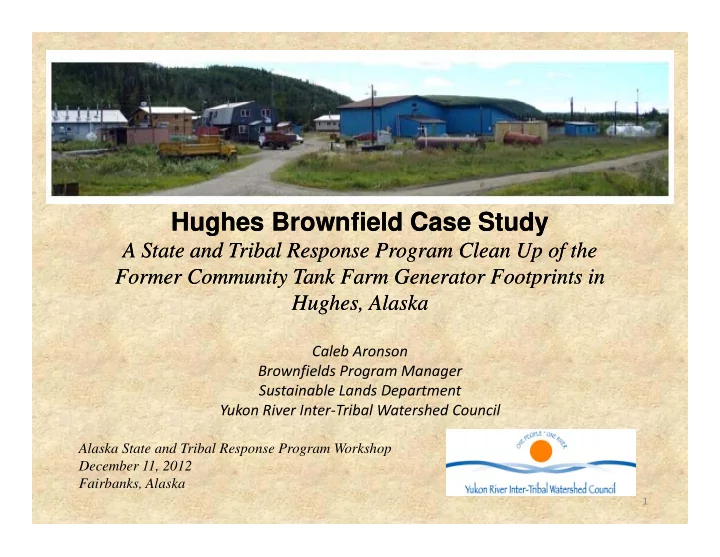
Hughes Brownfield Case Study Hughes Brownfield Case Study A S A S A State and Tribal Response Program Clean Up of the A State and Tribal Response Program Clean Up of the d T b l R d T b l R P P Cl Cl U U f h f h Former Community Tank


slide-1
SLIDE 1

Hughes Brownfield Case Study Hughes Brownfield Case Study

A S d T b l R P Cl U f h A S d T b l R P Cl U f h A State and Tribal Response Program Clean Up of the A State and Tribal Response Program Clean Up of the Former Community Tank Farm Generator Footprints in Former Community Tank Farm Generator Footprints in Hughes, Alaska Hughes, Alaska g

Caleb Aronson Brownfields Program Manager Sustainable Lands Department Yukon River Inter‐Tribal Watershed Council

Alaska State and Tribal Response Program Workshop laska State and ibal esponse

  • g am Wo kshop

December 11, 2012 Fairbanks, Alaska

1

slide-2
SLIDE 2

2

slide-3
SLIDE 3

3

slide-4
SLIDE 4

4

slide-5
SLIDE 5

What Was The Goal? What Was The Goal?

  • Generally: Finally do a cleanup! – after years of building capacity,

assessments, we wanted to use STRP funding to do more and go further further.

  • Specifically: Mitigate exposure pathways by removing petroleum

contaminated soil and replacing with clean fill before ANTHC installs contaminated soil and replacing with clean fill before ANTHC installs a 40,000 gallon water storage tank

  • DEC & YRITWC collaboration established by dividing tasks and

y g incorporated them into EPA funding requests

+ +

DEC’s Reuse & Redevelopment Program YRITWC’s Brownfields Program Environmental Protection Agency

slide-6
SLIDE 6

Where Did This All Begin? Where Did This All Begin?

Assessments

YRITWC conducted Phase I and Limited Phase II YRITWC conducted Phase I and Limited Phase II Environmental Site Assessment of Lots 11 & 13 in summer of 2008. DEC prepared an Environmental Management Plan in 2009 summarizing the characterization work already done and summarizing the characterization work already done and describing the recommended actions for removal.

6

slide-7
SLIDE 7

Assessments Confirmed Contamination: Assessments Confirmed Contamination:

  • Abandoned Generator Building

L i f F G

  • Location of Former Generator

Building

  • Location of Former Fuel

Dispenser Island Dispenser Island

  • Buried Piping Between Former

School Tank Farm and Abandoned Generator Building Abandoned Generator Building

  • Former School Tank Farm

7

slide-8
SLIDE 8
  • SHPO – State

ADEC’s ADEC’s Role Role

Historical Preservation Office

  • Endangered Species

A C Act Concurrence

  • ABCA – Analysis of

Brownfields Cleanup Alternatives Alternatives

  • CAP – Corrective

Action Plan

  • Regulation

8

slide-9
SLIDE 9

ABCA – Analysis of Brownfields Cleanup Alternatives ABCA – Analysis of Brownfields Cleanup Alternatives

  • Discusses different cleanup strategies

and prioritizes the best approach

  • This project had 5 alternatives:

Alternative 1 Alternative 1 – – No Action No Action Alternative 2 Alternative 2 – – Mitigation through capping and Mitigation through capping and institutional controls institutional controls Alternative 3a Alternative 3a – – Limited excavation and off Limited excavation and off-

  • site treatment

site treatment

  • f soil
  • f soil

Alternative 3b Alternative 3b – – Excavation and off Excavation and off-

  • site treatment of soil

site treatment of soil Alternative 3c Alternative 3c – – Prioritized excavation and off Prioritized excavation and off-

  • site

site treatment of soil treatment of soil treatment of soil treatment of soil

  • 30-day public comment period

followed release of draft ABCA

  • YRITWC & DEC held community

meeting during the comment period to discuss ABCA

9

  • ABCA was finalized after all public

comments had been resolved

slide-10
SLIDE 10

CAP CAP C ti A ti Pl C ti A ti Pl CAP CAP – – Corrective Action Plan Corrective Action Plan

a specific workplan for the project describing:

H l ill b d

  • How cleanup will be done
  • The number of samples to be taken
  • Where the contaminated soil will go to be managed

Alternative 3c Alternative 3c – – Prioritized excavation and off Prioritized excavation and off-

  • site treatment of soil

site treatment of soil Cleanup priority based on available funding was set to be: Cleanup priority based on available funding was set to be: p p y g p p y g 1.

  • 1. The Abandoned Generator building due to the installation of the new

The Abandoned Generator building due to the installation of the new water tank scheduled for 2012; water tank scheduled for 2012;

  • 2. The
  • 2. The footprint of the Former Generator Building due to its proximity

footprint of the Former Generator Building due to its proximity to the community drinking water well; to the community drinking water well; 3.

  • 3. The former fuel dispensing island; and

The former fuel dispensing island; and 4 Th b Th b d i f i li i h f d i f i li i h f

10

4.

  • 4. The above

The above-

  • ground portion of pipeline connecting the former

ground portion of pipeline connecting the former generator buildings to the school tank farm. generator buildings to the school tank farm.

slide-11
SLIDE 11

YRITWC’s YRITWC’s Role: Role:

D ft R i D ft R i Draft, Review Draft, Review Communicate & Plan Communicate & Plan

  • ABCA ABCA Public Notice & Announcement
  • ABCA, ABCA Public Notice & Announcement
  • RFP – Request For Proposals
  • Contractor Proposals
  • Contract and Award Notice

Contract and Award Notice

  • Community Involvement Plan/Community Relations Plan
  • Community Agreements & MOUs
  • QAPP - Quality Assurance Project Plan

y j

  • Site-Specific Health and Safety Plan
  • Property Profile Form
  • Final Report

11

slide-12
SLIDE 12

12

slide-13
SLIDE 13

Now The Field Work C B i Now The Field Work C B i Can Begin… Can Begin…

13

slide-14
SLIDE 14
  • Excavation 1: Abandoned
  • Excavation 1: Abandoned

Generator Building

  • Excavation 2: Former

Generator Building

  • Excavation 2: Former

Generator Footprint Generator Footprint

14

slide-15
SLIDE 15

Site Surveying – Containment Cell Site Surveying – Containment Cell

15

slide-16
SLIDE 16

Site Surveying – Containment Cell Site Surveying – Containment Cell

16

slide-17
SLIDE 17

Site Surveying – Fill Material Site Surveying – Fill Material

Hughes Village Council has a Hughes Village Council has a material sale contract with Department of Natural Resources Approximately 300 cubic yards were removed for stockpiling before potential flooding

17

slide-18
SLIDE 18

Containment Cell Construction Containment Cell Construction

18

slide-19
SLIDE 19

Dimensions are approx: 100ft X 50ft = 5,000 sq. ft.

19

slide-20
SLIDE 20

Sampling Prior to Stockpiling Soil Sampling Prior to Stockpiling Soil

10 random screening samples collected within cell and to 1 ft. deep deep

20

slide-21
SLIDE 21

First, protective non-woven t til f b i geotextile fabric Then, 20-mil thick l i li

21

petroleum resistant liner

slide-22
SLIDE 22

Utility Location Utility Location

22

slide-23
SLIDE 23

Excavation 1: Abandoned Generator Building Approximately 270 cubic yards removed Excavation 1: Abandoned Generator Building Approximately 270 cubic yards removed Approximately 270 cubic yards removed Approximately 270 cubic yards removed

23

slide-24
SLIDE 24

24

slide-25
SLIDE 25

25

slide-26
SLIDE 26

Excavation 2: Former Generator Footprint Excavation 2: Former Generator Footprint Footprint Approximately 70 cubic yards removed Footprint Approximately 70 cubic yards removed

26

slide-27
SLIDE 27

27

slide-28
SLIDE 28

28

slide-29
SLIDE 29

Summary of Results Summary of Results

Approximately 340 cubic yards of potentially contaminated soils were removed from the center of the community and placed in a landfarming cell on the east side of the landfill

y

east side of the landfill Landfarm soil thickness is estimated at 3.5-4 ft. Hughes is recommended to till the landfarm soil at least twice every summer to enhance degradation and y g to also cover the soil with 6-mil polyethylene sheeting in winter – reduces amount

  • f water from entering cell and increases solar heating

Contractor estimated 90% of funds stayed in the community: operators, laborers, accounting, equipment – loaders, CAT, excavator, dump trucks, pickup truck, etc. Alth h l t f t ti ll t i t d il ’t d d t f di Although a lot of potentially contaminated soil wasn’t removed due to funding constraints, something got cleaned up! A little goes a long way… First ever STRP funded cleanup for YRITWC builds capacity knowledge for

29

First ever STRP funded cleanup for YRITWC - builds capacity, knowledge for future cleanups

slide-30
SLIDE 30

Thank You Thank You

Hughes Brownfield Case Study Hughes Brownfield Case Study

A State and Tribal Response Program Clean Up of the Former A State and Tribal Response Program Clean Up of the Former Community Tank Farm Generator Footprints in Hughes Alaska Community Tank Farm Generator Footprints in Hughes Alaska

Caleb Aronson

Community Tank Farm Generator Footprints in Hughes, Alaska Community Tank Farm Generator Footprints in Hughes, Alaska

Caleb Aronson Brownfields Program Manager Yukon River Inter-Tribal Watershed Council Phone: (907)451-2530 Email: caronson@yritwc.org

rit c org

30

www.yritwc.org