http://www.open-mpi.org/ Graham Fagg, University of Tennessee - - PDF document

http open mpi org
SMART_READER_LITE
LIVE PREVIEW

http://www.open-mpi.org/ Graham Fagg, University of Tennessee - - PDF document

Open MPI Mini-Talks Introduction and Overview Jeff Squyres, Indiana University Open MPI Advanced Point-to-Point Architecture Join the Revolution Tim Woodall, Los Alamos National Lab Datatypes, Fault Tolerance and Other


slide-1
SLIDE 1

1

Open MPI Join the Revolution Supercomputing November, 2005

http://www.open-mpi.org/

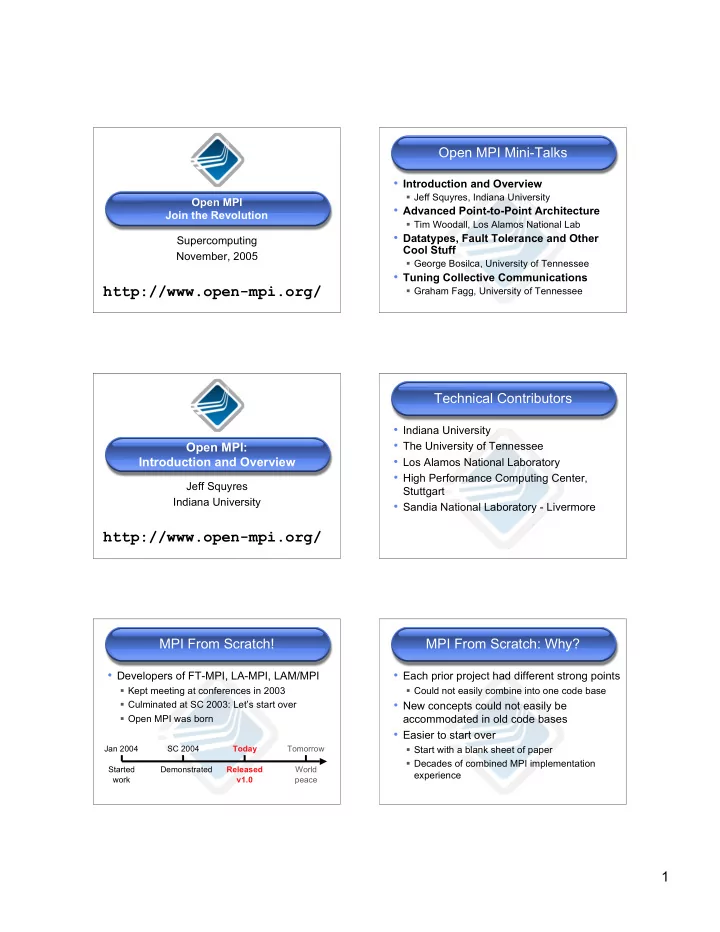
Open MPI Mini-Talks

  • Introduction and Overview
  • Jeff Squyres, Indiana University
  • Advanced Point-to-Point Architecture
  • Tim Woodall, Los Alamos National Lab
  • Datatypes, Fault Tolerance and Other

Cool Stuff

  • George Bosilca, University of Tennessee
  • Tuning Collective Communications
  • Graham Fagg, University of Tennessee

Open MPI: Introduction and Overview

Jeff Squyres Indiana University

http://www.open-mpi.org/

Technical Contributors

  • Indiana University
  • The University of Tennessee
  • Los Alamos National Laboratory
  • High Performance Computing Center,

Stuttgart

  • Sandia National Laboratory - Livermore

MPI From Scratch!

  • Developers of FT-MPI, LA-MPI, LAM/MPI
  • Kept meeting at conferences in 2003
  • Culminated at SC 2003: Let’s start over
  • Open MPI was born

Jan 2004 Started work SC 2004 Today Tomorrow Demonstrated Released v1.0 World peace

MPI From Scratch: Why?

  • Each prior project had different strong points
  • Could not easily combine into one code base
  • New concepts could not easily be

accommodated in old code bases

  • Easier to start over
  • Start with a blank sheet of paper
  • Decades of combined MPI implementation

experience

slide-2
SLIDE 2

2 MPI From Scratch: Why?

  • Merger of ideas from
  • FT-MPI (U. of Tennessee)
  • LA-MPI (Los Alamos)
  • LAM/MPI (Indiana U.)
  • PACX-MPI (HLRS, U. Stuttgart)

PACX-MPI LAM/MPI LA-MPI FT-MPI

Open MPI Open MPI

Open MPI Project Goals

  • All of MPI-2
  • Open source
  • Vendor-friendly license (modified BSD)
  • Prevent “forking” problem
  • Community / 3rd party involvement
  • Production-quality research platform (targeted)
  • Rapid deployment for new platforms
  • Shared development effort

Open MPI Project Goals

  • Actively engage the

HPC community

  • Users
  • Researchers
  • System administrators
  • Vendors
  • Solicit feedback and

contributions  True open source model

Open MPI Open MPI

Researchers Researchers Sys. Sys. Admins Admins Users Users Developers Developers Vendors Vendors

Design Goals

  • Extend / enhance previous ideas
  • Component architecture
  • Message fragmentation / reassembly
  • Design for heterogeneous environments
  • Multiple networks (run-time selection and striping)
  • Node architecture (data type representation)
  • Automatic error detection / retransmission
  • Process fault tolerance
  • Thread safety / concurrency

Design Goals

  • Design for a changing environment
  • Hardware failure
  • Resource changes
  • Application demand (dynamic processes)
  • Portable efficiency on any parallel resource
  • Small cluster
  • “Big iron” hardware
  • “Grid” (everyone a different definition)

Plugins for HPC (!)

  • Run-time plugins for combinatorial

functionality

  • Underlying point-to-point network support
  • Different MPI collective algorithms
  • Back-end run-time environment / scheduler

support

  • Extensive run-time tuning capabilities
  • Allow power user or system administrator to

tweak performance for a given platform

slide-3
SLIDE 3

3 Plugins for HPC (!)

Shmem MX TCP OpenIB mVAPI GM Networks rsh/ssh SLURM PBS BProc Xgrid Run-time environments Your MPI application Your MPI application

Plugins for HPC (!)

Shmem MX TCP OpenIB mVAPI GM Networks rsh/ssh SLURM PBS BProc Xgrid Run-time environments Your MPI application Your MPI application Shmem TCP rsh/ssh

Plugins for HPC (!)

Shmem MX TCP OpenIB mVAPI GM Networks rsh/ssh SLURM PBS BProc Xgrid Run-time environments Your MPI application Your MPI application Shmem TCP rsh/ssh GM

Plugins for HPC (!)

Shmem MX TCP OpenIB mVAPI GM Networks rsh/ssh SLURM PBS BProc Xgrid Run-time environments Your MPI application Your MPI application Shmem TCP rsh/ssh GM

Plugins for HPC (!)

Shmem MX TCP OpenIB mVAPI GM Networks rsh/ssh SLURM PBS BProc Xgrid Run-time environments Your MPI application Your MPI application Shmem TCP SLURM GM

Plugins for HPC (!)

Shmem MX TCP OpenIB mVAPI GM Networks rsh/ssh SLURM PBS BProc Xgrid Run-time environments Your MPI application Your MPI application Shmem TCP SLURM GM

slide-4
SLIDE 4

4 Plugins for HPC (!)

Shmem MX TCP OpenIB mVAPI GM Networks rsh/ssh SLURM PBS BProc Xgrid Run-time environments Your MPI application Your MPI application Shmem TCP PBS GM

Plugins for HPC (!)

Shmem MX TCP OpenIB mVAPI GM Networks rsh/ssh SLURM PBS BProc Xgrid Run-time environments Your MPI application Your MPI application Shmem TCP PBS GM

Plugins for HPC (!)

Shmem MX TCP OpenIB mVAPI GM Networks rsh/ssh SLURM PBS BProc Xgrid Run-time environments Your MPI application Your MPI application Shmem TCP PBS TCP GM

Plugins for HPC (!)

Shmem MX TCP OpenIB mVAPI GM Networks rsh/ssh SLURM PBS BProc Xgrid Run-time environments Your MPI application Your MPI application Shmem TCP PBS TCP GM

Plugins for HPC (!)

Shmem MX TCP OpenIB mVAPI GM Networks rsh/ssh SLURM PBS BProc Xgrid Run-time environments Your MPI application Your MPI application Shmem TCP BProc TCP GM

Plugins for HPC (!)

Shmem MX TCP OpenIB mVAPI GM Networks rsh/ssh SLURM PBS BProc Xgrid Run-time environments Your MPI application Your MPI application Shmem TCP BProc TCP GM

slide-5
SLIDE 5

5 Current Status

  • v1.0 released (see web site)
  • Much work still to be done
  • More point-to-point optimizations
  • Data and process fault tolerance
  • New collective framework / algorithms
  • Support more run-time environments
  • New Fortran MPI bindings
  • Come join the revolution!

Open MPI: Advanced Point-to- Point Architecture

Tim Woodall Los Alamos National Laboratory

http://www.open-mpi.org/

Advanced Point-to-Point Architecture

  • Component-based
  • High performance
  • Scalable
  • Multi-NIC capable
  • Optional capabilities
  • Asynchronous progress
  • Data validation / reliability

Component Based Architecture

  • Uses Modular Component Architecture

(MCA)

  • Plugins for capabilities (e.g., different

networks)

  • Tunable run-time parameters

Point-to-Point Component Frameworks

  • Byte Transfer Layer

(BTL)

  • Abstracts lowest native

network interfaces

  • Point-to-Point

Messaging Layer (PML)

  • Implements MPI

semantics, message fragmentation, and striping across BTLs

  • BTL Management

Layer (BML)

  • Multiplexes access to

BTL's

  • Memory Pool
  • Provides for memory

management / registration

  • Registration Cache
  • Maintains cache of

most recently used memory registrations

Point-to-Point Component Frameworks

slide-6
SLIDE 6

6 Network Support

  • Native support for:
  • Infiniband: Mellanox

Verbs

  • Infiniband: OpenIB

Gen2

  • Myrinet: GM
  • Myrinet: MX
  • Portals
  • Shared memory
  • TCP
  • Planned support for:
  • IBM LAPI
  • DAPL
  • Quadrics Elan4

Third party contributions welcome!

High Performance

  • Component-based architecture does not

impact performance

  • Abstractions leverage network capabilities
  • RDMA read / write
  • Scatter / gather operations
  • Zero copy data transfers
  • Performance on par with (and exceeding)

vendor implementations

Performance Results: Infiniband Performance Results: Myrinet Scalability

  • On-demand connection establishment
  • TCP
  • Infiniband (RC based)
  • Resource management
  • Infiniband Shared Receive Queue (SRQ) support
  • RDMA pipelined protocol (dynamic memory

registration / deregistration)

  • Extensive run-time tuneable parameters:
  • Maximum fragment size
  • Number of pre-posted buffers
  • ....

Memory Usage Scalability

slide-7
SLIDE 7

7 Latency Scalability Multi-NIC Support

  • Low-latency interconnects used for short

messages / rendezvous protocol

  • Message stripping across high bandwidth

interconnects

  • Supports concurrent use of heterogeneous

network architectures

  • Fail-over to alternate NIC in the event of

network failure (work in progress)

Multi-NIC Performance Optional Capabilities (Work in Progress)

  • Asynchronous Progress
  • Event based (non-polling)
  • Allows for overlap of computation with communication
  • Potentially decreases power consumption
  • Leverages thread safe implementation
  • Data Reliability
  • Memory to memory validity check (CRC/checksum)
  • Lightweight ACK / retransmission protocol
  • Addresses noisy environments / transient faults
  • Supports running over connectionless services

(Infiniband UD) to improve scalability

Open MPI: Datatypes, Fault Tolerance, and Other Cool Stuff

George Bosilca University of Tennessee

http://www.open-mpi.org/

Timeline

Pack Network transfer Unpack

User Defined Data-type

  • MPI provides many functions allowing users to

describe non-contiguous memory layouts

  • MPI_Type_contiguous, MPI_Type_vector,

MPI_Type_indexed, MPI_Type_struct

  • The send and receive type must have the same

signature, but not necessary have the same memory layout

  • The simplest way to handle such data is to …
slide-8
SLIDE 8

8 Problem With the Old Approach

  • [Un]packing: intensive CPU operations.
  • No overlap between these operations and the

network transfer

  • The requirement in memory is larger
  • Both the sender and the receiver have to

be involved in the operation

  • One to convert the data from its own memory

representation to some standard one

  • The other to convert it from this standard

representation in it’s local representation.

How Can This Be Improved?

  • No conversion to standard representation

(XDR)

  • Let one process convert directly from the remote

representation into its own

  • Split the packing / unpacking into small parts
  • Allow overlapping between the network transfer

and the packing

  • Exploit gather / scatter capabilities of some

high performance networks

Timeline

Pack Network transfer Unpack

Timeline Timeline Improvement

Open MPI Approach

  • Reduce the memory pollution by
  • verlapping the local operation with the

network transfer

Improving Performance

  • Others questions:
  • How to adapt to the network layer?
  • How to support RDMA operations?
  • How to handle heterogeneous communications?
  • How to split the data pack / unpack?
  • How to correctly convert between different data

representations?

  • How to realize data type matching and transmission

checksum?

  • Who handles all this?
  • MPI library can solve these problems
  • User-level applications cannot

MPI 2 Dynamic Processes

  • Increasing the number of processes in an

MPI application:

  • MPI_COMM_SPAWN
  • MPI_COMM_CONNECT /

MPI_COMM_ACCEPT

  • MPI_COMM_JOIN
  • Resource discovery and diffusion
  • Allows the new universe to use the “best”

available network(s)

MPI universe 1 MPI universe 1 Shmem TCP BProc TCP GM MPI universe 2 MPI universe 2 Shmem BProc TCP GM mVAPI

Ethernet switch Myrinet switch

MPI 2 Dynamic processes

  • Discover the common interfaces
  • Ethernet and Myrinet switches
  • Publish this information in the public registry
slide-9
SLIDE 9

9 MPI 2 Dynamic processes

  • Retrieve information about the remote

universe

  • Create the new universe

MPI universe 1 MPI universe 1 Shmem TCP BProc TCP GM MPI universe 2 MPI universe 2 Shmem BProc TCP GM mVAPI

Ethernet switch Myrinet switch

Fault Tolerance Models Overview

  • Automatic (no application involvement)
  • Checkpoint / restart (coordinated)
  • Log Based (uncoordinated)
  • Optimistic, Pessimistic, Casual
  • User-driven
  • Depends on application specifications, then

the application recover the algorithmic requirements

  • Communication mode: rebuild, shrink, blank
  • Message mode: reset, continue

Open Questions

  • Detection
  • How can we detect that a fault happens?
  • How can we globally decide the faulty processes?
  • Fault management
  • How to propagate this information to everybody

involved?

  • How to handle this information in a dynamic MPI-2

application?

  • Recovery
  • Spawn new processes
  • Reconnect the new environment (scalability)
  • How can we handle the additional entities required by the

FT models (memory channels, stable storages …) ?

Open MPI: Tuning Collective Communications; Managing the Choices

Graham Fagg Innovative Computing Laboratory University of Tennessee

http://www.open-mpi.org/

Overview

  • Why collectives are so important
  • One size doesn’t fit all
  • Tuned collectives component
  • Aims / goals
  • Design
  • Compile and run time flexibility
  • Other tools
  • Custom tuning
  • The Future

Why Are Collectives So Important?

  • Most applications use collective

communication

  • Stuttgart HLRS profiled T3E/MPI applications
  • 95% used collectives extensively (i.e. more

time spent in collectives than point to point)

  • The wrong choice of a collective can

increase runtime by orders of magnitude

  • This becomes more critical as data and

node sizes increase

slide-10
SLIDE 10

10 One Size Does Not Fit All

  • Many implementations perform a run-time

decision based on either communicator size or data size (or layout, etc.)

The reduce shown for just a single small communicator size has multiple ‘cross over points’ where

  • ne method performs better than

the rest (note the LOG scales)

Tuned Collective Component: Aims and Goals

  • Provide a number of methods for each of the MPI

collectives

  • Multiple algorithms/topologies/segmenting methods
  • Low overhead efficient call stack
  • Support for low level interconnects (i.e. RDMA)
  • Allow the user to choice the best collective
  • Both at compile time and at runtime
  • Provide tools to help users understand which, why and

how some collectives methods are chosen (including application specific configuration)

Four Part Design

  • The MCA framework
  • The tuned collectives behaves as any other

Open MPI component

  • The collectives methods themselves
  • The MPI collectives backend
  • Topology and segmentation utilities
  • The decision function
  • Utilities to help users tune their system /

application

Implementation

  • 1. MCA framework
  • Has normal priority and verbose

controls via MCA parameters

  • 2. MPI collectives backend
  • Supports: Barrier, Bcast, Reduce, Allreduce, etc.
  • Topologies: Trees (binary, binomial, multi-fan in/out,

k-chains, pipleines, Nd grids etc)

User application MPI API Architecture services

Coll decision binary. b i n

  • m

i a l . linear

K-Chain Tree Flat tree/Linear Pipeline / Ring

Implementation

  • 3. Decision functions
  • Decided which algorithm to invoke based on:
  • Data previously provided by user (e.g.,

configuration)

  • Parameters of the MPI call (e.g., datatype, count)
  • Specific run-time knowledge (e.g., interconnects

used)

  • Aims to choose the optimal (or best

available) method

Method Invocation

  • Open MPI communicators each have a

function pointer to the backend collective implementation

User application MPI API Architecture services Coll framework M C W c

  • m

. c

  • m

Bcast Barrier Reduce Alltoall

Inside each communicators collectives module

method method method method

slide-11
SLIDE 11

11 Method Invocation

  • The tuned collective component changes

the method pointer to a decision pointer

User application MPI API Architecture services Coll framework M C W c

  • m

. c

  • m

Bcast Barrier Reduce Alltoall

Inside each communicators collectives module

decision decision decision decision

How to Tune?

User application MPI API Architecture services

Coll decision binary. b i n

  • m

i a l . linear

Single decision function difficult to change once Open MPI has loaded it One decision function per Communicator per MPI call

How to Tune?

User application MPI API Architecture services

Coll decision binary. b i n

  • m

i a l . linear

Single decision function difficult to change once Open MPI has loaded it One decision function per Communicator per MPI call

User application MPI API Architecture services

Coll decision

Fixed

binary. b i n

  • m

i a l . linear

Coll decision

Dynamic

Fixed Decision Function

User application MPI API Architecture services

Coll decision

Fixed

binary. b i n

  • m

i a l . linear

Coll decision

Dynamic

  • Fixed means the decision

functions are as the module was compiled

  • You can change the

component, recompile it and rerun the application if you want to change it

 Since this is a plugin,

there is no need to re- compile or re-link the application

Fixed Decision Function

binary. b i n

  • m

i a l . linear

Matlab

commute = _atb_op_get_commute(op); if ( gcommode != FT_MODE_BLANK ) { if ( commute ) { /* for small messages use linear algorithm */ if (msgsize <= 4096) { mode = REDUCE_LINEAR; *segsize = 0; } else if (msgsize <= 65536 ) { mode = REDUCE_CHAIN; *segsize = 32768; *fanout = 8; } else if (msgsize < 524288) { mode = REDUCE_BINTREE; *segsize = 1024; *fanout = 2; } else { mode = REDUCE_PIPELINE; *segsize = 1024; *fanout = 1; }

OCC tests The fixed decision functions must decide a method for all possible [valid] input parameters (i.e., ALL communicator and message sizes)

Coll decision

Fixed User application MPI API Architecture services

Coll decision

Fixed

binary. b i n

  • m

i a l . linear

Coll decision

Dynamic

Dynamic Decision Function

  • Dynamic means the

decision functions are changeable as each communicator is created

  • Controlled from a file or

MCA parameters  Since this is a plugin, there is no need to re- compile or re-link the application

slide-12
SLIDE 12

12 Dynamic Decision Function

  • Dynamic decision = run-time flexibility
  • Allow the user to control each MPI

collective individually via:

  • A fixed override (known as “forced”)
  • A per-run configuration file
  • Or both
  • Default to fixed decision rules if neither

provided

MCA Parameters

  • Everything is controlled via MCA

parameters

Bcast Barrier Reduce Alltoall Fixed Fixed Fixed Fixed

  • -mca coll_tuned_use_dynamic_rules 0

bmtree Bruck K-chain Ngrid

MCA Parameters

  • Everything is controlled via MCA

parameters

Bcast Barrier Reduce Alltoall dynamic dynamic dynamic dynamic File based User forced File based Fixed bmtree User-dring K-chain Ngrid

  • -mca coll_tuned_use_dynamic_rules 1
  • For each collective:
  • Can choose a specific algorithm
  • Can tune the parameters of that algorithm
  • Example: MPI_BARRIER
  • Algorithms
  • Linear, double ring, recursive doubling, Bruck, two

process only, step-based bmree

  • Parameters
  • Tree degree, segment size

User-Forced Overrides File-Based Overrides

  • Configuration file holds detailed rule base
  • Specified for each collective
  • Only the overridden collectives need be specified
  • The rule base is only loaded once
  • Subsequent communicators share the information
  • Saves memory footprint

File-Based Overrides

  • Pruned set of values
  • A complete set would

have to map every possible comm size and data size/type to a method and its parameters (topology, segmentation etc)

  • Lots of data!
  • And lots of measuring

to get that data

slide-13
SLIDE 13

13 Pruning Values

  • We know some things

in advance

  • Communicator size
  • Can therefore prune
  • 2D grid of values
  • Communicator size vs.

message size

  • Maps to algorithm and

parameters

How to Prune

32 31 30 33 Communicator sizes Message Sizes Each colour is a different algorithm and parameter

  • Select communicator size, then search all

elements

  • Linear: slow, but not too bad
  • Binary: faster, but more complex than linear

32

How to Prune

  • Construct “clusters” of message sizes
  • Linear search by cluster
  • Number of compares = number of clusters

32

How to Prune

X1 X2 X3

File-Based Overrides

  • Separate fields for each MPI collective
  • For each collective:
  • For each communicator size:
  • Message sizes in a run length compressed format
  • When a new communicator is created it
  • nly needs to know its communicator size

rule

Automatic Rule Builder

  • Replaces dedicated graduate students

who love Matlab!

  • Automatically determine which collective

methods you should use

  • Performs a set of benchmarks
  • Uses intelligent ordering of tests to prune test

set down to a manageable set

  • Output is a set of file-based overrides
slide-14
SLIDE 14

14 Example: Optimized MPI_SCATTER

  • Search for:
  • Optimal algorithm
  • Optimal segment size
  • For 8 processes
  • For 4 algorithms
  • 1 message size (128k)
  • Exhaustive search
  • 600 tests
  • Over 3 hours (!)

Example: Optimized MPI_SCATTER

  • Search for:
  • Optimal algorithm
  • Optimal segment size
  • For 8 processes
  • For 4 algorithms
  • 1 message size (128k)
  • Intelligent search
  • 90 tests
  • 40 seconds

Future Work

  • Targeted Application tuning via Scalable

Application Instrumentation System (SAIS)

  • Used on DOE SuperNova TeraGrid

application

  • Selectively profiles an application
  • Output compared to a mathematical model
  • Decide if current collectives are non-optimal
  • Non-optimal collective sizes can be retested
  • Results then produce a tuned configuration file

for a particular application

http://www.open-mpi.org/

Join the Revolution!

  • Introduction and Overview
  • Jeff Squyres, Indiana University
  • Advanced Point-to-Point Architecture
  • Tim Woodall, Los Alamos National Lab
  • Datatypes, Fault Tolerance and Other Cool

Stuff

  • George Bosilca, University of Tennessee
  • Tuning Collective Communications
  • Graham Fagg, University of Tennessee