
SLIDE 1
HTML Marku p What is HTML? HYPERTEXT text which contains links to - - PowerPoint PPT Presentation
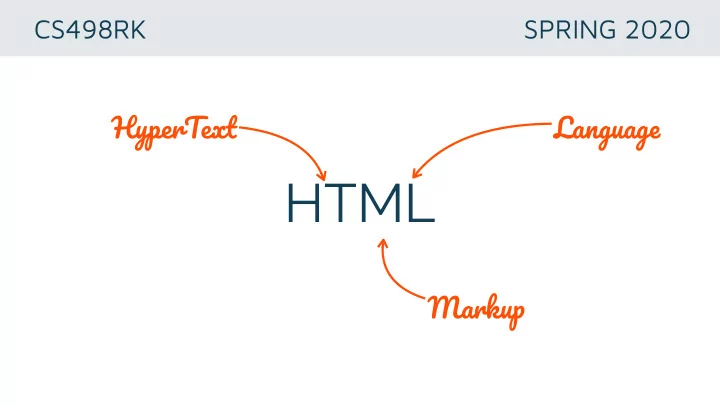
CS498RK SPRING 2020 HyperTex t Languag e HTML Marku p What is HTML? HYPERTEXT text which contains links to other texts 1945 : Vannevar Bush proposed the Memex, which could create and follow links between documents on microfiche 1989 : Tim
text which contains links to other texts 1945: Vannevar Bush proposed the Memex, which could create and follow links between documents on microfiche 1989: Tim Berners-Lee proposed Internet-based hypertext system to use and share CERN’s information
Nested elements that structure content
<!DOCTYPE html> <html> <head> <title>Photo Gallery</title> </head> <body> <div class="photo"> <h3>My first photo</h3> <img src="picture1.jpg"/> </div> ... </body> </html>
<!DOCTYPE html> <html> <head> <title>Photo Gallery</title> </head> <body> <div class="photo"> <h3>My first photo</h3> <img src="picture1.jpg"/> </div> ... </body> </html>
group elements spanning multiple lines line break before and after
group elements within a single line
new paragraph
line break
tables
unordered list
taking user input
set title that appears in browser
include CSS stylesheets
embed javascript
http://creativecommons.org <a><span id="home-button"> </span></a> <div id="logo"> <span> Creative Commons </span> </div>
HTML Document Object Model (DOM)
#logo img body span ul
topbar span { float: left; display: block; height: 40px; width: 150px; cursor: pointer; z-index: 1; top: 0;
cforms.js
//Collapse Functions String.prototype.tri function() { return this.replace}
creativecommons.css
topbar #home-button{ position: relative; float: left; display: block; height: 40px; width: 150px; }
cc-logo.png
Resources Rendered Page
<body> <div class="photo"> <h3>My first photo</h3> <img src="picture1.jpg"/> </div> ... </body>
BODY DIV H3 IMG
“My first photo”
1989 2015 1993: 1st HTML spec Tim Berners-Lee
Tim Berners-Lee proposed HTML draft to the IETF Draft referenced Mosaic (Marc Andreessen @ UIUC)
World Wide Web Consortium (W3C) Internet Engineering Task Force (IETF) Web Hypertext Application Technology Working Group (WHATWG)
1989 2015 1993: 1st HTML spec Tim Berners-Lee
the IETF created HTMLWG, who created HTML 2
1995: HTML 2.0 IETF takes first stab
1998: HTML 4 W3C release 1989 2015 1993: 1st HTML spec Tim Berners-Lee
Tim Berners-Lee creates the W3C in 1994
1995: HTML 2.0 IETF takes first stab 1997: HTML 3.2 W3C takes over
1998: HTML 4 W3C release 1989 2015 1993: 1st HTML spec Tim Berners-Lee 1995: HTML 2.0 IETF takes first stab 1997: HTML 3.2 W3C takes over 2008: HTML5 working draft 2014: HTML5 finalized
2008: HTML5 working draft 1998: HTML 4 W3C release
Web browsers have forgiving parsers 99% of pages have at least one error Move HTML from SGML to stricter XML X for extensibility
2000: XHTML 1.0 (HTML 4 as XML and not SGML) 2001: XHTML 1.1 XHTML2: complete departure from HTML 4 Browser vendors were slow to adopt
<!DOCTYPE HTML PUBLIC "-//W3C//DTD XHTML 1.0 Strict//EN” "http://www.w3.org/TR/xhtml1/DTD/ xhtml1-strict.dtd">
Set DOCTYPE to XHTML, MIME type to text/html Upgrade to XHTML syntax Browsers interpret document as HTML Loophole closed in XHTML 1.1
“The WHATWG was founded by individuals of Apple, the Mozilla Foundation, and Opera Software in 2004, after a W3C workshop. Apple, Mozilla and Opera were becoming increasingly concerned about the W3C’s direction with XHTML, lack of interest in HTML and apparent disregard for the needs of real-world authors. So, in response, these
concerns and the Web Hypertext Application Technology Working Group was born.”
wiki.whatwg.org/wiki/FAQ#What_is_the_WHATWG.3F
It is really important to have real developers on the ground involved with the development of HTML. It is also really important to have browser makers intimately involved and committed… It is necessary to evolve HTML incrementally. The attempt to get the world to switch to XML, including quotes around attribute values and slashes in empty tags and namespaces all at once didn't work…
Tim Berners-Lee
Reinventing HTML, 2006
2008: HTML5 working draft 1998: HTML 4 W3C release
2007: W3C adopts WHATWG’s HTML5 draft 2004: WHATWG formed 2000: XHTML 1.0 2001: XHTML 1.1
www.w3.org/TR/html5/
Browser vendors shape the future of HTML?
All code in this class will be written in HTML5!
www.w3.org/TR/html5-diff/#content-model
Metadata: link, script Flow: span, div Sectioning: aside, section Heading: h1
Phrasing: span, img Embedded: img, iframe Interactive: a, button
www.w3.org/TR/html5-diff/#content-model
support for richer graphics and video structural semantics
pages with sound and large video backgrounds
<body> <header> <h1>How to Get a PhD</h1> <nav>...</nav> </header> <article> <section> <figure><img src="benfranklin.jpg"></figure> <h3>Bribing your Committee</h3> <p>When blackmail fails...</p> </section> <aside> <h4>Useful Links></h4> <a href="www.bevmo.com">Research Supplies</a> </aside> </article> </body>
Thomas Fuchs
@thomasfuchs
Reuse stylesheets Remix pages and applications Retarget between form factors
<header> <nav> <article> <article> <article>
Often contain structural semantic clues many elements can share the same class value; id values are unique Use semantic class and id values for readability and maintainability
<div class="product"> <img class="product_image" /> <div class="product_description">…</div> </div>
Alternative text for images Use <h*> tags for headings, nested properly Sufficient contrast between text and background
www.w3.org/WAI/eval/preliminary.html
inspect a page’s implementation
map code to render-time environment