How to Participate Today Audio Modes Listen using Mic & S - - PDF document

how to participate today
SMART_READER_LITE
LIVE PREVIEW

How to Participate Today Audio Modes Listen using Mic & S - - PDF document

1/16/2020 Water Sector Priorities Before Congress and The Trump Administration for 2020 1 How to Participate Today Audio Modes Listen using Mic & S peakers Or, select Use Telephone and dial the conference (please


slide-1
SLIDE 1

1/16/2020 1

Water Sector Priorities Before Congress and The Trump Administration for 2020

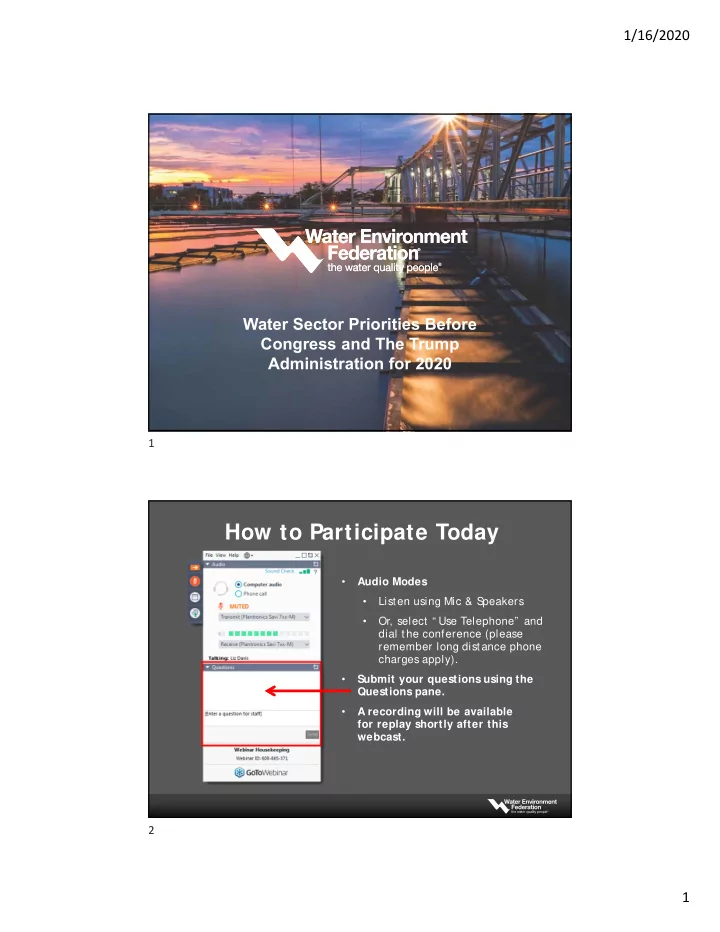
How to Participate Today

  • Audio Modes
  • Listen using Mic & S

peakers

  • Or, select “ Use Telephone” and

dial the conference (please remember long distance phone charges apply).

  • Submit your questions using the

Questions pane.

  • A recording will be available

for replay shortly after this webcast.

1 2

slide-2
SLIDE 2

1/16/2020 2

Government Affairs Update

 Regulatory Update – What to Expect from EP A and the Administration in 2020 (Claudio Ternieden, WEF S enior Director, Government Affairs)  Water Reuse Update – Next S teps for EP A ’s Water Reuse Action Plan (Greg Fogel, Policy Director, WateReuse Association)  Legislative Update – What to Expect from Congress in 2020 (S teve Dye, WEF Legislative Director)

Recent & Pending Key Regulatory Issues

  • The Maui Case
  • Waters of the United S

tates (aka WOTUS )

  • Peak Wet Weather Rulemaking
  • Affordability
  • Nutrients S

urvey

3 4

slide-3
SLIDE 3

1/16/2020 3

County of Maui, Hawaii, PETITIONER v. Hawaii Wildlife Fund, ET AL.

  • Maui Case: County of Maui v. Hawai’i

Wildlife Fund, U.S., No. 18-260.

  • Current S

tatus:

  • Council voted to settle the case; the County

Mayor refuses to implement the decision and to inform S upreme Court of settlement dispute – the parties are in litigation and the case was heard by the S upreme Court November 6, 2019, but no decision has been issued.

Waters of the United States (aka WOTUS)

  • EP

A has been working on repealing (which they did in October

  • f 2019 – become effective December 23, 2019) and revising

the definition of "waters of the United S tates" to “ clarify federal authority under the Clean Water Act” ;

  • THAT “ revision” rule was proposed in late 2018 and was

promised that a final rule would be proposed by January 2020;

  • We have information that Trump is expected to announce this

rule this coming S unday at the Farm Bureau convention in Austin, Texas – EP A Administrator Wheeler is expected to attend;

  • More information on the history and recent activity on this

rulemaking, go to: http:/ / www.epa.gov/ wotus-rule 5 6

slide-4
SLIDE 4

1/16/2020 4

Peak Wet Weather Rulemaking

  • In April 2018, EP

A announced a new rulemaking to look at issues associated with the management and treatment of peak flows during wet weather events at publicly owned treatment works (POTWs) with separate sanitary sewer systems. Through this rulemaking, EP A will evaluate changes to its National Pollutant Discharge Eliminat ion S ystem (NPDES ) regulations to establish a transparent and lasting framework to permitting peak flow management options;

  • Before proposing any changes to its NPDES

regulations, EP A is undertaking an extensive stakeholder engagement effort to encourage individual input for developing a rule that will support a consistent approach to permitting, allow for innovative flexibility, and protect human health and the environment;

  • EP

A expects to issue a proposed rule by the end of 2019; final is scheduled for the S ummer S pring of 2020… .

  • For more information: https:/ / www.epa.gov/ npdes/ peak-flows-sewage-

treatment-plants

Affordability

  • The National Association of Clean Water Agencies, Water Environment

Federation and the American Water Works Association co-funded a new study looking into how EP A evaluates affordability – which is then used to decide how much a community can spend on wastewater and drinking water proj ects;

  • The water sector hopes this study will assist U.S

. EP A respond to recommendations from the congressionally-mandated NAP A review of the Office of Water’s existing affordability policies;

  • The proposed framework is an alternative to current reliance on median

household income as a singular measure of affordability in regulatory decision- making;

  • The Core elements of the proposed framework reflects:
  • Recognition that individual households bear the total cost of all the water services they receive.
  • With modern America’s bi-modal income distribution and highly community-specific costs of

living, no one metric can serve as a bright line for when water service is affordable for individual households

  • Understanding the implications of affordability for water policy requires both considering the

capacity of low-income households to afford service and the community’s (the water system’s) financial capability (i.e., its ability to reliably provide service and make necessary improvements

  • ver time).

7 8

slide-5
SLIDE 5

1/16/2020 5

Nutrients Survey

  • On October 22, EP

A made available a voluntary screener survey which is intended to collect basic information from all secondary treatment facilities nationwide;

  • EP

A requested that participants submit their surveys by November 26, 2019, but is still accepting responses;

  • For more information: https:/ / www.epa.gov/ eg/ potw-

nutrient-survey

Federal Advocacy for Water Reuse in 2020

Greg Fogel

Policy Director WateReuse Association January 16, 2020 9 10

slide-6
SLIDE 6

1/16/2020 6

How We Advocate

Authorize

  • Congress

authorizes or reauthorizes programs

Appropriate

  • Congress

provides annual discretionary spending for programs

Implement

  • The

Administration writes rules and guidance documents and administers programs

11

Authorize

Water Resource Development Act (WRDA) 2020

  • The WateReuse Association will advocate to

reauthorize three programs:

  • USBR’s Title XVI-WIINWater Reclamation and Reuse

Program

  • Pilot Program for Alternative Water Source Grants Program
  • Clean Water State Revolving Fund Program
  • Inter-agency Working Group on Water Reuse

12

11 12

slide-7
SLIDE 7

1/16/2020 7

Appropriate

FY2018 Level FY19 Level FY20 Level Title XVI‐WIIN $20,000,000 $20,000,000 $20,000,000 Desalination and Water Purification Program $17,800,000 $19,800,000 $20,000,000 CWSRF $1,694,000,000 $1,694,000,000 $1,638,826,000 DWSRF $1,163,233,000 $1,164,000,000 $1,126,088,000 WIFIA $63,000,000 $68,000,000 $60,000,000 Drinking Water Infrastructure Resilience and Sustainability Program N/A N/A $3,000,000 Sewer Overflow and Stormwater Reuse Grants N/A N/A $28,000,000

Implement

National Water Reuse Action Plan (WRAP)

14

February 2019

EPA announces development

  • f Water Reuse

Action Plan

April 2019

EPA opens 1st public comment period

July 2019

1st public comment period closes

September 2019

EPA releases draft Action Plan, opens 2nd comment period

December 2019

2nd comment period closes

2020

EPA Releases Final Action Plan

13 14

slide-8
SLIDE 8

1/16/2020 8

Fiscal Year 2020 Appropriations Update

Program FY19 Omnibus

  • Pres. FY20

Senate FY20 Draft House FY20 Draft FY20 Final Function Clean Water SRF $1.7B $1.1B $1.6B $1.8B $1.6B

Wastewater & Stormwater Loans

Drinking Water SRF $1.2B $863M $1.1B $1.3B $1.1B

Drinking Water Loans

WIFIA $68M $25M $73M $45M $60M

All Water Infrastructure Loans

USDA Loans & Grants $2.02B $1.7B NA $1.45B

Rural Communities Loans and Grants

Water Workforce Grants $1M $1M $1M $1M

Western US Water Recycling and Reuse

AWIA – Sewer Overflow Control Grants $61M $20M $90M $28M

Grants for CSO, SSO, and SW Infrastructure

National Priorities Water Research $5M $6M

Grants for Water Research

Key Bills to Watch

  • WRDA 2020 – Coming S

pring 2020!

  • CW S

RF Reauthorization

  • WIFIA Reauthorization
  • Etc…
  • H.R. 1497* - Water Quality Protection and Job

Creation Act of 2019, by Rep. Peter DeFazio

  • H.R. 3521 – Wastewater Infrastructure Workforce

Investment Act of 2019, by Rep. Greg S tanton

  • H.R. 1764* – NPDES

permit terms extension legislation, by Rep. John Garamendi * = Calls-t o-Act ion up on WEF .org

15 16

slide-9
SLIDE 9

1/16/2020 9

Water Quality Protection and Job Creation Act of 2019 (H.R. 1497)

S ponsor: Chairman Pet er DeFazio (D-OR) Co-sponsors: Grace Napolit ano (D-CA), Don Y

  • ung (R-AK), and John Kat ko (R-NY)

The key provisions of the bill include (FY20 – 24):

  • Clean Water S

RF reauthorized at $16B/ 5 years

  • 1%

CW S RF set-aside for wastewater workforce development assistance to utilities of $140M/ 5 years. (WEF PROVIS ION)

  • S

tate management assistance at $1.295B/ 5 years

  • Watershed pilot proj ects at $110M/ 5 years
  • Redefines "alternative water source proj ects" as wastewater,

stormwater, or by treating wastewater or stormwater and authorizes $150M/ 5 years

  • Extends authorization for grant assistance for CS

O, S S O and stormwater proj ects for $1.125B/ 5 years.

P AS S ED BY COMMITTEE 10/ 29/ 19

PFAS Update – Federal Only

US EPA – Proposed Determination to OMB for PFOA and

PFOS “ f ollowing t hrough on it s commit ment in t he Act ion Plan t o evaluat e PFOA and PFOS under t he S af e Drinking Wat er Act .” (Dec. 3)

National Defense Authorization Act (NDAA) – CWA

and CERCLA not included.

  • WEF Call-to-Action:

https:/ / wef.org/ advocacy/ water-advocates2/

PFAS Receivers Fact Sheet: https:/ / www.wef.org/ pfas Additional WEF resources:

https:/ / wef.org/ biosolids/

17 18

slide-10
SLIDE 10

1/16/2020 10

H.R. 535, The PFAS Action Act of 2019

  • Passed House Jan. 10, 2020, by a vote of 247-159
  • S

enate Environment & Public Works Comm. Chairman John Barrasso (R-WY) said the bill has “ no prospects in the S enate.”

  • WEF wrote the House detailing concerns: http:/ / www.wef.org/ wef-comment-

letter-re-h.r.-535-the-pfas-action-act

  • WEF also co-signed a water sector letter: http:/ / www.wef.org/ h.r.-535-house-

letter-pfas-action-act/ Key CERCLA provisions:

  • Requires EP

A within one year to designate PFOS and PF AO as hazardous substances under CERCLA.

  • Within 5 years EP

A shall determine if additional PF AS substances should be designated as hazardous.

  • Requiring a study of US

EP A's actions under CERCLA to clean-up PF AS contaminated sites.

H.R. 535, The PFAS Action Act of 2019 (continued)

CWA provisions:

  • Require EP

A by 9/ 30/ 2021 to develop effluent standards, pretreatment standards, and water quality criteria for PF AS chemicals introduced or discharged by industries, other than publicly

  • wned treatment works.
  • Authorizes $100 million in funding to support POTWs to implement

mandates related to pretreatment standards. S DWA provisions:

  • Requires EP

A in two years to finalize an MCL under S DWA for PFOA and PFOS .

  • Requires EP

A to expedite regulations for additional PF AS under S DWA.

  • Requires EP

A to regularly issue drinking water health advisories for additional PF AS .

19 20

slide-11
SLIDE 11

1/16/2020 11

H.R. 535, The PFAS Action Act of 2019 (continued)

Additional provisions:

  • Authorizes $125 million to fund the PF

AS Infrastructure Grant Program for each of the fiscal years 2020 and 2021, of which $25 million is to assist affected community water systems that have previously implemented eligible treatment technologies.

  • Creating a tool on US

EP A website to help the public understand testing results for their well water and connect them to local health and government resources and $1 million to support this activity.

  • Adding the term "disproportionately exposed communities" to

the category of "disadvantaged communities." 21 22