SLIDE 1
1
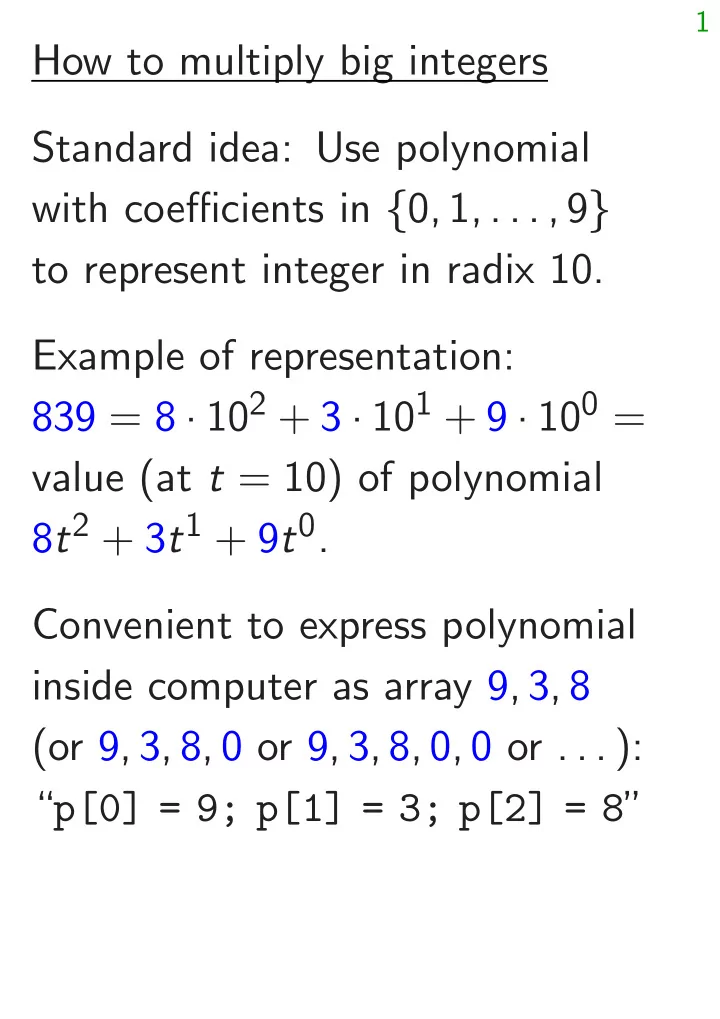
How to multiply big integers Standard idea: Use polynomial with coefficients in {0; 1; : : : ; 9} to represent integer in radix 10. Example of representation: 839 = 8 · 102 + 3 · 101 + 9 · 100 = value (at t = 10) of polynomial 8t2 + 3t1 + 9t0. Convenient to express polynomial inside computer as array 9; 3; 8 (or 9; 3; 8; 0 or 9; 3; 8; 0; 0 or : : : ): “p[0] = 9; p[1] = 3; p[2] = 8”
SLIDE 2
2
Multiply two integers by multiplying polynomials that represent the integers. Polynomial multiplication involves small integer coefficients. Have split one big multiplication into many small operations. Example, squaring 839: (8t2 + 3t1 + 9t0)2 = 8t2(8t2 + 3t1 + 9t0) + 3t1(8t2 + 3t1 + 9t0) + 9t0(8t2 + 3t1 + 9t0) = 64t4 +48t3 +153t2 +54t1 +81t0.
SLIDE 3
3
Oops, product polynomial usually has coefficients > 9. So “carry” extra digits: ctj → ⌊c=10⌋ tj+1+(c mod 10)tj. Example, squaring 839: 64t4 +48t3 +153t2 +54t1 +81t0; 64t4 + 48t3 + 153t2 + 62t1 + 1t0; 64t4 + 48t3 + 159t2 + 2t1 + 1t0; 64t4 + 63t3 + 9t2 + 2t1 + 1t0; 70t4 + 3t3 + 9t2 + 2t1 + 1t0; 7t5 + 0t4 + 3t3 + 9t2 + 2t1 + 1t0. In other words, 8392 = 703921.
SLIDE 4 4
What operations were used here? 8
P P P P P P P P P P P 3
♥♥♥♥♥♥♥♥♥♥♥♥ multiply
❅ ❅ ❅ ❅ ❅ 9
add ⑦ ⑦ ⑦ ⑦ ⑦ ⑦ 153
⑧ ⑧ ⑧ ⑧ ⑧ ⑧ 6 add ⑥ ⑥ ⑥ ⑥ ⑥ ⑥ 159 divide by 10 ⑥ ⑥ ⑥ ⑥ ⑥ ⑥ ⑥ mod 10
9
SLIDE 5 5 8
✶ ✶ ✶
9
✰ ✰ ✰ ✰ ✰ ✰
81
◗ ◗ ◗
24
✪
✪ ✪ ✪ ✪ ✪ ✪ ✪ ✪ ✪ ✪ ✪ ✪ ✪ ✪
9
✶ ✶ ✶ ✶ ✶ ✶ ✶ ✶ ✶
27
▲ ▲ ▲ ▲ ▲ ▲ ▲
81
✮
✮ ✮ ✮ ✮ ✮ ✮ ✮ ✮ ✮ ✮ ✮ ✮ ✮ ✮ ✮ ✮ ✮
24
✹ ✹ ✹ ✹ ✹ ✹ ✹ ✹ ✹ ✹ ✹ ✹ ✹ 72
■ ■ ■ ■ ■ ■ ■ ■ ■ ■ ■
54
⑤
8
⑤
⑤
1 153
⑤
6
⑤
⑤
2 48
⑤
15
⑤
⑤
9 64
⑤
6
⑤
⑤
3 70
⑤
7
⑤
⑤
7
SLIDE 6
6
The scaled variation 839 = 800 + 30 + 9 = value (at t = 1) of polynomial 800t2 + 30t1 + 9t0. Squaring: (800t2+30t1+9t0)2 = 640000t4 + 48000t3 + 15300t2 + 540t1 + 81t0. Carrying: 640000t4 + 48000t3 + 15300t2 + 540t1 + 81t0; 640000t4 + 48000t3 + 15300t2 + 620t1 + 1t0; : : : 700000t5 +0t4 +3000t3 +900t2 + 20t1 + 1t0.
SLIDE 7 7
What operations were used here? 800
❚ ❚ ❚ ❚ ❚ ❚ ❚ ❚ ❚ ❚ ❚ ❚ ❚ 30
❥❥❥❥❥❥❥❥❥❥❥❥❥❥❥ multiply
■ ■ ■ ■ ■ ■ 900
add ✇✇✇✇✇✇✇ 15300
④④④④④④ 600 add ✈✈✈✈✈✈✈ 15900 subtract ✉✉✉✉✉✉✉✉ mod 1000
900
SLIDE 8
8
Speedup: double inside squaring (· · · + f2t2 + f1t1 + f0t0)2 has coefficients such as f4f0 + f3f1 + f2f2 + f1f3 + f0f4. 5 mults, 4 adds.
SLIDE 9
8
Speedup: double inside squaring (· · · + f2t2 + f1t1 + f0t0)2 has coefficients such as f4f0 + f3f1 + f2f2 + f1f3 + f0f4. 5 mults, 4 adds. Compute more efficiently as 2f4f0 + 2f3f1 + f2f2. 3 mults, 2 adds, 2 doublings. Save ≈ 1=2 of the mults if there are many coefficients.
SLIDE 10
9
Faster alternative: 2(f4f0 + f3f1) + f2f2. 3 mults, 2 adds, 1 doubling. Save ≈ 1=2 of the adds if there are many coefficients.
SLIDE 11
9
Faster alternative: 2(f4f0 + f3f1) + f2f2. 3 mults, 2 adds, 1 doubling. Save ≈ 1=2 of the adds if there are many coefficients. Even faster alternative: (2f0)f4 + (2f1)f3 + f2f2, after precomputing 2f0; 2f1; : : :. 3 mults, 2 adds, 0 doublings. Precomputation ≈ 0:5 doublings.
SLIDE 12
10
Speedup: allow negative coeffs Recall 159 → 15; 9. Scaled: 15900 → 15000; 900. Alternative: 159 → 16; −1. Scaled: 15900 → 16000; −100. Use digits {−5; −4; : : : ; 4; 5} instead of {0; 1; : : : ; 9}. Small disadvantage: need −. Several small advantages: easily handle negative integers; easily handle subtraction; reduce products a bit.
SLIDE 13
11
Speedup: delay carries Computing (e.g.) big ab + c2: multiply a; b polynomials, carry, square c poly, carry, add, carry. e.g. a = 314, b = 271, c = 839: (3t2+1t1+4t0)(2t2+7t1+1t0) = 6t4 + 23t3 + 18t2 + 29t1 + 4t0; carry: 8t4 + 5t3 + 0t2 + 9t1 + 4t0. As before (8t2 + 3t1 + 9t0)2 = 64t4 +48t3 +153t2 +54t1 +81t0; 7t5 + 0t4 + 3t3 + 9t2 + 2t1 + 1t0. +: 7t5+8t4+8t3+9t2+11t1+5t0; 7t5 + 8t4 + 9t3 + 0t2 + 1t1 + 5t0.
SLIDE 14
12
Faster: multiply a; b polynomials, square c polynomial, add, carry. (6t4 +23t3 +18t2 +29t1 +4t0)+ (64t4+48t3+153t2+54t1+81t0) = 70t4+71t3+171t2+83t1+85t0; 7t5 + 8t4 + 9t3 + 0t2 + 1t1 + 5t0. Eliminate intermediate carries. Outweighs cost of handling slightly larger coefficients. Important to carry between multiplications (and squarings) to reduce coefficient size; but carries are usually a bad idea before additions, subtractions, etc.
SLIDE 15
13
Speedup: polynomial Karatsuba How much work to multiply polys f = f0 + f1t + · · · + f19t19, g = g0 + g1t + · · · + g19t19? Using the obvious method: 400 coeff mults, 361 coeff adds. Faster: Write f as F0 + F1t10; F0 = f0 + f1t + · · · + f9t9; F1 = f10 + f11t + · · · + f19t9. Similarly write g as G0 + G1t10. Then f g = (F0 + F1)(G0 + G1)t10 + (F0G0 − F1G1t10)(1 − t10).
SLIDE 16
14
20 adds for F0 + F1, G0 + G1. 300 mults for three products F0G0, F1G1, (F0 + F1)(G0 + G1). 243 adds for those products. 9 adds for F0G0 − F1G1t10 with subs counted as adds and with delayed negations. 19 adds for · · · (1 − t10). 19 adds to finish. Total 300 mults, 310 adds. Larger coefficients, slight expense; still saves time. Can apply idea recursively as poly degree grows.
SLIDE 17 15
Many other algebraic speedups in polynomial multiplication: “Toom,” “FFT,” etc. Increasingly important as polynomial degree grows. O(n lg n lg lg n) coeff operations to compute n-coeff product. Useful for sizes of n that occur in cryptography? In some cases, yes! But Karatsuba is the limit for prime-field ECC/ECDLP
SLIDE 18
16
Modular reduction How to compute f mod p? Can use definition: f mod p = f − p ⌊f =p⌋. Can multiply f by a precomputed 1=p approximation; easily adjust to obtain ⌊f =p⌋. Slight speedup: “2-adic inverse”; “Montgomery reduction.”
SLIDE 19
17
e.g. 314159265358 mod 271828: Precompute ⌊1000000000000=271828⌋ = 3678796. Compute 314159 · 3678796 = 1155726872564. Compute 314159265358 − 1155726 · 271828 = 578230. Oops, too big: 578230 − 271828 = 306402. 306402 − 271828 = 34574.
SLIDE 20
18
We can do better: normally p is chosen with a special form to make f mod p much faster. Special primes hurt security for F∗
p, Clock(Fp), etc.,
but not for elliptic curves! Curve25519: p = 2255 − 19. NIST P-224: p = 2224 − 296 + 1. secp112r1: p = (2128 − 3)=76439. Divides special form. gls1271: p = 2127 − 1, with degree-2 extension (a bit scary).
SLIDE 21
19
Small example: p = 1000003. Then 1000000a + b ≡ b − 3a. e.g. 314159265358 = 314159 · 1000000 + 265358 ≡ 314159(−3) + 265358 = −942477 + 265358 = −677119. Easily adjust b − 3a to the range {0; 1; : : : ; p − 1} by adding/subtracting a few p’s: e.g. −677119 ≡ 322884.
SLIDE 22
20
Hmmm, is adjustment so easy? Conditional branches are slow and leak secrets through timing. Can eliminate the branches, but adjustment isn’t free. Speedup: Skip the adjustment for intermediate results. “Lazy reduction.” Adjust only for output. b − 3a is small enough to continue computations.
SLIDE 23 21
Can delay carries until after multiplication by 3. e.g. To square 314159 in Z=1000003: Square poly 3t5 + 1t4 + 4t3 + 1t2 + 5t1 + 9t0,
- btaining 9t10 + 6t9 + 25t8 +
14t7 + 48t6 + 72t5 + 59t4 + 82t3 + 43t2 + 90t1 + 81t0. Reduce: replace (ci)t6+i by (−3ci)ti, obtaining 72t5 + 32t4 + 64t3 − 32t2 + 48t1 − 63t0. Carry: 8t6 − 4t5 − 2t4 + 1t3 + 2t2 + 2t1 − 3t0.
SLIDE 24
22
To minimize poly degree, mix reduction and carrying, carrying the top sooner. e.g. Start from square 9t10+6t9+ 25t8 +14t7 +48t6 +72t5 +59t4 + 82t3 + 43t2 + 90t1 + 81t0. Reduce t10 → t4 and carry t4 → t5 → t6: 6t9 + 25t8 + 14t7 + 56t6 − 5t5 + 2t4 + 82t3 + 43t2 + 90t1 + 81t0. Finish reduction: −5t5 + 2t4 + 64t3 − 32t2 + 48t1 − 87t0. Carry t0 → t1 → t2 → t3 → t4 → t5: −4t5 −2t4 +1t3 +2t2 −1t1 +3t0.
SLIDE 25 23
Speedup: non-integer radix p = 261 − 1. Five coeffs in radix 213? f4t4 + f3t3 + f2t2 + f1t1 + f0t0. Most coeffs could be 212. Square · · · + 2(f4f1 + f3f2)t5 + · · ·. Coeff of t5 could be > 225. Reduce: 265 = 24 in Z=(261 − 1); · · · + (25(f4f1 + f3f2) + f 2
0 )t0.
Coeff could be > 229. Very little room for additions, delayed carries, etc.
SLIDE 26
24
Scaled: Evaluate at t = 1. f4 is multiple of 252; f3 is multiple of 239; f2 is multiple of 226; f1 is multiple of 213; f0 is multiple of 20. Reduce: · · · + (2−60(f4f1 + f3f2) + f 2
0 )t0.
Better: Non-integer radix 212:2. f4 is multiple of 249; f3 is multiple of 237; f2 is multiple of 225; f1 is multiple of 213; f0 is multiple of 20. Saves a few bits in coeffs.
SLIDE 27
25
More bad choices from NIST NIST P-256 prime: 2256 − 2224 + 2192 + 296 − 1. i.e. t8 − t7 + t6 + t3 − 1 evaluated at t = 232.
SLIDE 28
25
More bad choices from NIST NIST P-256 prime: 2256 − 2224 + 2192 + 296 − 1. i.e. t8 − t7 + t6 + t3 − 1 evaluated at t = 232. Reduction: replace cit8+i with cit7+i − cit6+i − cit3+i + citi. Minor problem: often slower than small const mult and one add.
SLIDE 29
25
More bad choices from NIST NIST P-256 prime: 2256 − 2224 + 2192 + 296 − 1. i.e. t8 − t7 + t6 + t3 − 1 evaluated at t = 232. Reduction: replace cit8+i with cit7+i − cit6+i − cit3+i + citi. Minor problem: often slower than small const mult and one add. Major problem: With radix 232, products are almost 264. Sums are slightly above 264: bad for every common CPU. Need very frequent carries.