How to follow fast processes? Nobel Lecture, Ahmed Zewail, 1999 31 - - PowerPoint PPT Presentation

how to follow fast processes
SMART_READER_LITE
LIVE PREVIEW

How to follow fast processes? Nobel Lecture, Ahmed Zewail, 1999 31 - - PowerPoint PPT Presentation

How to follow fast processes? Nobel Lecture, Ahmed Zewail, 1999 31 07 2019 Ultrafast Dynamics 1 Pulsed excitation Intensity Excited state population Time A = c l sample Pulsed probe light Map of time evolution Pulsed Pump light of


slide-1
SLIDE 1

31‐07‐2019 Ultrafast Dynamics 1
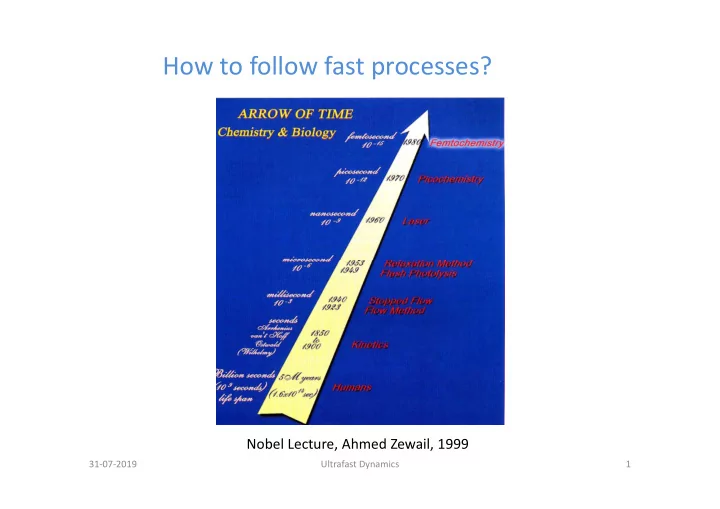
How to follow fast processes?

Nobel Lecture, Ahmed Zewail, 1999

slide-2
SLIDE 2

31‐07‐2019 Ultrafast Dynamics 2

Pulsed excitation

Time Intensity Excited state population sample Pulsed Pump light Pulsed probe light

A =  c l Map of time evolution

  • f the excited state
slide-3
SLIDE 3

31‐07‐2019 Ultrafast Dynamics 3

Snapshots of bond breaking

Nobel Lecture, Ahmed Zewail, 1999; Atkins, Physical Chemistry

slide-4
SLIDE 4

Chemistry beyond the Ground State

Electronic arrangement different from that in the ground state HOMO LUMO Singlet excited state, S1 HOMO LUMO Triplet excited state, T1 HOMO LUMO Ground state, So Reactivity in the excited state is not the same as that in ground state

slide-5
SLIDE 5

Photoacidity

Acids are more acidic in the excited state, bases are more basic Phenols: Delocalozation of electrons on O‐: Stabilization of the phenoxide ion ‐ * transition: Delocalization involves lower energy  orbitals Further stabilization of the phenoxide ion Electron donating groups Aromatic carboxylates: Withdraw p electrons from the ring High electron density on O‐: Efficient proton abstraction ‐ * transition: * electrons are easier to withdraw More efficient proton abstraction Electron withdrawing groups

HOMO LUMO

slide-6
SLIDE 6

An example: 2‐naphthol

pKa = 9.2, pKa* = 2!

Absorption spectra

pH titration curves Fluorescence spectra pH 3: protonated ground state, partially deprotonated excited state Acids are more acidic in the excited state

  • J. R. Lakowicz, Principles of fluorescence spectroscopy, 3rd ed. 2006
slide-7
SLIDE 7

31‐07‐2019 Ultrafast Dynamics 7

The mechanism of acid base reactions

Matteo Rini, Ben‐Zion Magnes, Ehud Pines, Erik T. J. Nibbering Science, 2003, 301, 349 – 352 Pyranine Photoacid Visible pump, Mid IR probe Photobase

slide-8
SLIDE 8

Dynamics from the time – resolved IR Spectra

  • B. High CH3COO‐ concn
  • C. Low CH3COO‐ concn

Increasing CH3COO‐ concn.  Smaller risetime of CH3COOH CH3COOH Photobase CH3COOH

slide-9
SLIDE 9

The mechanism of acid‐base reactions

Further reading: Nibbering and coworkers, Science, 2005, 310, 83 ‐ 86

slide-10
SLIDE 10

31‐07‐2019 Ultrafast Dynamics 10

The take home message

  • There is more to Chemistry than mixing solutions
  • Physical Chemistry vs. Unphysical Chemistry
  • We need to know theory, we need to understand instruments
  • Look wide and never be scared of new challenges