How to create an effective poster presentation By Rose O. Sherman, - - PDF document

how to create an effective poster presentation
SMART_READER_LITE
LIVE PREVIEW

How to create an effective poster presentation By Rose O. Sherman, - - PDF document

Strictly Clinical Strictly Clinical How to create an effective poster presentation By Rose O. Sherman, EdD, RN, NEA O RGANIZERS of nursing con- Allowable poster sizes for con- Presenting your project at a ferences depend on nurses


slide-1
SLIDE 1

Strictly Clinical —

www.AmericanNurseToday.com September 2010 American Nurse Today 13

ORGANIZERS of nursing con-

ferences depend on nurses who have created new pro- grams or are doing research to submit their work for pres- entation at conferences. Through these presentations, nursing knowledge is disseminated. If you belong to a professional organization, you’ve probably received at least one call for abstracts. Arriving well in advance of the conference date, this is an invita- tion to submit an abstract for presentation at the confer-

  • ence. You may have the choice of submitting an abstract

for either an oral (podium) presentation or a poster pres-

  • entation. Poster presentations can be a good way to get

started presenting your work—and they’re a great oppor- tunity to get feedback and suggestions from colleagues.

Congrats! Now get started.

It’s exciting to get a letter or e-mail telling you that your poster proposal has been accepted for a conference. But don’t waste timing resting on your laurels. When asked what they’ve learned about doing posters, many experienced presenters say they wish they’d begun their poster design earlier because the process took much longer than they

  • anticipated. So to avoid a time crunch,

start designing your poster shortly af- ter your abstract is accepted. Plan the size, content, and layout Unlike an oral presentation, the poster itself should do most of the talking about your project. Good de- sign matters. It allows you to tell the “story” of your work more effectively. Begin by carefully reviewing the poster guidelines for the conference. These guidelines specify what size the poster should be and how it will be displayed—tabletop, corkboard, or

  • easel. Poster size affects how much in-

formation you can put on the poster. Allowable poster sizes for con- ferences vary widely. Poster content should close- ly follow the format of the ab- stract you submitted. But keep in mind that a poster is not an

  • abstract. With a poster, your goal is to tell a clear, sim-

ple story of your work. If your poster topic is a project

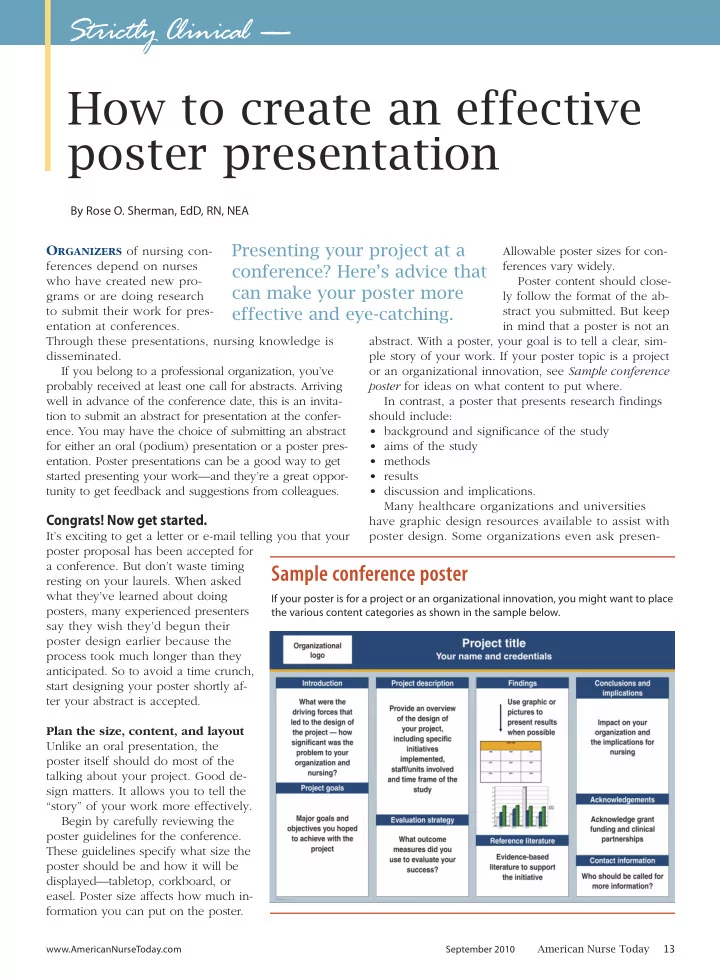
  • r an organizational innovation, see Sample conference

poster for ideas on what content to put where. In contrast, a poster that presents research findings should include:

  • background and significance of the study
  • aims of the study
  • methods
  • results
  • discussion and implications.

Many healthcare organizations and universities have graphic design resources available to assist with poster design. Some organizations even ask presen-

Strictly Clinical —

How to create an effective poster presentation

By Rose O. Sherman, EdD, RN, NEA

Presenting your project at a conference? Here’s advice that can make your poster more effective and eye-catching.

Sample conference poster

If your poster is for a project or an organizational innovation, you might want to place the various content categories as shown in the sample below.

slide-2
SLIDE 2

14 American Nurse Today Volume 5, Number 9 www.AmericanNurseToday.com

ters to use a specific template. Today many posters are designed with Microsoft PowerPoint templates, but you can also lay out the sections of your poster

  • n a large piece of poster board (available at art sup-

ply or office supply stores) before finalizing it. Or you might consider using an Internet vendor (such as www.makesigns.com). Many vendors not only guide you through poster design but also can print and ship your poster. Use a “less is more” design The maxim “less is more” is good advice to follow for a poster. Although you may be tempted to include every detail of your project or research, you won’t have enough space to do this. What’s more, you shouldn’t do this; it would make your poster too busy. Here are some design tips to follow:

  • Leave adequate white space. Some empty space is

critical to readability and legibility. Without it, the reader has no visual pauses.

  • Convey your message clearly. The poster should

capture the attention of attendees and convey at least one significant idea they’ll remember. Most people spend 3 to 5 minutes viewing a poster, so use plain, descriptive language that leaves no doubt what your poster is about. Generally, posters are read from left to right; organize the content with this in mind. When possible, lead the viewer through the logical flow using bold take-home points or arrows.

  • Use a visual image. People retain visual images

longer than the written word, so aim for at least one visual image—a photograph, an illustration, a graph.

  • Make it readable. Design the poster so it can be

read from a distance of 4' to 6'. To accomplish this, lettering has to be at least 1" high. The title should be readable from 15' to 20' away, with letters 2" to 3" high. Try to have high contrast between the back- ground and text. Generally, a lighter background with darker text is easier to read.

  • Pick fonts carefully. Arial and Tahoma are examples
  • f nonserif fonts that work well for poster titles. Serif

fonts, such as Times New Roman and Courier, are easier to read at smaller sizes and work well for body text. Having too many font types on a poster can be distracting, so use at most two to three fonts, with bold or italics for emphasis only. Avoid all up- percase letters (capitals) in your poster, as this makes material harder to read.

  • Use color sparingly. Although most presenters want

colorful posters, color must be incorporated careful-

  • ly. Blue and green are popular because they’re con-

sidered calming.

  • Ask colleagues for help. If this

is your first time designing a poster, ask an experienced col- league for help. Before the poster is printed, have col- leagues familiar with your sub- ject area review it for clarity and possible errors. Proofread the poster carefully before you transport it to the conference.

Transporting and setting up your poster

Posters can be delivered to the conference site by overnight services, such as FedEx or UPS, but many presenters prefer to hand-carry them in poster can- isters or portfolios. Normally, posters are set up just before the conference begins. You should receive advance guide- lines from conference organizers telling you how to set up your poster. If the poster will be attached to corkboard, find out if you’re expected to bring the re- quired materials (usually pushpins or Velcro strips) to adhere it. Most professional meeting agendas set aside specific times for poster presentations. Many organizations offer continuing education credit for poster session atten-

  • dance. Be aware that if your poster is accepted at a

conference, a presenter familiar with the project or re- search is expected to be available during poster ses- sions to answer questions.

P

resenting a poster is a chance to learn from attendees about aspects of your work that particularly resonate with your audience.

slide-3
SLIDE 3

www.AmericanNurseToday.com

A networking opportunity

Poster presentations are excellent opportunities not just to showcase your work but also to network with colleagues who have similar interests. Effective pre- senters introduce themselves to attendees and “walk” them through their poster, often adding information that they think will interest them. Some attendees may want to take the information back to their or- ganizations, so consider having handouts available to distribute at the conference. Also, bring your busi- ness cards or written contact information to give to participants.

From poster to article?

Interest in your poster by conference attendees may in- spire you to take the next step—turning it into an arti-

  • cle. Often, journal editors attend specialty conferences

and visit poster exhibits. This can be a good opportu- nity to query them about their journals’ potential inter- est in your topic. Presenting a poster is a chance to learn from at- tendees about aspects of your work that particularly resonate with your audience. This can give you a better idea of how to present your work in a journal article to ensure it’s informative and interesting and provides clear implications for the nursing pro- fession. Poster sessions have become an important part of most professional conferences and are an excellent way for presenters to share their work. Enjoy the expe- rience of proudly standing next to your poster and dis- cussing your work with interested colleagues. ✯ Selected references

Blakesley D, Brizee A. Designing research posters. Purdue University Writing Lab. 2008. http://owl.english.purdue.edu/media/pdf/ 20080626013023_727.pdf. Accessed July 20, 2010. Briggs DJ. A practical guide to designing posters for presentation. Nurs Stand. 2009;23(34):35-39. Halligan P. Poster presentations: valuing all forms of evidence. Nurse Educ Pract. 2008;8:41-45. Keely BR. Planning and creating effective scientific posters. J Contin Educ Nurs. 2004;35(4):182-185. Moore LW, Augspurger P, King MO, Proffitt C. Insights on the poster presentation and presentation process. Appl Nurs Res. 2001;14(2): 100-104. Sherman RO. Writing abstracts for podium and poster presentations. In: Saver C. ed. Anatomy of Writing for Publication for Nurses. Indi- anapolis, IN: Sigma Theta Tau International; 2011. University of Buffalo Libraries. Poster presentations: designing effec- tive posters. http://library.buffalo.edu/asl/guides/bio/posters.html. Accessed July 20, 2010.

Rose O. Sherman is director of the Nursing Leadership Institute and associate professor of nursing at the Christine E. Lynn College of Nursing at Florida Atlantic University in Boca Raton. She can be reached at rsherman@fau.edu.

Walden University is accredited by The Higher Learning Commission and a member

  • f the North Central Association, www.ncahlc.org; 1-312-263-0456.

Walden University’s Master of Science in Nursing (MSN) is accredited by the Commission

  • n Collegiate Nursing Education (CCNE), a national accrediting agency recognized by the

U.S. Department of Education and the Council for Higher Education Accreditation.

In today’s ever-changing healthcare environment, an advanced degree can go a long way in moving your career

  • forward. Walden University’s School of Nursing helps

RNs from all educational backgrounds gain the enhanced knowledge and expertise they need to succeed and thrive. Walden is an accredited institution with 40 years of experience in distance education. Our MSN program is CCNE-accredited, and every professor in our School of Nursing holds a doctoral degree. In May 2010, U.S. News & World Report again identified Walden as having the

  • No. 2 largest online graduate nursing program by enrollment.

Get the nursing degree you need to make the difference you want—for your future and the future of healthcare.

1-888-889-5196 WaldenU.edu/nursing

ONLINE PROGRAMS

Bachelor of Science in Nursing (BSN) Completion Program Master of Science in Nursing (MSN) Post-Master’s Certificates in Nursing

Earn a higher degree. To make a greater difference.