
SLIDE 1
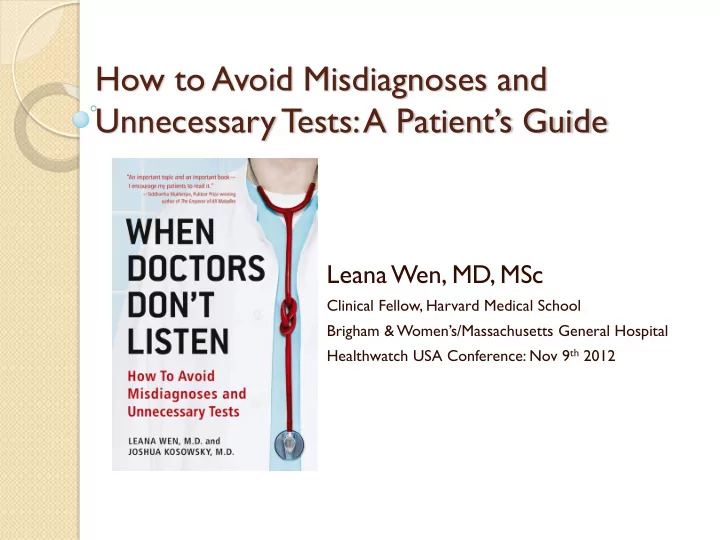
How to Avoid Misdiagnoses and Unnecessary T ests: A Patient’s Guide
Leana Wen, MD, MSc
Clinical Fellow, Harvard Medical School Brigham & Women’s/Massachusetts General Hospital Healthwatch USA Conference: Nov 9th 2012
How to Avoid Misdiagnoses and Unnecessary T ests: A Patients Guide - - PowerPoint PPT Presentation
How to Avoid Misdiagnoses and Unnecessary T ests: A Patients Guide Leana Wen, MD, MSc Clinical Fellow, Harvard Medical School Brigham & Womens/Massachusetts General Hospital Healthwatch USA Conference: Nov 9 th 2012 The story of
Clinical Fellow, Harvard Medical School Brigham & Women’s/Massachusetts General Hospital Healthwatch USA Conference: Nov 9th 2012
“chest pain” “chest pain pathway” Overnight stay
Unnecessary tests & side effects The doctor isn’t listening. The patient isn’t involved with his/her healthcare. Doctors and patients are disconnected, frustrated, with
Lots of patients, little time Use technology instead of talking to patients Medical training “Cookbook medicine”,
Passive acceptance by patients
100,000 deaths from medical errors per year Most medical errors are errors in diagnosis. 80%+ of diagnoses are made based on history. But doctors are listening less and less….
Doctors need to be better Healthcare system needs to be reformed But we cannot wait! Patients need to:
Find a good doctor, if you can Make sure your doctor knows that you expect an equal
Partner in your decision-making Ask to share in the thought process
Why is diagnosis so important?
Never leave the doctor without knowing your diagnosis Assure your doctor, it’s OK if not 100% sure
Not listening leads to grave errors Tell a good story
Write down key details Rehearse
Every test should be done for a specific reason Little use for “screening” test Every test has potential harms Ask:
Come prepared with questions
Some questions:
If something doesn’t seem right, ask about it now
Absolutely!
NOW is the time to get the healthcare you deserve.
8 Pillars to Better Diagnosis 50+ “Prescriptions” 21 Exercises 4 Worksheets
Lots of pressures leading to bad healthcare system You can make a difference in your care, today
Final follow-up
Clinical Fellow, Harvard Medical School Brigham & Women’s/Massachusetts General Hospital
www.DrLeanaWen.com www.whendoctorsdontlisten.com @DrLeanaWen Wen.Leana@gmail.com