
SLIDE 1
ANDRÉ OLSCHEWSKI, SWISS ASSOCIATION OF WATER UTILITIES SVGW, HEAD OF WATER, ZÜRICH
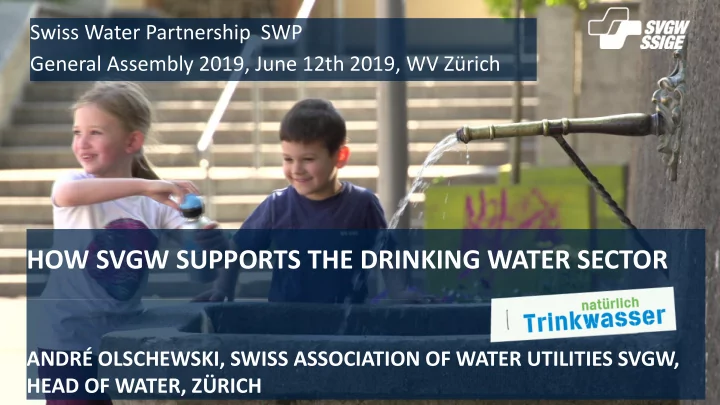
HOW SVGW SUPPORTS THE DRINKING WATER SECTOR
Swiss Water Partnership SWP General Assembly 2019, June 12th 2019, WV Zürich
HOW SVGW SUPPORTS THE DRINKING WATER SECTOR ANDR OLSCHEWSKI, SWISS - - PowerPoint PPT Presentation
Swiss Water Partnership SWP General Assembly 2019, June 12th 2019, WV Zrich HOW SVGW SUPPORTS THE DRINKING WATER SECTOR ANDR OLSCHEWSKI, SWISS ASSOCIATION OF WATER UTILITIES SVGW, HEAD OF WATER, ZRICH Agenda Who is the SVGW ?
ANDRÉ OLSCHEWSKI, SWISS ASSOCIATION OF WATER UTILITIES SVGW, HEAD OF WATER, ZÜRICH
HOW SVGW SUPPORTS THE DRINKING WATER SECTOR
Swiss Water Partnership SWP General Assembly 2019, June 12th 2019, WV Zürich
Agenda
sector in Switzerland
Swiss Association of Gas- and Water Industry SVGW - representing also 530 drinking water utilities
Schweizerischer Verein des Gas- und Wasserfaches (SVGW) 370% der Einwohner
SVGW services in water:
70% of
population served Key characteristics:
Organisation and Governance:
How are we organized - how do we work?
Schweizerischer Verein des Gas- und Wasserfaches (SVGW) 4 Members:
communities
Funding sources:
and conferences
Who are members? How are we funded?
Schweizerischer Verein des Gas- und Wasserfaches (SVGW) 5 Drinking water provision: Legal basis, roles and responsibilities
6 F A T S V System responsibility Law national → cantonal Related topic all GSchG environment natural resources DW supply system consumer Commune / utility LMG/TBDV foodstuff House owner LMG/TBDV foodstuff km_AnforderungWV_0301_02Constitution Bundesverfassung BV BV Art 5 / 43a: Delegation of duties (Subsidiarity principle): → National level to Cantons → Cantons can delegate duty e.g. for water supply to communes BV Art 76: → cantons are owner of water bodies
Structure of drinking water utilities 2015
Basiswissen Wasserversorgung 7 139 191 144 142 86 215 1'647 604 223 114 36 10 200 400 600 800 1'000 1'200 1'400 1'600 1'800 30 60 90 120 150 180 210 240 270 < 2000 2'000 - 4'999 5'000 - 9'999 10'000 - 19'999 20'000 - 49'999 > 50'000 Anzahl Wasserversorgungen Wasserabgabe im eigenen Versorgungsgebiet [Mio. m3] Grösse der Wasserversorgung (versorgte Einwohner)Wasserversorgungen und Wasserabgabe 2013 (hochgerechnet)
(Annahme: Gesamtanzahl der Wasserversorgungen rund 10% höher als Anzahl Gemeinden)Few big and many small utilities
No of utilities (SVGW members) Share of total water provided
Some key figures (2015)
Basiswissen Wasserversorgung 8People served: 8.3 Mio. Water provided: 933 Mio. m3 Coverage DW: 98% (2% by «Self Supply») Average daily consumption
300 l / cap* day Average daily consumption per cap in household 142 L / cap Average costs for DW: 1m3 → 2.00 CHF Costs per cap in household for DW: 0.30 CHF /day Eco footprint: Tap water : mineral water → 1: >500
Water Production
springs pumped groundwater Surface water (treated) About 70% of water distributed without major treatment
Usage of drinking water
«Replacement Value» of drinking water infrastructure
12 Basiswissen WasserversorgungReplacement value CHF
Key technical and processes
Basiswissen Wasserversorgung 13SVGW-Standards / Best practices Technical key components:
Key processes:
Capture zone/ well Treatment plant reservoir mains/distribution network
Outlook: challenges for the Swiss water supply sector
security
from pollution
structural and organisational changes
water supply by communities
«Added Value» for members
(“anerkannte Regeln der Technik”)
networking
practitioners, consultants, industry and state government of different levels
safety training www.svgw.ch/mehrwert
Basiswissen Wasserversorgung 15 Regional pattern of pesticides in groundwater e.g. Chloridazon (BAFU → NAQUA)
Schweizerischer Verein des Gas- und Wasserfaches (SVGW) 16Chloridazon: regional concentration pattern for main substance and metabolites
Sugar beet /fodder beet:
Pesticides in drinking water in Switzerland
17use farmland show concentration of pesticides
Atrazine detected in many water samples > 0.1 µg/L (was banned 2007 in CH) New substances detected, e.g. Chlorothalonil Unknown impact of cocktail of pesticides in ground- and drinking water Consumer and water utilities don’t want pesticides to be in drinking water!
Currently two relevant political initiatives for drinking water
«Drinking water initiative (TWI)» «Initiative for pesticide ban»
Basiswissen Wasserversorgung 18Public Consultation on Agriculture policy AP22+ Vote on TWI and Pesticide ban initiative Agriculture policy AP22+ defined
March 2019 20.6.2019 end 2020 2018
Parliament: counter project for initiatives: yes or no?
SVGW & international context
Schweizerischer Verein des Gas- und Wasserfaches (SVGW) 19Public consultation: e.g. ChemRRV Virtual Water
André Olschewski, SVGW a.olschewski@svgw.ch
Trinkwasserverband SVGW Grütlistrasse 44 Postfach 2110 8027 Zürich Tel:+41 44 288 33 33
KEEP GROUND WATER CLEAN FOR SAFE DRINKING WATER IN FUTURE