Drinking Water Regulation National Primary Drinking Water - - PowerPoint PPT Presentation

drinking water regulation
SMART_READER_LITE
LIVE PREVIEW

Drinking Water Regulation National Primary Drinking Water - - PowerPoint PPT Presentation

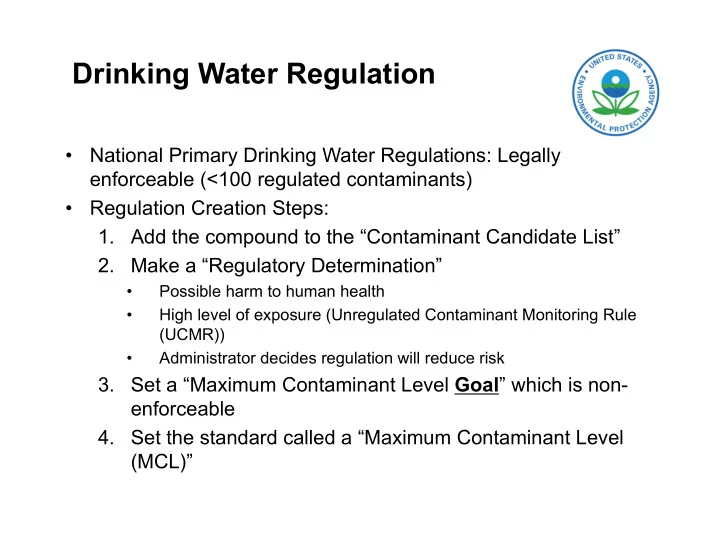
Drinking Water Regulation National Primary Drinking Water Regulations: Legally enforceable (<100 regulated contaminants) Regulation Creation Steps: 1. Add the compound to the Contaminant Candidate List 2. Make a


slide-1
SLIDE 1

Drinking Water Regulation

  • National Primary Drinking Water Regulations: Legally

enforceable (<100 regulated contaminants)

  • Regulation Creation Steps:

1. Add the compound to the “Contaminant Candidate List” 2. Make a “Regulatory Determination”

  • Possible harm to human health
  • High level of exposure (Unregulated Contaminant Monitoring Rule

(UCMR))

  • Administrator decides regulation will reduce risk

3. Set a “Maximum Contaminant Level Goal” which is non- enforceable 4. Set the standard called a “Maximum Contaminant Level (MCL)”

slide-2
SLIDE 2

Maximum Contaminant Level (MCL)

  • MCL = (Reference Dose x Relative Source Contribution

x Body Weight) ÷ Intake Rate

  • RFD: Reference dose calculated using no adverse effect

levels in studies where mammals were dosed orally

https://www.wsj.com/articles/with‐ drinking‐water‐safe‐enough‐is‐the‐ epas‐goal‐1457702107

slide-3
SLIDE 3

PhD (Environmental Engineering): Per- and Polyfluoroalkyl Substances (PFAS) in Municipal Solid Waste and Landfill Leachate.

slide-4
SLIDE 4

ORISE Postdoc at the EPA, NC

Neil Chernoff and Donna Hill: EPA toxicologists working on the toxins produced from harmful algal blooms Mark Strynar and Andy Lindstrom: EPA chemists measuring PFAS and other compounds with mass spectrometry

slide-5
SLIDE 5
  • Used for drinking

water reference doses

  • Established

methods for relating to humans

Toxicity Testing

  • Cannot be used to

set drinking water reference doses

  • Unclear how relates

to humans

In Vivo In Vitro

  • Difficult to

interpret

  • Exposed

without consent

Epidemiology

slide-6
SLIDE 6

You can’t have your cake and eat it too….

In Vivo In Vitro

Before we ban animal testing, regulators need to establish a new method for regulating chemicals in drinking water!!! Required to regulate EPA research focus

slide-7
SLIDE 7

Wilmington, NC

GenX: PFOA alternative

PFOA (C8) GenX

slide-8
SLIDE 8

Sun et al. 2016

  • Red is GenX in

both graphs

  • PFAS in the

bottom graph are byproducts of manufacture without standards NCSU Study on Wilmington, NC’s Drinking Water

slide-9
SLIDE 9

TSCA Loophole for Industrial Byproducts

40 CFR § 720.30 - Chemicals not subject to notification requirements:

  • The chemical substances described below:

(1) Any impurity (2) Any byproduct which is not used for commercial purposes (8) Any non-isolated intermediate

slide-10
SLIDE 10

NCSU CHHE Study in Wilmington, NC

  • The four PFAS in the blood are byproducts of manufacture

(not products) and therefore are not regulated under TSCA

https://chhe.research.ncsu.edu/wordpress/wp‐content/uploads/2018/11/Community‐ event‐BLOOD‐slides.pdf

  • Dr. Nadine Kotlarz
slide-11
SLIDE 11

EPA’s PFAS Action Plan

  • EPA issued this action plan in response to public pressure about

PFAS

  • Long Term Action: “Generate PFAS toxicology data through new

approaches such as high throughput screening, computational toxicology tools, and chemical informatics for chemical prioritization, screening, and risk assessment”

  • “The EPA plans to generate additional PFAS toxicity data through in

vitro high throughput toxicity testing (HTT) and high throughput toxicokinetic (HTTK) assays to inform hazard effects characterization and promote prioritization of chemicals for further in vivo testing”

https://www.epa.gov/sites/production/files/2019‐ 02/documents/pfas_action_plan_021319_508compliant_1.pdf

slide-12
SLIDE 12
slide-13
SLIDE 13

Conclusions

  • Byproducts of industrial chemical manufacture should be

regulated

  • The current system for regulating contaminants in drinking

water is taking way too long

  • Regulators need in vivo data to set drinking water limits for

a compound

  • If we send soldiers into battle to protect us, then why not

sacrifice a few mice for protection? Required to regulate EPA research focus