SLIDE 1
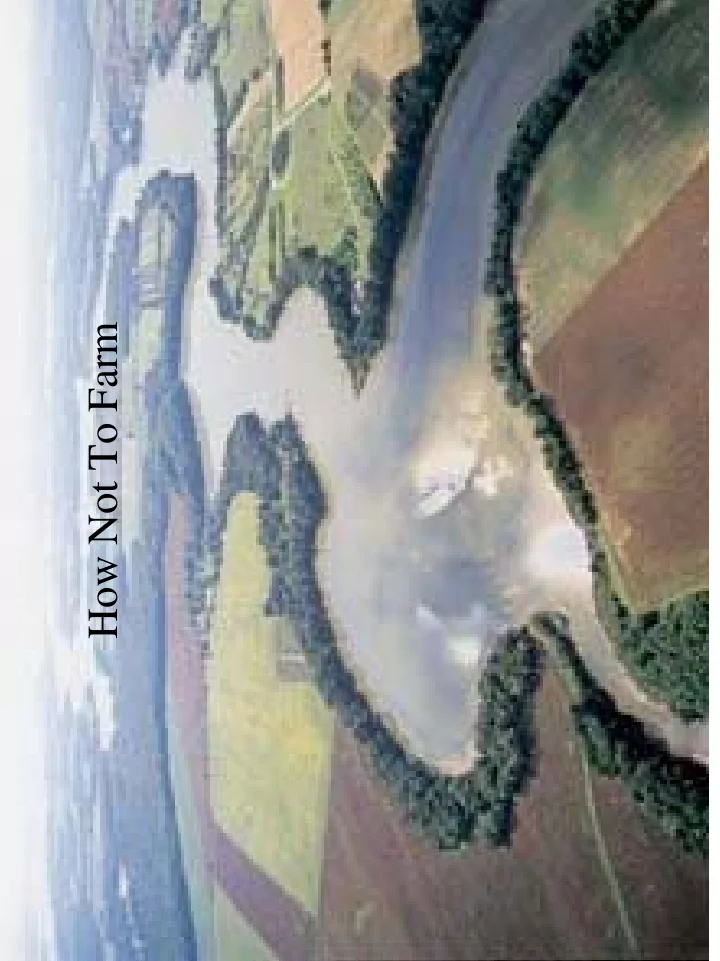
How Not To Farm
SLIDE 2
This Is Why
SLIDE 3
Water: Part I Agricultural Runoff
SLIDE 4
SLIDE 5
SLIDE 6
SLIDE 7
SLIDE 8
Environmental Degradation Leads To Health Risks
SLIDE 9
http://www.fao.org/ag/magazine/0304sp1.htm
SLIDE 10
Many Tropical Diseases Are Transmitted At The Agricultural Interface
Malaria Hookworm Geohelminths (ascaris, trichuris) Schistosomiasis Filariasis Nipha
SLIDE 11
SLIDE 12
SLIDE 13
SLIDE 14
A Very Brief History Of Farming
SLIDE 15
Human Evolution
SLIDE 16
SLIDE 17 Early Wheat Farming Sites
The Fertile Crescent
Einkorn Wheat*
*double the seeds, needs watering.
SLIDE 18
Bhutanese Buckwheat Farmers (Circa 2003) Bhutanese Buckwheat Farmers (Circa 2003)
SLIDE 19 Global Totals*: 71 79 91 101 109 125 1975 1980 1985 1990 1995 2000
Global Agricultural Production Index
Source: FAOSTAT
*Net Production Index Number
http://geocompendium.grid.unep.ch/data_sets/land/reg_land_ds.htm
SLIDE 20 http://images.google.com/imgres?imgurl=people.uncw.edu/hinese/HON%2520210/McDonalds%2520Josh.jpg&imgrefurl=http://people.uncw.edu/hinese/HON%2520210/ Honors%2520Food%2520index.htm&hl=en&h=1584&w=1714&start=20&prev=/images%3Fq%3Dorigins%2Bof%2Bagriculture%26svnum%3D10%26hl%3Den%26lr% 3D%26ie%3DUTF-8%26sa%3DG
SLIDE 21 40% Of All Grains Are Grown For Animal Feed
http://www.gov.on.ca/OMAFRA/english/livestock/swine/facts/info_qs_species.htm
SLIDE 22
SLIDE 23
Agricultural Land Abuses
Pesticides Herbicides Fertilizers
SLIDE 24
World Pesticide Use (1,000 metric tons) http://www.pan-uk.org/briefing/SIDA_FIL/Chap1.htm#_ftnref1
SLIDE 25
SLIDE 26
SLIDE 27
SLIDE 28
http://www.tfi.org/Statistics/worldfertuse.asp * * Thousand metric tons
SLIDE 29
SLIDE 30
SLIDE 31
Originally enacted under the administration of Gerald Ford in 1977 and amended under the administration of George W. Bush in 2002
Clean Water Act
See: http://www.epa.gov/region5/water/cwa.htm
SLIDE 32 To get a new drug approved by the FDA industry needs to fill up a good sized room with reports and tests proving it does more good than harm. To get an agro-industry product taken off the market,
- ne needs to fill a good sized room with reports
that prove it does more harm than good. To get a new drug approved by the FDA industry needs to fill up a good sized room with reports and tests proving it does more good than harm. To get an agro-industry product taken off the market,
- ne needs to fill a good sized room with reports
that prove it does more harm than good.
SLIDE 33
http://www.fao.org/desertification/default.asp?lang=en
SLIDE 34
SLIDE 35
Global Density Of Livestock
SLIDE 36
Global Deforestation (%) 1990-1995
SLIDE 37
Human Degraded Land (%)
SLIDE 38
Land With Erosion and Salinity Risk (%)
SLIDE 39
SLIDE 40
http://www.fao.org/desertification/default.asp?lang=en
SLIDE 41
SLIDE 42
SLIDE 43
SLIDE 44
SLIDE 45
Case History: The Mississippi River Flood Of 1993
SLIDE 46 50 Years Of Agricultural Abuse*
Pesticides Herbicides Fertilizers
*chickens coming home to roost
50 Years Of Agricultural Abuse*
SLIDE 47 QuickTime™ and a TIFF (Uncompressed) decompressor are needed to see this picture.
SLIDE 48 QuickTime™ and a TIFF (Uncompressed) decompressor are needed to see this picture.
Location Of Dams On Tributaries Of The Kansas River
SLIDE 49 QuickTime™ and a TIFF (Uncompressed) decompressor are needed to see this picture.
SLIDE 50 QuickTime™ and a TIFF (Uncompressed) decompressor are needed to see this picture.
Weather Conditions
This pattern prevailed for 2 months (June & July)
SLIDE 51 QuickTime™ and a TIFF (Uncompressed) decompressor are needed to see this picture. QuickTime™ and a TIFF (Uncompressed) decompressor are needed to see this picture.
1992 1993
What A Difference A Year Makes
SLIDE 52
SLIDE 53
SLIDE 54
1973 1989 2003
Mississippi Delta
SLIDE 55 People and the Flood:
Nearly fifty people died as a result of the flooding, 26,000 were evacuated and over 56,000 homes were damaged. Economic losses that are directly attributable to the flooding totaled $10-12 billion. Indirect losses in the form
- f lost wages and production can not be accurately
calculated.
The consequences of flooding were determined by land use patterns.
SLIDE 56
Welcome To The Dead Zone
The Gulf of Mexico Dead Zone and Red Tides
SLIDE 57
http://www.savesfbay.org/campaigns/fillpollution/runoff.cfm
SLIDE 58
Imagination Leads To Reality
Flight and on to the moon, Mars, and beyond The telephone, the cell phone Satellites of all kinds Telescope, Hubble Space Telescope Microscope, atomic force field microscope Computer, DNA as a programming substance The Internet Genetic engineering, altering the course of evolution
SLIDE 59
Imagine, if you will, a vertical farm
SLIDE 60
Imagine all the good that will come from it
SLIDE 61 Advantages Of Vertical Farming
- Year-round crop production
- No weather related crop failures due to droughts, floods
- Eliminates agricultural runoff
- Converts black water to potable water
- Greatly reduces the incidence of many infectious diseases
- Adds energy back to the grid via methane generation
- Dramatically reduces fossil fuel use (no tractors, plows, etc.)
- Converts abandoned urban properties into food production
- Sustainability for urban centers
- Creates new employment opportunities
- Returns farm land to nature, restoring ecosystem services
- Reduces the incidence of armed conflict over natural
resources, such as water and land for agriculture
SLIDE 62 A Vertical Farm*
* not exactly what I imagined
SLIDE 63
Virtual Vertical Farm*
*www.verticalfarm.com
SLIDE 64
The Vertical Farm: A possible Solution
SLIDE 65 http://www.urbanecology.org/
Vibrant, successful cities are not only possible but necessary for the health of society and our planet. Urban Ecology plans and designs cities that sustain the people, natural resources, and economy necessary for everyone to thrive.
SLIDE 66
Advantages Of Vertical Farming
Adds energy back to the grid via methane generation
August 14th August 15th “What A Difference A Day Makes”
SLIDE 67 Ecosystem Services*
* from: Living In The Environment Thompson Brooks/Cole Pubs. 2004
SLIDE 68
Returns farm land to nature, restoring ecosystem services Advantages Of Vertical Farming
SLIDE 69
Vertical New York City
Photo: NASA
SLIDE 70
Kristin Anderson Nicola Areshenko Alan Brown Jennifer Buskey Amanda Colligan Marisa Dahlman Catherine Dell’Orto Catherine Tuglus Steve Chen, technical advisor
Medical Ecology Class Of 2003
SLIDE 71
How It Could Work
SLIDE 72
Bioremediation
SLIDE 73
Energy Considerations
SLIDE 74
Methane Digester
SLIDE 75 Original Design by Andrew Kranis, Columbia University School of Architecture 2003
SLIDE 76
A lunar colony
SLIDE 77
Schematic for advanced life-support system
SLIDE 78
Or a colony on Mars
SLIDE 79
Components for a Mars colony
SLIDE 80
SLIDE 81
So, What’s For Dinner?
SLIDE 82
Anything you want
SLIDE 83
Any Time You Want It
SLIDE 84
Any Where In The World Any Where In The World
SLIDE 85
Or In The Universe