How Does MnDOT Select Projects? Project Selection Policy Initial - - PowerPoint PPT Presentation

how does mndot select projects
SMART_READER_LITE
LIVE PREVIEW

How Does MnDOT Select Projects? Project Selection Policy Initial - - PowerPoint PPT Presentation

How Does MnDOT Select Projects? Project Selection Policy Initial Input October 4, 2017 ATP-8 Many have tried to explain it 10/4/2017 2 MnDOT has tried long explanations Weve tried elevator speeches How MnDOT Selects Projects in


slide-1
SLIDE 1

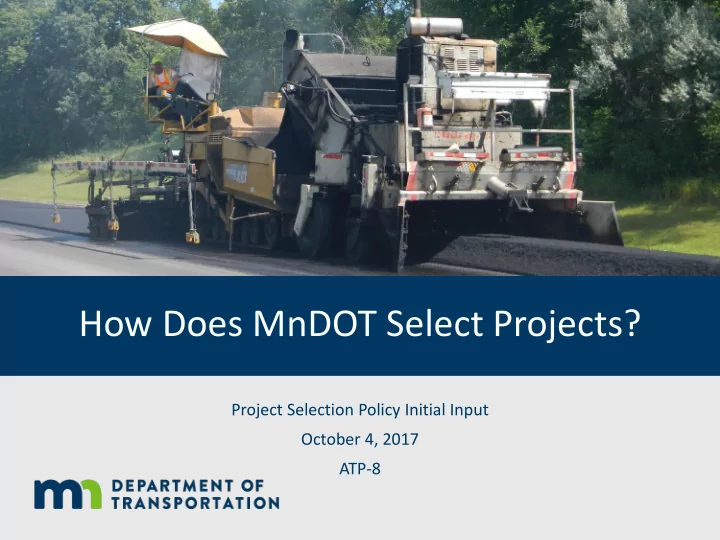
How Does MnDOT Select Projects?

Project Selection Policy Initial Input October 4, 2017 ATP-8
slide-2
SLIDE 2

Many have tried to explain it…

10/4/2017 2

slide-3
SLIDE 3

MnDOT has tried long explanations…

slide-4
SLIDE 4

We’ve tried elevator speeches…

How MnDOT Selects Projects in Less Than 100 words Transportation investments should improve the quality of life and support economic development. To meet Minnesota’s goals, MnDOT evaluates physical factors like smoothness for pavement or state-of-good-repair for bridges combined with qualitative factors like Minnesota’s quality of life or economic development potential. There are never enough resources to meet every worthy goal completely. So with the aid of citizen and transportation partner input, MnDOT chooses a mix

  • f projects that represent the best compromise of asset preservation, system

expansion, enhancements, local needs, legal obligations, and public opinion. Learn more in the Minnesota State Highway Investment Plan.

slide-5
SLIDE 5

We’ve tried pictures…

slide-6
SLIDE 6

We’ve tried video…

slide-7
SLIDE 7

We’ve tried presentations…

slide-8
SLIDE 8

We welcomed an audit…

  • How does MnDOT select

projects?

  • How transparent is MnDOT’s

process?

  • Who makes decisions?
  • What criteria are used?
  • How do special programs

compare to the standard project selection process?

10/4/2017 8

http://www.auditor.leg.state.mn.us/ped/pedrep/mndotprojects.pdf

slide-9
SLIDE 9

OLA Audit Findings

“In our interviews with MnDOT staff, it was clear that standard programming decisions were carefully thought

  • ut and took into consideration a wide variety of important
  • factors. Further, we found that when we asked specific

questions, MnDOT staff could generally provide cogent explanations for the reasons behind specific programming

  • decisions. We do not have significant concerns about the

decisions themselves.”

10/4/2017 9

slide-10
SLIDE 10

OLA Audit Findings

“MnDOT does not provide sufficient information about its project-selection decisions to the public or interested stakeholders.” “MnDOT publishes lists of the projects it plans to construct, but it does not publish information about how these decisions were reached or what alternatives were

  • considered. Without that basis for comparison, it is difficult

for those outside of MnDOT to understand or assess its decisions.”

10/4/2017 10

slide-11
SLIDE 11

OLA Recommendation #1

11

The Minnesota Department of Transportation (MnDOT) should take steps to improve the transparency of its standard project selection process.

slide-12
SLIDE 12

Chapter 3

The commissioner of transportation, after consultation with the Federal Highway Administration, metropolitan planning

  • rganizations, regional development

commissions, area transportation partnerships, local governments, the Metropolitan Council, and transportation stakeholders, must develop, adopt, and implement a policy ...

10/4/2017 12

https://www.revisor.mn.gov/laws/?year=2017&type=1&doctype=Chapter&id=3

slide-13
SLIDE 13

Chapter 3

For each selection process, the policy adopted under this section must…establish a process that identifies criteria, the weight of each criterion, and a process to score each project based on the weighted criteria;

10/4/2017 13

https://www.revisor.mn.gov/laws/?year=2017&type=1&doctype=Chapter&id=3

slide-14
SLIDE 14

Chapter 3

The commissioner must submit a report… concerning the adopted policy and how the policy is anticipated to improve the consistency, objectivity, and transparency of the selection process. The report must include information on input from members of the public and the [other]organizations…

10/4/2017 14

https://www.revisor.mn.gov/laws/?year=2017&type=1&doctype=Chapter&id=3

slide-15
SLIDE 15

Chapter 3

  • MnDOT has until November of 2018 to adopt a policy for

project selection.

  • It is expected that the 2020 to 2024 STIP will be the first

STIP that is governed by the new policy.

10/4/2017 15

slide-16
SLIDE 16

We Need Your Input…

10/4/2017 16

slide-17
SLIDE 17

Discussion Areas

  • Project Selection Information
  • Transparency
  • Involvement of ATPs in the Selection Process

10/4/2017 17

slide-18
SLIDE 18

Area #1: Project Selection Information

10/4/2017 18

slide-19
SLIDE 19

Discussion Questions:

  • Do you know how project selection decisions are made at

MnDOT and who does them?

  • From where do you get your information or

understanding about MnDOT’s project selection?

  • Is the information provided by MnDOT for project

selection understandable and helpful to you and/or your constituents? Is it adequate for your needs?

  • If you could have more information on project selection,

what would you want?

10/4/2017 19

slide-20
SLIDE 20

Discussion

20

slide-21
SLIDE 21

Area #2: Transparency

10/4/2017 21

slide-22
SLIDE 22

Discussion Questions:

  • Over the past 5-years, would you say that MnDOT has

been more transparent, less transparent, or stayed about the same in the level of transparency it provides on how it selects projects?

  • Can you give some examples of why you would say that?

10/4/2017 22

slide-23
SLIDE 23

Scoring Based Project Selections

  • Are you familiar with scoring-based project selection

methods at MnDOT?

  • Transportation Economic Development (TED) program
  • Transportation Alternative Program (TAP)
  • Do you think these methods are more transparent to you

(see next slide)?

10/4/2017 23

slide-24
SLIDE 24

Corridor Investment Management Strategy (CIMS)

Project Name Location CIMS Request % Non- MnDOT Pts B/C Ratio Pts Local Econ System Multimodal Health Context Total Score Mainstreet TH 61 Downtown Improvements Red Wing 2,445,000 $ 34% 5.9 10.7 60.0 90.9 Multimodal for TH 23 w/o Bridge Duluth 3,035,000 $ 10% 0.0 15.0 60.0 90.0 TH 10/TH 75 Safety/Operational Improvements Moorhead 3,404,000 $ 31% 5.5 10.7 60.0 89.5 TH 25-CSAH 75 Intersection Improvements Monticello 506,000 $ 84% 9.7 25.0 60.0 85.9 US 52-CSAH 9 Interchange Goodhue County 250,000 $ 20% 4.0 19.8 60.0 83.3 TH 23 J-Turn & Ped Overpass Marshall 4,500,170 $ 21% 4.1 4.2 49.5 71.1 OPTION: Buffalo TH25 Phase 1 only Buffalo 2,100,000 $ 33% 5.7 2.0 36.0 69.8 TH 25 Corridor Improvements Buffalo 3,503,000 $ 35% 6.0 1.8 34.8 68.9 Hwy 71 Complete Streets Jackson 1,260,000 $ 54% 8.2 1.2 31.3 62.7 Gateway Corridor Improvements International Falls 776,180 $ 48% 7.7 1.7 34.2 60.6 TH 29 Reconstruction Parkers Prairie 1,800,000 $ 33% 5.7 1.0 30.0 58.7 Veterans Memorial Bridge Mankato 565,000 $ 23% 4.4 1.4 32.4 58.6 Broadway Streetscaping & Pedestrian Improvements Albert Lea 794,089 $ 33% 5.7 1.4 32.7 55.7 TH 220 Reconstruction East Grand Forks 2,318,070 $ 17% 3.5 1.5 32.8 51.5 TH10/59 Trail Detroit Lakes 200,000 $ 10% 0.0 1.1 30.3 46.6 18th Ave. S Waite Park 1,067,000 $ 83% 9.6 0.5 10.0 44.6 Old Hwy 61 Trail Dresbach 450,000 $ 40% 6.6 0.0 0.4 28.8 10/4/2017 24

slide-25
SLIDE 25

Discussion Questions - Transparency

  • Do you have any concerns about how these types of methods

may be used or their results?

  • Are there types of projects or programs where a numeric score

approach would be more helpful than the regular programs?

  • Do you have any other advice on how MnDOT can “improve

the consistency, objectivity, and transparency of the selection process?”

10/4/2017 25

slide-26
SLIDE 26

Area #3: ATP Involvement in Project Selection

10/4/2017 26

slide-27
SLIDE 27

Chapter 3 Law

“For each selection process, the policy adopted under this section must: … involve area transportation partnerships and other local authorities, as appropriate, in the process.”

10/4/2017 27

slide-28
SLIDE 28

Involvement of ATPs and Other Local Agencies in the Project Selection

  • What type of involvement do you feel you, the ATP, and
  • ther local agencies should have in the selection of

MnDOT projects?

  • How many and what type of projects do you think

MnDOT selects annually for its program?

10/4/2017 28

slide-29
SLIDE 29

MnDOT’s Actual 2017-2020 STIP Projects

10/4/2017 29

ATP Total # of Projects in STIP Total # of Major Projects in STIP Percent of Total Projects that are Major 1 119 25 21.0% 2 101 6 5.9% 3 100 15 15.0% 4 77 7 9.1% 6 118 19 16.1% 7 84 27 32.1% 8 96 8 8.3% Metro 225 17 7.6% Central 46 11 23.9% Total 966 135 14.0%

* Major projects are projects with a cost greater than $5.0 M in Greater Mn and $15.0 M in Metro.

slide-30
SLIDE 30

Involvement of ATPs and Other Local Agencies in the Project Selection Now that you have a seen a summary of MnDOT’s 2017-2020 project selection breakdown…

  • Does it change you opinion on what type of ATP

involvement should be in MnDOT project selection?

  • Why or why not?

10/4/2017 30

slide-31
SLIDE 31

Final Thoughts

  • Do you have any other thoughts or ideas about how

MnDOT can improve its project selection process?

  • We will be back in the future to provide you an
  • pportunity to provide more input as we start to develop

some draft policies around the project selection process at MnDOT.

10/4/2017 31

slide-32
SLIDE 32

Contact Us

Philip Schaffner Philip.Schaffner@state.mn.us 651-366-3743 Patrick Weidemann Pat.Weidemann@state.mn.us 651-366-3758 Brian Gage Brian.gage@state.mn.us 651-366-3748 Sheila Kauppe Sheila.kauppe@state.mn.us 651-366-3794 Mark Gieseke Mark.Gieseke@state.mn.us 651-366-3770

10/4/2017 32

slide-33
SLIDE 33

Thank you!

Patrick Weidemann MnDOT Office of Transportation System Management 651-366-3758

10/4/2017 33