Sasha ¡Philippov, ¡Jodrell ¡Bank ¡2016
Sasha ¡Philippov, ¡Purdue2014 5/12/14
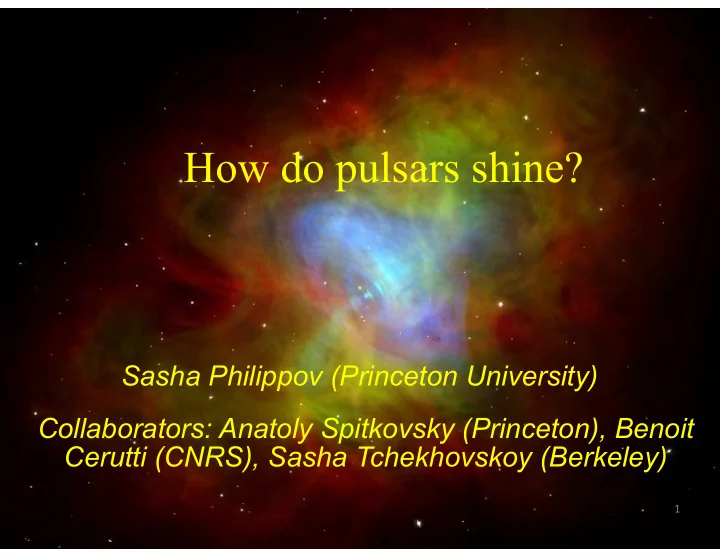
How do pulsars shine?
Sasha Philippov (Princeton University) ¡ Collaborators: Anatoly Spitkovsky (Princeton), Benoit Cerutti (CNRS), Sasha Tchekhovskoy (Berkeley)
1
How do pulsars shine? Sasha Philippov (Princeton University) - - PowerPoint PPT Presentation
How do pulsars shine? Sasha Philippov (Princeton University) Collaborators: Anatoly Spitkovsky (Princeton), Benoit Cerutti (CNRS), Sasha Tchekhovskoy (Berkeley) 1 Sasha Philippov, Jodrell Bank 2016 5/12/14 Sasha
Sasha ¡Philippov, ¡Jodrell ¡Bank ¡2016
Sasha ¡Philippov, ¡Purdue2014 5/12/14
1
2
3
4
5
Kraus-‑Polstorff ¡& ¡Michel, ¡1985; ¡ ¡Spitkovsky ¡& ¡Arons, ¡2002; ¡ ¡ Petri ¡et ¡al., ¡2002; ¡Philippov ¡& ¡Spitkovsky, ¡2014
6
7
8
Kraus-‑Polstorff ¡& ¡Michel, ¡1985; ¡ ¡Spitkovsky ¡& ¡Arons, ¡2002; ¡ ¡ Petri ¡et ¡al., ¡2002; ¡Philippov ¡& ¡Spitkovsky, ¡2014
9
Kraus-‑Polstorff ¡& ¡Michel, ¡1985; ¡ ¡Spitkovsky ¡& ¡Arons, ¡2002; ¡ ¡ Petri ¡et ¡al., ¡2002; ¡Philippov ¡& ¡Spitkovsky, ¡2014
Sasha ¡Philippov, ¡Goddard ¡2016
¡ ¡ ¡ ¡ ¡ ¡dissipated ¡within ¡2RLC. ¡
current ¡sheet. ¡
10
11
¡ ¡ ¡ ¡ ¡ ¡ ¡ ¡ ¡ ¡ ¡ ¡ ¡ ¡Pair ¡Production ¡ ¡ ¡ ¡ ¡ ¡ ¡ ¡ ¡ ¡ ¡ ¡(plasma ¡skin ¡scale) ¡ ¡ ¡ ¡Magnetospheric ¡structure ¡ ¡ ¡ ¡ ¡ ¡ ¡ ¡ ¡ ¡ ¡ ¡(light ¡cylinder ¡scale) ¡Provides ¡charge ¡ carriers ¡Defines ¡current ¡ distribution ¡in ¡the ¡ discharge ¡zone
12
Approaches ¡ force-‑free ¡ like ¡ solution, ¡ but ¡ no ¡ pair ¡ production ¡ in ¡ the ¡ polar ¡ region, ¡ where ¡ the ¡ space-‑ charge ¡ limited ¡ flow ¡ does ¡ not ¡ lead ¡ to ¡ particle ¡
required ¡to ¡drive ¡an ¡active ¡circuit. ¡
j<jGJ
Chen, ¡Beloborodov, ¡ApJ, ¡2014 ¡ Philippov ¡et ¡al., ¡ApJ, ¡2015
13
Philippov ¡et ¡al., ¡ApJ, ¡2015 ¡
14
j>jGJ
Drift-‑kink ¡instability
Sasha ¡Philippov, ¡Purdue ¡2016
15
Plasmoid ¡instability ¡develops E>B ¡regions ¡are ¡confined ¡to ¡the ¡current ¡sheet
16
17
Timokhin ¡& ¡Arons, ¡MNRAS, ¡2013 ¡
charge ¡and ¡current ¡
is ¡
charges ¡are ¡advected ¡ with ¡non-‑relativistic ¡ velocity ¡ ¡
When ¡realistic ¡currents ¡set ¡by ¡global ¡ magnetosphere ¡are ¡included ¡in ¡the ¡ simulation ¡of ¡polar ¡cap ¡discharge, ¡we ¡find ¡ that ¡abundant ¡pair ¡production ¡may ¡not ¡ happen ¡for ¡most ¡pulsars! ¡Is ¡this ¡possible?
18
Frame-‑dragging ¡makes ¡effective ¡rotation ¡frequency ¡of ¡ the ¡star ¡smaller ¡close ¡to ¡the ¡star ¡(this ¡lowers ¡the ¡ necessary ¡corotation ¡charge), ¡but ¡the ¡rotation ¡is ¡still ¡ the ¡same ¡far ¡from ¡the ¡star ¡(this ¡keeps ¡the ¡current ¡the ¡ same). ¡ ¡ ¡
Beskin ¡1990, ¡Muslimov ¡& ¡Tsygan ¡1992
19
Philippov ¡et ¡al., ¡2015 ¡ApJ ¡ Flat ¡space ¡solution, ¡no ¡pair ¡production
Chen ¡& ¡Beloborodov, ¡ApJ, ¡2014 ¡
20
waves ¡in ¡the ¡open ¡field ¡zone. ¡
process ¡of ¡electric ¡field ¡screening ¡ by ¡plasma ¡clouds. ¡They ¡are ¡driven ¡ by ¡ collective ¡ plasma ¡ motions, ¡ thus, ¡ coherent ¡ (see ¡ al so ¡ Beloborodov ¡ 2008, ¡ Timokhin ¡ & ¡ Arons ¡2013) ¡ ¡ ¡ ¡ ¡ ¡ ¡ ¡ ¡ ¡ ¡ ¡ ¡ ¡ ¡ ¡ ¡ ¡ ¡ ¡ ¡
21
GR, ¡radiative ¡cooling, ¡ extraction ¡of ¡ions ¡and ¡ photon ¡propagation ¡is ¡ included ¡now!
Philippov ¡et ¡al., ¡ApJ, ¡2015
Philippov ¡& ¡Spitkovsky, ¡in ¡preparation ¡
GR ¡helps ¡to ¡establish ¡polar ¡pair ¡cascade ¡for ¡inclined ¡rotators! ¡
22
Philippov ¡& ¡Spitkovsky, ¡in ¡preparation ¡
J2 J2
Return ¡ layer ¡ supports ¡ multi-‑ streaming ¡ particle ¡ distribution. ¡ Contains ¡“auroral” ¡electrons ¡from ¡ pair ¡ production ¡ region ¡ near ¡ the ¡ Y-‑point ¡ and ¡ energetic ¡ ions, ¡ extracted ¡ from ¡ the ¡ polar ¡ cap. ¡ Highest ¡ energies ¡ are ¡ reached ¡ in ¡ the ¡current ¡sheet.
Auroral ¡electrons ¡and ¡ ¡
Energetic ¡ions
23
Highlights ¡polar ¡cap, ¡return ¡ current ¡layers ¡ ¡and ¡the ¡current ¡
vacuum ¡gap ¡above ¡the ¡current ¡ sheet ¡do ¡not ¡launch ¡an ¡ avalanche.
Philippov ¡& ¡Spitkovsky, ¡in ¡preparation ¡
24
Philippov ¡& ¡Spitkovsky, ¡in ¡preparation ¡
Plasma ¡density ¡is ¡also ¡highly ¡non-‑ uniform ¡with ¡latitude Not ¡exactly ¡a ¡split ¡monopole, ¡has ¡a ¡ non-‑uniform ¡magnetic ¡field ¡with ¡ latitude
Tchekhovskoy, ¡Philippov ¡& ¡Spitkovsky ¡2016 ¡
25
Cerutti, ¡Philippov ¡& ¡Spitkovsky ¡ MNRAS ¡2016 ¡
sheet ¡as ¡a ¡particle ¡accelerator. ¡ Particles ¡radiate ¡synchrotron ¡
particles ¡and ¡collect ¡photons. ¡ ¡
1-‑20% ¡depending ¡on ¡the ¡ inclination ¡angle. ¡Higher ¡ inclinations ¡are ¡much ¡less ¡ dissipative.
usually ¡double ¡peak ¡ lightcurves.
26
Cerutti, ¡Philippov ¡& ¡Spitkovsky, ¡MNRAS ¡2016 ¡
usually ¡double ¡peak ¡ lightcurves.
27
Cerutti, ¡Philippov ¡& ¡Spitkovsky, ¡MNRAS ¡2016 ¡
What ¡sets ¡the ¡sigma ¡parameter?
from ¡simulations ¡with ¡ self-‑consistent ¡pair ¡
usually ¡double ¡peak ¡
current ¡sheet ¡ quenches ¡particle ¡
much ¡less ¡sensitive ¡to ¡ BLC.
28
Philippov ¡& ¡Spitkovsky, ¡in ¡preparation ¡
as ¡normal ¡pulsars. ¡
extract ¡ions ¡start ¡from ¡a ¡photon ¡ coming ¡from ¡outside. ¡
emission) ¡seems ¡to ¡be ¡the ¡same, ¡ do ¡the ¡ion ¡streams ¡change ¡the ¡ physics ¡of ¡radio?
29
Philippov ¡& ¡Spitkovsky, ¡in ¡preparation ¡
Ions ¡were ¡ extracted ¡from ¡ the ¡surface ¡on ¡ these ¡field ¡ lines
30
What ¡happens ¡if ¡pair ¡formation ¡is ¡suppressed ¡in ¡the ¡outer ¡magnetosphere?
Observe ¡oscillations ¡around ¡the ¡electrosphere ¡state ¡with ¡negligible ¡spin-‑down, ¡with ¡periodic ¡ bursts ¡of ¡current ¡circuit ¡formation. ¡Seem ¡to ¡be ¡mostly ¡“dead” ¡pulsars ¡most ¡of ¡the ¡time. ¡In ¡quasi-‑ active ¡states ¡current ¡is ¡well ¡below ¡the ¡GJ ¡current, ¡unlikely ¡to ¡launch ¡pair ¡formation ¡and ¡radio ¡ emission.
31