
SLIDE 1
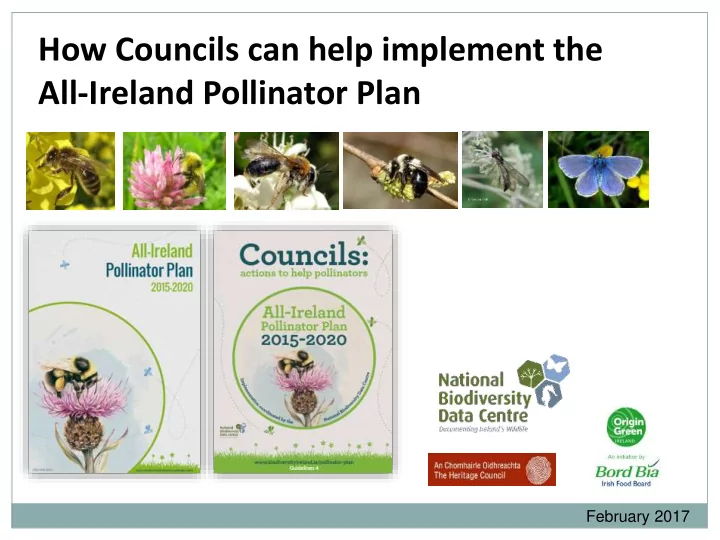
How Councils can help implement the All-Ireland Pollinator Plan
February 2017
How Councils can help implement the All-Ireland Pollinator Plan - - PowerPoint PPT Presentation
How Councils can help implement the All-Ireland Pollinator Plan February 2017 WHY IS POLLINATION IMPORTANT? 53 million/ annum 7M 3.9M The value of pollinator dependent crop 78% of our wild plants require production is insect
February 2017
€3.9M £7M
78% of our wild plants require insect pollination The value of pollinator dependent crop production is increasing
Most pollination of crops and wild plants is carried out by bees
The rest is provided by various
particularly flies
Ireland has 98 bee species:
Honeybee Bumblebees Solitary bees
More than half of Ireland’s bee species have undergone substantial declines in their numbers since 1980. Two species have become extinct One third of our 98 bee species are threatened with extinction from Ireland 6 species are critically endangered, 10 endangered 14 vulnerable
Bees are declining because we’ve drastically reduced the areas where they can nest and the amount of food our landscape provides for them. We’ve also inadvertently introduced pests and diseases that negatively impact their health, and we subject them to levels of pesticides that make it difficult for them to complete their life cycles.
HABITAT LOSS: HOMELESSNESS GENERAL DECLINE IN WILDFLOWERS: HUNGER PESTS AND DISEASE: SICKNESS PESTICIDES: POISONING CLIMATE CHANGE: CHANGING ENVIRONMENT
In the Republic of Ireland this will involve County and City
District and City Councils. To help pollinators we need to ensure that they have food, shelter
actions simply require us to manage the land in a slightly different way than we have become used to. It is not about letting the landscape go wild, but about managing it in a way that is sustainable for pollinators so that they can survive and continue to provide us with their vital service.
A.Identify and protect existing areas that are good for pollinators
Action 1: Promote the management and restoration of semi-natural habitats and their native plants on council land Action 2: Identify and protect existing sources of food and shelter for pollinators on general council land
to flower
Action 3: At least 10 locations mown under a pollinator friendly regime (5 cut & lifts per year)
to flower
Action 3: At least 10 locations mown under a pollinator friendly regime (5 cut & lifts per year) Action 4: At least 5 meadows (one cut and lift per year) Action 5: 10 flagship roadside verges that are managed to be pollinator friendly (one cut and lift per year) Action 6: Introduce a layered mowing approach to other roadside verges
Signage templates can be downloaded from the website for use. Space has been left at the bottom for Councils to add their own logo before use
Action 7: Replace grass with a dense clover sward
Action 9: For new works ensure 75% of ornamental planting is pollinator friendly Action 10: In future ornamental maintenance planting select pollinator friendly species Action 11: Make some urban planters pollinator friendly Action 8: For future tree planting select from pollinator friendly species
Action 7: Replace grass with a dense clover sward
Action 9: For new works ensure 75% of ornamental planting is pollinator friendly Action 10: In future ornamental maintenance planting select pollinator friendly species Action 11: Make some urban planters pollinator friendly Action 12: Make some urban roundabouts pollinator friendly Action 13: Deliberately plant a native wildflower meadow Action 8: For future tree planting select from pollinator friendly species
USE NATIVE LOCAL PROVENANCE SEED
D: Provide wild pollinator nesting habitat: hedgerows, earth banks and hotels
Action 14: Manage hedgerows for pollinators Action 15: Bare earth/sand banks for wild pollinator nesting Action 16: Holes in wood or concrete for wild pollinator nesting Action 17: Bee hotels for wild pollinators
Aim to eliminate in some locations Turf - spray only sports pitches, bowling greens, cricket squares Adopt a policy of not spraying paths until the 15th April Have spraying buffer zones around important pollinator habitat Adopt the pesticide best practice code
Action 18: Reduce or eliminate the use of pesticides Action 19: Ensure best practice where they cannot be avoided
F: Raise public awareness of pollinators within the local area
Action 20: Build actions on pollinators into existing frameworks and initiatives Action 25: Facilitate or deliver training on pollinators and how to take action to protect them Action 26: Promote and get involved in other pollinator related initiatives Action 21: Fund pollinator projects on council land to demonstrate best practice to other sectors Action 22: Put up signage to identify pollinator friendly habitats on council land Action 23: Print & distribute pollinator friendly guidelines to other sectors Action 24: Promote & distribute the Junior Pollinator Plan to local schools
Action 27: Log your ‘Actions for Pollinators’ on the mapping system to ensure your efforts are recognised Action 28: Take part in the Bumblebee Monitoring Scheme
Actions for Pollinators will ensure that the efforts of those who take pollinator friendly actions are recognised publicly. It will also act as a tool to facilitate and encourage local coordination.
MAKING IRELAND POLLINATOR FRIENDLY
Provide food and shelter across all types of land so that our pollinators can survive and thrive
Collecting evidence to track change and measure success Expanding our knowledge on pollinators Managed pollinators – supporting beekeepers Raising awareness of pollinators and how to protect them
Zoe Devlin Tom Cuffe