
SLIDE 1
Housing in the Evolving American Suburb
The Story of Atlanta
Prepared for ULI Atlanta | February, 2017
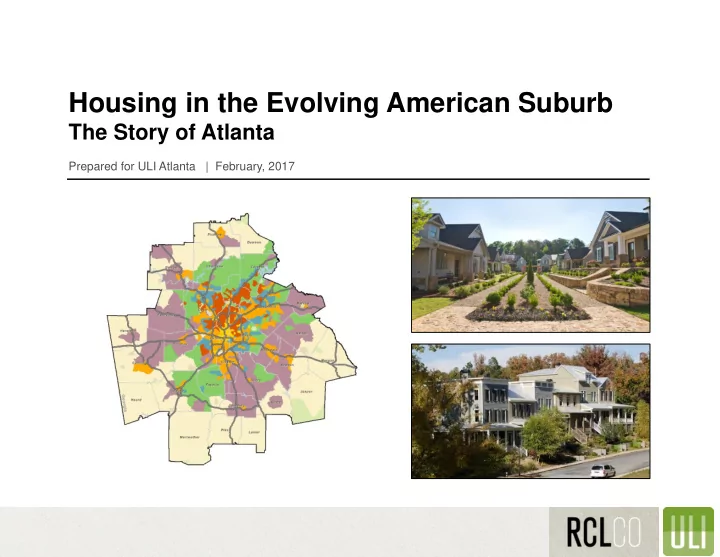
Housing in the Evolving American Suburb The Story of Atlanta - - PowerPoint PPT Presentation
Housing in the Evolving American Suburb The Story of Atlanta Prepared for ULI Atlanta | February, 2017 Contents Background and Study Objectives Today, much of the discussion surrounding the future of real estate has Key Findings 03
Prepared for ULI Atlanta | February, 2017
Housing in the Evolving American Suburb: Atlanta | February, 2017
2
Today, much of the discussion surrounding the future of real estate has shifted away from the areas in which the majority of Americans currently live and work: The suburbs. The often-overlooked reality is that there are many types of suburbs, and the unique challenges and opportunities within each of those types of suburbs are frequently lost within the
the ULI Terwilliger Center for Housing to publish Housing in the Evolving American Suburb, so as to re-orient the discussion around suburbs and focus on their unique challenges and opportunities, rather than the prevailing “cities versus suburbs” dynamic. For the purpose of the original report, RCLCO developed a new way to analyze suburbs. This methodology takes into account the fact that, for many Americans, the word “suburb” is very much tied to housing. As such, RCLCO created a housing-focused approach to classifying suburban neighborhoods, considering factors such as density, housing type, home value, and proximity to downtown. Using this classification system, RCLCO determined that there are a wide variety of suburban typologies and densities, and that, despite recent urban growth, the suburbs continue to be profoundly important to the nation as a whole. For the purpose of this report, RCLCO has refined its housing-focused methodology, and applied it to the Atlanta-Sandy Springs-Roswell, GA Metropolitan Statistical Area (“MSA”). The following information and conclusions are based on this new way of thinking about the suburbs. While some of the maps and findings in this report may therefore defy conventional wisdom about the suburbs, they are reflective of a more nuanced way
thinking about development and redevelopment
rapidly changing suburban context. Key Findings 03 Methodology 05 Suburbs Today: The Atlanta Story 09 Suburban Paradigms in Atlanta 18 Upcoming Suburban Trends 26 Methodological Notes 32 Critical Assumptions 33
Housing in the Evolving American Suburb: Atlanta | February, 2017
3
metropolitan areas, suburbs account for 78% of the population, 76% of households, and 31% of the land area.
2000 to 2015, suburban areas accounted for 91% of population growth in the top 50 metros, while urban areas accounted for only 2%. Although urban areas captured a larger share of 16% of total population growth between 2010 and 2015, suburbs still accounted for 79% of population growth, more than their share of population.
disproportionate amount of recent job growth has occurred in the suburbs. As of 2014, 65% of employment in the 50 largest metros was in suburbs. Between 2005 and 2010, employment in suburban areas remained stagnant, while it increased by 8% in urban areas. But between 2010 and 2014, the number of jobs increased by 10% in suburbs, compared with 6% in urban areas. During this same time, 71% of job growth occurred in the suburbs.
household income in suburbs ($71,600) is substantially higher than in urban areas ($49,100). In addition, 87% of 35- to 54-year-olds with incomes above $75,000 live in the suburbs (compared with 76% of those with incomes less than $75,000). And 90% of those between ages 55 and 74 earning more than $75,000 live in the suburbs (compared with 79% of those in this age range earning less).
84% of children ages 18 and younger and, contrary to popular perception and most media attention, 71% of 25- to 34-year-olds in the 50 largest metros live in the suburbs.
metros lives in the suburbs— not much lower than the 78% of the population in these metro areas as a whole.
cities is substantial. On average, the median home value in urban areas is $340,000 compared with $306,000 in suburban areas (not controlling for home type or size), with substantial variation by
areas are 20% higher than in suburban areas. However, the
Detroit and Providence) and Heartland (like Indianapolis and Minneapolis) metro areas, where suburban areas have median home values that are substantially higher than median home values in urban areas (25% for both). In Gateway (including Chicago and Los Angeles), Sun Belt (such as Dallas and Orlando), and New West (like Denver and Seattle) metro areas, median home values are very similar in urban and suburban areas, not controlling for home type or size.
and development opportunities. There are many development trends, issues, and innovative housing development examples in five distinct types
suburb within the 50 largest metros: “established high-end,” “stable middle-income,” “economically challenged,” “greenfield lifestyle,” and “greenfield value.”
Housing in the Evolving American Suburb: Atlanta | February, 2017
4
Atlanta has a higher share of suburban population and employment than the 50 largest metros, in general, and the region, in particular. In the Atlanta metro, most urban neighborhoods are confined to locations within the Perimeter, while the suburbs encompass a large share of the land outside of this boundary.
still very suburban as a whole, it is growing differently from many other parts of the Sunbelt, and that it is urbanizing similarly to Gateway metros. Growth trends, income patterns, and value dynamics suggest that Atlanta is growing increasingly similar to areas like Boston and San Francisco, which have more established downtown cores than metro areas in the Sunbelt.
are a larger driver of metropolitan growth than they are in many other areas in the Sunbelt. In the Sunbelt, many suburban areas are still growing faster than urban areas, but this pattern is flipped in Atlanta, where the suburban population increased by only 5% between 2010 and 2015, as compared to the 6% urban population increase that occurred during the same years. This dynamic, wherein urban neighborhoods are growing faster than the suburbs, is more commonly seen in Gateway metros.
and suburban employment are growing at similar rates. During the recession, urban areas in Atlanta lost jobs, while suburban employment remained constant. Nonetheless, urban employment increased by 9% between 2010 and 2014, relative to 11% suburban employment growth. This gap is narrower than it is in other Sunbelt metros, indicating that, though suburban employment is strong (74% of metro jobs in 2014), new job growth is occurring in line with the existing distribution of employment in Atlanta, rather than shifting towards the suburbs as it is in many other Sunbelt metros.
and urban home values are higher in Atlanta than they are in many other Sunbelt metropolitan areas. While suburban home values of Sunbelt metros are generally comparable to urban home values, this gap is wider in Atlanta, where urban home values are 21% higher. This difference is most likely a result of the fact that urban home values are higher in Atlanta than they are in the Sunbelt as a whole ($285K for Atlanta vs. $222K for the Sunbelt), and not reflective of suburban home values, which are roughly comparable ($225K for Atlanta vs. $227K for the Sunbelt). Also present in many Gateway metros, this trend is likely indicative of the fact that people in Atlanta are willing to pay a premium to live in
While suburban household incomes in Atlanta are similar to suburban household incomes of other Sunbelt metros ($65,000 for Atlanta vs. $64,700 for the Sunbelt), urban household incomes are higher ($51,400 for Atlanta vs. $43,200 for the Sunbelt), and this trend is also common in Gateway metros where housing in urban neighborhoods is generally expensive and supply constrained.
suburbs of the 50 largest metros, in general, and the Sunbelt, in particular. In the Atlanta metro, 90% of the minority population lives in the suburbs, compared to 80% of the minority population for Sunbelt metros and 74% for the 50 largest metros. Similarly, minorities living in the Atlanta metro comprise a larger share of the suburban population (52%) than the urban population (51%). The
comprise, on average, 46% of the suburban population and 63% of the urban population.
Housing in the Evolving American Suburb: Atlanta | February, 2017
5
Housing in the Evolving American Suburb: Atlanta | February, 2017
6
Most existing methods of distinguishing suburban areas from urban and rural areas use jurisdictional boundaries, which can be problematic because jurisdictional boundaries do not necessarily reflect differing character of development.
rural, areas within the boundaries of the principal cities (or sometimes just the largest city) inside the CBSA are urban, and the suburbs constitute everything else that is located within the CBSA.
changed in ways that make sense from a governmental perspective but do not reflect the physical and social attributes of the place.
suburban, or rural based on measurable and quantifiable, place- based characteristics, such as population or employment density, distance from downtown, transportation nodes, and building types.
Kolko’s methodologies. These methodologies have their own unique shortcomings, which are described in the table below.
Existing Urban/Suburban Classification Methods: Name Wendell Cox’s City Sector Model Jed Kolko’s Methodology Other Studies Factors Used Transportation, employment, population, and housing characteristics, zip code boundaries Household density, with breaks that are based
they describe where they live Jurisdictional boundaries Shortcomings Shows differences between suburban areas based on when they were developed, but produces very small urban cores, and does not include any rural areas within MSA boundaries, regardless of how developed
Uses the same methodology and breaks for all MSAs, even though densities mean different things to people in different regions. As a result, produces too much urban in some metropolitan areas, and too much rural in others In areas like Nashville, the principal city comprises a large portion of MSA, resulting in a lot more “urban” than there is; vice versa in areas like Boston
Housing in the Evolving American Suburb: Atlanta | February, 2017
7
Although the existing methods
defining suburbs are analytically credible and useful for understanding aspects of these places, they are insufficient for understanding the issue arguably at the heart of the suburban story: housing. As such, RCLCO created a housing-focused classification of suburbs.
suburbs at the census tract level. Although they are not perfect proxies for neighborhoods, census tracts offer an appropriate level of granularity for assessing housing issues that the county scale does not. Importantly, the approach reflects the common reality that within many city boundaries are areas that are functionally suburban, just as there are places outside city limits that are, for all intents and purposes, urban.
premise that suburbs are areas outside a city center, RCLCO used census-level data and data thresholds on population density, employment density, housing structure type, and distance from city center to reflect the ways in which certain combinations of those characteristics produce recognizably suburban places.
located are grouped into one of six categories because certain regions are more likely to follow similar development patterns than are others. For example, a metro area like Columbus, Ohio, is assumed to be more likely to exhibit similar patterns to Indianapolis than it is to a metro area like San Francisco. This approach allows for the regional variation of development patterns across the United States, given that one city’s downtown may be the same density as another’s suburbs. Six MSA Categories High-Density Urban Urban/Suburban High-Density Medium-Density Low-Density Rural Gateway Sunbelt New West Heartland Legacy + New York Based on household
density per square mile Based on housing unit type, distance from downtown, and what drives the density (population
Suburban High-Density Suburban Low-Density Urban Urban Low-Density Suburban
Housing in the Evolving American Suburb: Atlanta | February, 2017
8
Classification of Urban and Suburban Tracts; Atlanta-Sandy Springs-Roswell, GA MSA Source: RCLCO; ESRI Business Analyst This map is intended to show the results of the housing- focused methodology, which has been used to calculate the key findings in this report. While the classifications may defy conventional thinking about some specific neighborhoods, the reasons for these cases are twofold:
boundaries, and are not always reflective of the quality and type of built environment.
development. For example, Perimeter Center is currently classified as a high-density suburb, despite having urbanized very rapidly over the last several years. However, the census tracts that surround Perimeter Center are drawn to include residential neighborhoods comprised of single- family homes, causing the density of Perimeter Center to be lower than one might believe. Nonetheless, it is highly likely that, in the next few years, these tracts will be classified as urban, as it continues to
Center is already attracting dense forms of residential development, which is a type of development that can be expected in similarly classified neighborhoods where it is no longer valuable to construct low-density housing.
Housing in the Evolving American Suburb: Atlanta | February, 2017
9
Housing in the Evolving American Suburb: Atlanta | February, 2017
10
NEW DEVELOPMENT IN URBAN AREAS Name Beltline Westside Midtown Relevant Projects Ponce City Market, Krog Street Market White Provision, Walton Westside Spire, 1010 Midtown, Stockyards Atlanta, NCR, Coda Tech Square, Sixty 11th Description Large-scale redevelopment along 22-mile historic rail corridor that encircles the City of Atlanta Industrial adaptive reuse with new construction multifamily development High-rise construction activity in office core near downtown
The Atlanta metro area, like other regions across the country, has seen a recent emphasis on the growth occurring in urban places. This emphasis is attributable, at least in part, to the amount and type of urban development.
development and population growth, resulting in an urban fringe that extends past the downtown central business district. These neighborhoods include in-town areas such as Inman Park and Cabbagetown, as well as slightly more outer office cores like Midtown.
are attracting people who historically have lived elsewhere in the region, fueling the densification of these neighborhoods, as well as the expansion of Atlanta’s urban core, which historically comprised only its downtown central business district.
Housing in the Evolving American Suburb: Atlanta | February, 2017
11
However, urban development is not occurring at the expense of the suburbs, and there are suburbs that have experienced or are beginning to experience forms of urbanization.
historically been suburban, but have grown increasingly urbanized due to recent development activity. Today, these suburbs represent some of the strongest local examples of “drive-to” urbanism.
urban downtown cores, while others have sizable development pipelines, and will likely continue to urbanize going forward.
area and 4.8% of suburban population, meaning there are still a number of suburbs that are residentially-focused.
NEW DEVELOPMENT IN SUBURBAN AREAS Name Dunwoody (Perimeter Center) Decatur Cumberland Alpharetta Land Area 0.10% of MSA 0.19% of Suburbs 0.05% of MSA 0.09% of Suburbs 0.07% of MSA 0.12% of Suburbs 0.21% of MSA 0.39% of Suburbs Pop. 0.87% of MSA 1.00% of Suburbs 0.36% of MSA 0.41% of Suburbs 1.9% of MSA 2.1% of Suburbs 1.1% of MSA 1.3% of Suburbs Ex. Perimeter Center, Citizen Perimeter, Mercedes-Benz USA Decatur’s Square Battery at SunTrust Park Avalon Description Urbanizing suburban office core that is densifying with infill residential development, partially attributable to neighborhood planning. However, the area still has a sizable pipeline, and will likely be classified as urban when these buildings deliver. Close-in neighborhood that is served by rail transit, and has recently seen the emergence of a walkable town center environment in an otherwise suburban context. In fact, downtown Decatur is now classified as urban. The completion of SunTrust Park represents the movement of urban land uses to the suburbs, and will add density and fuel development
pipeline of under construction, planned, and proposed projects. Mixed-use, walkable town center that offers many of the same retail and neighborhood amenities as downtown, but in a more outer location and suburban context. The area represents a strong example of “drive-to” urbanism.
Housing in the Evolving American Suburb: Atlanta | February, 2017
12
Despite recent growth in urban areas, there is still strong national demand for housing in suburban, residentially-focused areas.
influencing the move from cities to suburbs include:
homes that are comparatively more affordable on a per square foot basis, in many cases
difficult to find in cities, and, when available, are also very expensive. As such, there has been and will continue to be demand for housing in the suburbs, where homes that meet these criteria are often both more prevalent, as well as more affordable.
52% 20% 14% 13% 2%
0% 10% 20% 30% 40% 50% 60% All Buyers Suburb/Subdivision Small Town Urban Area/Central City Rural Area Resort/Recreation Area 2.68 2.90 3.17 3.23 3.27 3.31 3.39 3.51 3.63 3.66 3.69 3.71 3.71 3.97 0.00 0.50 1.00 1.50 2.00 2.50 3.00 3.50 4.00 4.50 Public Transit Mix of people with various backgrounds Walkable to local stores More prestigious neighborhood New home and exactly what I want Shorter commute Established neighborhood with older homes Upscale finishes Similar services Larger lots Better schools Access to Highways Only single family homes Able to buy a larger home
Factors Influencing Move from City to Suburbs; National Locational Distribution of Homes Purchased; National Source: RCLCO; 2016 NAR Home Buyer and Seller Generational Trends Report
Housing in the Evolving American Suburb: Atlanta | February, 2017
13
People in Atlanta are more likely to live in the suburbs than people in other areas, but proportionally more people are moving to urban neighborhoods in Atlanta, many of which are growing faster than other urban neighborhoods in the Sunbelt.
compared to 77% of population in the 50 largest metros
more likely to live in the suburbs than people in other areas.
for 9% of metropolitan population growth, as compared to only 2%
than its urban areas. In Atlanta, urban areas grew by 6% between 2010 and 2015, while the suburbs grew by only 5%.
Sunbelt, indicating that urban growth is a larger driver of metropolitan growth in Atlanta than it is for other cities in the region.
San Francisco, where people are more likely to live in or move to urban areas than they are elsewhere. As such, this trend suggests that the Atlanta, despite historically being very suburban, is becoming increasingly similar to Gateway metros, in that it has an urbanizing population that is now growing faster than its suburban population. Distribution of Population; Various Geographies; 2015 Source: RCLCO; ESRI Business Analyst
DISTRIBUTION OF POPULATION POPULATION GROWTH (2000-2015) POPULATION GROWTH (2010-2015) URBAN SUBURBAN URBAN SUBURBAN URBAN SUBURBAN NATIONAL Top 50 Metros 16.7% 77.5% 1.4% 13.1% 3.4% 3.7% REGIONAL Sunbelt 11.6% 81.3% 1.0% 26.6% 4.9% 6.9% PEER CITIES Raleigh 10.5% 79.6% 6.9% 44.9% 6.9% 9.9% Nashville 8.0% 73.1% 0.8% 25.8% 4.8% 7.6% Dallas 9.9% 84.4%
27.4% 6.2% 7.3% ATLANTA 7.2% 87.1% 5.7% 26.0% 5.7% 4.7% 87.1% 81.3% 77.5% Atlanta Sunbelt Metros Top 50 Metros 0% 10% 20% 30% 40% 50% 60% 70% 80% 90% 100% Urban Suburban Rural/Park/Institutional
Housing in the Evolving American Suburb: Atlanta | February, 2017
14
Atlanta has proportionally more suburban employment than other metro areas, though urban and suburban employment are growing at similar rates. This trend indicates job growth is occurring in line with the current distribution of employment in Atlanta, rather than continuing to expand outwards as it is in many other Sunbelt metros.
to 65% of jobs in the 50 largest metros, as well as 65% of jobs in those of the 50 largest metros that are also located in the Sunbelt.
more likely to work in the suburbs than people in the nation, as a whole, and the region, in particular.
metropolitan job growth in Atlanta, where suburban employment is continuing to grow faster than urban employment. However, urban and suburban employment are increasing at more similar rates in Atlanta than they are elsewhere in the Sunbelt.
experienced significant employment losses. However, jobs are returning to urban neighborhoods in Atlanta, where employment increased by 9% in urban neighborhoods between 2010 and 2014, nearly as quickly as occurred in the suburbs (11% growth) at this time.
in Atlanta than it is for the Sunbelt as a whole, suggesting job growth in Atlanta is occurring in line with the current distribution
suburbs as it is in many other Sunbelt metros. Distribution of Employment; Various Geographies; 2014 Source: RCLCO; Longitudinal Employer-Household Dynamics (LEHD)
DISTRIBUTION OF EMPLOYMENT EMPLOYMENT GROWTH (2005-2010) EMPLOYMENT GROWTH (2010-2014) URBAN SUBURBAN URBAN SUBURBAN URBAN SUBURBAN NATIONAL Top 50 Metros 30.4% 65.2% 7.5%
6.4% 9.6% REGIONAL Sunbelt 30.9% 64.7% 2.8% 3.0% 6.3% 14.2% PEER CITIES Raleigh 31.8% 64.7% 40.8% 11.8%
22.9% Nashville 34.3% 57.0% 7.2%
9.9% 13.6% Dallas 30.0% 65.4% 7.9% 7.8% 10.0% 14.4% ATLANTA 20.7% 74.3%
8.5% 10.6% 74.3% 64.7% 65.2% Atlanta Sunbelt Metros Top 50 Metros 0% 10% 20% 30% 40% 50% 60% 70% 80% 90% 100% Urban Suburban Rural/Park/Institutional
Housing in the Evolving American Suburb: Atlanta | February, 2017
15
71.1% 74.6% 78.8% 0% 10% 20% 30% 40% 50% 60% 70% 80% 90% 100% Top 50 Metros Sunbelt Metros Atlanta Suburban Urban Rural/Park/Institutional 29.3% 34.0% 39.3% 17.8% 20.4% 19.4% 0.0% 5.0% 10.0% 15.0% 20.0% 25.0% 30.0% 35.0% 40.0% 45.0% Top 50 Metros Sunbelt Metros Atlanta Urban Suburban
Contrary to popular belief and most media attention, there are many Millennials living in the suburbs, particularly in Atlanta. While the share of Millennial households is indeed higher in urban areas than it is in suburban areas, there are many more Millennial households living in suburban areas.
households in urban areas, as compared to 18% of households in suburban areas. However, though Millennial households represent a larger share of the households living in urban neighborhoods, 71% of all Millennial households still live in the suburbs.
live in urban neighborhoods is based on the fact that Millennials represent a larger share of urban population than other groups. Nonetheless, while urban neighborhoods are generally more likely to attract Millennials instead of other demographic groups, the majority of Millennials still live in the suburbs.
suburbs, suggesting Atlanta suburbs serve proportionally more Millennials households than the suburbs of other cities in the country and region. What Percentage of All Households are Under the Age of 35? Various Geographies; 2015 Source: RCLCO; ESRI Business Analyst Where Do All Households that are Under the Age of 35 Live? Various Geographies;2015
Housing in the Evolving American Suburb: Atlanta | February, 2017
16
Suburbs are very racially and ethnically diverse, and this is particularly true for the suburbs of Atlanta.
the suburbs. The percentage of minorities living in the suburbs is even higher for the Sunbelt, in general, and Atlanta, in particular.
most urban areas, the opposite dynamic is true for Atlanta, where minorities comprise 52% of the suburban population, but
DISTRIBUTION OF MINORITY POPULATION PERCENT MINORITY PERCENT MINORITY
URBAN SUBURBAN URBAN SUBURBAN TOTAL
NATIONAL Top 50 Metros 21.9% 73.7% 62.8% 45.6% 48.0% REGIONAL Sunbelt 14.3% 80.0% 62.6% 50.0% 50.8% PEER CITIES Raleigh 13.8% 78.0% 51.4% 38.3% 39.1% Nashville 15.6% 76.2% 53.6% 28.5% 27.3% Dallas 11.7% 84.8% 64.5% 54.8% 54.5% ATLANTA 7.2% 90.0% 50.5% 51.8% 50.2%
Source: RCLCO; ESRI Business Analyst Minority Population as a Percentage of Total Population; Various Geographies; 2015 Distribution of Minority Population; Atlanta-Sandy Springs-Roswell, GA MSA; 2015
62.8% 62.6% 50.5% 45.6% 50.0% 51.8% 0% 10% 20% 30% 40% 50% 60% 70% Top 50 Metros Sunbelt Atlanta Urban Suburban 7.2% 90.0% 2.8% Urban Suburban Rural/Park/Institutional
Housing in the Evolving American Suburb: Atlanta | February, 2017
17
Home value and income dynamics suggest that households in Atlanta are generally willing to pay more of a premium to live in urban neighborhoods than those high-income households living in other cities in the Sunbelt.
10% lower than urban home values. While this gap is negligible in the Sunbelt, it is much larger in Atlanta, where suburban home values are, on average, 21% less than urban ones.
Sunbelt cities, the suburbs of Atlanta are more affordable than its urban areas. Commonly seen in Gateway metros such as Boston and San Francisco, this dynamic indicates that people in Atlanta are willing to pay a premium to live in urban areas.
to supply constraints. In Atlanta, urban neighborhoods represent only 9% of all housing units, while they represent more than 13% of these units for the Sunbelt as a whole.
household incomes, relative to other metros. This trend, which is also seen in many Gateway metros, is reflective of the fact that, on average, urban neighborhoods in Atlanta have higher household incomes than those neighborhoods in other Sunbelt metros.
HOME VALUES INCOMES
AVERAGE HOME VALUE DIFFERENCE FROM URBAN MEDIAN HOUSEHOLD INCOME DIFFERENCE FROM URBAN
URBAN SUBURBAN ABSOLUTE PERCENT
URBAN SUBURBAN ABSOLUTE PERCENT
NATIONAL Top 50 Metros $340,000 $306,000
$49,100 $71,600 $22,500 46.1% REGIONAL Sunbelt $222,000 $227,000 $5,000 2.4% $43,200 $64,700 $21,500 49.7% PEER CITIES Raleigh $193,000 $269,000 $76,000 39.0% $36,000 $68,000 $32,000 88.9% Nashville $205,000 $234,000 $29,000 14.4% $39,800 $61,900 $22,100 55.5% Dallas $241,000 $234,000
$48,300 $71,700 $23,400 48.3% ATLANTA $285,000 $225,000
$51,400 $65,000 $13,600 26.6%
Source: RCLCO; ESRI Business Analyst Median Home Values; Various Geographies; 2015 Median Household Incomes; Various Geographies; 2015
$340K $222K $285K $306K $227K $225K $0K $100K $200K $300K $400K Top 50 Metros Sunbelt Atlanta Urban Suburban $49,100 $43,200 $51,400 $71,600 $64,700 $65,000 $0 $20,000 $40,000 $60,000 $80,000 Top 50 Metros Sunbelt Atlanta Urban Suburban
Housing in the Evolving American Suburb: Atlanta | February, 2017
18
Housing in the Evolving American Suburb: Atlanta | February, 2017
19
To account for the fact that not all suburbs look or function the same way, RCLCO developed a more nuanced way of thinking about suburban neighborhoods.
current and future development potential, RCLCO focused on those census tracts which were classified as high-density suburban, suburban, and low-density suburban, and outlined five suburban paradigms to incorporate the impact of land value and availability on development trends:
median home value in each suburban census tract as a proxy for land value to identify them as:
MSA’s average.
that MSA’s average.
MSA’s average.
and information about distance from the principal city, RCLCO then re-classified each suburban census tract to fit one of the aforementioned suburban paradigms. For more information on specific criteria of these classifications, please reference the chart to the right.
Less Than 5 Miles From Downtown 5-10 Miles From Downtown 10-15 Miles From Downtown More Than 15 Miles From Downtown High Density Urban High Value Middle Value Low Value Urban High Value Middle Value Low Value Low Density Urban High Value Middle Value Low Value High Density Suburban High Value Middle Value Low Value Suburban High Value Middle Value Low Value Low Density Suburban High Value Middle Value Low Value Urban Established High-End Stable Middle-Income Economically Challenged Greenfield Lifestyle Greenfield Value
Suburb Classification Methodology; Top 50 Metropolitan Areas
Housing in the Evolving American Suburb: Atlanta | February, 2017
20
have high home values and established development patterns that offer strong opportunities for market-based development, but also tend to have some community
to new growth. When new homes
communities are built, they are often at higher densities or price points than nearby neighborhoods.
wide range of home values attainable to a range of households. Some evidence indicates that these areas are becoming increasingly scarce, as they are gentrifying into higher-end communities or deteriorating into economically challenged areas.
Park, have lower home values and have seen little population growth in recent years. They may have aging infrastructure or underperforming city services that make them less attractive for new market-rate development.
close to the suburban fringe, typically adjacent to established high-end suburbs, and are where the bulk of new community development is
and likely have some land still available for new development.
the suburban fringe, often adjacent to stable or economically challenged areas, or near lower-wage job concentrations. These suburbs attract new value-oriented communities that offer attractive home prices for many households, and sometimes reflect a “drive until you qualify” pattern. POPULATION EMPLOYMENT ECONOMICS DEMOGRAPHICS
MAP KEY SUBURB CLASSIFICATION % OF TOTAL POPULATION POPULATION GROWTH (2000-2015) % OF TOTAL JOBS JOB GROWTH (2005-2010) JOB GROWTH (2010-2014) MEDIAN INCOME MEDIAN HOME VALUE % MINORITY % HOUSEHOLDS WITH KIDS % HOUSEHOLDS UNDER 35 Urban 7% 6% 21%
9% $51,400 $285K 51% 21% 39% Established High-End Suburb 14% 17% 19%
11% $88,900 $448K 34% 35% 19% Stable Middle-Income Suburb 12% 23% 13% 1% 12% $65,700 $219K 57% 38% 20% Economically-Challenged Suburb 24% 7% 22%
4% $41,900 $135K 72% 40% 25% Greenfield Lifestyle Suburb 16% 56% 9% 11% 18% $87,900 $295K 33% 45% 13% Greenfield Value Suburb 21% 45% 11% 1% 20% $55,600 $132K 53% 43% 19%
Suburb Classification; Atlanta-Sandy Springs-Roswell, GA MSA
Housing in the Evolving American Suburb: Atlanta | February, 2017
21
In the Atlanta-Sandy Springs-Roswell, GA MSA: 14% of total population 16% of suburban population 11% of growth in suburban housing units 2000–15 34% minority $88,900 median income 40 median age 35% households with kids 19% households under 35 1985 median year build $448k median home value 61% owner-occupied units
Location: Atlanta, GA Product: Townhome and cluster home community on an infill site at the edge of the urban fringe of Buckhead Price Point: $1.2M - $1.4M, versus $500K - $1M for most nearby resales
Source: RCLCO; ESRI Business Analyst; Redfin; Community Websites
Housing in the Evolving American Suburb: Atlanta | February, 2017
22
In the Atlanta-Sandy Springs-Roswell, GA MSA: 12% of total population 13% of suburban population 12% of growth in suburban housing units 2000–15 57% minority $65,700 median income 36 median age 38% households with kids 20% households under 35 1989 median year build $219k median home value 56% owner-occupied units
Location: Woodstock, GA Product: 140-unit craftsman and courtyard home community Price Point: $300K - $475K, versus $150K - $300K for most nearby resales
Source: RCLCO; ESRI Business Analyst; Redfin; Community Websites
Housing in the Evolving American Suburb: Atlanta | February, 2017
23
In the Atlanta-Sandy Springs-Roswell, GA MSA: 24% of total population 28% of suburban population 20% of growth in suburban housing units 2000–15 72% minority $41,900 median income 35 median age 40% households with kids 25% households under 35 1982 median year build $135k median home value 48% owner-occupied units
Location: Riverdale, GA Product: Centrally-located starter home community near the airport, I-75, I-85, and I-285 Price Point: $130K - $160K, versus $40K - $150K for most nearby resales
Source: RCLCO; ESRI Business Analyst; Redfin; Community Websites
Housing in the Evolving American Suburb: Atlanta | February, 2017
24
In the Atlanta-Sandy Springs-Roswell, GA MSA: 16% of total population 19% of suburban population 25% of growth in suburban housing units 2000–15 33% minority $87,900 median income 39 median age 45% households with kids 13% households under 35 1995 median year build $295k median home value 72% owner-occupied units
Location: Chattahooche Hills, GA Product: 1,000-acre, agriculture-oriented community, nestled in 40,000 acres of forest Price Point: $550K - $1.2M, versus $100K - $350K for most nearby resales
Source: RCLCO; ESRI Business Analyst; Redfin; Community Websites
Housing in the Evolving American Suburb: Atlanta | February, 2017
25
In the Atlanta-Sandy Springs-Roswell, GA MSA: 21% of total population 24% of suburban population 33% of growth in suburban housing units 2000–15 53% minority $55,600 median income 37 median age 43% households with kids 19% households under 35 1992 median year build $132k median home value 65% owner-occupied units
Location: Conyers, GA Product: Large homes with family-sized yards at attainable price points in a builder subdivision Price Point: $230K - $310K, versus $110K - $250K for most nearby resales
Source: RCLCO; ESRI Business Analyst; Redfin; Community Websites
Housing in the Evolving American Suburb: Atlanta | February, 2017
26
Housing in the Evolving American Suburb: Atlanta | February, 2017
27
Distribution of Population; Atlanta-Sandy Springs-Roswell, GA MSA NOTE: “Top 50 MSAs – Population Distribution” represents the age distribution of all MSAs examined, applied to Atlanta’s overall population Source: RCLCO; ESRI Business Analyst
Year Student Housing Rental Housing Rent as Couple / Buy Condo Young Family Own Mature Family Own Empty Nester Downsize Own Buy/Rent Retirement Home 2015 Millennials Millennials Millennials Gen X Baby Boomers Baby Boomers Eisenhowers Millennials Gen X Baby Boomers 2020 Gen Z Millennials Millennials Millennials Gen X Baby Boomers Eisenhowers Gen X Baby Boomers 2025 Gen Z Millennials Millennials Millennials Gen X Gen X Baby Boomers Gen Z Gen Z Millennials Baby Boomers 2030 Gen Z Gen Z Gen Z Millennials Gen X Gen X Baby Boomers Millennials Baby Boomers
As time goes on, the suburbs of Atlanta are likely to confront a number of issues related to the aging population and changing preferences.
fuel demand for student housing, rental housing, and other forms of entry-level housing as they enter and graduate college.
larger homes as they begin to get married and have children.
demand for smaller homes as they become empty nesters and begin to downsize.
rent their retirement homes.
their retirement homes. In general, the Atlanta MSA has an outsized share of members of Gen X (24% for Atlanta, versus 22% for the Sunbelt), and an undersized share of Eisenhowers (6% for Atlanta, versus 7% for the Sunbelt).
10,000 20,000 30,000 40,000 50,000 60,000 70,000 80,000 90,000 2 4 6 8 10 12 14 16 18 20 22 24 26 28 30 32 34 36 38 40 42 44 46 48 50 52 54 56 58 60 62 64 66 68 70 72 74 76 78 80 82 84 "Gen Z" Millennials "Gen X" Baby Boomers Eisenhowers Top 50 MSAs - Population Distribution
Housing in the Evolving American Suburb: Atlanta | February, 2017
28
As the population ages, and as housing occupied by Eisenhower and Baby Boomer households becomes available, there is uncertainty surrounding whether the evolving product preferences of younger generations will generate enough demand to fill newly vacated units.
than the general population.
and family households, many of which are still renting because they cannot afford a down payment yet.
neighborhoods in which Eisenhower and Baby Boomer households live have relatively high home values.
Atlanta MSA, 17% of Baby Boomers (ages 51-69) and 18% of Eisenhowers (ages 70+) live in established high-end suburbs, as compared to only 15% of Millennials (ages 18-34).
smaller share of these households relative to other metro areas. SOURCE: RCLCO; U.S. Census Bureau
3% 4% 8% 8% 4% 10% 17% 32% 31% 49% 27% 18% 17% 20% 21% 40% 48% 18% 27% 0% 10% 20% 30% 40% 50% 60% 70% 80% 90% 100% All Households Single-Family Owned Single-Family Rental Multifamily Rental Post Grad Young Workers, No Kids Family Middle Aged, No Kids Older Workers & Retirees, No Kids
Distribution of Households Living in Established High-End Suburbs; Atlanta-Sandy Springs-Roswell, GA MSA Life Stage Distribution Comparisons by Household Type; National; 2014
16% 15% 17% 17% 18% 10% 11% 12% 13% 14% 15% 16% 17% 18% 19% Gen Z Millennials Gen X Baby Boomers Eisenhowers
Housing in the Evolving American Suburb: Atlanta | February, 2017
29
A separate but related issue pertains to the idea that there is a gap in the housing being built. Today most new housing is either large, exurban, and single-family, or small, urban, and multifamily, and there are few in-between product types currently being built.
clustered housing types comparable in scale with single-family homes that…provides a solution to the mismatch between the available U.S. housing stock and shifting demographics combined with the growing demand for walkability.”
supply being built today typically falls into one of two buckets:
rent new product but are currently underserved.
detached product, but want or need more space than an apartment or small condo. Location of new detached product may be too suburban for their preferred lifestyle.
give up their front door, porch, garden, etc.
luxury product coming online today.
urban or larger exurban product, these buyers are often unable to find the mid-sized product that fits their lifestyles.
are being resold by older households are located in established, high-value suburbs, where many people looking for “missing middle housing” cannot yet afford to purchase.
Source: Opticos Design
Small units in urban, midrise/high- rise multifamily buildings Large, exurban single-family detached homes
Housing in the Evolving American Suburb: Atlanta | February, 2017
30
63% 35% 53% 63% 28% 39% 63% 39% 50% 67% 34% 44% 51% 34% 57% 72% 33% 53% 0% 10% 20% 30% 40% 50% 60% 70% 80% Urban Established High-End Suburb Stable Middle-Income Suburb Economically Challenged Suburb Greenfield Lifestyle Suburb Greenfield Value Suburb Top 50 MSAs Sunbelt Metros Atlanta-Sandy Springs-Roswell, GA MSA
Issues pertaining to the available housing stock and the product currently being built are exacerbated by issues pertaining to racial, ethnic, and income inequality in the suburbs.
diverse, despite the traditional stereotype that suburbs are mostly enclaves for middle- and upper-class whites. However, while the suburbs are diverse as a whole, the minority population is more likely to live in economically-challenged suburbs than the general population, especially in Atlanta.
economically-challenged suburbs, as compared to 24% of the general population. Meanwhile, minorities are less likely to live in established high-end (10% vs. 14%) and greenfield lifestyle (11% vs. 16%) than the general population.
the population of economically-challenged suburbs.
are seeing very little new development activity, and, at the same time, the existing housing and infrastructure in these neighborhoods is growing increasingly likely to fall into disrepair. Minority Population as a Percentage of Total Population; Various Geographies Source: RCLCO; ESRI Business Analyst
Housing in the Evolving American Suburb: Atlanta | February, 2017
31
As younger households move from cities to the suburbs, many of them will look for neighborhood amenities that are similar to the ones to which they are accustomed, such as walkability. Suburbs with elements of walkability are strong candidates to attract younger households moving from urban neighborhoods as well as older households downsizing from within the suburbs, and it is therefore likely that walkability will be a strong driver of home values.
some of which have emerged in recent years (Decatur, Sandy Springs, etc.).
have relatively high home values, in comparison to the region as a whole, which has a median home value of $169,900. Heat Map of Walk Scores; Atlanta, Georgia
MAP KEY Walkscore of 100 City of Atlanta Walkscore of 25
Source: Walk Score; Zillow
1 2 3
Marietta, GA Walkable Core: Walk Score of 80 Median Home Value: $246,200 % Over MSA Median Value: 45%
1
Sandy Springs, GA Walkable Core: Walk Score of 75 Median Home Value: $446,400 % Over MSA Median Value: 163%
2
Decatur, GA Walkable Core: Walk Score of 92 Median Home Value: $453,700 % Over MSA Median Value: 167%
3
Housing in the Evolving American Suburb: Atlanta | February, 2017
32
each of the 50 largest metropolitan statistical areas (“MSAs”) individually, as defined by the U.S. Census 2016 population
adapted the original methodology to better reflect the practical geographic boundaries
regional economies and housing
groupings, which include 59 Census-defined MSAs. Primarily, these changes combined and added certain MSAs to present a complete picture of the regions encompassed by the original top 50
combined into one region, as were Los Angeles and Riverside. In addition, smaller MSAs that are outside the top 50 but an integral part of larger metro regions were combined with the primary MSA from the original analysis. These additions include Oxnard (added to Los Angeles), Ogden and Provo MSAs (added to Salt Lake City), Boulder and Greeley MSAs (added to Denver), Bremerton (added to Seattle), Worcester (added to Boston), Bridgeport (added to New York), and Durham (added to Raleigh).
location reflects those locations which were outlined in the 2016 NAR Home Buyer and Seller Generational Trends Report, and do not represent the typologies used in this report.
census tract-level employment data from the U.S. Census Bureau’s Longitudinal Employer-Household Dynamics (“LEHD”) program. LEHD provides historical data for the years between 2002 and
2010, and 2014 – to capture how trends in urban and suburban employment varied by location and macro-level economic trends.
16, Data Table: “Minority Population” includes all demographic groups that are not reported as non-Hispanic white by the U.S. Census Bureau.
Housing in the Evolving American Suburb: Atlanta | February, 2017
33
Our conclusions are based on our analysis of the information available from our own sources and from the client as of the date of this report. We assume that the information is correct, complete, and reliable. We made certain assumptions about the future performance of the global, national, and local economy and real estate market, and on
analyzed trends and the information available to us in drawing these
economy and real estate markets, as well as the uncertainty surrounding particularly the near-term future, it is critical to monitor the economy and markets continuously and to revisit the aforementioned conclusions periodically to ensure that they are reflective of changing market conditions. We assume that the economy and real estate markets will grow at a stable and moderate rate to 2020 and beyond. However, stable and moderate growth patterns are historically not sustainable over extended periods of time, the economy is cyclical, and real estate markets are typically highly sensitive to business cycles. Further, it is very difficult to predict when an economic and real estate upturn will end. With the above in mind, we assume that the long term average absorption rates and price changes will be as projected, realizing that most of the time performance will be either above or below said average rates. Our analysis does not consider the potential impact of future economic shocks on the national and/or local economy, and does not consider the potential benefits from major "booms” that may occur. Similarly, the analysis does not reflect the residual impact on the real estate market and the competitive environment of such a shock or boom. Also, it is important to note that it is difficult to predict changing consumer and market psychology. As such, we recommend the close monitoring of the economy and the marketplace, and updating this analysis as appropriate. Further, the project and investment economics should be “stress tested” to ensure that potential fluctuations in revenue and cost assumptions resulting from alternative scenarios regarding the economy and real estate market conditions will not cause failure. In addition, we assume that the following will occur in accordance with current expectations:
including consumer confidence levels.
mortgage interest, and so forth).
estate developers, owners and buyers.
future) and that a reasonable stream of supply offerings will satisfy real estate demand.
Should any of the above change, this analysis should be updated, with the conclusions reviewed accordingly (and possibly revised).
Housing in the Evolving American Suburb: Atlanta | February, 2017
34
Reasonable efforts have been made to ensure that the data contained in this study reflect accurate and timely information and are believed to be reliable. This study is based on estimates, assumptions, and other information developed by RCLCO from its independent research effort, general knowledge of the industry, and consultations with the client and its representatives. No responsibility is assumed for inaccuracies in reporting by the client, its agent, and representatives or in any other data source used in preparing or presenting this study. This report is based on information that to our knowledge was current as of the date
research effort since such date. Our report may contain prospective financial information, estimates, or
particular time, but such information, estimates, or opinions are not
profit will be achieved, that particular events will occur, or that a particular price will be offered or accepted. Actual results achieved during the period covered by our prospective financial analysis may vary from those described in our report, and the variations may be
that any of the projected values or results contained in this study will be achieved. Possession of this study does not carry with it the right of publication thereof or to use the name of "Robert Charles Lesser & Co." or "RCLCO" in any manner without first obtaining the prior written consent
may be made without first obtaining the prior written consent of
private offering of securities or other similar purpose where it may be relied upon to any degree by any person other than the client without first obtaining the prior written consent of RCLCO. This study may not be used for any purpose other than that for which it is prepared or for which prior written consent has first been obtained from RCLCO.