SLIDE 1
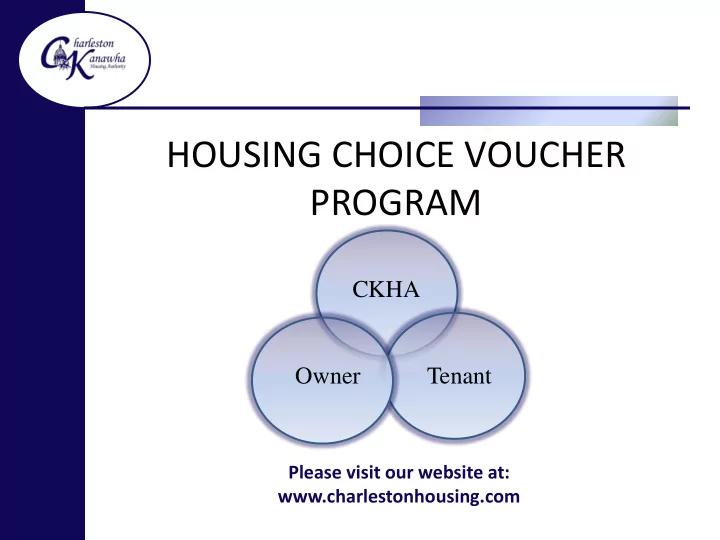
HOUSING CHOICE VOUCHER PROGRAM
Please visit our website at: www.charlestonhousing.com
CKHA Owner Tenant
SLIDE 2 HOUSING CHOICE VOUCHER PROGRAM
THE NEED FOR THE PROGRAM
In West Virginia, the Fair Market Rent (FMR) for a two-bedroom apartment is $721. In order to afford this level of rent and utilities, without paying more than 30% of income on housing, a household must earn $2,403 monthly or $28,840 annually. Assuming a 40-hour work week, 52 weeks per year, this level of income translates into a Housing Wage of $13.87. In West Virginia, a minimum wage worker earns an hourly wage of $8.00. In
- rder to afford the FMR for a two-bedroom apartment, a minimum wage
earner must work 69 hours per week, 52 weeks per year. Monthly Supplemental Security Income (SSI) payments for an individual are $733 in West Virginia. The FMR for a one-bedroom is $605. A unit is considered affordable if it costs no more than 30% of the renter's income.
SLIDE 3
HOUSING CHOICE VOUCHER PROGRAM
What is the step-by-step procedure for the Section 8 Program? 1) The applicant applies for Section 8 when the waiting list is open. 2) The applicant’s name comes to the top of the waiting list. 3) CKHA determines if the applicant is eligible for the program. 4) The applicant is issued a Voucher and a Request for Tenancy Approval (RFTA) form. 5) The voucher holder looks for housing within the area for up to 120 days. 6) The voucher holder finds a unit on the private market to rent. 7) The property owner/manager of the unit screens the applicant for suitability as tenant (CKHA does not screen for suitability). 8) The property owner/manager and the voucher holder complete the RFTA form and return it to CKHA.
SLIDE 4
HOUSING CHOICE VOUCHER PROGRAM
What is the step-by-step procedure for the Section 8 Program (cont.)? 9) CKHA receives the RFTA, CKHA will determine if the applicant qualifies for the unit. 10) CKHA inspects the unit according to Housing Quality Standards. 11) CKHA passes and approves the unit or notes needed repair items. 12) CKHA enters into a contract with the property owner/manager of the unit. 13) The owner and tenant sign the property owner/manager’s rental agreement or Lease. 14) CKHA receives a copy of rental agreement or lease between the tenant and property owner/manager. 15) CKHA inspects the unit annually. 16) CKHA reviews tenant eligibility annually.
SLIDE 5 HOUSING CHOICE VOUCHER PROGRAM
- What is the Housing Choice Voucher
(HCV) Program?
- How can I participate in the HCV
Program?
Responsibilities
SLIDE 6 HOUSING CHOICE VOUCHER PROGRAM
What is the Housing Choice Voucher (HCV) Program? The Housing Choice Voucher (HCV) Program is the federal government’s major program for assisting very low-income families, the elderly, and the disabled to afford decent, safe, and sanitary housing in the private
- market. A family that is issued a housing voucher is responsible for
finding a suitable housing unit of the family’s choice where the owner agrees to rent under the program. This unit may include the family’s present residence. Rental units must meet minimum standards of health and safety, as determined by CKHA. A housing subsidy is paid to the landlord directly by CKHA on behalf of the participating family. The family then pays the difference between the actual rent charged by the landlord and the amount subsidized by the program.
SLIDE 7 HOUSING CHOICE VOUCHER PROGRAM
How can I participate in the HCV Program? Although the HCV Program may seem a bit confusing and overwhelming
- n the surface, it is actually a fairly simple program. Here’s a look at the
top 21 FAQs asked by landlords who want to know more about the HCV Program.
SLIDE 8 HOUSING CHOICE VOUCHER PROGRAM
Q: What type of housing units can participate in the HCV Program?
A: The Housing Choice Voucher Program provides rental assistance for apartments, homes, condos, duplexes and mobile homes. Q: Are restrictions placed on where program participants may seek housing? A: Each Housing Authority works within a certain geographic location. Program participants are restricted to finding housing within the geographic location that is serviced by a particular Housing Authority. CKHA covers the city of Charleston, Kanawha, Clay, and Putnam counties. In addition, the neighborhood must be one that is not subject to dangerous steps, walks, flooding, instability, septic tank backups, poor drainage, mud slides, sewage hazards, smoke or dust, abnormal air pollution, vermin infestations, excessive accumulation of trash or fire hazards.
SLIDE 9 HOUSING CHOICE VOUCHER PROGRAM
Q: What type of criteria is the housing required to meet? A: The housing must be decent, safe and sanitary while also meeting the Housing Quality Standards. These standards include having all of the following:
- An alternative exit in case of fire
- A cooking stove or range
- A kitchen sink with hot and cold running water
- A refrigerator that is of appropriate size for the unit
- Space for storage, food preparation and serving
- Facilities and services for food waste disposal
- At least one window in living room and sleeping rooms
- A working light fixture in the bathroom and kitchen
- At minimum of two electric outlets in the kitchen, living room and
each bedroom
SLIDE 10 HOUSING CHOICE VOUCHER PROGRAM
Q: What type of criteria is the housing required to meet (cont.)?
- Adequate air circulation
- Free from dangerous levels of sewer gas, carbon monoxide, dust,
fuel gas and other harmful air pollutants
- Toilets that flush
- A fixed tub or shower with hot and cold running water
- A fixed basin with hot and cold running water
- A kitchen, living room, bathroom and at least one bedroom or a
living-sleeping room
- No serious defects, such as large holes, bulging or loose surface
materials, on floors, ceilings and walls and a firm and weather tight roof
SLIDE 11 HOUSING CHOICE VOUCHER PROGRAM
Q: Are there limitations placed on rental amounts? A: Each Housing Authority is responsible for determining rent
- limitations. CKHA performs rent reasonableness surveys in order to
determine a reasonable rate for the area and to ensure the rent is comparable to that being paid by those who are not involved in the
- program. Furthermore, CKHA will not approve a unit if the rental cost is
more than 40% of the tenant's income.
SLIDE 12 HOUSING CHOICE VOUCHER PROGRAM
Q: Are landlords required to lease to people who have Housing Authority vouchers? A: No. As a landlord, you have the freedom to rent to whoever you like, so long as you are not discriminating against potential tenants based on color, race, religion, sex, familial status or national origin. CKHA does not require landlords to house families involved in the program, nor does it screen families. Rather, CKHA only determines program eligibility and leaves the responsibility of screening families up to the
- landlord. So long as you require all potential tenants to complete an
application and screening process, you are fully within your rights as a landlord.
SLIDE 13
HOUSING CHOICE VOUCHER PROGRAM
Q: Are landlords expected to treat program participants differently from those who are not receiving assistance? A: No. Program participants are expected to abide by the same regulations as unassisted tenants. Q: How many people can live in a unit through the HCV Program? A: Each Housing Authority places its own restrictions on unit size, which is based on the size of the family. CKHA will issue a voucher to the family, which will indicate the unit bedroom size that is required through the program. As a landlord, it is essential for you to make certain the bedroom size of your rental property is in compliance with the voucher.
SLIDE 14 HOUSING CHOICE VOUCHER PROGRAM
Q: Are landlords required to accept pets through the HCV Program? A: No. Whether or not you accept pets is up to you and should be in the
- lease. Exceptions include terms such as, “service/comfort animals” or
“reasonable accommodation.” Q: Who pays the security deposit? A: Tenants are required to pay their own security deposits, though you are restricted from charging a security deposit that is greater than what you charge unassisted tenants.
SLIDE 15
HOUSING CHOICE VOUCHER PROGRAM
Q: Is the landlord required to pay for the utilities? A: The landlord is not responsible for paying the tenant's utilities, though the tenant must have an electric, gas and water meter that is separate from other tenants. If the tenant is responsible for paying the utilities, the utilities must be transferred to the tenant's name.
SLIDE 16
HOUSING CHOICE VOUCHER PROGRAM
Q: What kind of paperwork is involved with the program? A: Once you have reached an agreement with a potential tenant, you will need to complete a Request for Tenancy Approval form. This form requests basic information, such as the address of the unit, the monthly rental fee and the utilities the tenant will be required to pay. You will also be required to negotiate a lease agreement with the potential client. After your unit has passed inspection, you will be required to sign a contract with CKHA. Every year, CKHA be required to inspect the unit. You will not receive HAP until the unit has passed inspection, the tenant has moved in, and you have signed a contract with CKHA.
SLIDE 17 HOUSING CHOICE VOUCHER PROGRAM
Q: How involved is CKHA with the tenant/landlord relationship? A: CKHA encourages landlords and tenants to resolve issues on their
- wn, but will provide assistance if the landlord or the tenant are
experiencing problems. Q: When does the landlord receive rental payments from the CKHA? A: CKHA makes every effort to get payments to the landlord as close to the first of each month. CKHA also provides a mid-month adjustment for payments that have not been processed by the end of month
- deadline. All payments are sent via first class mail and direct deposit.
Effective April 1, 2015, all payments will be direct deposit only.
SLIDE 18 HOUSING CHOICE VOUCHER PROGRAM
Q: Am I able to evict a tenant if necessary?
- A. Yes. You may evict a tenant who is participating in the HCV Program,
so long as you provide proper legal notice. You must also provide CKHA with a copy of the initial eviction notice once the process has been
- started. In order to evict the tenant, you must abide by all local and
state eviction laws. Legal reasons for eviction include failure to pay rent, causing damage beyond normal wear and tear and illegal use of the unit.
SLIDE 19
HOUSING CHOICE VOUCHER PROGRAM
Q: What are the responsibilities of the landlord through the HCV Program? A: As the landlord, you will be responsible for screening your tenants and for selecting the family you will rent your unit out to. You will also be responsible for performing all management and renting functions as well as performing all necessary maintenance. If you are supplying utilities to the unit, you will also be responsible for the payment of these utilities. In addition, you are responsible for complying with the Housing Assistance Payment Voucher Contract as well as with the lease you have with your tenant.
SLIDE 20
HOUSING CHOICE VOUCHER PROGRAM
Q: What are the responsibilities of the tenant through the HCV Program? A: Families participating in the HCV Program are responsible for finding suitable housing and for providing CKHA with the income and family information needed to verify and certify program eligibility. This information must be provided at least on an annual basis in order to maintain eligibility. Families participating in the program are also responsible for repairing any damage that they cause to the unit and must allow CKHA to inspect the unit. Finally, families must abide by the obligations as defined by the HCV and by the lease.
SLIDE 21
HOUSING CHOICE VOUCHER PROGRAM
Q: What are the responsibilities of CKHA through the HCV Program? A: CKHA is responsible for determining whether or not the client is eligible to participate in the HCV Program. Once eligibility is established, CKHA is responsible for processing the certification and recertification application, for inspecting the unit, for executing the Housing Assistance Payment Contract. CKHA is also responsible for determining the amount of assistance to be provided and for making payments to the landlord on behalf of the tenant. Finally, CKHA is responsible for monitoring the program and making certain everyone involved is in compliance with HUD regulations.
SLIDE 22 HOUSING CHOICE VOUCHER PROGRAM
Voucher specifies Family Obligations Housing Assistance Payments (HAP) Contract specifies Owner and PHA Obligations Lease specifies Tenant and Landlord Obligations
SLIDE 23
HOUSING CHOICE VOUCHER PROGRAM
Q: Why would a landlord want to participate in the HCV Program? A: Landlords who participate in the HCV Program enjoy rent security in terms of the portion that is paid by CKHA. Accepting program participants also helps keep vacancies low while providing landlords with good residents to fill their empty units. You have the opportunity to help the elderly, the disabled, families with low incomes and single parent families by providing affordable housing.
SLIDE 24
VAWA
Violence Against Women Act (VAWA) The Violence Against Women Act of 1994 (VAWA) is a United States federal law signed by President Bill Clinton on September 13, 1994. A federal law that went into effect in 2006 protects individuals who are victims of domestic violence, dating violence and stalking. The name of the law is the Violence Against Women Act, or “VAWA”. This notice explains your obligations under VAWA.
SLIDE 25
SPECIAL PROGRAMS Shelter Plus Care (S+C) HUD-VASH
SLIDE 26
ADDITIONAL SERVICES Family Self-Sufficiency Scholarships
SLIDE 27 LANDLORD INFORMATIONAL MEETINGS 1st Floor Conference Room 5:00 – 6:00 p.m.
- February 19, 2015 – Evictions/VAWA
- May 21, 2015
- August 20, 2015
- November 19, 2015
Meetings are held once a quarter, 3rd Thursday.