Presentation Outline 1. The FFC and the public hearings on housing - - PowerPoint PPT Presentation

presentation outline
SMART_READER_LITE
LIVE PREVIEW

Presentation Outline 1. The FFC and the public hearings on housing - - PowerPoint PPT Presentation

Presentation Outline 1. The FFC and the public hearings on housing finance 2. FFC starting points and stakeholder views Building an Inclusionary Housing Market: Shifting the Paradigm for Housing Delivery in South Africa 3. Key challenges identified


slide-1
SLIDE 1

Building an Inclusionary Housing Market: Shifting the Paradigm for Housing Delivery in South Africa

Presentation to the FinMark Forum

25 April 2012

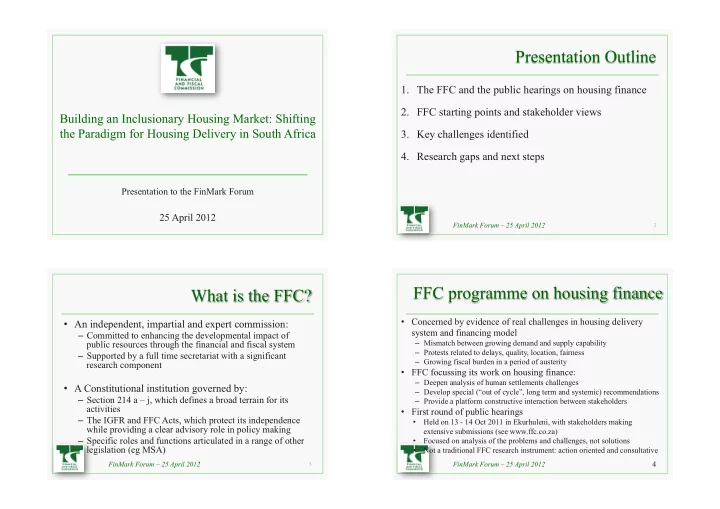
Presentation Outline

  • 1. The FFC and the public hearings on housing finance
  • 2. FFC starting points and stakeholder views
  • 3. Key challenges identified
  • 4. Research gaps and next steps

FinMark Forum – 25 April 2012

2

What is the FFC?

  • An independent, impartial and expert commission:

– Committed to enhancing the developmental impact of public resources through the financial and fiscal system – Supported by a full time secretariat with a significant research component

  • A Constitutional institution governed by:

– Section 214 a – j, which defines a broad terrain for its activities – The IGFR and FFC Acts, which protect its independence while providing a clear advisory role in policy making – Specific roles and functions articulated in a range of other legislation (eg MSA)

3

FinMark Forum – 25 April 2012

FFC programme on housing finance

  • Concerned by evidence of real challenges in housing delivery

system and financing model

– Mismatch between growing demand and supply capability – Protests related to delays, quality, location, fairness – Growing fiscal burden in a period of austerity

  • FFC focussing its work on housing finance:

– Deepen analysis of human settlements challenges – Develop special (“out of cycle”, long term and systemic) recommendations – Provide a platform constructive interaction between stakeholders

  • First round of public hearings
  • Held on 13 - 14 Oct 2011 in Ekurhuleni, with stakeholders making

extensive submissions (see www.ffc.co.za)

  • Focused on analysis of the problems and challenges, not solutions
  • Not a traditional FFC research instrument: action oriented and consultative

FinMark Forum – 25 April 2012

4

slide-2
SLIDE 2

FFC starting points

  • An unsustainable housing subsidy approach

– Inadequately financed but fiscally unsustainable – Distortionary effects on house prices and perverse incentives for beneficiaries

  • Inefficiencies in most aspects of the housing delivery chain

– Subsidy administration, Land location and acquisition, Development planning and control systems, Infrastructure delivery, Tenure provision

  • Significant knowledge gaps in the sector

– Extent of the demand for housing in SA – Supply-side constraints (subsidized and mortgaged housing) – Nature and extent of housing affordability – Regulatory impacts: what incentives and constraints are created by the current legislative, policy, fiscal and regulatory framework FinMark Forum – 25 April 2012

5

Government is not the primary source

  • f housing finance

6

FinMark Forum – 25 April 2012

Rich set of stakeholder concerns

  • Generally, stakeholders agreed with the FFC starting points
  • Stakeholders emphasised the following points as concerns:

– Policy flexibility versus implementation rigidity

  • While national policy gives provincial and local governments the

flexibility to adapt housing policy and plans according to their context, stakeholders perceived national government as dictating a “one size fits all” approach

– Legislative and administrative barriers in the housing market

  • Include limited accreditation of municipalities to perform housing

functions (Housing Act)

  • Regulatory constraints (MFMA) prevent metros using own revenues as

bridging finance for low-income housing developments

FinMark Forum – 25 April 2012

7

FFC perspective on the key challenges

  • 1. Insufficient scale relative to demand
  • 2. Fiscal and physical sustainability
  • 3. Household affordability
  • 4. Informality
  • 5. Barriers in the delivery chain (land,

infrastructure, zoning, registration in deeds, etc)

8

FinMark Forum – 25 April 2012

slide-3
SLIDE 3
  • 1. Insufficient delivery
  • Impressive progress since 1994 unfortunately no longer sufficient

– Nearly 3 million fully subsidised houses since 1994 (average of 167,000 houses / yr); – Rising backlog - More than 2 million households are presumed homeless in South Africa

  • Needs of lower income households not being met
  • Historical issues of size of subsidy and availability of credit
  • Distortionary effects of subsidy: gap market
  • Poor data and understanding of housing demand

– While stakeholders agreed that the demand for adequate housing remains high, it is difficult to ascertain accurately the extent of this because of poor data on past delivery, trends, needs and effective demand – Good data is needed and can be used to improve understanding of the current situation and to inform housing policy

FinMark Forum – 25 April 2012

9

Rising backlog

10

FinMark Forum – 25 April 2012

Exploding waiting lists

11

FinMark Forum – 25 April 2012

Declining outputs

FinMark Forum – 25 April 2012

12

slide-4
SLIDE 4

Declining delivery with rising allocations

13

FinMark Forum – 25 April 2012

  • 2. Sustainability
  • The budget allocated has increased significantly but has

not resulted in increased delivery

  • As costs increase over time, more and bigger subsidies

are required to deliver on promises, which makes the current housing finance policy unsustainable

  • To eliminate housing backlog at a cost of R140 000 per

unit, about R300 billion is required - a sum far beyond the fiscal capacity of the state

  • Assuming a delivery rate of 250 000 houses per year,

the annual budgetary implication is R35 billion

14

FinMark Forum – 25 April 2012

Rising backlogs vs Spending

FinMark Forum – 25 April 2012

15

!"!!# $"!!# %!"!!# %$"!!# &!"!!# &$"!!# !"!!# !"$!# %"!!# %"$!# &"!!# &"$!# %''(# &!!%# &!%%# !"#$%%$&'() *+,-()) !".$%%$&'() )*+,-./0#1-23456# 78/90:96#

  • 3. Affordability
  • Average price of house is over R500 000
  • Household earning about R10,000 per month

could afford the cheapest house costing about R250,000

– However, delivery in this segment of the market is far below the estimated demand

  • According to the Affordable Land and Housing Data Centre,

in 2010 only 6,252 new units priced between R250,000 and R500,000 were registered on the Deeds Registry

  • Shortfall of 5 to 6 million properties under R100 000

(Lightstone, 2011)

FinMark Forum – 25 April 2012

16

slide-5
SLIDE 5

Household income

17

FinMark Forum – 25 April 2012

Production

  • According to Stats SA (2011), residential building activity for this segment of

the market has been negative since about 2009 and has only recently started moving again

– Growth in residential building activity: houses (<80m2), 2-month moving average FinMark Forum – 25 April 2012

18

  • 4. Informal settlements are an emergency

19

300

estimate 1994

1066

2001

2628

2010

  • Nationally 10 shack fires each day, over 200 deaths p.a.
  • 7% HIV annual incidence rate - 1.8% in urban formal areas
  • Diarrhoea-related infant mortality up to 10 times higher than urban formal areas
  • Official estimates over 40% unemployment compared to 26% national average
  • Service delivery protests average two per week

… and informality may be part of the solution

  • Accepting informality as a reality and as a point of

entry into the housing market

– Stakeholders suggested that the 60% at the bottom of the market could access decent housing only through combination of informal self-build and government financing assistance – Could have a real impact on reducing backlogs

  • Shift from a focus on ownership to all forms of

housing supply is required

– Instead of a narrow focus on ownership, there is need to consider other forms of tenure and incentivising them where possible

FinMark Forum – 25 April 2012

20

slide-6
SLIDE 6
  • 5. Barriers in the delivery chain
  • Supply and access to well-located land and bulk infrastructure as well as

housing delivery chain inefficiencies

– Stakeholders agreed with the FFC that main challenges for affordable housing supply include access to well-located land and bulk infrastructure – Inefficiencies in the housing delivery chain – Although up to 70,000 hectares of state-owned land have been identified for housing developments, none have been made available for this purpose

  • Intergovernmental coordination and leadership

– Perception of a “one size fits all” approach – insufficient authority and responsibility at municipal level (limited accreditation?) – Weak inter-sector planning and lack of long-term spatial planning – Non-complementary zoning and land use management practices

FinMark Forum – 25 April 2012

21

Priority needs for housing finance policy

  • Building a single, inclusionary housing market

– Formal and informal markets are operating, although under severe stress and with exclusion of the poorest – State financed houses will always remain only one component of the overall market

  • Clarifying the role of state in housing provision

– Largest public good derived from well-located, adequately serviced and securely tenured land – Houses themselves are a private good

  • Rethinking housing entitlements

– Households should be actively engaged in determining and meeting their housing needs – Household power relative to other actors needs substantial strengthening (“from consultation to control”)

  • Address the needs of people living in informal settlements

– Informality reflects both state and market failure, but must be addressed directly – Informality is not a problem, but an opportunity to redesign our cities and social relations FinMark Forum – 25 April 2012

22

Research Gaps Identified

  • Understanding demand for housing: what do households want?

– Credible data on current and projected housing needs – Affordability and unlocking effective demand

  • Unlocking supply

– Land acquisition and production – Housing finance (crowding in private sector) – Regulatory constraints:

  • Quantifying the cost of delays and how such delays could be minimised
  • Land use management regulations (zoning, development control)
  • Spatial form and the apartheid city

– Instruments for public investment to alter not reinforce and Inefficient, inequitable and costly urban form – Financing sustainable human settlements

– The role of subsidised housing finance – Infrastructure financing

FinMark Forum – 25 April 2012

23

Next steps

  • Comprehensive research focusing on the analysis of

alternative housing delivery and funding options and their impact on different role players including households themselves and fiscus

  • The report will be tabled in second public hearings

scheduled for August 2012

  • Other research issues identified will form part of medium

to long term FFC research agenda

FinMark Forum – 25 April 2012

24

slide-7
SLIDE 7

Issues for discussion

  • Sustainability of the current delivery model

– Fiscal gap and implications – Impacts of new instruments (new guarantees)

  • Alternative options for public finance

– Depth vs. breadth – Demand vs. supply side – Non-fiscal instruments

  • Institutional arrangements

– Unexplored partnerships – Intergovernmental arrangements and relationships

  • Leveraging household and private finance

– Crowding in private sector – Household savings and investments

FinMark Forum – 25 April 2012

25 26

FinMark Forum – 25 April 2012

Thank You

;;;<=2<25<>-#?@/0:-A)B/9.*#C#DEF4:2#G/-H:96*#C#G5E*:96#I:9-92/J# ######KIILM7N# #######I:9-92:-4O-90OI:*2-4OL5,,:**:59O75E.PONQH:2-#