Housekeeping & Introductions
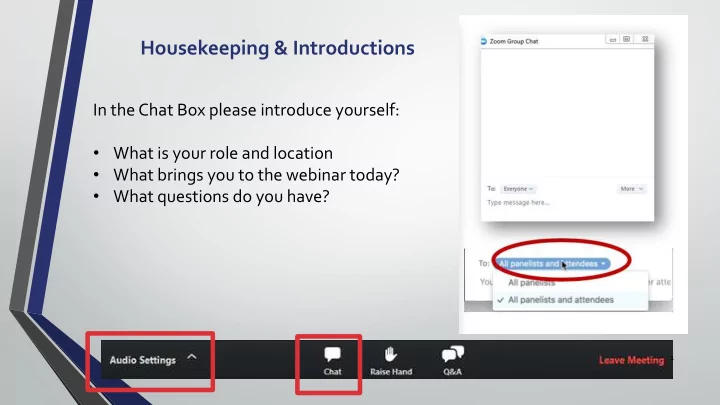
In the Chat Box please introduce yourself:
- What is your role and location
- What brings you to the webinar today?
- What questions do you have?
1
Housekeeping & Introductions In the Chat Box please introduce - - PowerPoint PPT Presentation
Housekeeping & Introductions In the Chat Box please introduce yourself: What is your role and location What brings you to the webinar today? What questions do you have? 1 The Benefits and Importance of Using Youth Participatory
1
2
(YPAR), particularly for individuals working with COIP, as a valuable method of:
skills;
critical;
leverages developmental relationships with youth participants through the YPAR process.
3
implementation
4
▪ Support enhanced collaboration to improve outcomes for youth ▪ Identify and disseminate evidence-based strategies that support youth ▪ Create a federal interagency website on youth ages 10-24
6
▪ Webinars (e.g., Model Arrest Policy) ▪ Tip Sheets for Teachers and Adults who work with COIP; Incarcerated Parents; Staff at correctional facilities; and Youth ▪ Guides for Incarcerated Parents and their families ▪ Youth Voices and Profiles ▪ Research summarizing the impact of incarceration ▪ COIP community of practice listserv
7
8
Roger Jarjoura, Ph.D.
Principal Researcher
Fausto A. Lopez M.Ed.
Senior TA Consultant & Content Area Specialist
Camisha Harrison
Youth with experience in YPAR
11
13
14
15
16
17
18
19
20
21
22
1. Express Care 2. Challenge Growth 3. Provide Support 4. Share Power 5. Expand Possibilities
23
Source: https://www.search-institute.org/developmental-relationships/learning-developmental-relationships/
Ratings by Youth on Relationships with Teachers Ratings by Youth on Relationships with Leaders of Youth Programs
24
Ratings by Youth on Relationships with Program Staff Trained in Developmental Relationships Ratings by Youth on Relationships with Mentors Trained in Developmental Relationships
25
26
27
28
29
30 Jagers et al, 2029; CASEL, 2012.
Self-Awareness
Understanding one’s emotions, personal and social identities, goals, and values.
Self- Management
Skills and attitudes that facilitate the ability to regulate emotions and behaviors.
Social Awareness
Having the critical historical grounding to take the perspective of those with the same and different cultural backgrounds and appropriately empathize and feel compassion.
Relationship Skills
Interpersonal sensibilities needed to establish and maintain healthy and rewarding relationships and navigate diverse settings.
Responsible Decision Making
Knowledge, skills, and attitudes needed to make caring, constructive choices about personal and group behaviors across, diverse, social interactions.
31
32
33
35
36
37
Abraczinskas, M., & Zarrett, N. (2020). Youth Participatory Action Research for Health Equity: Increasing Youth Empowerment and Decreasing Physical Activity Access Inequities in Under‐resourced Programs and Schools. American Journal of Community Psychology. Anselma, M., Chinapaw, M., & Altenburg, T. (2020). Not Only Adults Can Make Good Decisions, We as Children Can Do That as Well” Evaluating the Process of the Youth-Led Participatory Action Research ‘Kids in Action. International journal of environmental research and public health, 17(2), 625. Ballonoff Suleiman, A., Ballard, P. J., Hoyt, L. T., & Ozer, E. J. (2019). Applying a developmental lens to youth-led participatory action research: A critical examination and integration of existing evidence. Youth & Society, 0044118X1983787 Collaborative for Academic, Social, and Emotional Learning. (n.d.) Overview of SEL. Retrieved from https://casel.org/overview-sel/. Damon, W., Menon, J., & Cotton Bronk, K. (2003). The development of purpose during adolescence. Applied Developmental Science, 7, 119–
Durlak, J., Dymnicki, A. B., Taylor, R. D., Weissberg, R., & Schellinger, K. B. (2011). The impact of enhancing students’ social and emotional learning: A meta-analysis of school-based universal interventions. Child Development, 82(1), 405–432. Fine, M., & Torre, M. E. (2004). Re-membering exclusions: Participatory action research in public institutions. Qualitative Research in Psychology, 1, 15–37. Israel, B. A., Schulz, A., Parker E. A., Becker, A., Alllen, A., & Guzman, J. R. (2003). Critical issues in developing and following community based participatory research principles. In M. Minkler & N. Wallerstein (Eds.), Community-Based Participatory Research for Health (pp. 53–76). San Francisco: Jossey-Bass.
38
Jagers, R. J., Rivas-Drake, D., & Williams, B. (2019). Transformative social and emotional learning (SEL): Toward SEL in service of educational equity and excellence. Educational Psychologist, 54(3), 162-184 Langhout, R. D., and Thomas, E. (2010). Imagining Participatory Action Research in Collaboration with Children: an Introduction. American Journal of Community Psychology (2010) 46:60–66. London, J., Zimmerman, K., & Erbstein, N. (2003). Youth-led research and evaluation: Tools for youth, organizational, and community
Masten, A. S., & Coatsworth, J. D. (1998). The development of competence in favorable and unfavorable environments: Lessons from research on successful children. American Psychologist, 53, 205– 220. doi:10.1037//0003- 066x.53.2.205 Mitra, D. L. (2004). The significance of students: Can increasing student voice in schools lead to gains in youth development? Teachers College Record, 106(4), 651–688. Osher, D., Kidron, Y., Brackett, M., Dymnicki, A., Jones, S., & Weissberg, R. P. (2016). Advancing the science and practice of social-emotional learning: Looking back and moving forward. Review of Research in Education, 40(1), 644–681. Ozer, E. J., Afifi, R., Gibbs, L., & Mathur, R. T. (2018). Youth engagement and participation: Field-building across research and practice. Journal
Osher, D., Pittman, K., Young, J., Smith, H., Moroney, D., & Irby, M. (2020). Thriving, robust equity, and transformative learning & development: A more powerful conceptualization of the contributors to youth success. Washington, DC: American Institutes for Research and Forum for Youth Investment
39
Rodriguez, L. F., & Brown, T. M. (2009). From voice to agency: Guiding principles for participatory action research with youth. New Directions for Youth Development, 2009(123), 19-34. Search Institute (2018) Developmental Relationships Framework. Search Institute, Minneapolis, MN. Wilson, N., Dasho, S., Martin, A., Wallerstein, N., Wang, C., & Minkler, M. (2007). Engaging young adolescents in social action through photovoice: The youth empowerment strategies (YES!) project. The Journal of Early Adolescence, 27(2), 241–261. Youniss, J., & Yates, M. (1997). Community service and social responsibility in youth. Chicago, IL: University of Chicago Press