Housekeeping & Introductions What is your definition of an - - PDF document

housekeeping introductions
SMART_READER_LITE
LIVE PREVIEW

Housekeeping & Introductions What is your definition of an - - PDF document

01/05/2019 Advanced Communication Skills Refresher Transferring skills back into your workplace Welcome to the study day! Housekeeping & Introductions What is your definition of an effective communicator? 1 01/05/2019 Do any of these


slide-1
SLIDE 1

01/05/2019 1

Advanced Communication Skills Refresher

Transferring skills back into your workplace

Welcome to the study day!

Housekeeping & Introductions

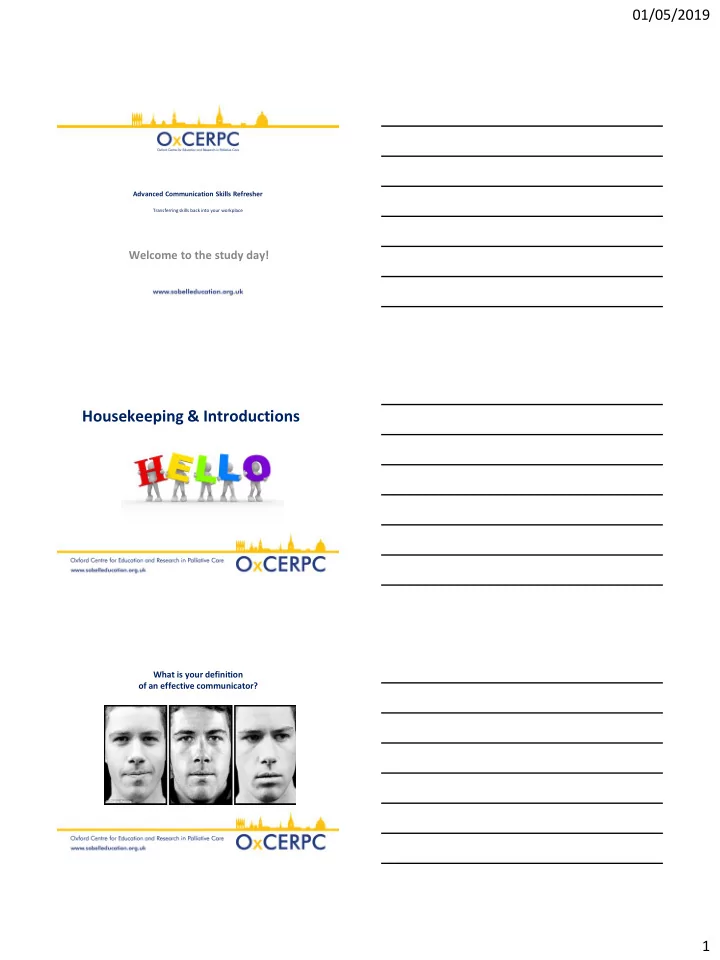
What is your definition

  • f an effective communicator?
slide-2
SLIDE 2

01/05/2019 2 Do any of these definitions describe how you believe patients, carers and/or colleagues experience their communication with you ?

Is this an Effective Communicator?

Someone who…………………

  • Listens before responding and asks for feedback?
  • Recognises the difference between relational and transactional care (Sweeney 2009)
  • Questions widely held beliefs enshrined in communication skills training (Stokoe 2018)
  • Values the patients uniqueness alongside EBM and clinical expertise (Stewart et al 2007)
  • Structures a consultation which “flows” and prioritises rapport (Silverman, Kurtz & Draper 2005)
  • Gathers what the patient has been told, has understood and how he/she feels (Gawande 2014)
  • Anticipates potential pitfalls (Stokoe 2014)

Something More?

Lim R, & Dunn S. (2018) Journeys to the Centre of Empathy: the authentic core of communication skills: OUP

slide-3
SLIDE 3

01/05/2019 3 Feedback Forms

Reflect 1 REVISE/REFLECT What was covered previously?

  • Overview of evidence
  • Agenda set by the participants
  • Presentation of communication skills in practice with trigger tapes
  • Practice of key skills with feedback
  • TRANSFERENCE

REFRESH Core components of today AIM

– Refresh and reflect on previous learning (ACST/ECST) and its impact when you transferred skills back into practice

OBJECTIVES

– Revisit & reflect on what is effective communication – Critique your communication behaviours/techniques – Practice & analyse some key communication skills – Decide what to transfer & evaluate back at base

slide-4
SLIDE 4

01/05/2019 4 What’s new out there? What has ‘communicated’ to you?

What are patients saying?

Kieran Sweeney https://youtu-be/-uMNY55nw4

slide-5
SLIDE 5

01/05/2019 5

Fast forward from NHS Cancer Plan (2000) & Darzi (2008)………

  • Communication continues to be at the heart of care

Mid Staffs NHS Public Enquiry 2013; 6Cs 2012; CQC Caring services criteria ongoing; www.telegraph.co.uk/health-fitness/body 28 Jan 2018; Awdish 2018; Kissane et al 2018

  • Good communication can improve physiological functioning

Stewart et al 1995; Harari et al 2000

  • Poor communication can lead to psychological morbidities

Maguire 1996; Thylen et al 2013; Mitchell et al 2013

  • Unsatisfactory communication can lead to patients and carers feeling

anxious, unsafe and dissatisfied & can affect adherence to care

Shilling et al 2003; www.pointofcarefoundation.org.uk ; National Patient Survey Reports 2010 onwards; Doyle et al 2014; Duty of Candour 2015; YouGov survey 2017; Achieving World Class Outcomes for Cancer 2015-20

What are your colleagues facing?

Atul Gawande https://youtu.be/45b2QZxDd_o

What more do we know…?

  • Lack of skills and job purpose affects staff leading to stress, poor job satisfaction and

emotional burnout

Giving Sad & Bad News Fallowfield 1993; Zohar & Marshall 2004; Gurgis et al 2006; Assisted Dying debate 2019 & ongoing

  • Many patients state that they do not receive the information that they need

Montgomery Ruling 2015; www.each.eu

  • Honest and regular conversations with patients and carers are needed to achieve shared

decision-making

Ambitions for Palliative & EOLC 2015-20; www.respectprocess.org.uk; Royal College of Physicians 2018; Zwakman et al 2018

  • A single word/para verbals can all change a conversation

Parry et al 2014; Stokoe 2018; Real Talk Project – Pine & Parry 2018

  • Communication skills do not improve through experience alone

Thorne et al 2013
slide-6
SLIDE 6

01/05/2019 6 Working Agreement Feedback Forms

Revise and Refresh

COFFEE BREAK

slide-7
SLIDE 7

01/05/2019 7

“However brilliant we might believe we are at communication, we never see ourselves as

  • thers do and we always need to learn, both

from the experience and evidence from what went before and from what the next generation have learnt from us, improved upon, and developed.”

Baroness Ilora Finlay, 2018

REFLECT Revisiting the transfer session

Aim

  • Reflect on skills, behaviours & strategies practised to improve the likelihood of

their transfer and sustainability back in your workplace In order to do this you were asked to:

  • Set yourself a goal – identify a key skill/behaviour/strategy to transfer
  • Anticipate the consequences of transfer – both benefits and potential negatives
  • Identify support mechanisms you could draw on to ‘stay on course’
slide-8
SLIDE 8

01/05/2019 8 Headline feedback

Since my last communication skills training…

  • Name that skill!
  • What effect has this had on my communications with

patients/ relatives/ colleagues? On me?

  • What challenges did I face? How did I overcome

these?

Throw away a worry

Feedback Forms

Reflect 2

slide-9
SLIDE 9

01/05/2019 9

  • Interactive
  • Everybody participates but

nobody’s on their own

  • Fun
  • Relevant

This afternoon Say ‘Good Luck’ to Sakina!

Restart at 13.45 please

Forum theatre

A live scenario in real time

slide-10
SLIDE 10

01/05/2019 10

Listening

L – Listening (actively) I – Interrogating S – Sermonising T – Taking turns E – Egocentric listening N – Not listening

Empathy

‘People don’t care how much you know until they know how much you care’

US President Theodore Roosevelt

What does it mean for me?

Discussion

slide-11
SLIDE 11

01/05/2019 11

Back in 15 minutes please

Game time My Secret Profession

  • Open
  • Closed
  • Leading
  • Multiple
  • QAQA

Questions

slide-12
SLIDE 12

01/05/2019 12

Game time

My Secret Profession (part 2)

What does it mean for me?

Discussion

Feedback Forms

Experiential learning

slide-13
SLIDE 13

01/05/2019 13

Unfinished Business?

Next Steps?

Your feedback will be key to this

REFLECT Confidence versus Competence

Witmer D. (2017)

slide-14
SLIDE 14

01/05/2019 14

The Four Stages of Competence “The Conscious Competence Learning Model”

Noel Burch 1970s – “4 stages for learning any new skill”

Dunning D. & Kruger J. (1999) “When individuals are inept (they can’t see their own faults) or highly skilled (they underestimate their abilities) they are often caught in a bubble of inaccurate self-perception.”

Or alternatively............!

slide-15
SLIDE 15

01/05/2019 15 The PDSA Cycle

Act Plan Study Do

The change to be tested or implemented Carry out the test or change Collect agreed feedback or measurable outcomes before & after the

  • change. Reflect on

impact & learning. Plan the next change/cycle or progress to full implementation

Feedback Forms

Next Steps

slide-16
SLIDE 16

01/05/2019 16

Evaluation of the Day THANK YOU!!