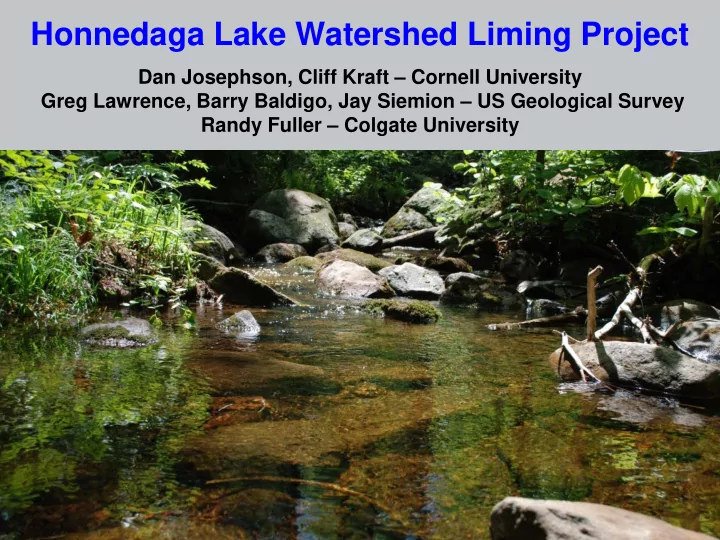
SLIDE 1
Honnedaga Lake Watershed Liming Project
Dan Josephson, Cliff Kraft – Cornell University Greg Lawrence, Barry Baldigo, Jay Siemion – US Geological Survey Randy Fuller – Colgate University
SLIDE 2 Honnedaga Lake
Surface Area : 312 ha (770 acres) Max Depth : 56 m (183 feet) Elevation : 701 m (2300 feet)
SLIDE 3 4.5 5.0 5.5 6.0 6.5 10/3/1954 12/20/1962 3/8/1971 5/25/1979 8/11/1987 10/28/1995 1/14/2004 4/1/2012
pH
2 4 6 8 10 12 14 10/3/1954 12/20/1962 3/8/1971 5/25/1979 8/11/1987 10/28/1995 1/14/2004 4/1/2012
Alim (umol/L)
20 40 60 80 10/3/1954 12/20/1962 3/8/1971 5/25/1979 8/11/1987 10/28/1995 1/14/2004 4/1/2012
SO-4 (umol/L)
Honnedaga Lake Summer Surface Water : 1959 to 2010
SLIDE 4 Honnedaga Lake Summer Surface Water : 1980 to 2010
20 40 60 80 100 120 140 8/28/1976 2/18/1982 8/11/1987 1/31/1993 7/24/1998 1/14/2004 7/6/2009
DOC (umol/L)
0.0 0.2 0.4 0.6 0.8 1.0 8/28/1976 2/18/1982 8/11/1987 1/31/1993 7/24/1998 1/14/2004 7/6/2009
Chla (ug/L)
5 10 15 20 25 30 8/28/1976 2/18/1982 8/11/1987 1/31/1993 7/24/1998 1/14/2004 7/6/2009
Secchi Depth (m)
DOC Secchi Depth Chla
SLIDE 5
Fall Trapnet Surveys
SLIDE 6 20 40 60 80 100 120 140 1955 1958 1961 1964 1967 1970 1973 1976 1979 1982 1985 1988 1991 1994 1997 2000 2003 2006 2009
CPUE (n/night)
Fall Trapnet CPUE of Brook Trout
No Trap Net Surveys
5 10 15 20 25 30
1970s 2000s
CPUE (n/night)
SLIDE 7 Mean pH < 5.0 Mean pH > 5.0
pH in Honnedaga Lake Tributaries
SLIDE 8
Stream Electro-Fishing Surveys
SLIDE 9 50 100 150 200 250 Inorganic Monomeric Aluminum (microgra YOY Brook Trout Presence (Y/N) N Y P < 0.05 R
2
= 0.65
0.0 0.1 0.2 0.3 0.4 0.5 0.6 0.7 12 14 16 18 20 22 24 50 100 150 200 250
YOY Brook Trout CPUE (number / m
2)
Temperature A l
i m
( m i c r
r a m s / L )
0.0 0.1 0.2 0.3 0.4 0.5 0.6 0.7 12 14 16 18 20 22 24 50 100 150 200 250
YOY Brook Trout CPUE (number / m
2)
Temperature A l
i m
( m i c r
r a m s / L )
Presence / Absence Density
Young-of-Year Brook Trout and Alim in Tributaries
SLIDE 10
3 g Leaf Packs Composed of Acer rubrum (Red Maple) Leaves
Leaf Breakdown Assessment
SLIDE 11 Chronically Acidic Episodically Acidic Chronically Acidic Episodically Acidic
SLIDE 12 Chronically Acidic Episodically Acidic
SLIDE 13
Since 1990 Amendments to the Clean Air Act
Modest chemical and brook trout population recovery within Honnedaga Lake – reflective of an acid impaired ecosystem Chronic acidification of numerous groundwater influenced tributaries / catchments within the watershed The acid impaired state of tributaries likely limits young-of-year and consequently adult brook trout abundance – as well as invertebrate community diversity Honnedaga Lake remains an acid impaired ecosystem with low probability of recovery in chronically acidified tributaries / catchments
Current Status of the Honnedaga Lake Ecosystem
SLIDE 14
Tributary Watershed Liming
Design and Rationale Selective in-stream and watershed lime applications to restore habitat for spawning and young-of-year brook trout, macroinvertebrates and forests
SLIDE 15 Honnedaga Lake Tributaries
Proposed design for the Honnedaga Lake tributary and watershed liming project: Chronically Acidified Tributaries
- T24 (control – no lime)
- T15 (instream liming)
- T16 (watershed liming)
Episodically Acidified Tributaries
- T9 (control – no lime)
- T6 (instream liming)
- T8 (watershed liming)
SLIDE 16
- Episodically Acidified/Near Chronic
- Chronically Acidified Tributaries
I I
Episodically Acidified Tributaries
7
J ./ / _k_,_
r.'
SLIDE 17 4.0 4.5 5.0 5.5 6.0 1/22/2010 3/13/2010 5/2/2010 6/21/2010 8/10/2010 9/29/2010 11/18/2010
0.0 20.0 40.0 1/22/2010 3/13/2010 5/2/2010 6/21/2010 8/10/2010 9/29/2010 11/18/2010 0.0 5.0 10.0 15.0 3/3/2010 3/23/2010 4/12/2010 5/2/2010 5/22/2010 6/11/2010 7/1/2010 7/21/2010 8/10/2010
pH ANC (ueq/L) Alim (umol/L)
Tributary 16
Chronically Acidified Tributaries
SLIDE 18 4.5 5.0 5.5 6.0 6.5 1/22/2010 3/13/2010 5/2/2010 6/21/2010 8/10/2010 9/29/2010 11/18/2010
20 40 60 80 100 120 140 1/22/2010 3/13/2010 5/2/2010 6/21/2010 8/10/2010 9/29/2010 11/18/2010 0.0 1.0 2.0 3.0 4.0 5.0 3/3/2010 3/23/2010 4/12/2010 5/2/2010 5/22/2010 6/11/2010 7/1/2010 7/21/2010 8/10/2010
pH ANC (ueq/L) Alim (umol/L)
Episodically Acidified Tributaries
Tributary 8
SLIDE 19 Chronically Acidified Tributaries
- T24 (control – no lime)
- T15 (in-stream liming)
- T16 (watershed liming)
Episodically Acidified Tributaries
- T9 (control – no lime)
- T6 (in-stream liming)
- T8 (watershed liming)
SLIDE 20
Proposed Liming Schedule
In-Stream Lime Applications Annual applications in June (2012, 2013, 2014) West Virginia and Clayton Formulas High calcium sand limestone T6 (11 tons/yr), T15 (0.5 tons/yr) Watershed Lime Application One time application (tentative 2012) Aerial application of pelletized lime Amount to be determined for T16 and T8
SLIDE 21 Tributary Monitoring Program: Pre-Lime and Post-Lime Application
- Tributary Chemistry and Flow (stream
gages, automated water samplers)
- Brook Trout Populations (back pack electro-
fishing, redd surveys)
- Macroinvertebrate Populations
- Leaf Litter Decomposition
- Forest and Soils
SLIDE 22
Tributary Chemistry and Flow
(Stream Gages, Automated Water Samplers)
SLIDE 23
Anticipated Outcomes from Lime Applications
In-Stream Lime Applications Improved stream chemistry ( pH, ANC, Alim) Increased presence and density of YOY brook trout Increased presence / diversity of macro-invertebrates Increased leaf litter decomposition rates Watershed Lime Application Improved stream chemistry ( pH, ANC, Alim) Increased presence and density of YOY brook trout Increased presence / diversity of macro-invertebrates Increased leaf litter decomposition rates Improved soil chemistry and forest “health”