
SLIDE 1
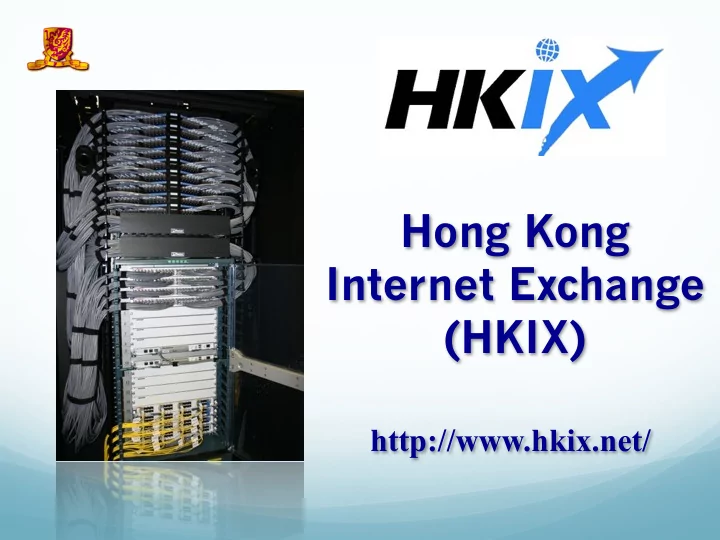
Hong Kong Internet Exchange (HKIX) http://www.hkix.net/ What is - - PowerPoint PPT Presentation
Hong Kong Internet Exchange (HKIX) http://www.hkix.net/ What is HKIX? HKIX is a public Internet Exchange Point (IXP) in Hong Kong HKIX is the main Interconnection point in HK where ISPs in HK can interconnect with one another and
HKIX - AS4635
ISP 4 ISP 5 ISP 6 ISP 1 ISP 2 ISP 3 Internet Internet Internet Internet Internet Internet
HKIX2 HKIX1
2 x 10Gbps links
Kwai Chung Shatin
Routes of ISP A Routes of All ISPs in HKIX Routes of ISP B Routes of ISP C Routes of ISP D Routes of All ISPs in HKIX Routes of All ISPs in HKIX Routes of All ISPs in HKIX
MLPA Route Server
Routes of All ISPs in HKIX Routes from All ISPs
Switched Ethernet
layer 2 without going through MLPA Route Server
same layer 2 infrastructure
ITSC of CUHK
Sep 1991: CUHK set up the 1st Internet link in HK to NASA Ames in US
Jul 1992: The HK Academic & Research Network (HARNET) IP-based Backbone was set up and JUCC/HARNET took over the management of the Internet link
Late 1993: 2 commercial ISPs (HK Supernet and HKIGS) were set up with their own links to US
1994: More ISPs were set up; ITSC of CUHK saw the needs of setting up a local exchange point and started negotiating with individual ISPs
April 1995: ISPs started connecting to CUHK and HKIX was established
2004: Started supporting IPv6 and 10GE for traffic exchange and established a secondary site of HKIX (i.e. HKIX2)
2006: International Network Services Providers and R&E networks were allowed to connect without telecom license
Present: Ranked #15 in the World on Wikipedia according to traffic volume; Ranked #2 in Asia Pacific
An evolution from the free-of-charge model adopted at the very beginning
HKIX provides two GE ports at each HKIX site for each member free of charge as Basic Setup
No formal agreement is needed for Basic Setup
Requesting for 10GE ports or additional GE ports involves formal agreement
If port utilization is lower than 50%, there will be charges
If higher, no charges This is to curb abuse
Co-location service is chargeable
Not for profit
HKIX Ltd (100% owned by CUHK) to sign agreement with participants
Target for self-sustained operations
HKIX
We have members from Mainland China, Taiwan, Korea, Japan, Singapore, Malaysia, Thailand, Indonesia, Philippines, India, Bhutan, Qatar and other Asian countries
We have more non-Hong Kong routes than Hong Kong routes
So, we do help keep intra-Asia traffic within Asia
In terms of network latency, Hong Kong is a good central location in Asia
~50ms to Tokyo
~30ms to Singapore
HKIX is good for intra-Asia traffic
HKIX helps HK be ahead of Singapore in terms of Internet hub in Asia
OGCIO OFTA Hong Kong Police HK Computer Emergency Response Team (HKCERT) Major FTNS operators / ISPs HKIRC
.hk .cn . .com .asia .gov.hk .com.hk .org.hk esdlife.hk cedb.gov.hk
Root:
Top Level Domain (TLD):
itc.gov.hk
Resolving Server (Cache)
Authoritative Server
Due to Earthquake in South of Taiwan (Luzon Strait) on 26 Dec 2006
Most cable systems going through Luzon Strait were cut then
HK was almost isolated from Global Internet
Restoration was done slowly and gradually
Cable repair finally complete in late Jan 2007
Lessons learnt:
Cable route diversity must be observed
Should not rely totally on cables of East routing which all go
through Luzon Strait
Should be prepared to pay more for cables of West/North/South
routing for better reliability
DNS infrastructure in HK had to be improved
.com, .net and .org TLD servers could not be found on HKIX
MLPA route server
HKIX (layer 2 part) could be used for acquiring temporary IP transit services during emergency period
As important as Root Servers
Anycast is getting more and more popular at TLD level
During the disaster, we had Root Servers F & I connected to HKIX so .hk, .mo and .cn are fine
.com/.net/.org were half dead even though IP connectivity among HK, Macau and Mainland China was fine
Although there was anycast servers in HK serving .org and others, they did not have connectivity to HKIX MLPA so could not help the situation!
We spend effort to encourage set-up of DNS server instances of major TLDs in Hong Kong with connection to HKIX MLPA (plus BLPA
neighboring economies
The authoritative servers of the following TLDs are connecting to HKIX directly:
.com, .net, .org, .asia, .info, .hk, .mo, .*.tw, .sg, .my and many
n IPv4 address space is really running out n APNIC region first n http://www.apnic.net/__data/assets/pdf_file/0018/33246/Key-
Turning-Point-in-Asia-Pacific-IPv4-Exhaustion_English.pdf
n CUHK/HKIX is committed to help Internet development in HK n IPv6 supported by HKIX since Mar 2004 n HKIX participates in initiatives to push for IPv6 development in HK
together with ISOC-HK, IPv6 Forum HK Chapter and DotAsia
n Today, >60% of HKIX participants have IPv6 enabled n Expect more will do so as IPv6 deployment becomes more and
more urgent
continuously
serve >170 participants
participants
model
core equipment from time to time
equipment is high-end high-speed equipment and high availability is important
Capital Expenses needed which are growing continuously
Establish Dual Core within CUHK in 2013 taking advantage of
new data center
HKIX1 + HKIX1b Provide site resilience, chassis resilience in addition to card
resilience
Support 40G/100G connections Government to provide one-off funding for capital expenses of
network equipment at HKIX1b
In order to ensure self-sustained operations, will gradually
change to simple port charge model starting 2013
Possible Long-Term Plan HKIX2, HKIX3, HKIX4, HKIX5 and so on at major commercial data
centers as satellite sites for ease of connections