
SLIDE 1
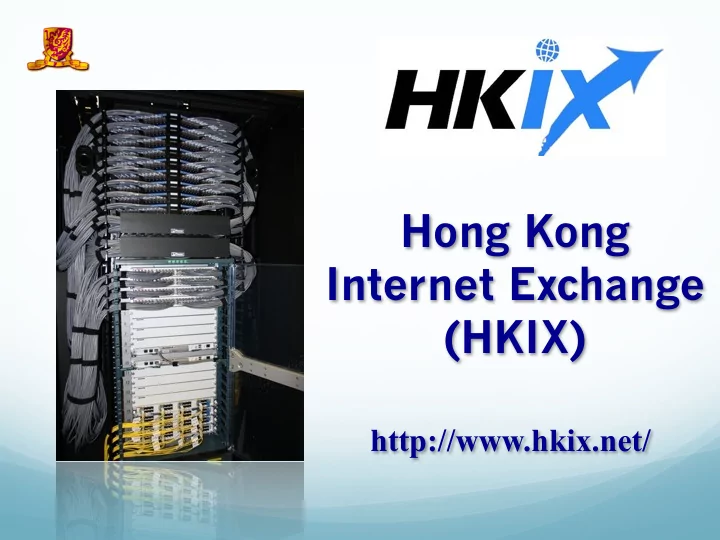
Hong Kong Internet Exchange (HKIX) http://www.hkix.net/ What is - - PowerPoint PPT Presentation
Hong Kong Internet Exchange (HKIX) http://www.hkix.net/ What is HKIX? HKIX is a Public Internet Exchange Point (IXP) in Hong Kong it is not a Transit Provider HKIX is the major domestic Interconnection point in HK where ISPs in HK
HKIX is a Public Internet Exchange Point (IXP) in Hong Kong
– it is not a Transit Provider
HKIX is the major domestic Interconnection point in HK
where ISPs in HK can interconnect with one another and exchange inter-ISP traffic
HKIX is a Settlement-Free Layer2 Internet Exchange Point,
with mandatory Multi-Lateral Peering Agreement (MLPA) for Hong Kong routes
HKIX supports and encourages Bi-Lateral Peering
Agreement (BLPA)
HKIX was a project initiated and funded by ITSC of CUHK in
Apr 1995 as a community service
Still supported and operated by ITSC of CUHK
HKIX - AS4635
ISP 4 ISP 5 ISP 6 ISP 1 ISP 2 ISP 3 Internet Internet Internet Internet Internet Internet
HKIX2 HKIX1
2 x 10Gbps links
HK Island Shatin
Routes of ISP A Routes of All ISPs in HKIX Routes of ISP B Routes of ISP C Routes of ISP D Routes of All ISPs in HKIX Routes of All ISPs in HKIX Routes of All ISPs in HKIX
MLPA Router Server
Routes of All ISPs in HKIX Routes from All ISPs
Switched Ethernet
layer 2 without going through MLPA Route Server
same layer 2 infrastructure
ITSC of CUHK
Sep 91: CUHK set up the 1st Internet link in HK to NASA Ames in US
Jul 92: The HK Academic & Research Network (HARNET) IP-based Backbone was set up and JUCC/HARNET took over the management of the Internet link
Late 93: 2 commercial ISPs (HK Supernet and HKIGS) were set up with their own links to US
94: More ISPs were set up; ITSC of CUHK saw the needs of setting up a local exchange point and started negotiating with individual ISPs
April 95: ISPs started connecting to CUHK and HKIX was established
Early 04: Started supporting IPv6 and 10GE for traffic exchange and established a secondary site of HKIX (i.e. HKIX2)
Early 06: International Network Services Providers and R&E networks were allowed to connect without telecom license
Present: 133 AS’es connecting to HKIX; Ranked #14 in the World on Wikipedia according to traffic volume
HKIX provides 2 GE ports at each HKIX site for each member
free of charge as Basic Setup
No formal agreement is needed for Basic Setup Requesting for 10GE ports or additional GE ports involves
formal agreement
If port utilization is lower than 50%, there will be charges If higher, no charges This is to curb abuse Co-location service is chargeable now Not really for profit Target for self-sustained
HKIX
HKIX
We have members from Mainland China, Taiwan, Korea, Japan, Singapore, Malaysia, Thailand, Indonesia, Philippines, Bhutan, Qatar and other Asian countries
Ten members are announcing more than 1,000 routes to MLPA so we have more non-Hong Kong routes than Hong Kong routes
BLPA over HKIX facilitates even more non-Hong Kong routes
So, we do help keep intra-Asia traffic within Asia
In terms of network latency, Hong Kong is a good central location in Asia
~50ms to Tokyo
~30ms to Singapore
HKIX is good for intra-Asia traffic
Due to Earthquake in South of Taiwan (Luzon Strait) on 26 Dec 2006
Most cable systems going through Luzon Strait were cut then
HK was almost isolated from Global Internet
Restoration was done slowly and gradually
Cable repair finally complete in late Jan 2007
Lessons learnt:
Cable route diversity must be observed
Should not rely totally on cables of East routing which all go
through Luzon Strait
Should be prepared to pay more for cables of West/North/South
routing for better reliability
DNS infrastructure in HK must be improved
.com, .net and .org TLD servers could not be found on HKIX
MLPA route server
HKIX (layer 2 part) could be used for acquiring temporary IP transit services during emergency period
As important as Root Servers
Anycast is getting more and more popular at TLD level
During the disaster, we had Root Servers F & I connected to HKIX so .hk, .mo and .cn are fine
.com/.net/.org were half dead even though IP connectivity among HK, Macau and Mainland China was fine
Although there was anycast servers in HK serving .org and others, they did not have connectivity to HKIX MLPA so could not help the situation!
We spend effort to encourage set-up of DNS server instances of major TLDs in Hong Kong with connection to HKIX MLPA (plus BLPA
neighboring economies
The authoritative servers of the following TLDs are connecting to HKIX directly:
.com, .net, .org, .asia, .info, .hk, .mo, .*.tw, .sg, .my and many
CUHK/HKIX is committed to help Internet development in HK IPv6 supported by HKIX since Mar 2004
Dual stack
Today, 48 AS’es have been assigned addresses at HKIX and have
joined MLPA
BLPA encouraged
Root server instance F supports IPv6 transport at HKIX Dual stack so cannot know for sure how much IPv6 traffic in total
Should be lower than 1% of the total traffic
With the new switch installed, we should be able to have more detailed statistics later
OGCIO OFTA Hong Kong Police HK Computer Emergency Response Team (HKCERT) Major FTNS operators / ISPs HKDNR
HKIX-R&E in Mega-i with 2 x GE links back to HKIX1 but it is for R&E network connections only
1 x Cisco Nexus 7018 + 2 x Cisco Catalyst 6513 at HKIX1 and 1 x Cisco Catalyst 6513 at HKIX2 plus 1 x Cisco 7603 at HKIX-R&E
Most connected to HKIX switches without co-located routers
possible
Ethernet over MPLS or Ethernet over SDH
Officially allow overseas ISPs to connect
23
133 AS’es connected with IPv4 and 48 AS’es with IPv6
26 10GE connections and 211 E/FE/GE connections
>31,000 IPv4 routes and >2,400 IPv6 routes carried by HKIX MLPA
Peak 5-min traffic >130Gbps
HKIX1 supports and encourages Link Aggregation (LACP)
24
Basic Set-up:
ports at HKIX2: Free of charge and no formal agreement
Advanced Set-up:
Formal agreement is needed and there will be colo charge and a small port charge unless aggregate traffic volume of all ports exceeds 50% (95th percentile)
See http://www.hkix.net/hkix/connectguide.htm for details
25
To sustain growth, HKIX needed a brand new high-end switch at the core (HKIX1)
Cisco Nexus 7018 selected after extensive pre-tender POC tests and complicated tendering
In production since 15 June 2009
Migration of connections from 6513 to 7018 still in progress
Have ordered another 7018 chassis for resilience
26
27
Non-standard equipment rack needed:
Chassis failure: fast replacement
Port Security problem
Security
SFP+ contact problem: unplug->plug to solve
ISSU seems working fine
First IX customer so had good support from Cisco
28
7018 in production since 15 Jun 2009 Large participants’ migration to new switch is a
6513 as central hub -> 7018 as central hub Inter-switch links 2x10GE -> 4x10GE
Xenpak changed to SFP+
Concerns on migration by individual participants
29
Mandatory for Hong Kong routes only
Our MLPA route servers do not have full routes
We do monitor the BGP sessions closely
ASN of Router Server: AS4635
IPv4 route filters implemented strictly
number of prefixes and bogus routes filter
IPv6 route filter not implemented in order to allow easier interconnections
But have max number of prefixes and bogus routes filter
Accept /64 or shorter prefixes
30
HKIX does support and encourage BLPA as HKIX is basically a layer-2 IXP
With BLPA, your can have better routes and connectivity
Do not blindly prefer routes learnt from HKIX’s MLPA by using higher LocalPref
Set up a record of your AS on www.peeringdb.com and tell everyone that you are on HKIX and willing to do BLPA
Most content providers are willing to do bilateral peering
Do set up bilateral peering with root / TLD DNS servers on HKIX to enjoy faster DNS queries
31
Port Security implemented strictly
One MAC address / one IPv4 address / one IPv6 address per port (or LACP port channel)
UFB (Unicast Flood Blocking) feature is important
Some participants are unaware of this and do change of router / interface without notifying us
32
Having many connections to HKIX increases difficulties of traffic engineering
May not be able to support many connections if you only have a few routers
HKIX
LACP is a solution to solve these issues when your traffic grows
Now, 7018 at HKIX1 can support LACP
However, please do check whether your circuit providers can provide clear channel Ethernet circuits to HKIX1 with enough transparency before you place orders
Please also check whether your routers can support LACP
33
Must disable Proxy ARP
HKIX cannot help blackhole traffic because HKIX is basically a layer-2 infrastructure
If there is scheduled maintenance, please notify hkix- noc@cuhk.edu.hk in advance so that we will not treat your BGP down message as failure
Do monitor the growth of number of routes from our route server and adjust your max prefix settings accordingly
Do monitor the utilization of your links closely and do upgrade before they are full
When your link / BGP session is down, do also check with your circuit providers at the same time
Do your own route / route6 / as-set objects on IRRDB and keep them up-to-date
34
HKIX1 broadcast domain / VLAN has been extended to HKIX2
involve change of IP addresses
All IPv4 connections to migrate to 202.40.160/23 from 202.40.161/24 (and 218.100.16/24):
All IPv6 connections to migrate to 2001:7FA:0:1::/64 from 2001:7FA:0:1::CA28:A100/120 (and 2001:7FA: 0:1::DA64:1000/120):
Change of network mask only
Support MLPA route server redundancy:
(rs2.hkix.net)
Support 4-byte ASN
35
To have one single HKIX broadcast domain
To have better resilience To sustain future growth To reduce confusion
36
MLPA: Support daily automatic route filter updates from routing registry database (IRRDB)
MLPA: Support more BGP community for easier traffic engineering
Portal for Participants
Improve after-hour support
Suggestions are welcome
37
Workshop: ¡15 ¡– ¡19 ¡Feb, ¡2011 ¡(@Cyberport) Hong ¡Kong ¡Conven9on ¡and ¡Exhibi9on ¡Centre