
SLIDE 1
Revisiting the Standard Joint Hierarchy:
Improving Realistic Modeling of Articulated Characters
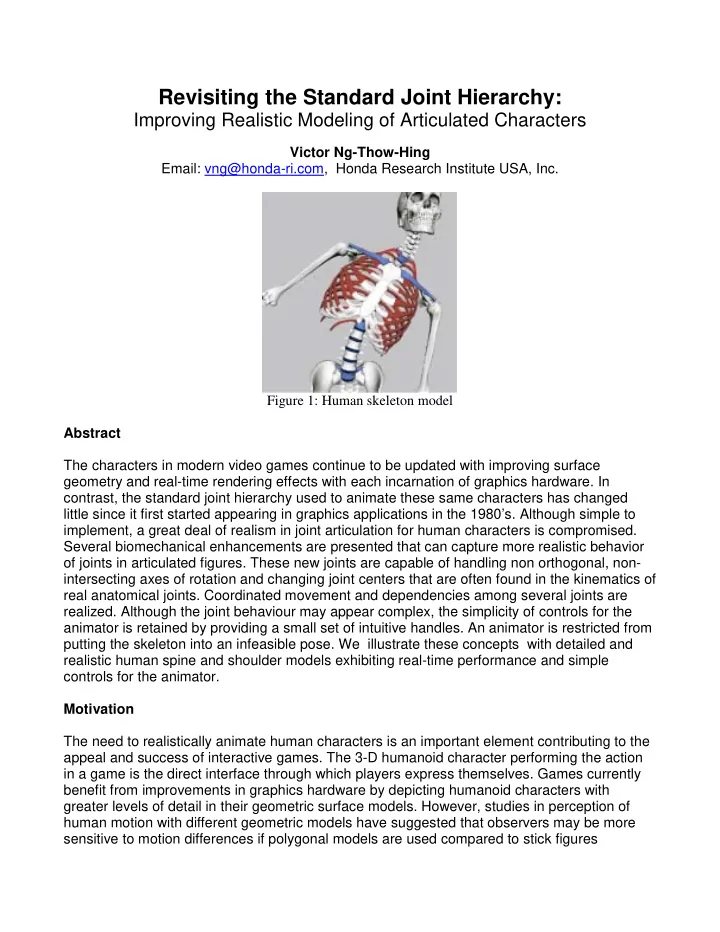
Victor Ng-Thow-Hing Email: vng@honda-ri.com, Honda Research Institute USA, Inc. Figure 1: Human skeleton model Abstract The characters in modern video games continue to be updated with improving surface geometry and real-time rendering effects with each incarnation of graphics hardware. In contrast, the standard joint hierarchy used to animate these same characters has changed little since it first started appearing in graphics applications in the 1980’s. Although simple to implement, a great deal of realism in joint articulation for human characters is compromised. Several biomechanical enhancements are presented that can capture more realistic behavior
- f joints in articulated figures. These new joints are capable of handling non orthogonal, non-
intersecting axes of rotation and changing joint centers that are often found in the kinematics of real anatomical joints. Coordinated movement and dependencies among several joints are
- realized. Although the joint behaviour may appear complex, the simplicity of controls for the