HIV Clinical Update: Treatment in 2017 and Beyond Shobha - - PDF document

hiv clinical update treatment in 2017 and beyond
SMART_READER_LITE
LIVE PREVIEW

HIV Clinical Update: Treatment in 2017 and Beyond Shobha - - PDF document

5/25/17 HIV Clinical Update: Treatment in 2017 and Beyond Shobha Swaminathan, MD Associate Professor of Medicine Rutgers New Jersey Medical School Overview Whats new in the guidelines Starting antiretroviral therapy Switching


slide-1
SLIDE 1

7 2017 HIV Clinical Update

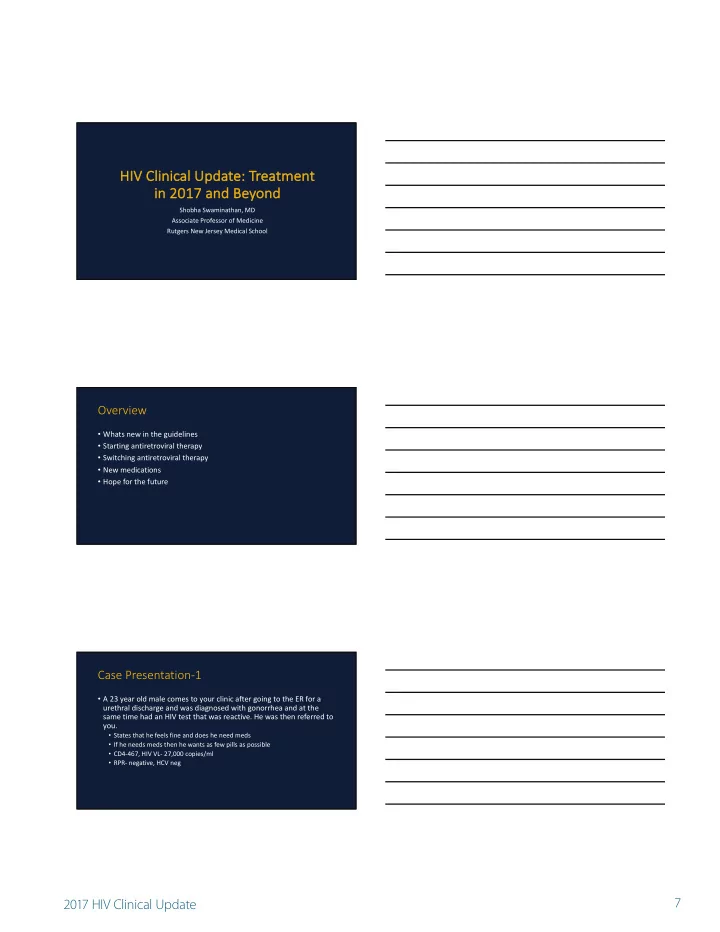
5/25/17 1 HIV Clinical Update: Treatment in 2017 and Beyond

Shobha Swaminathan, MD Associate Professor of Medicine Rutgers New Jersey Medical School

Overview

  • Whats new in the guidelines
  • Starting antiretroviral therapy
  • Switching antiretroviral therapy
  • New medications
  • Hope for the future

Case Presentation-1

  • A 23 year old male comes to your clinic after going to the ER for a

urethral discharge and was diagnosed with gonorrhea and at the same time had an HIV test that was reactive. He was then referred to you.

  • States that he feels fine and does he need meds
  • If he needs meds then he wants as few pills as possible
  • CD4-467, HIV VL- 27,000 copies/ml
  • RPR- negative, HCV neg
slide-2
SLIDE 2

8 2017 HIV Clinical Update

5/25/17 2

DHHS Guidelines for Initial HIV Treatment (Preferred)

  • Integrase Strand Transfer Inhibitor-Based (INSTI) Regimens:
  • Dolutegravir (DTG)/abacavir (ABC)/lamivudine (3TC)—only for patients who are

HLA-B*5701 negative

  • DTG plus either tenofovir disoproxil fumarate (TDF)/emtricitabine(FTC) or

tenofovir alafenamide (TAF)/FTC

  • Elvitegravir (EVG)/cobicistat (c) /TAF/FTC
  • EVG/c/TDF/FTC
  • Raltegravir (RAL) plus either TDF/FTC or TAF/FTC
  • Protease Inhibitor-Based Regimens:
  • Darunavir(DRV)/ritonavir (r) plus either TDF/FTC or TAF/FTC

DHHS Guidelines, updated July 2016

DHHS Guidelines for Initial HIV Treatment (Alternate)

  • NNRTI plus 2 NRTIs:
  • EFV/TDF/FTC
  • EFV plus TAF/FTC
  • RPV/TDF/FTCor RPV/TAF/FTC—if HIV RNA <100,000 copies/mL and CD4 >200

cells/mm3

  • Boosted PI plus 2 NRTIs:
  • ATV/c or ATV/r plus either TDF/FTCor TAF/FTC
  • DRV/c or DRV/r plus ABC/3TC—if HLA-B*5701 negative
  • DRV/c plus either TDF/FTC or TAF/FTC

DHHS Guidelines, updated July 2016

Case Presentation-1

  • A 23 year old male comes to your clinic after going to the ER for a

urethral discharge and was diagnosed with gonorrhea and at the same time had an HIV test that was reactive. He was then referred to you.

  • States that he feels fine and does he need meds
  • If he needs meds then he wants as few pills as possible
  • CD4-467, HIV VL- 27,000 copies/ml
  • RPR- negative, HCV neg
slide-3
SLIDE 3

9 2017 HIV Clinical Update

5/25/17 3

What would you recommend for him

  • 1. EFV/TDF/FTC
  • 2. RPV/TDF/FTC
  • 3. TDF/FTC/RAL
  • 4. TDF/FTC/DRV/r
  • 5. EVG/c/TDF/FTC

Case Presentation-2

  • A 32 year old woman diagnosed with HIV in 2011
  • Baseline CD4- 145 cells/cu mm, HIV VL 250,000 copies/ml
  • HIV genotype- wild type
  • HLA B 5701 negative
  • Has been on EFV/TDF/FTC
  • Usually well controlled, has rare blips
  • Current CD4- 564 cells/cu mm, HIV VL < 50 copies/ml
  • Feels grateful to her current regimen for saving her life

Would you advise her to change her regimen

  • Yes
  • No
slide-4
SLIDE 4

10 2017 HIV Clinical Update

5/25/17 4

What would you switch to

  • 1. EFV/TDF/FTC
  • 2. RPV/TDF/FTC
  • 3. TDF/FTC/RAL
  • 4. TDF/FTC/DRV/r
  • 5. EVG/c/TDF/FTC

Switching From Suppressive ART: Study Results

  • 1. Nelson M, et al. ICAAC 2013. Abstract H-672b.
  • 2. Pozniak A, et al. Lancet Infect Dis. 2014;14:590-599.

Slide credit: clinicaloptions.com

Trial Switch From Switch To Findings UK Multicenter Study[1] EFV/TDF/ FTC RPV/TDF/ FTC

  • Pts switched due to CNS toxicity (N = 40)
  • 100% maintained virologic suppression following switch
  • Grade 2-4 CNS AEs significantly decreased at Wks 4, 12, including

dizziness, depression, insomnia, aggressive mood, abnormal dreams STRATEG Y-NNRTI[2] NNRTI + TDF/FTC EVG/COBI/T DF/FTC

  • Phase IIIb randomized study; pts switched (n = 291) or remained on
  • riginal regimen (n = 143)
  • Switch to EVG/COBI/TDF/FTC noninferior to remaining on stable NNRTIs

at Wk 48 (93% vs 88% HIV-1 RNA < 50 c/mL)

  • Dizziness, insomnia, anxiety, vivid dreams significantly decreased from BL

at Wk 48 in switch group; no changes noted for pts who remained on EFV + TDF/FTC

  • Switching From Suppressive ART: Study Results
  • 1. Lake JE, et al. IAC 2016. Abstract THAB0203.
  • 2. Mills A, et al. Lancet Infect Dis. 2016;16:43-52.

Slide credit: clinicaloptions.com

Trial Switch From Switch To Findings STRIIVING[1

]

2 NRTIs + NNRTI, PI, or INSTI DTG/ABC/3T C

  • Phase IIIb randomized study; pts switched

(n = 275) or remained on original regimen (n = 278)

  • Switch to DTG/ABC/3TC noninferior to maintaining baseline ART (Wk 24

HIV-1 RNA < 50 c/mL 85% vs 88%, respectively)

  • For pts initially switched to DTG/ABC/3TC, 83% maintained suppression

through Wk 48 GS-109[2] TDF-based regimen EVG/COBI/T AF/FTC

  • Pts randomized to switch regimen (n = 959) or remaining on previous

regimen (n = 477)

  • Switch to TAF regimen noninferior to maintaining TDF-based ART (97%

vs 93% HIV-1 RNA < 50 c/mL; P = .0002)

  • Prior EFV/TDF/FTC, HIV-1 RNA < 50 c/mL 96% with switch vs 90% with

remaining on EFV/TDF/FTC

slide-5
SLIDE 5

11 2017 HIV Clinical Update

5/25/17 5

Drugs That Should Not Be Used With Antiretroviral Agents

ARV Drugs That Should Not Be Used Concomitantly DTG[1] Dofetilide, rifapentine, St John’s wort EFV[1] St John’s wort, dasabuvir, ombitasvir, paritaprevir, simeprevir, elbasvir/grazoprevir EVG/COBI[1] Ranolazine, eplerenone, ivabradine, lovastatin, simvastatin, rifampin, rifapentine, carbamazepine, phenobarbital, phenytoin, lurasidone, pimozide, midazolam, triazolam, St John’s wort, dasabuvir, elbasvir/grazoprevir, ledipasvir, ombitasvir, paritaprevir, simeprevir, alfuzosin, cisapride, ergot derivatives, flibanserin, salmeterol, sildenafil for PAH RPV[1] Rifampin, rifapentine, carbamazepine, oxcarbazepine, phenobarbital, phenytoin, St John’s wort, dasabuvir,

  • mbitasvir, paritaprevir, PPIs (eg, omeprazole)

TDF/FTC[2] Nephrotoxic drugs

  • 1. DHHS guidelines. July 2016.
  • 2. TAF/FTC [package insert]. 2016.
  • 3. TDF/FTC [package insert]. 2016.

Slide credit: clinicaloptions.com

  • If the pt wished to become pregnant via sperm donation, what

regimen would you recommend?

  • A. RAL + TAF/FTC
  • B. EVG/COBI/TDF/FTC
  • C. EVG/COBI/TAF/FTC
  • D. RPV/TDF/FTC or RPV/TAF/FTC
  • E. DRV + RTV + TDF/FTC
  • F. Maintain current regimen

DHHS Recommendations: ART in Pregnant Women

DHHS Guidelines[1] PIs NNRTIs NRTIs Entry Inhibitors Integrase Inhibitors Recommended Atazanavir/RTV* Darunavir/RTV* Efavirenz*† ABC/3TC TDF/FTC TDF + 3TC ZDV/3TC Raltegravir* Alternative Lopinavir/RTV* Rilpivirine* Insufficient data to recommend Fosamprenavir RPV/TAF/ FTC[2] TAF/FTC[3] Maraviroc Dolutegravir EVG/COBI/TDF/ FTC EVG/COBI/TAF/FTC[2] Not recommended Indinavir/RTV Nelfinavir Ritonavir Saquinavir/RTV Tipranavir/RTV Etravirine Nevirapine ABC/3TC/ZDV d4T ddI Enfuvirtide

  • 1. DHHS Perinatal Guidelines. August 2015. 2. EVG/COBI/TAF/FTC

[package insert]. 2015. 3. RPV/TAF/FTC [package insert]. 2016.

  • 4. TAF/FTC [package insert]. 2016.

*In addition to 2-NRTI backbone. †May be initiated after first 8 wks of pregnancy. Slide credit: clinicaloptions.com

slide-6
SLIDE 6

12 2017 HIV Clinical Update

5/25/17 6

HIV Coinfection

  • TAF/FTC OR TDF/FTC recommended for patients with HIV/HBV
  • HCV infection
  • All patients should be treated
  • Use Direct acting agents
  • Monitor for DDI

AASLD Guidance on HCV/HIV DDIs

SMV SOF LDV VEL DCV PrOD Grazo/ElbXa s Atazanavir/r C Ö » » » Ö X Darunavir/r C Ö » » Ö » X Lopinavir/r C Ö » » Ö C X Tipranavir/r C C C No data C C No data Efavirenz C Ö Ö X » C X Rilpivirine Ö Ö Ö Ö Ö C Ö Etravirine » Ö No data No data » No data No data Raltegravir Ö Ö Ö Ö Ö Ö Ö Elvitegravir/c C » » » » No data X Dolutegravir Ö Ö Ö Ö Ö Ö Ö Maraviroc Ö Ö Ö Ö Ö » No data TDF Ö Ö » » Ö Ö Ö TAF Ö Ö Ö Ö Ö Ö Ö

AASLD/IDSA. HCV guidelines. July 2016. No clinically significant interaction expected Potential interaction may require dose adjustment , timing, or monitoring Do not coadminister

DHHS Guidelines, updated July 2016

Why Do We Need New Options for Pts With HIV

  • Short-term and long-term safety
  • Tolerability
  • Convenience
  • Cost
  • Activity against panresistant virus
  • Still no available cure
slide-7
SLIDE 7

13 2017 HIV Clinical Update

5/25/17 7

Long Acting ART

  • Can we move away from daily oral therapy for HIV?
  • Are emerging long-acting therapies as effective as oral therapies?
  • What about toxicity?
  • Is self-administration feasible? Is it desirable?
  • What pts might be ideal candidates for long-acting therapy?
  • How can resistance be prevented if pts miss doses?
  • Can these agents be used as PrEP?

LATTE-2: Cabotegravir IM + Rilpivirine IM for Long- Acting Maintenance ART

  • Multicenter, open-label, randomized phase IIb study
  • Cabotegravir: INSTI formulated as oral tablet and for long-acting IM injection

Margolis DA, et al. IAC 2016. Abstract THAB0206LB. ClinicalTrials.gov. NCT02120352.

CAB 400 mg + RPV 600 mg IM Q4W† (n = 115) CAB 600 mg + RPV 900 mg IM Q8W‡ (n = 115)

*Pts with HIV-1 RNA < 50 copies/mL from Wks 16-20 continued to maintenance phase. †CAB loading dose at Day 1. ‡CAB loading doses at Day 1 and Wk 4.

ART-naive HIV- infected pts > 18 yrs of age with CD4+ cell count > 200 cells/mm3 (N = 309) CAB 30 mg + ABC/3TC 600/300 mg PO QD (n = 56) CAB 30 mg + ABC/3TC 600/ 300 mg PO QD

Wk 32 Wk 20

Induction Phase* Maintenance Phase

Day 1 Wk 96 Wk 16: RPV 25 mg PO QD added Wk 48 Slide credit: clinicaloptions.com

§ Injections were 2-3 mL, IM (gluteal region), provider administered

  • Virologic

Success*

LATTE-2: Efficacy and Safety Through Maintenance Wk 48

§ Virologic efficacy of Q4W/Q8W IM therapy similar to PO therapy[1] – Phase III maintenance trials (ATLAS and FLAIR) moving forward with Q4W dose[2,3] § 99% of ISRs for pts receiving injectable therapy grade 1 (82%) or 2 (17%); none grade 4 – Most frequent ISRs: pain (67%), nodules (7%), swelling (6%) – 2/230 pts (< 1%) withdrew for ISRs (both in Q8W arm) § AEs leading to withdrawal – Pooled Q4W/Q8W IM arms, 4% – PO arm, 2%

References in slidenotes.

92 91 89 7 < 1 2 < 1 8 9 Virologic Non- response No Virologic Data Pts (%) 100 80 60 40 20

IM CAB + RPV Q4W (n = 115) IM CAB + RPV Q8W (n = 115) PO CAB + ABC/3TC (n = 56) n/N = 105/ 115 106/ 115 50/ 56 *HIV-1 RNA < 50 copies/mL. Slide credit: clinicaloptions.com

slide-8
SLIDE 8

14 2017 HIV Clinical Update

5/25/17 8

LATTE-2: Wk 48 Pt Satisfaction With IM and PO Regimens

§ Pt satisfaction assessed using 0-6 scoring (0 = very dissatisfied, 6 = very satisfied)

Margolis DA, et al. IAC 2016. Abstract THAB0206LB.

Wk 48 Pt-Reported Outcomes, % IM CAB + RPV Q4W (n = 103) IM CAB + RPV Q8W (n = 109) PO CAB + ABC/3TC (n = 49) How satisfied are you with your current treatment? § 6 (very satisfied) 79 83 67 § 5 20 14 29 § < 5 1 3 4 How satisfied would you be to continue with your present form of treatment? § 6 (very satisfied) 85 88 55 § 5 13 11 33 § < 5 2 1 12

Slide credit: clinicaloptions.com

  • Additional Longer-Acting Investigational Agents

(Phase II/III)

Agent MoA Phase Implications 3BNC117[1,2] Anti-CD4 receptor mAb II § Studies ongoing in treatment- experienced and naive pts TMC278 LA[3] LA injectable RPV (IM) II § Potential as long-acting injectable (Q8W) UB-421[4] Anti-CD4 receptor mAb II § Studied as possible ART alternative for maintenance therapy in suppressed pts VRC01[5,6] Anti-CD4 receptor mAb II § Phase II PrEP and treatment trials

  • ngoing
  • 1. Caskey M, et al. Nature. 2015;522:487-491. 2. ClinicalTrials.gov. NCT03041012. 3. Bekker L-G, et al.

CROI 2017. Abstract 421LB. 4. Wang C-Y, et al. CROI 2017. Abstract 450LB. 5. ClinicalTrials.gov.

  • NCT02716675. 6. ClinicalTrials.gov. NCT02568215.

Slide credit: clinicaloptions.com

Role of Long Acting Agents

§ Maintenance therapy § First line therapy for patients with adherence issues § Prevention § Something else

slide-9
SLIDE 9

15 2017 HIV Clinical Update

5/25/17 9

Emerging Investigational Agents

Bictegravir + FTC/TAF vs DTG + FTC/TAF for Treatment-Naive Pts

§ Randomized, double-blind, active-controlled phase II trial – Bictegravir: novel QD unboosted INSTI, active against most INSTI RAVs, low DDI potential § At baseline, 15% to 21% HIV-1 RNA > 100,000 copies/mL, 5% to 9% CD4+ cell count ≤ 200 cells/mm3

Sax PE, et al. CROI 2017. Abstract 41. Sax PE, et al. Lancet HIV. 2017;[Epub ahead of print].

Open-label extension Wk 48 BIC + FTC/TAF QD + Placebo for DTG QD (n = 65) DTG + FTC/TAF QD + Placebo for BIC QD (n = 33) Wk 24 Primary Endpoint ART-naive pts with HIV-1 RNA ≥ 1000 copies/mL; CD4+ ≥ 200 cells/mm3; HBV and HCV negative (N = 98)

Slide credit: clinicaloptions.com

  • Bictegravir + FTC/TAF vs DTG + FTC/TAF: Key

Results

§ No drug resistance among pts with virologic failure in either arm through Wk 48

Sax PE, et al. CROI 2017. Abstract 41. Sax PE, et al. Lancet HIV. 2017;[Epub ahead of print].

AE at Wk 48, % (n/N) BIC + FTC/TAF DTG + FTC/TAF TR-SAE Diarrhea, any grade* 12 (8/65) 12 (4/33) Nausea, any grade* 8 (5/65) 12 (4/33) Creatine kinase, grade 2-4* 13 (8/64) 9 (3/32) Hyperglycemia, grade 2-4* 8 (5/64) 13 (4/32)

*HIV-1 RNA < 50 copies/mL. Slide credit: clinicaloptions.com

Virologic Failure Wk 48 Efficacy Virologic Success* No Data 100 80 60 40 20 97 91 2 6 2 3

Treatment difference: 6.4% (95% CI: -6.0% to 18.8%)

DTG + FTC/TAF (n = 33)

Pts (%)

BIC + FTC/TAF (n = 65)

*Showing AEs occuring in > 10% in either treatment arm.

§ 1 pt discontinued at Wk 24 in BIC arm for urticaria (past history of urticaria)

slide-10
SLIDE 10

16 2017 HIV Clinical Update

5/25/17 10

Patient Isolates with INSTI Resistance Mutations: Resistance Profile of BIC and Other INSTIs

Phenotypic Analysis of Clinical Isolates

  • 1. White K, et al., European Workshop HIV & Hep 2016. Rome, Italy. Poster O-01. 2. Tsiang M, et al., AAC 2016;60:7086-7097.
92% 89% 4% 2% 4% 6% 2% 10 20 30 40 50 60 70 80 90 100 EVG RAL % of Isolates by FC Categories 17% 17% 17% 49% DTG 2% 13% 15% 70% BIC

BIC has a statistically improved resistance profile compared to RAL, EVG, and DTG

Mean fold changes: BIC 2.8 (ref) ; DTG 5.8, p=0.042; RAL >100, p<0.001; EVG >106, p<0.001 Each of 47 patient-derived clinical isolates (from Monogram Biosciences) had ≥ 1 primary and/or other INSTI mutations with phenotypic resistance to INSTIs and comprised all available INSTI resistant variants in the Monogram library). EC50, effective concentration of half maximal response. 24 isolates with >2.5-fold reduced susceptibility to DTG

Stratification of 47 HIV-1 Clinical Isolates Based on Fold Change in Resistance

< 2.5 ≥ 10 2.5 to < 5 5 to < 10 EC50 Fold Change (FC) vs Reference Wild Type

Bictegravir: Additional Ongoing Randomized Phase III Trials

§ All assessing coformulated bictegravir/FTC/TAF

  • 1. ClinicalTrials.gov. NCT02607956. 2. ClinicalTrials.gov. NCT02607930.
  • 3. ClinicalTrials.gov. NCT02603120. 4. ClinicalTrials.gov. NCT02603107.
  • 5. ClinicalTrials.gov. NCT02652624.

Treatment Setting Regimen Naive Bictegravir/FTC/TAF vs DTG + FTC/TAF[1] Bictegravir/FTC/TAF vs DTG/ABC/3TC[2] Switch Bictegravir/FTC/TAF from DTG/ABC/3TC[3] Bictegravir/FTC/TAF from boosted ATV or DRV + FTC/TDF or ABC/3TC[4] Bictegravir/FTC/TAF from EVG/COBI/FTC/TAF, EVG/COBI/FTC/TDF,

  • r ATV + RTV + FTC/TDF (all women)[5]

Slide credit: clinicaloptions.com

DRIVE-FORWARD: Doravirine or DRV + RTV Plus 2 NRTIs for Treatment-Naive Pts

§ Randomized, multicenter, double-blind phase III trial

– Doravirine: NNRTI with unique resistance profile, low DDI potential

Molina JM, et al. CROI 2017. Abstract 45LB.

14-day follow-up DOR 100 mg QD + FTC/TDF or ABC/3TC QD + Placebo for DRV + RTV (n = 385) DRV 800 mg + RTV 100 mg QD + FTC/TDF or ABC/3TC QD + Placebo for DOR (n = 384) ART-naive pts with HIV-1 RNA ≥ 1000 copies/mL within 45 days of Day 1; no resistance to study drugs (N = 769) Wk 48 Primary Endpoint Wk 96

Slide credit: clinicaloptions.com

slide-11
SLIDE 11

17 2017 HIV Clinical Update

5/25/17 12

TMB-301: Key Results

§ 9 pts reported 17 serious AEs – 1 drug-related serious AE (IRIS) resulted in discontinuation § 8 other pts discontinued – Death (n = 4; liver failure, Kaposi sarcoma; end-stage AIDS, lymphoma) – Consent withdrawal (n = 3) – Lost to follow-up (n = 2) § Additional phase III study ongoing[3]

  • 1. Lalezari J, et al. IDWeek 2016. Abstract LB-6. 2. Lewis S, et al. CROI 2017. Abstract 449LB.
  • 3. ClinicalTrials.gov. NCT02707861.

Virologic Outcome Ibalizumab (N = 40) Day 14[1] § ≥ 0.5 log10 HIV-1 RNA decrease, % 83* § ≥ 1.0 log10 HIV-1 RNA decrease, % 60 § Mean log10 HIV-1 RNA decrease 1.1 Wk 24[2] § ≥ 1.0 log10 HIV-1 RNA decrease, % 55 § ≥ 2.0 log10 HIV-1 RNA decrease, % 48 § HIV-1 RNA < 50 copies/mL, % 43 § HIV-1 RNA < 200 copies/mL, % 50 § Mean HIV-1 RNA decrease from baseline, log10 1.6

*P < .0001 vs 3% at end of control period. Slide credit: clinicaloptions.com

Fostemsavir vs ATV/RTV Both With RAL + TDF for Treatment-Experienced Pts

§ Fostemsavir: attachment inhibitor; binds to HIV-1 gp120 § AI438-011: randomized, active-controlled, partially blinded, dose-ranging phase IIb study of fostemsavir vs ATV/RTV, each with RAL + TDF, for treatment-experienced pts with HIV-1 RNA ≥ 1000 copies/mL and susceptibility to study agents (N = 254)[1,2] § Key results: – 90% of pts had HIV-1 RNA < 50 copies/mL at Wk 96 in fostemsavir and ATV/RTV arms in observed analysis – Compared with pts in fostemsavir arm, pts in ATV/RTV arm had higher rates of treatment-related grade 2-4 AEs (37% vs 9%) and d/c for AEs (10% vs 3%) at Wk 96 § Phase III trial in heavily treatment–experienced pts ongoing[3]

  • 1. Granados-Reyes ER, et al. HIV Glasgow 2016. Abstract O335A.
  • 2. Llamoso C, et al. HIV Glasgow 2016. Abstract O335B.
  • 3. ClinicalTrials.gov. NCT02362503.

Slide credit: clinicaloptions.com Wk 49 Placebo Pts with HIV-1 RNA ≥ 400 copies/mL

  • n current regimen; ≤ 2 classes of active

approved ARVs left to compose OBR due to resistance, intolerance, or contraindications Fostemsavir + OBR Day 8* Fostemsavir Fostemsavir + OBR Fostemsavir As above but with no active approved ARV options remaining

Additional Emerging Investigational Agents and Formulations (Phase II/III)

Agent MoA Phase Implications RAL QD[1] INSTI III § Potential for RAL QD dosing (2 600-mg tablets) PRO140[2-4] Humanized IgG4 CCR5 mAb IIb/III § Possible switch/failure strategy for pts with R5-tropic HIV Cenicriviroc[5] CCR2/5 antagonist IIb § Assessed in treatment-naive pts with R5- tropic HIV Elsulfavirine[6] Prodrug of new NNRTI VM1500A IIb § Potentially less toxic alternative to EFV for initial ART Vaccines II/III § Numerous strategies in clinical development

  • 1. Cahn P, et al. IAC 2016. Abstract FRAB0103LB.
  • 2. Lalezari J, et al. CROI 2017. Abstract 437.
  • 3. ClinicalTrials.gov. NCT02859961.
  • 4. ClinicalTrials.gov. NCT02483078.
  • 5. Thompson M, et al. AIDS. 2016;30:869-878.
  • 6. Murphy R, et al. CROI 2017. Abstract 452LB.

Slide credit: clinicaloptions.com

slide-12
SLIDE 12

18 2017 HIV Clinical Update

5/25/17 13

Summary

§ Newer regimens

– STR – Safety and tolerability – DDI

§ Injectable agents will be here soon § New ARV will be available for MDR virus

slide-13
SLIDE 13

19 2017 HIV Clinical Update

Notes

slide-14
SLIDE 14

20 2017 HIV Clinical Update

Notes