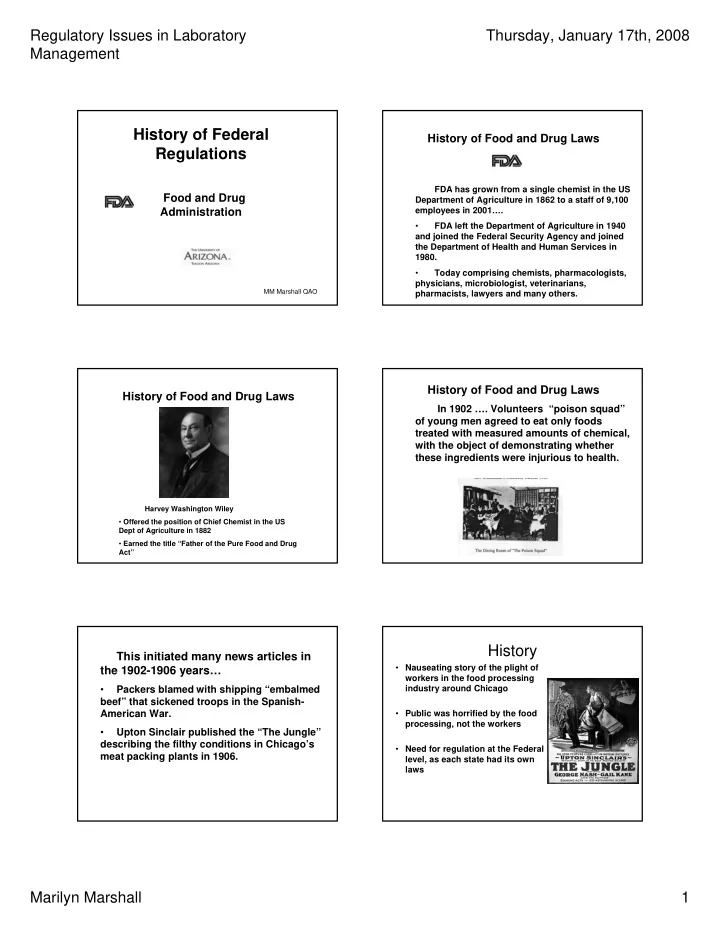
History of Federal History of Food and Drug Laws Regulations FDA - - PDF document

history of federal
SMART_READER_LITE
LIVE PREVIEW

History of Federal History of Food and Drug Laws Regulations FDA - - PDF document

Regulatory Issues in Laboratory Thursday, January 17th, 2008 Management History of Federal History of Food and Drug Laws Regulations FDA has grown from a single chemist in the US Food and Drug Department of Agriculture in 1862 to a staff of


slide-1
SLIDE 1

Regulatory Issues in Laboratory Management Thursday, January 17th, 2008 Marilyn Marshall 1

History of Federal Regulations

Food and Drug Administration

MM Marshall QAO

History of Food and Drug Laws

FDA has grown from a single chemist in the US Department of Agriculture in 1862 to a staff of 9,100 employees in 2001….

  • FDA left the Department of Agriculture in 1940

and joined the Federal Security Agency and joined the Department of Health and Human Services in 1980.

  • Today comprising chemists, pharmacologists,

physicians, microbiologist, veterinarians, pharmacists, lawyers and many others.

History of Food and Drug Laws

Harvey Washington Wiley

  • Offered the position of Chief Chemist in the US

Dept of Agriculture in 1882

  • Earned the title “Father of the Pure Food and Drug

Act”

History of Food and Drug Laws

In 1902 …. Volunteers “poison squad”

  • f young men agreed to eat only foods

treated with measured amounts of chemical, with the object of demonstrating whether these ingredients were injurious to health.

This initiated many news articles in the 1902-1906 years…

  • Packers blamed with shipping “embalmed

beef” that sickened troops in the Spanish- American War.

  • Upton Sinclair published the “The Jungle”

describing the filthy conditions in Chicago’s meat packing plants in 1906.

History

  • Nauseating story of the plight of

workers in the food processing industry around Chicago

  • Public was horrified by the food

processing, not the workers

  • Need for regulation at the Federal

level, as each state had its own laws

slide-2
SLIDE 2

Regulatory Issues in Laboratory Management Thursday, January 17th, 2008 Marilyn Marshall 2

Strenuous opposition….from: Whiskey distillers and patent medicine firms, who were the largest advertisers in the country. It was argued, the Federal Government had no business policing what people ate, drank, or used for medicine.

  • However, support came from the vote less

but militant club women of the country who rallied to the pure food cause and…..

  • 1906 Food and Drugs Act became law … to

control adulterated and misbranded drugs and food in interstate commerce. President Theodore Roosevelt who used his weigh decisively to ensure that this time Congress would not adjourn, as so often before until the food bill was passed.

  • However assurances of safety issues

were not mandated

  • Still unclear as to new drugs….

And…

History

  • Continuing problems with dangerous

drugs that fell outside the parameters

  • f the Pure Food and Drugs Act, finally

received national attention with the Elixir Sulfanilamide disaster in 1937.

  • Massengill distributed this preparation

without testing for safety (which was not required by law).

  • It contained diethylene glycol as a

vehicle, a chemical analogue of antifreeze,

  • Over 100 people died, many of whom

were children.

Provisions lacking in the 1906 law were corrected in 1938…President Franklin D. Roosevelt signed the Federal Food, Drug, and Cosmetic Act. therapeutic devices and cosmetics become

subject to regulation

standards of identity and quality be instituted

for foods

formalized FDA’s ability to conduct factory

inspections.

slide-3
SLIDE 3

Regulatory Issues in Laboratory Management Thursday, January 17th, 2008 Marilyn Marshall 3

This remains the basic law we have today …with numerous amendments and other acts which broaden FDA’s responsibilities considerably. The goal for FDA is above all else to safeguard the health and well being of the American people

Durham-Humphrey Amendment

(1951) clarified the vague line between prescription and nonprescription drugs The Amendment specifically stated:

“dangerous drugs, defined by several parameters, could not be dispensed without a prescription, witnessed by the prescription legend: "Caution: Federal law prohibits dispensing without prescription." Interesting development in 1960 . . . A Pharmaceutical company applied to FDA for permission to market a drug [very popular sleeping pill in Europe] in the US.

  • Application was assigned to “new” staff

member Frances O. Kelsey… asked for more data……concerned that drug acted differently in animals than it did in humans (it wasn’t a sedative in animals).

  • During this time a single report in a

British journal, indicated that some long term users of this drug developed nerve damage in their hands and feet.

  • Dr. Kelsey asked the company to conduct

studies to show that drug could safely be taken by pregnant women without harming the fetus.

  • Company officials were appalled that this

“stubborn bureaucrat”……

  • Long before the Company could

complete its tests . . . news broke of a terrible deformity in babies born with tiny flipper-like stumps instead of arms and hands.

  • All the baby’s mothers

had taken the drug thalidomide in the first 20- 40 days of pregnancy

  • 17 American babies were born with the

deformity because [at the time] the company was permitted to provide free samples to physicians as soon as the company applied for FDA licensing permission. Frances Kelsy received the Distinguished Federal Civilian Service Award from President John

  • F. Kennedy August 1962.
slide-4
SLIDE 4

Regulatory Issues in Laboratory Management Thursday, January 17th, 2008 Marilyn Marshall 4

  • Congress responded to thalidomide

tragedy by passing the Kefauver-Harris drug law in 1962

  • This law, for the first time, gave FDA ..

the power to require specific procedures for testing new drugs for safety and effectiveness.

However…..

In the 70’s FDA’s investigation into “sloppy and fraudulent” research resulted in the Senate investigaiton- Kenndy Hearings and the conclusion to the hearings stated that…. Findings of the Senate Committee on review

  • f documents of the Drug company found

that personnel did not…. assure the accuracy of data which are transcribed from original documents to final reports make accurate observations of the appropriate parameters and to document their observations promptly, and accurately, and to sign and date records of such

  • bservations

“Lack of understanding appears to stem from ……… [1] insufficient appreciation by managers of the need for instruction and indoctrination of personnel in laboratory methods [2] An absence of established, written laboratory procedures and [3] A general lack of attention … to routine quality assurance procedures and correction of deficiencies” So ……….

Chapter 1, Title 21 Regulatory Sections of the Code of Federal Regulations [CFR] 58 21 CFR 58

1978: Original Regulation 1987;1997 Amendments Regulations are for all to follow…. 1992 FDA officials marched into the office of the University of Minnesota President to announce that the agency had imposed a hold on a Clinical Study The investigator, was world renown for transplant surgery. ……Grand jury indictment

slide-5
SLIDE 5

Regulatory Issues in Laboratory Management Thursday, January 17th, 2008 Marilyn Marshall 5

There were many factors ….. But several crucial GLP deviations.. Paper work didn’t get done…. “ PI saw himself, says a former colleague as a pacesetter who was moving the field of transplant surgery forward, someone who couldn’t be bothered with the details of the rules because he was changing the rules”

Federal regulations are government documents describing the rules!

is the codification of the general and permanent

rules published in the Federal Register by the executive departments and agencies of the Federal Government

Code of Federal Regulations (CFR)

History

Code of Federal Regulations (CFR) which establishes the laws under which some 50 different government agencies operate and exert their influence.

– 21 CFR is the FDA [Food and Drug Administration] – 45 CFR is the DHHS [Department of Human Health and Safety] – 40 CFR is EPA [Environmental Protection Agency] – 12 CFR is Banking – 6 CFR is Homeland Security

slide-6
SLIDE 6

Regulatory Issues in Laboratory Management Thursday, January 17th, 2008 Marilyn Marshall 6

Federal Register

Published by the Office of the Federal Register, National Archives and Records Administration (NARA), the Federal Register is the official daily publication for rules, proposed rules, and notices of Federal agencies and

  • rganizations, as well as executive orders and

presidential documents….

Regulations…..

They are the law and therefore following the law means compliance. As lab managers, senior technologist or project managers, Study Directors…..know the regulations! This course is an introduction to the world of some federal regulations…but not all. Regulations are amended so ……be a web warrior and be in compliance.

Federal regulations for GLP non- clinical studies are to safeguard the health and well being of the American people

21 CFR 58 40 CFR 160 40 CFR 792

  • Title 21 CFR 50 Protection of Human Subjects

Investigators

  • Title 21 CFR 56 Institutional Review Boards
  • Title 21 CFR 312 Investigational New Drug Application
  • Title 21 CFR 812 Investigational Device Exemptions
  • Title 21 CFR 801 Labeling
  • Title 21 CFR 803 Medical Device Reporting
  • Title 21 CFR 806 Medical Devices; Reports of

Corrections and Removals

  • Title 21 CFR 820 Quality System Regulation

Title 38 CFR Pensions, Bonuses, and Veterans’ Relief Part 16 Protection of Human Subjects Title 42 CFR Public Health Part 50 Polices of General Applicability Subpart A Responsibility of PHS Awardee and Applicant Institutions for Dealing With and Reporting Possible Misconduct in Science Part 1003 “Possession, Use, and Transfer of Selected Agents and Toxins” Title 45 CFR Public Welfare Subtitle A Department of Health and Human Services Part 46 Protection of Human Subjects Part 160 General Administrative Requirements Part 164 Security and Privacy

slide-7
SLIDE 7

Regulatory Issues in Laboratory Management Thursday, January 17th, 2008 Marilyn Marshall 7

Questions ??